No: an evaluation is not the same as an appraisal, and for a farm loan the difference decides who may produce the value, what the file has to contain and how much weight the number can take. An appraisal is performed by a State certified or licensed appraiser to a professional standard; an evaluation is a supported estimate of market value produced by a qualified person inside or outside the bank, allowed in place of an appraisal only where the transaction qualifies for an exemption. Botminds' Agricultural Collateral Monitoring sits firmly on the evaluation side — it re-marks every pledged tract, machinery unit and head each quarter to keep the file current, and it orders an appraisal from a panel appraiser when the bank's own triggers say the file needs one.
What follows is the rulebook as it stands today, which matters because the numbers most often quoted for this are the 2010 ones, and two of the three have moved since. The lender used as an example is fictional: Ridgefold Agricultural Credit, 1,186 secured loans across central Iowa.
Two documents that get called by one name
Appraisal: A State certified or State licensed appraiser, to the Uniform Standards of Professional Appraisal Practice.
Evaluation: A qualified person independent of loan production — bank staff, a fee appraiser, or a documented analytical method the bank can defend.
Appraisal: Every real estate-related financial transaction except those the regulation exempts.
Evaluation: Permitted in place of an appraisal only where the transaction falls inside one of those exemptions.
Appraisal: Everything USPAP requires of the assignment, including the scope of work and the appraiser’s certification.
Evaluation: Enough analysis, assumptions and conclusions to support the credit decision, with the sources named and the preparer identified.
Appraisal: Underwriting a new transaction, and the exceptions the regulation does not exempt.
Evaluation: Keeping a value current between appraisals, and the exempt transactions.
Appraisal: Not a monitoring tool: it is a point-in-time assignment with a fee and a turnaround.
Evaluation: Not a substitute where an appraisal is required, however good the analysis behind it is.
Two different documents, one word people use for both
In day-to-day conversation a lender says "we need a value on that ground" and means either document. The loose usage is harmless until a file is examined, at which point the two are judged by different tests, and a quarterly monitoring value described in the file as an appraisal fails a test it was never meant to take.
The confusion has a cause worth naming. Both documents answer the same question — what would this property sell for — and both can be produced by the same person. A certified general appraiser can write an appraisal on Monday and an evaluation on Tuesday. What separates them is not skill or even accuracy but the standard the document is held to and the circumstances in which the regulation lets you rely on it.
That is why the practical rule in a monitoring program is lexical as much as procedural: the quarterly value is called an evaluation, in the file, on the screen and in the signature block of the report that goes to the risk committee. At the sample lender the manager's signature carries the qualification in words — prepared and reviewed, and these values are evaluations, not appraisals — so that no later reader has to infer it.
What is the difference between an appraisal and an evaluation?
An appraisal is a written opinion of market value prepared by a State certified or licensed appraiser in conformance with the Uniform Standards of Professional Appraisal Practice. An evaluation is a written estimate of market value prepared by a qualified person, which need not follow USPAP and need not be prepared by a licensed appraiser, but which must contain enough analysis and supporting information to justify the value and to let a reviewer follow how it was reached.
The federal banking agencies set out the circumstances in which the second may stand in for the first.
The Agencies' appraisal regulations permit an institution to obtain an appropriate evaluation of real property collateral in lieu of an appraisal for transactions that qualify for certain exemptions.
Interagency Appraisal and Evaluation Guidelines, December 2010
Three things follow from that sentence. The exemption is a property of the transaction, not of the lender's convenience. The evaluation has to be "appropriate", which the guidelines then define in detail. And where no exemption applies, no quality of evaluation substitutes for the appraisal — the choice is not available.
Does a farm loan always need a full appraisal?
No. Many farm loans at a commercial bank qualify for one of two exemptions, and a good many monitoring situations qualify for a third. The first is size: a commercial real estate transaction of $500,000 or less, or a residential one of $400,000 or less, does not require a State certified or licensed appraiser. The second is the business loan exemption: a business loan of $1 million or less that is "not dependent on the sale of, or rental income derived from, real estate as the primary source of repayment" (12 CFR 34.43(a)(5)). An operating line repaid from the crop and the cattle, secured by ground taken for coverage, is the ordinary case.
The third exemption is the one monitoring lives inside. A transaction involving an existing extension of credit needs no new appraisal where either there has been no obvious and material change in market conditions or in the property that threatens the bank's collateral protection, even with new money advanced, or no new money is advanced beyond reasonable closing costs. Keeping a value current between appraisals is not itself a transaction at all.
What none of this says is that the bank may stop knowing what the collateral is worth. The exemption removes the appraiser, not the value. "For a transaction that does not require the services of a State certified or licensed appraiser," the regulation continues, "the institution shall obtain an appropriate evaluation of real property collateral that is consistent with safe and sound banking practices."
Which rulebook you are under: 12 CFR 34 or the Farm Credit rules
Two different regimes govern farm collateral valuation in the United States, and they do not say the same thing. Which one applies depends on what kind of lender you are, not on what kind of borrower you have.
A national bank or federal savings association is under the OCC's appraisal regulation at 12 CFR 34, subpart C, with the other federal banking agencies' parallel rules for the institutions they supervise, and all of them under the 2010 interagency guidelines. The Comptroller's Handbook is explicit that farm ground is not special here: "The appraisal or evaluation approaches used for Ag real estate are the same as those techniques used to value other types of real estate and are governed by subpart C of 12 CFR 34" (OCC, Agricultural Lending, version 1.4).
A Farm Credit System institution is under the Farm Credit Administration's rules at 12 CFR part 614, subpart L, which run on a separate track with their own thresholds, their own independence rule and their own content requirements. Those rules are frequently quoted in material written for farm lenders generally, which is how a commercial bank ends up applying a $250,000 figure that has not governed it for years.
The thresholds that decide it, and the ones that moved
This is where the stale numbers do the most damage, so it is worth setting all of them out together with their source.
Appraisal thresholds today, by the rulebook you are actually under
| Transaction | Commercial bank — 12 CFR 34.43 | Farm Credit System institution — 12 CFR 614.4260 |
|---|---|---|
| Residential real estate | Appraisal not required at $400,000 or less | Appraisal not required at $250,000 or less (no separate residential figure) |
| Commercial real estate | Appraisal not required at $500,000 or less | Appraisal not required at $250,000 or less |
| Business loan not repaid from the real estate | Appraisal not required at $1 million or less | Appraisal not required at $1,000,000 or less |
| Above the figure, below $1,000,000 | Commercial real estate, which includes farm ground: State certified appraiser. Residential: licensed or certified, certified if the appraisal is complex | State licensed or certified appraiser |
| $1,000,000 and above | State certified appraiser | State certified appraiser (above $1,000,000) |
| Where no appraisal is required | An appropriate evaluation is still required | A valuation by a qualified individual is still required |
The practical consequence for an ag book is large. On a commercial bank's book, a $480,000 farm real estate transaction needs an evaluation rather than an appraisal; the same transaction at a Farm Credit System lender needs a State licensed appraiser. Build one collateral policy from a document that quotes the other regime's figure and the bank either buys appraisals it does not need or skips ones it does.
The business loan exemption carries its own trap. It applies only where repayment does not depend on the sale or rental of the real estate. A loan to a grain farmer repaid from the crop qualifies; a loan to a landowner repaid from cash rent on the same ground does not, whatever its size. The test is the source of repayment, and it has to be documented — the Farm Credit rule says so in terms, requiring the institution to "document that the repayment of a 'business loan' is not dependent on income derived from the sale or cash rental of real estate".
When the threshold forces a licensed appraiser
A monitoring program's job at this boundary is to see it coming. Three things push a farm loan across it: a new transaction above the figure, a material change in the property or the market on an existing credit where new money is advanced, and the bank's own policy triggers, which are usually tighter than the regulation.
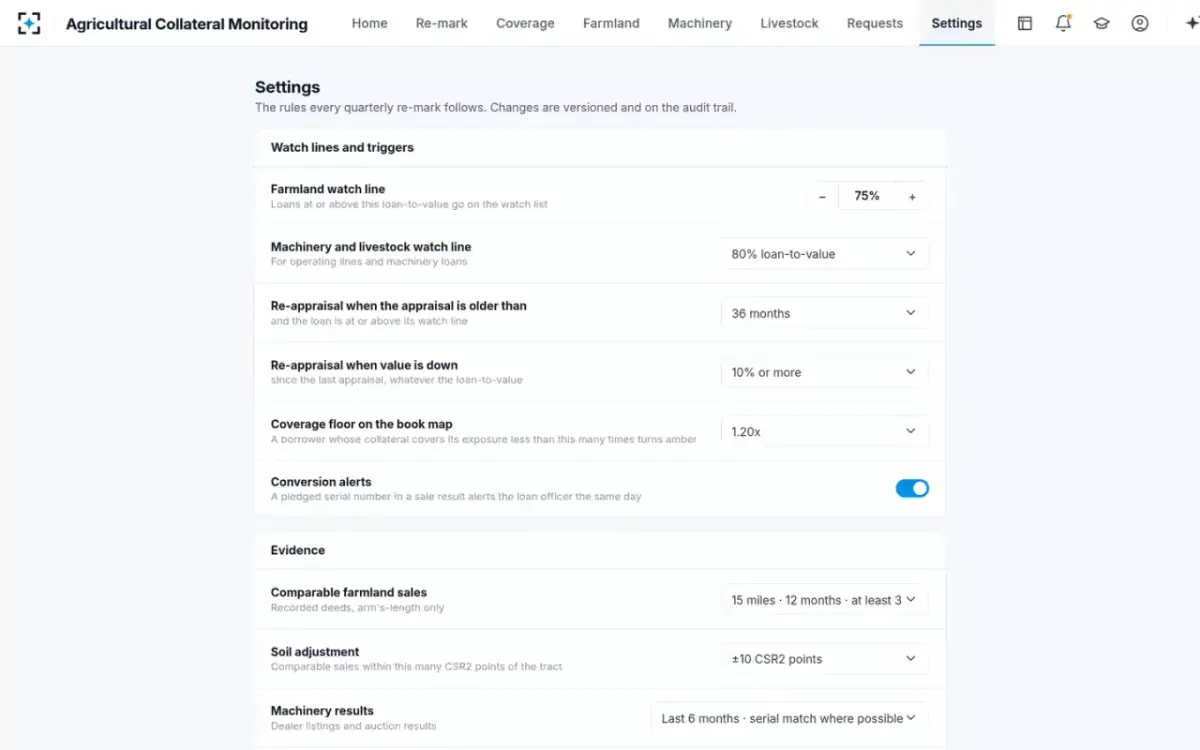
At the sample lender the policy triggers are two. An appraisal older than thirty-six months on a loan at or above its watch line produces a re-appraisal order, and so does a fall in value of ten per cent or more. In the quarter those two triggers produced fourteen orders against 612 tracts whose last appraisal was more than three years old. The arithmetic is the point: age alone is not a reason, age plus a thinned cushion is.
Those triggers are settings rather than code, which matters for the reason described in going live on quarterly ag collateral monitoring: a bank's collateral policy is its own, and a value has to be readable against the rules that were in force when it was produced.
The triggers, written down as settings
What has to be in a collateral evaluation file?
An evaluation file has to show the analysis, not just the answer. The interagency guidelines list what an evaluation should contain at a minimum, and the list is the best available checklist for a monitoring value because it was written for exactly this situation.
What an evaluation must show, from the agencies' own minimum list
- The location of the property
Identified specifically enough that a reviewer can find the same ground.
- A description of the property and its current and projected use
On farm ground this is acreage, soil rating, tiling, buildings and whether it is cropped, pastured or rented.
- An estimate of market value in its actual physical condition, use and zoning, as of an effective date
With any limiting conditions stated. The effective date is the date the analysis was completed, not the date it was read.
- How the property’s actual physical condition was confirmed, and whether an inspection was performed
A value that assumes condition has to say that it assumes it.
- The analysis performed, and the supporting information used
For sales comparison: the sales, the adjustments and the reconciliation — not the conclusion alone.
- All sources of information used
The guidelines name external data sources such as market sales databases and public tax and land records, property-specific data such as previous sales and comparable sales, evidence of inspection, photos, and local market conditions.
- Information on the preparer
Name, contact details and signature where a person prepared it — which is why an approval under a named person matters more than a system stamp.
The Comptroller's Handbook gives the shorter ag-specific version, and it applies to every class of collateral rather than real estate alone. The critical information that should be documented in all collateral valuations is "identifying details about the collateral (location, age/hours of use, and overall condition)", a "fair market value estimate as of a specific date", and the "source of, or basis for calculating, the value estimate". Three items, and the third is the one most often missing.
The same tract, as a file that survives and a file that does not
What fails
"T4 South Creek, 320 acres, $7,950/acre, $2,544,000. Q3 2026 re-mark."
A value and a date. No sales, no adjustments, no statement of condition, no preparer, nothing a reviewer can test. It is a number, not an evaluation.
What stands
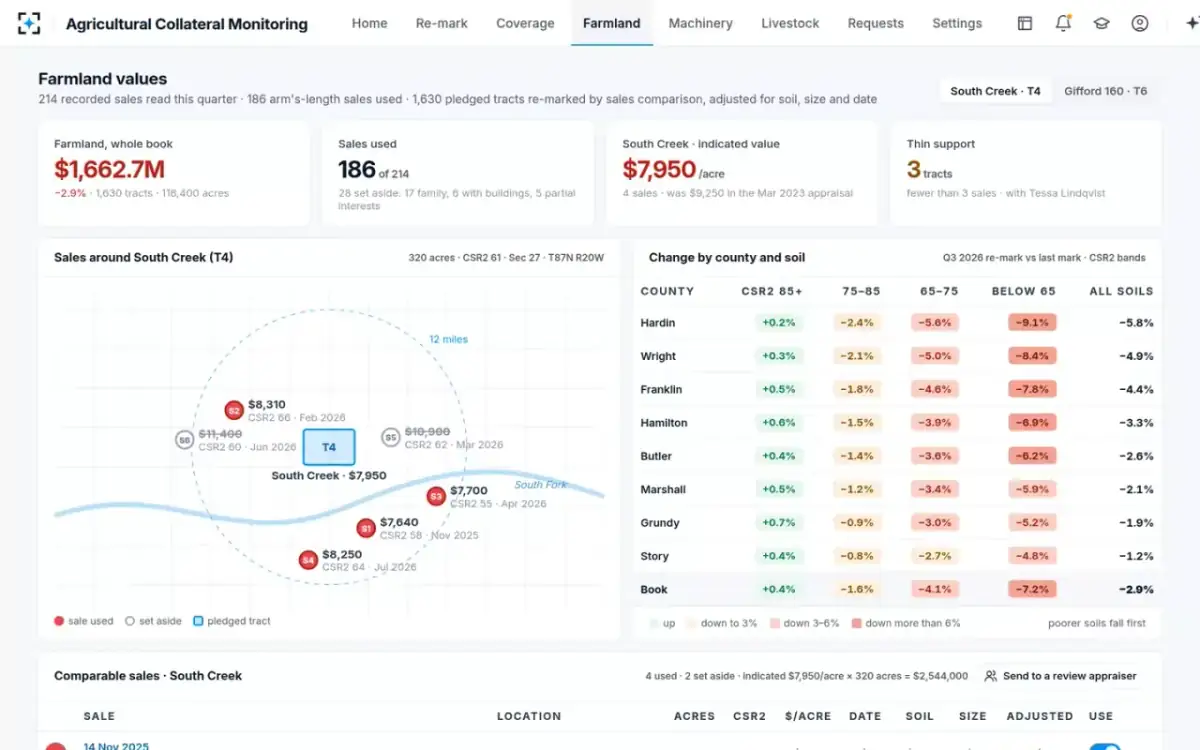
320 acres, CSR2 61, creek-bottom ground, part untiled; cropped, not rented. Four arm's-length sales within twelve miles in the last twelve months at $7,640 to $8,310 an acre, adjusted for date, soil and size, indicating $7,950; sales set aside: a family transfer at $10,900 and a farm with a building site and grain bins at $11,400. Condition not re-inspected this quarter; value assumes condition as last inspected. Effective date and preparer named, approved by the Rural Appraisal Manager.
Same number. A reviewer can disagree with the adjustments, which is the point: there is something there to disagree with.
Why farmland gets a review appraiser at fewer than three sales
Sales comparison works by reconciliation. Each comparable is adjusted toward the subject for date, soil, size, drainage and improvements, and the adjusted indications are then reconciled into one value. With three or more sales there is something to reconcile and an outlier announces itself. With two, the "reconciliation" is an average of two numbers. With one, it is a sale price with arithmetic applied.
That is why the sample lender's rule sends any tract whose value rests on fewer than three comparable sales to a review appraiser, whatever the tract is worth, and why the rule is written as a count of sales rather than a dollar figure. The regulation does not set this threshold; the bank does, and setting it is a policy decision with a workload attached. Three tracts of 1,630 crossed the line in the quarter.
The default comparable rule behind it — within fifteen miles, within twelve months, at least three sales — is also a setting, with tighter and looser alternatives. Tightening it to ten miles improves comparability and increases how often the review appraiser is called; widening it to twenty miles and eighteen months does the reverse. Neither is right in the abstract; what matters is that the choice is recorded and the same for every tract.
The sales behind a value, and the ones set aside
Machinery and livestock: evaluated against a different standard
Almost everything written about appraisals and evaluations is about real estate, and the thresholds above apply only to real estate-related financial transactions. Machinery, equipment and livestock sit outside that regime entirely.
For a Farm Credit System institution, the rule for personal property is separate and lighter in form but not in substance: valuations of personal property "shall be performed by qualified individuals who meet the established standards of this subpart and the Farm Credit System institution obtaining the collateral valuation", and where the institution deems an appraisal necessary, personal property "shall be appraised in accordance with procedures and standards established by the institution by individuals deemed qualified by the institution to complete the work under the USPAP Competency and Ethics Provisions" (12 CFR 614.4260(a); 614.4266(e)). The institution sets the standard; it does not escape having one, and a personal property evaluation must name its source of comparisons, such as equipment dealer listings or market sales reports, with the property's quantity, condition and date.
For a commercial bank the handbook carries the expectation instead: non-real estate collateral supporting term debt should be inspected and valued periodically, with condition and marketability documented, and the analysis of equipment condition should include a supported estimate of depreciation from the amount and type of use. The practical reading is that a machinery value needs the same three documented items as any other: what it is, what it is worth at a stated date, and where the figure came from.
Independence: why the valuer cannot be the loan officer
Independence is a condition of both documents, and it is the requirement most often lost when a small lender automates. The interagency guidelines put the valuation program outside loan production. The Farm Credit rule goes further for real property that is the primary security for a loan and outside the exemptions: it must be valued by a qualified real estate appraiser with no interest, financial or otherwise, in the loan or the property, who is not engaged in the institution’s marketing, lending, collection or credit decision processes (12 CFR 614.4255(c)). For exempt real property and for personal property the bar is narrower: no one may evaluate where they have an interest, and officers may value collateral on loans they decide only where the institution’s controls require prior approval or post-review of the decision.
What this means for an evaluation produced inside the bank is that the question is not who typed it but who owns and approves it. A value produced by a method the valuation function defined, reviewed against evidence the valuation function admits, and approved by a person who reports outside lending, is independent. The same value approved by the officer whose loan it secures is not, however it was computed. Who holds each of those roles in practice is set out in who watches a farm loan book's collateral, and what each decides.
What an examiner checks first
Examiners work from procedures that are published, which makes this one of the few parts of banking where you can read the test before you sit it. The agricultural lending booklet tells examiners to "evaluate sufficiency of collateral coverage" and to "determine whether the appraisals or evaluations on real estate were obtained consistent with regulatory requirements (12 CFR 34, subpart C) and meet Uniform Standards of Professional Appraisal Practice", then to "determine whether appraisals and inspections of significant machinery and equipment are present" and evaluate whether wear and damage were assessed.
Read as a checklist for the file, that is four questions. Was the right document obtained for this transaction? Does it meet the standard that applies to it? Is there one for the significant machinery as well as the ground? And did somebody assess condition rather than assume it? A monitoring program that answers all four every quarter is doing the examiner's arithmetic in advance.
To see the quarterly values, the comparable sales behind each one and the triggers that turn a thinned cushion into an order, start from Agricultural Collateral Monitoring.
Questions people ask
What is the appraisal threshold for a business loan?
$1 million, in both regimes, and it is conditional rather than absolute. A business loan of $1 million or less is exempt from the appraisal requirement only where it is not dependent on the sale of, or rental income derived from, real estate as the primary source of repayment. An operating line repaid from crops and livestock qualifies; a loan repaid from cash rent on the pledged ground does not, at any size. The Farm Credit rule requires the institution to document that the repayment is not dependent on the real estate.
Can a lender's own staff value farm collateral?
Yes, for an evaluation, provided they are qualified for the type of collateral and independent of loan production. The 2010 interagency guidelines place the valuation function beyond the reach of the lending side and expect the people who order, review and accept appraisals and evaluations to report somewhere other than loan production. For an appraisal, no: only a State certified or licensed appraiser may perform one, and bank employment does not change that.
Does an AI-generated value count as an evaluation?
It can, if it meets the same test as any other. The agencies apply one standard to a value reached by a person and to one reached by an analytical method or a technological tool: the institution has to be able to show it is a reliable estimate of market value as of a stated effective date. A method that returns a figure without the market value analysis behind it is not acceptable as an evaluation, however it was produced, and the approval still belongs to a qualified person.
Why would an examiner reject a collateral value?
Most often because the file shows a conclusion rather than an analysis: a number and a date, with no sales, no adjustments, no statement of how condition was established and no identified preparer. The next most common reasons are a document of the wrong kind for the transaction, an evaluation produced or approved by someone inside loan production, and a value whose effective date predates a market move everyone in the room knows about.
When must a farm real estate loan get a licensed appraiser?
At a commercial bank, when the transaction is above the applicable figure and no other exemption applies. For commercial real estate, which includes farm ground, that is above $500,000, and the appraiser must then be State certified; for residential real estate it is above $400,000, where a licensed appraiser may do a non-complex appraisal; and any transaction of $1 million or more needs a certified appraiser. At a Farm Credit System institution the figure is $250,000 for a State licensed or certified appraiser and $1,000,000 for a State certified one. Bank policy commonly requires a new appraisal earlier than the regulation does, on age and on a fall in value.
What has to be in a collateral evaluation file?
At a minimum: the location of the property, a description of it and its current and projected use, an estimate of market value in its actual physical condition as of an effective date, how condition was confirmed and whether it was inspected, the analysis performed and the information supporting it, every source used, and information on the preparer. The agricultural lending booklet adds the short form that applies to every collateral class — identifying details including age or hours of use and overall condition, a fair market value estimate as of a specific date, and the source of or basis for calculating the estimate.