Antibody–drug conjugates fail in clinical trials when the dose patients can tolerate is too low to shrink the tumour, and the reason usually traces to the payload and the chemistry around it rather than to the biology of the target. A 2023 review of toxicity mechanisms puts the pattern in one sentence: off-site toxicity "remains problematic, limiting tolerable ADC doses to levels below those required for substantial anti-cancer efficacy" (Nguyen et al., Cancers, 2023). The tolerability burden is large: in a pooled series of 169 clinical trials and 22,492 patients, 91.2% of patients had a treatment-related adverse event of any grade and 46.1% had one of grade 3 or worse. ADC Design Knowledge Base is Botminds' knowledge base for antibody–drug conjugate design: it holds every construct a team has built or inherited with the studies behind it, so a new proposal arrives at the design board already compared with the ones that stopped.
Published findings are linked at the figure that uses them. The constructs named below — NB-ADC-103, NB-ADC-106, NB-ADC-119 — are sample data on a fictional portfolio inside the solution, used to show what checking against your own history looks like. They are not real programmes, and nothing here is a customer's measured result.
The toxicity base rate for the class, pooled across trials from 2000 to 2022
91.2%
of patients had a treatment-related adverse event of any grade
95% CI 90.7%–91.7%
46.1%
had a treatment-related adverse event of grade 3 or worse
95% CI 45.2%–47.0%
169trials
pooled in the systematic review and meta-analysis
22,492
patients treated with an antibody–drug conjugate in those trials
Why toxicity and efficacy failures are usually the same failure
A 2023 review in mAbs that followed every ADC tested in oncology found 92 of 267 discontinued after clinical testing, and sorted the reasons into three: insufficient benefit because of intolerable toxicity, benefit no better than standard care because of insufficient efficacy, and business decisions (Maecker et al., 2023). The first two are often one problem seen from two sides. The Cancers review notes that the high attrition of ADCs with antimitotic payloads "is primarily due to a suboptimal efficacy at the MTD" — the maximum tolerated dose — which is to say the efficacy failure was set by the toxicity ceiling.
The premise of the class is that a potent cytotoxic can be aimed. The 2023 review of toxicity mechanisms states what a decade of clinical experience showed instead: "prior ADC development efforts suggest that the clinical toxicity profile of ADCs primarily relates to the payload component" (Nguyen et al., Cancers, 2023). The conjugate's behaviour in a patient is governed less by what it was aimed at than by what it is carrying and how tightly that cargo is held.
That is how a programme ends up with a target that was right and a construct that still stopped. The target work can be exemplary — good tumour expression, low normal-tissue expression, brisk internalisation — and the construct can still produce a dose-limiting finding that has nothing to do with any of it. The chemistry travels with the molecule; the biology does not rescue it.
What percentage of patients in ADC clinical trials have a serious adverse event?
About forty-six in a hundred, on the pooled evidence. The same meta-analysis reports 46.1% for grade 3 or worse and 91.2% for any grade, and both come with a caveat its authors state: heterogeneity was very high, so these are the centre of a wide spread of trials in different diseases with different conjugates, not a figure to apply to any one molecule.
The breakdown is more useful than the total, because it is where the mechanisms become visible. Two of the five most common all-grade events, lymphopenia and neutropenia, are haematologic — the marrow is the tissue most exposed to anything circulating — one is nausea, and two are the direct signatures of specific payload classes.
The five most common all-grade treatment-related adverse events, pooled
Blurred vision at 40.5% is the striking one. Nothing about delivering a cytotoxic to a tumour explains an eye finding in four patients in ten; what explains it is which payloads were in the pool. The trials covered MMAE in 63 of them, DM1 in 24, pyrrolobenzodiazepine dimers in 22, deruxtecan in 13, DM4 in 13, MMAF in 11 and SN-38 in 10 — and ocular toxicity is a known signature of two of those classes.
Failure mode one: off-target delivery of the payload in an antibody–drug conjugate
Off-target toxicity is injury caused where the conjugate or its payload went but was not aimed. It arises two ways: the intact conjugate is taken up non-specifically, by endocytosis influenced by its own hydrophobicity and charge; or payload freed anywhere diffuses into cells that never expressed the antigen. Both put a potent cytotoxic into normal tissue, and between them they set the dose.
off-target payload delivery is the critical driver for the tolerability of ADCs and, ultimately, the recommended doses used in patients
Nguyen et al., Cancers, 2023
The counterpart — on-target toxicity, where the antigen is genuinely present in a healthy tissue — is the one teams spend most of their target-selection effort avoiding, and the review notes it "is infrequently a major concern during the clinical evaluation and use of ADCs", partly because candidates that would cause it tend to be identified early. The failure mode that survives screening is the one that belongs to the payload.
Failure mode two: a cleavable linker releasing payload in plasma
A linker designed to open inside the tumour that opens in the bloodstream converts a targeted therapy into a systemic one. The 2024 meta-analysis of linker cleavability puts the mechanism at the centre of the class's problems: "the toxicities of currently approved ADCs appear to be driven primarily by premature release of the payload into the bloodstream by the linker, by an excessively prominent bystander effect, or even payload released by the lysed tumor cells" (Tang et al., Cancer and Metastasis Reviews, 2024).
This mode is measurable before the clinic, which is what makes it the most preventable of the four. Plasma stability at seven days, free payload at release and the linker's chemistry class are all known at the bench. The trade-off against bystander killing is worked through in choosing a linker and payload; what matters here is that the mode is a design property, not an accident.
Failure mode three: a payload class with an organ signature of its own
Some molecules injure a particular organ wherever they are delivered, and they do it consistently enough that a new construct should assume the finding until it has data of its own. The 2025 Antibody Therapeutics review groups the dominant payloads as "microtubule inhibitors such as monomethyl auristatin E [MMAE], monomethyl auristatin F [MMAF], and the maytansine derivatives DM1/DM4" (Cheng et al., Antibody Therapeutics, 2025), and clinical experience has attached an organ to each.
The clearest demonstration is a natural experiment the field ran without meaning to. Eight separate conjugates built on the same valine–citrulline MMAE payload–linker reached phase II against eight different antigens, at doses within a narrow band of 1.8 to 2.4 mg/kg — and "all eight MMAE ADCs demonstrated similar DLTs (severe bone marrow toxicity, sepsis, and severe motor neuropathy)". Eight targets, one dose-limiting profile.
Four failure modes, each with the mechanism that produces it
Failure mode One
Off-target delivery of the payload
The conjugate is taken up where it was not aimed — non-specific endocytosis, or released payload diffusing into cells that never expressed the antigen.
Any lipophilic payload. On the 2023 Cancers review's reading, most off-site ADC toxicity seen so far has come by this route.
Failure mode Two
Premature release in plasma
A cleavable linker hydrolyses in circulation before the conjugate reaches the tumour, so the payload is loose in the bloodstream.
Hydrazone, disulfide and peptide linkers; the hydrazone linker of the first-generation conjugate gemtuzumab ozogamicin is the textbook case.
Failure mode Three
A payload class with an organ signature
The molecule injures a particular organ wherever it is delivered, and the signature repeats across sponsors and targets.
Ocular findings for MMAF and DM4; thrombocytopenia and hepatic toxicity for DM1; neuropathy for MMAE.
Failure mode Four
Loading that outruns clearance
High drug load makes the conjugate hydrophobic, which clears it faster, narrows the therapeutic index and pushes aggregate past its release limit.
Maytansinoid conjugates at a ratio of 10 cleared five times faster than those below 6.
Failure mode four: loading that outruns clearance
Drug–linker constructs are mostly lipophilic, so the more payload an antibody carries the more hydrophobic it is, and hydrophobic conjugates are cleared faster and aggregate more readily. The effect is large enough to measure directly: maytansinoid-conjugated ADCs "with a DAR of 10 had a 5-fold higher clearance and a decreased in vivo efficacy and tolerability compared to ADCs with a DAR lower than 6". In the same work, mice given low-ratio conjugates at 2 and 3.5 lost about 4% of body weight at nadir, against 7 to 9% above a ratio of 5.5.
This is the failure mode that looks like a manufacturing problem and is really a design one. A batch that misses a size-exclusion limit at release is usually carrying too much hydrophobic payload on too much of its antibody — the heavily loaded tail of the distribution rather than the average. How that average is produced, and why the tail is invisible in it, is the subject of how drug-to-antibody ratio is calculated.
Is ADC toxicity caused by the target or by the chemistry?
Mostly the chemistry, on the published evidence — with one important qualification. Antigen expression in a healthy tissue is a weaker predictor of injury to that tissue than intuition suggests. The mucin MUC16 is expressed in human ocular surface epithelia, yet an anti-MUC16 MMAE conjugate produced no ocular toxicity in trials; TROP-2 is expressed widely across normal tissues, yet the clinical profile of an anti-TROP-2 SN-38 conjugate "largely resembles that of the SN-38 payload".
That second example is the general case in miniature. The toxicity profile looked like the payload, not like the target map. The qualification is that targets are not irrelevant — a target expressed on a tissue that also internalises briskly can produce genuine on-target injury, and the review links trastuzumab emtansine's liver findings partly to HER2 expressed on normal human hepatocytes. The point is about where to look first, and where to look first is the payload and the linker.
What a published rate can tell you about your next design, and what it cannot
What the pooled figure gives you: 46.1% of patients with a grade 3 or worse event: the price of admission for the class, useful for setting expectations with a board.
What only your own constructs give you: Whether your constructs on this payload class ran above or below it, and at which doses.
What the pooled figure gives you: The five commonest events across all conjugates, dominated by marrow and by two payload signatures.
What only your own constructs give you: Which organ your repeat-dose studies actually reported, in which species, at which dose, with the page.
What the pooled figure gives you: Off-target delivery, premature release, payload class, loading — described in general terms.
What only your own constructs give you: Which of the four your stopped constructs ran, and what the stop decision said at the time.
What the pooled figure gives you: Nothing specific. A meta-analysis cannot tell you what your chemistry should be.
What only your own constructs give you: The changes your own portfolio shows work, each with the constructs that demonstrate it.
What the pooled figure gives you: Heterogeneity above 95%; different diseases, lines of therapy and conjugates pooled together.
What only your own constructs give you: A small sample. Your portfolio is a handful of constructs, so it informs a judgement rather than settling one.
Why do two different targets show the same toxicity finding?
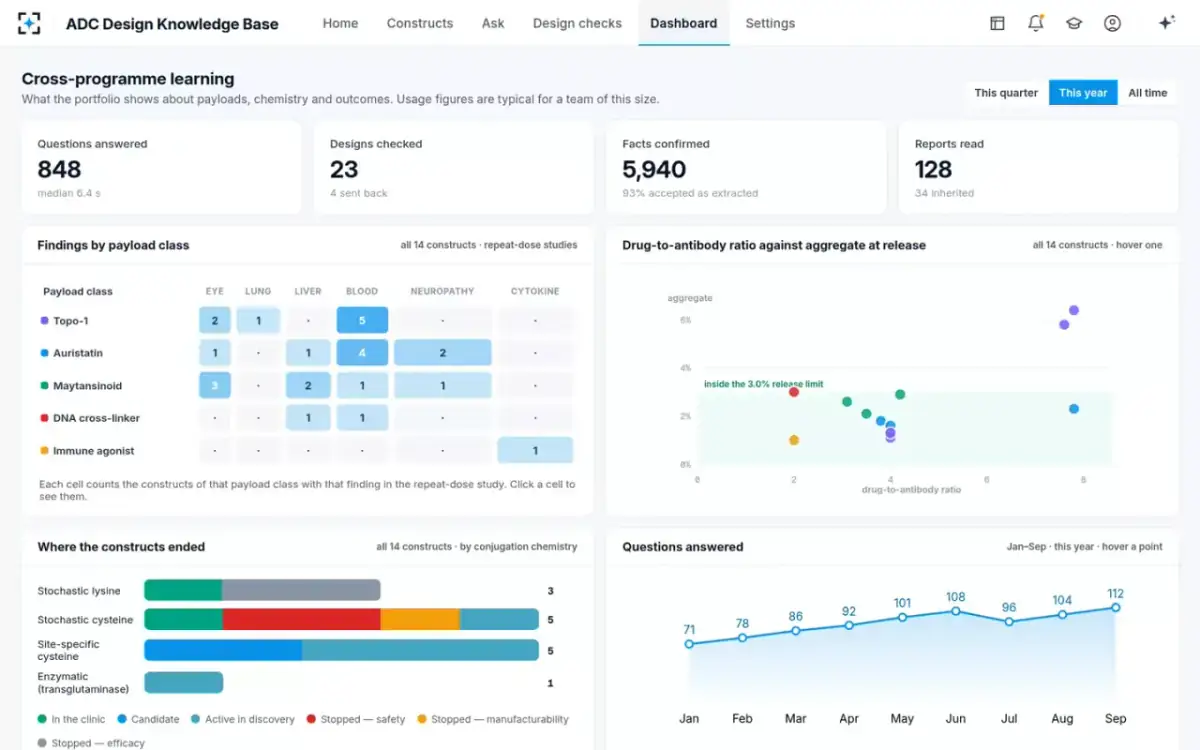
Because the finding belongs to the payload and the chemistry, and both travel from programme to programme unchanged. The eight MMAE conjugates above are the published version. The sample portfolio inside the solution shows the same pattern at the scale a single company sees it: two fictional constructs against entirely different antigens, TRP-2 and NRX-7, both carrying a topoisomerase-1 payload on a hydrophobic tetrapeptide linker with stochastic cysteine conjugation at a ratio near 8, both producing corneal findings in the four-week cynomolgus study — grade 2 to 3 in four of six animals at 10 mg/kg on one, grade 2 in three of six on the other.
One stopped on safety and one on manufacturability, which is how the same physical cause ends up filed under two different reasons and remembered as two unrelated events. That is the practical trap: a team that recalls "the TRP-2 programme had an eye problem" will not connect it to a new NRX-7 proposal, because the targets are not the same. The chemistry is.
Findings counted by payload class, not by target
Can a check against your own stopped constructs catch a toxicity failure before the clinic?
It can catch the repeats, which is a smaller claim than it sounds and a more useful one. No search of a company's own history predicts a finding nobody has ever seen. What it does is stop a construct whose chemistry has already failed from being proposed, approved and made as though it were new — and in a group that has built a dozen conjugates across five payload classes, that can be a meaningful share of the risk.
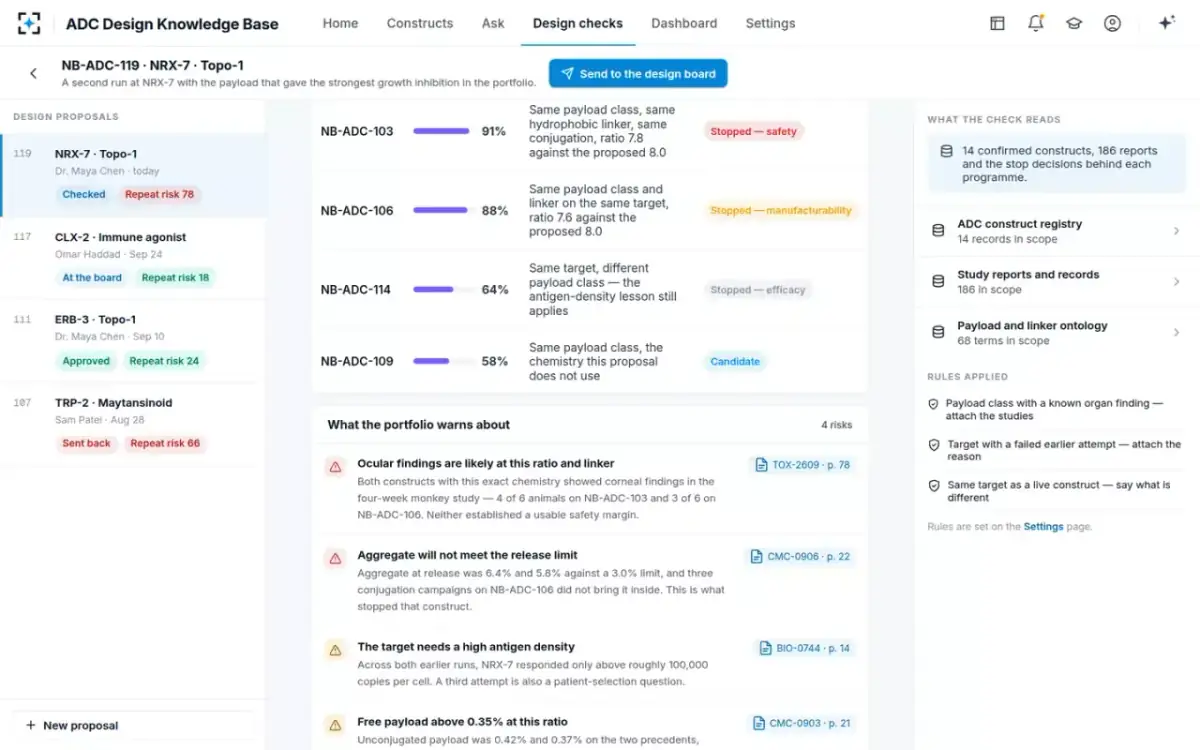
The mechanics are unglamorous. Score the proposal against every construct on target, payload class, linker, conjugation and ratio. Pull the studies behind the closest ones. Name each risk with the precedent and the page it rests on. In the sample portfolio, a proposal for a second run at NRX-7 with a topoisomerase-1 payload, a hydrophobic tetrapeptide linker, stochastic cysteine conjugation and a ratio of 8.0 scores a repeat risk of 78 against the fourteen constructs before it, with the two nearest precedents at 91% and 88% similarity — one stopped on safety, one on manufacturability.
A new design, scored against every construct built before it
What brings a repeat risk back down
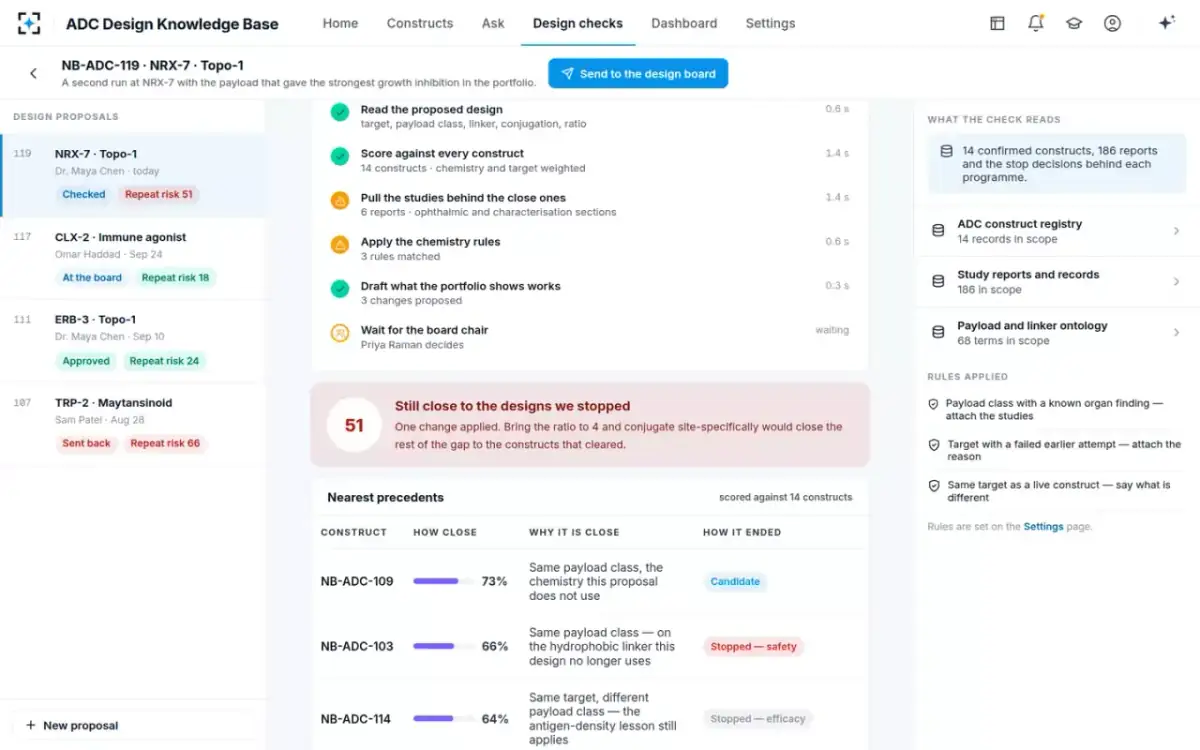
The useful output of a check is not the number; it is the list of changes the team's own portfolio shows work, each attached to the constructs that demonstrate it. In the sample portfolio those are the three that separate the stopped constructs from the clean ones: the PEG-extended linker, on which none of four constructs had ocular findings and aggregate stayed between 1.1% and 2.3% even at a ratio of 7.8; a ratio of 4; and site-specific conjugation. Applied in turn they take the fictional proposal from 78 to 51 to 33 to 21, and re-order the precedents as they go.
Each change re-scores the design and re-orders the precedents
That is the whole argument of a design history: toxicity is the expected cost of the class, the published rates tell you roughly what it is, and the only part a team controls is whether it pays the same one twice. ADC Design Knowledge Base is built to make the second payment avoidable — by keeping every construct's chemistry, outcome and study pages where the next proposal has to pass them.
Questions people ask
Do more ADCs fail for safety than for efficacy?
The two are hard to separate, because toxicity caps the dose and an efficacy failure is often a failure at the maximum tolerated dose. Reviews of discontinued candidates name intolerable toxicity, insufficient efficacy and business reasons, and many discontinuations publish no reason at all. What the pooled trial data does show is the size of the toxicity burden: 46.1% of patients across 169 trials had a treatment-related adverse event of grade 3 or worse.
Why do ADCs cause eye problems?
Because some payload classes injure the cornea wherever they are delivered. Severe ocular toxicity is consistently reported for MMAF and DM4 conjugates, and blurred vision appeared in 40.5% of patients across the pooled trials. It is a property of the molecule rather than of the antigen, which is why an ocular finding on one programme is a warning for the next programme carrying the same payload, whatever it is aimed at.
Is a high drug-to-antibody ratio by itself a reason to stop a design?
No, but it changes what the rest of the construct has to do. A higher ratio makes the conjugate more hydrophobic, which raises clearance and aggregation — maytansinoid conjugates at a ratio of 10 cleared five times faster than those below 6. Some approved conjugates carry eight payloads successfully. The question is whether the linker and conjugation chemistry can hold that much cargo without shedding it.
Can on-target toxicity be ruled out by target selection alone?
Not entirely, but it is the failure mode target selection handles best, and the published view is that on-target toxicity is infrequently the major clinical concern. Counter-examples run in both directions: an antigen present on the ocular surface produced no ocular finding in one conjugate, while HER2 expression in hepatocytes may contribute to a real hepatic signal in another. Expression maps inform the question; they do not close it.
What should a design board ask about a new ADC proposal?
Which constructs the team has already built with this payload class and this linker chemistry, what each repeat-dose study found and at what dose, whether aggregate at release met the limit, what unconjugated payload was at release, and which of the team's constructs with this chemistry stopped and why. All five are answerable from documents the programme already owns, with the page behind each answer.
How many ADCs have been discontinued in the clinic?
A 2023 review in mAbs counted 267 ADCs tested in oncology since the first trial in 1997: 11 approved by the FDA, 164 still in trials and 92 discontinued after clinical testing. For 22 of those 92 no clinical results had been published; for about half of them the company cited portfolio or strategic reasons, and for the other half it gave none. The count moves every year, so treat it as a snapshot; the durable part is the pattern behind the published cases, that the stop usually belongs to the payload and the chemistry.