A cleavable linker releases its payload inside or around the target cell, which gives an antibody–drug conjugate the ability to kill neighbouring tumour cells that do not express the antigen at all; a non-cleavable linker holds on until the whole conjugate is broken down inside the cell, which gives up that reach and keeps far more of the payload out of circulation. The choice between them is therefore not a preference. In a meta-analysis of 40 clinical trials, 47% of patients on ADCs with cleavable linkers had a grade 3 or worse composite adverse event, against 34% on non-cleavable chemistry. ADC Design Knowledge Base is Botminds' knowledge base for antibody–drug conjugate design, and it exists so a linker and payload choice can be made against what a team's own constructs did, not against habit.
Published findings below are linked at the figure that uses them. The constructs — NB-ADC-103, NB-ADC-116 and the rest of the Northwind Bio portfolio — are sample data on a fictional company inside the solution, and are marked as such each time they appear. No figure on this page is a customer's measured result.
The difference between a cleavable and a non-cleavable ADC linker
The difference is where the payload comes off. Cleavable linkers "contain chemical or enzymatic liable chemistries formulated to exploit specific conditions unique to the intracellular or tumor extracellular environments" — a protease-sensitive peptide such as valine–citrulline, a disulfide that reduces in the cytosol's glutathione, a hydrazone that hydrolyses at lysosomal pH. Non-cleavable linkers have no such trigger: "non-cleavable linkers are more stable in plasma but require the complete intracellular proteolytic catabolism of the ADCs to yield cytotoxic metabolites" (Nguyen et al., Cancers, 2023).
That second mechanism has a consequence worth stating plainly, because it is the root of everything that follows. When a non-cleavable conjugate is digested, what is left is not the payload: it is the payload still attached to its linker and to the amino acid it was conjugated to — lysine-SMCC-DM1, cysteine-MC-MMAF. Those metabolites are charged, they do not cross membranes easily, and they stay where they were made.
The design intent of a cleavable linker is that it stays shut in the bloodstream and opens at the tumour. The review is blunt about how well that holds: "In practice, cleavable linkers are often hydrolyzed in plasma at an appreciable rate, leading to the premature release of the payload in the extra-tumoral compartments." A 2025 review in Antibody Therapeutics puts the same point in the language of risk — "cleavable linkers may have the risk of premature release of the payload into the circulation, causing systemic toxicities" (Cheng et al., Antibody Therapeutics, 2025).
What each linker class buys, and what it charges for it
Cleavable: A trigger the tumour environment supplies: a protease, the cytosol's glutathione, lysosomal pH.
Non-cleavable: Complete proteolytic breakdown of the conjugate inside the cell — no trigger, no shortcut.
Cleavable: The free payload, membrane-permeable where the payload is lipophilic.
Non-cleavable: The payload still attached to its linker and conjugating residue, which largely stays put.
Cleavable: Bystander killing of neighbouring antigen-negative tumour cells.
Non-cleavable: None to speak of: the metabolite does not travel.
Cleavable: Hydrolysed at an appreciable rate, releasing payload outside the tumour.
Non-cleavable: More stable in plasma.
Cleavable: 47% of patients, across nine ADCs and 2,985 patients.
Non-cleavable: 34% of patients, across two ADCs and 4,894 patients.
Cleavable: Heterogeneous antigen expression, slow internalisation, solid tumours with uneven staining.
Non-cleavable: High, even antigen expression, and a payload whose organ signature you cannot afford systemically.
What is the bystander effect in antibody–drug conjugates?
It is the ability of released payload to leave the cell that made it and kill the cells around it. The 2023 review defines it as "the ability of the free payload to diffuse from intracellular sites of ADC catabolism and payload release to neighboring cells within the local tumor environment". The 2025 Antibody Therapeutics review describes the same thing from the clinic: ADCs "can not only directly kill target cancer cells after recognizing and targeting them, but also kill surrounding tumor cells that do not express target antigens".
This is the single strongest argument for a cleavable linker, and it is why the field leans so heavily that way: "ADCs with lipophilic payloads and cleavable linkers … make up more than 80% of the currently approved ADCs, are the preferred choice for the treatment of cancers associated with heterogeneous antigen expression or slow rates of antigen/ADC internalization."
It is also the same mechanism as the toxicity. A payload that can diffuse out of one tumour cell into its neighbour can diffuse out of any cell, anywhere: "Besides amplifying the anti-tumor potency, the bystander effect can also exacerbate the off-target toxicities of an ADC due to the increased distribution of lipophilic membrane-permeable payloads in normal tissues." Bystander killing and systemic exposure are not two properties to be traded against each other. They are one property seen in two places.
Which linker chemistry carries the most systemic toxicity?
On the published evidence, cleavable chemistry does, and the effect survives adjustment for how much payload each antibody carries. The 2024 meta-analysis pooled 40 trials across eleven approved conjugates — nine cleavable (2,985 patients) and two non-cleavable (4,894 patients) — using generalized linear mixed effects logistic models.
Significantly more composite adverse events (AEs) ≥ grade 3 occurred in patients in the cleavable linkers arm (47%) compared with the non-cleavable arm (34%).
Tang et al., Cancer and Metastasis Reviews, 2024
The gap is not a single headline. On the composite grade 3 or worse rate, the weighted risk difference was −12.9% (95% CI −17.1% to −8.8%) in favour of non-cleavable chemistry; among specific grade 3 or worse toxicities, neutropenia (−9.1%, 95% CI −12% to −6.2%) and anaemia (−1.7%, 95% CI −3.3% to −0.1%) were significantly lower on it. Adjusted for drug-to-antibody ratio, "non-cleavable linkers remained independently associated with lower toxicity for any AE (p = 0.002)" — so this is not simply a story about loading.
Two honest cautions. The non-cleavable arm is two molecules, which is a narrow base for a general claim, and the authors note heterogeneity statistics above 50% for most toxicities, meaning the trials differ from one another in ways the pooled number hides. And the relationship is not simply linear: the same analysis found "a significant interaction between cleavability status and DAR for any AE (p = 0.002)", which is to say the effect of each depends on the other. The ratio question is worked through separately in what a higher drug-to-antibody ratio does to risk.
When a non-cleavable linker is the safer choice
A non-cleavable linker earns its place when the biology does not need the reach and the payload cannot be allowed to roam. Three conditions point that way, and all three are knowable before synthesis.
The first is antigen expression. Bystander killing exists to cover cells the antibody cannot reach; where the target is "highly expressed in a tumor and has low or no expression in normal tissues", as the Antibody Therapeutics review describes the ideal target, the conjugate can reach what it needs to reach without a diffusing payload. The second is the payload's own organ signature: if the molecule is known to injure the cornea or the peripheral nerves, every milligram that leaves the tumour is spent on that organ. The third is simple arithmetic on the stability data — a linker that holds in plasma puts less payload into circulation to begin with.
The sample portfolio inside the solution shows what that looks like as a measurement rather than an argument. Across the fictional Northwind Bio constructs, plasma stability at seven days in cynomolgus plasma separates the chemistries cleanly.
Share of conjugate still intact after seven days in plasma, by linker
Read it as the shape of a trade-off rather than as a rule. In this portfolio, the 23-point spread between the most and least stable cleavable chemistries is far larger than the 4-point gap between the non-cleavable linker and the best cleavable one — which means "cleavable or not" is the second question, not the first.
Which payload classes cause ocular toxicity, and which cause neuropathy?
Payload class, more than target, predicts which organ turns up in a repeat-dose study. The 2023 review summarises a decade of clinical data this way: "severe anemia, neutropenia, and peripheral neuropathy were commonly reported for MMAE ADCs. For DM1 ADCs, grade 3/4 thrombocytopenia and hepatic toxicity are typically observed, and severe ocular toxicity is consistently reported for MMAF and DM4 ADCs."
What each payload class has been seen to injure, and what the finding implies for a linker
| Payload class | The signature finding reported for it | What that implies when choosing a linker |
|---|---|---|
| MMAE (auristatin) | Severe anaemia, neutropenia and peripheral neuropathy commonly reported. | The finding arrives with the payload rather than with the target. A cleavable linker raises systemic exposure to it; neither linker class removes it. |
| MMAF (auristatin) | Severe ocular toxicity consistently reported. | A non-cleavable linker, as in belantamab mafodotin, limits systemic diffusion but does not remove an ocular signature; ophthalmic examinations belong in the study design from the start. |
| DM1 (maytansinoid) | Grade 3/4 thrombocytopenia and hepatic toxicity typically observed. | Seen on the non-cleavable linker of trastuzumab emtansine too. Liver and platelet monitoring are the known cost of this class; linker choice moves the margin, not the organ. |
| DM4 (maytansinoid) | Severe ocular toxicity consistently reported. | Where it is paired with a cleavable linker, an ocular payload plus cleavable chemistry is the combination that most needs a stability argument before synthesis. |
| PBD dimer (DNA cross-linker) | In a review of 15 investigational applications, highly comparable profiles: vascular leak syndrome, elevated liver enzymes, bone marrow suppression, gastrointestinal events. | A class whose profile repeats across sponsors. A new construct should assume the class finding until it has data of its own. |
One counter-example matters, because it stops the table being read as a law. The membrane-associated mucin MUC16 is expressed in human ocular surface epithelia, and an anti-MUC16 MMAE conjugate produced no ocular toxicity in trials. Antigen expression in a healthy tissue does not by itself predict injury to that tissue — which is exactly why the payload's own history, and your own constructs' history, carry more weight than a target map.
Does site-specific conjugation reduce toxicity compared with stochastic conjugation?
The evidence says it helps, through two mechanisms that are worth keeping apart. The first is control of loading: site-specific methods "enable a more precise control of DAR and improve the stability of the conjugated payload due to its conjugation to more stable site, while also simplifying the in-process control and ADC manufacturing". A tighter distribution means less of the heavily loaded, hydrophobic tail that clears fast and aggregates.
The second is tolerability measured directly. In the engineered-cysteine work the review cites, healthy rats tolerated the site-specific conjugate at a far higher dose than its stochastic counterpart — 4,150 µg/m² of MMAE against 2,250 µg/m² — and "reduced hematologic and hepatic toxicities were observed in rats and monkeys treated with TDC compared to ADC". The review also notes a second route to the same end that does not require re-engineering the antibody: modifying the linker to reduce hydrophobicity, which is what a PEG-extended linker does.
What this does not mean is that conjugation chemistry can rescue a payload–linker pair that the biology does not support. It widens a margin. It does not move an organ finding.
A decision path: target biology, payload class, linker, in that order
Most linker arguments go wrong by starting at the linker. The order below starts where the information is, and each step narrows the next.
Four questions, in the order that makes the fourth one easy
1 · How evenly is the antigen expressed, and how fast does it internalise?
Uneven staining or slow internalisation is the case bystander killing was invented for, and it points at cleavable chemistry. High, even expression with brisk internalisation removes most of the argument for it.
2 · What has this payload class injured before?
Ocular, neuropathic, hepatic, haematologic — the class signature arrives with the molecule. If the signature is one the indication cannot tolerate, the systemic exposure a cleavable linker produces is the thing to minimise.
3 · How much payload does this linker put into plasma?
In the sample portfolio, stability at seven days separates linkers inside the cleavable class by more than it separates the classes. Ask for the number before the class name.
4 · What happened the last time we built this exact combination?
Target, payload class, linker and conjugation together. If a construct with this chemistry was stopped, the reason it was stopped is the first risk on the new proposal.
What the constructs a team has stopped usually have in common
Not the target. In the sample portfolio inside the solution, the two constructs stopped for reasons traceable to chemistry — NB-ADC-103 against TRP-2 and NB-ADC-106 against NRX-7 — share a topoisomerase-1 payload on a hydrophobic tetrapeptide linker, stochastic cysteine conjugation and a ratio near 8. Their targets are different. Their stop reasons are different, one on safety and one on manufacturability. Their chemistry is the same.
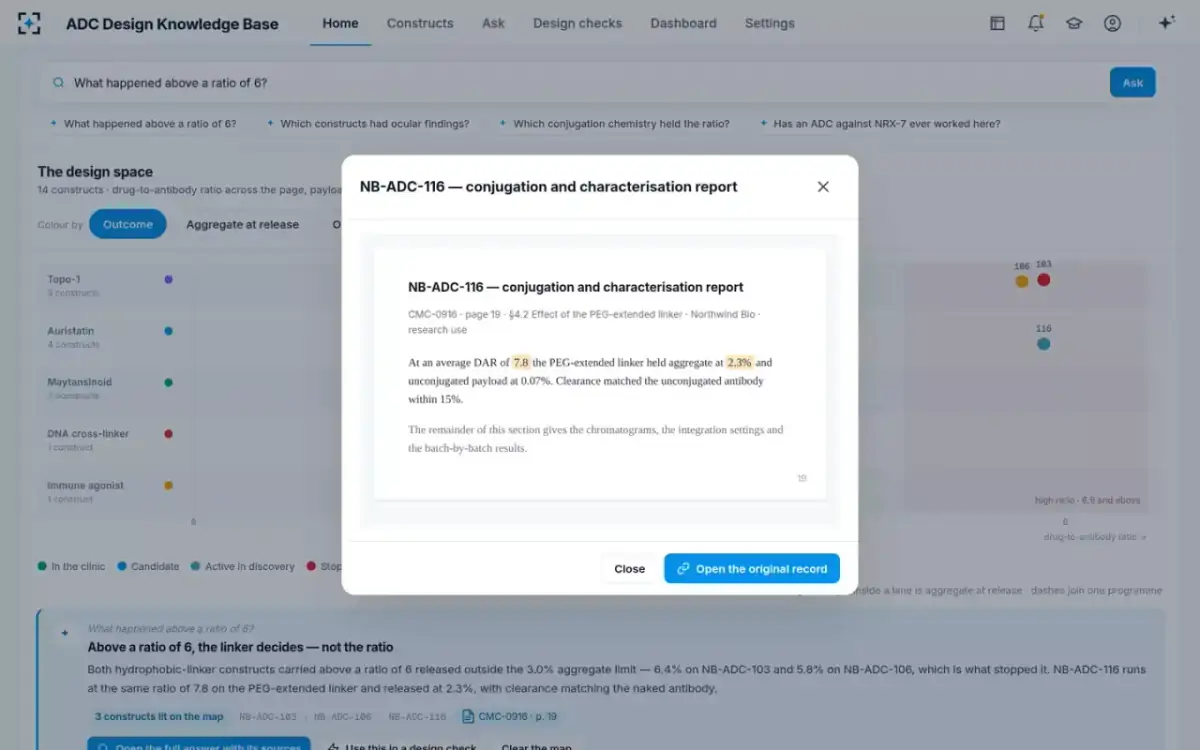
What that chemistry produced is on the record for both: aggregate at release of 6.4% and 5.8% against a 3.0% limit, and corneal findings in the four-week cynomolgus study — grade 2 to 3 in four of six animals at 10 mg/kg on one, grade 2 in three of six on the other, with reversal by day 49 and a no-observed-adverse-effect level set at 3 mg/kg. A third fictional construct, NB-ADC-116, runs at essentially the same ratio of 7.8 on a PEG-extended linker and releases at 2.3%, with clearance matching the unconjugated antibody within 15%.
One question, three molecules, and the lesson the portfolio has already learned
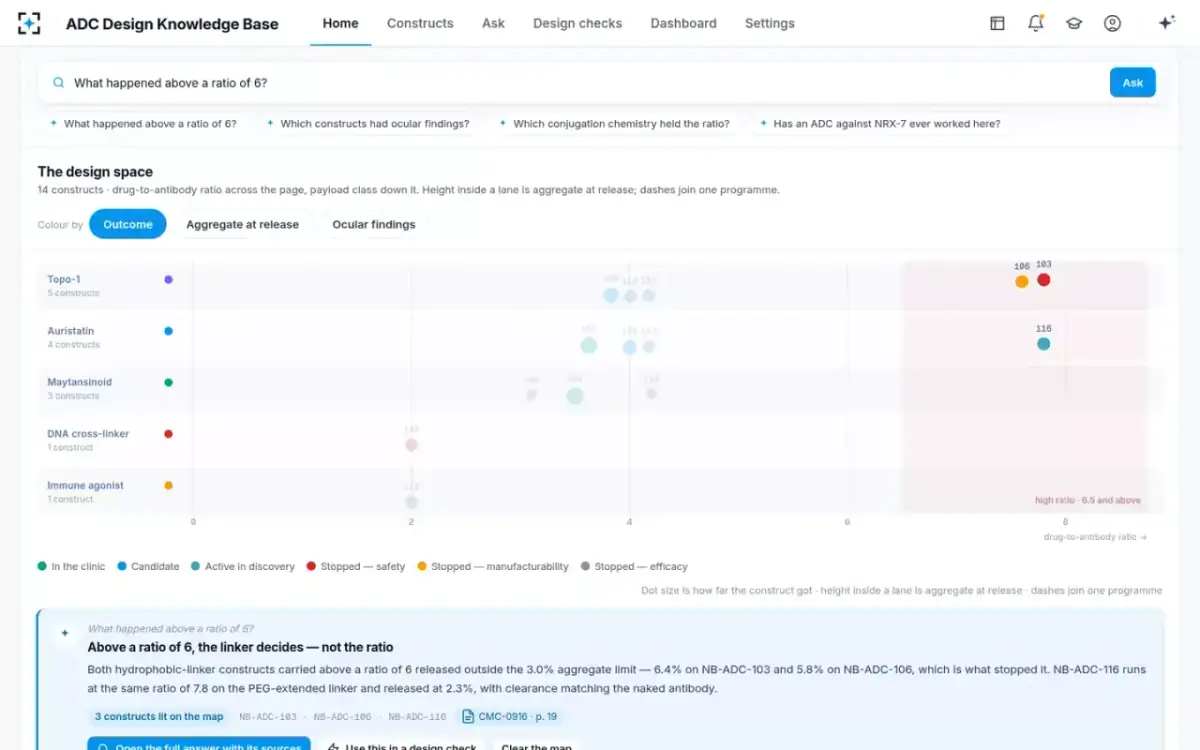
That is the shape of a usable linker argument: not "cleavable linkers are riskier", which is true on average and useless on a Thursday, but "at this ratio, with this payload, these two chemistries did this and that one did that, and here are the pages." The published rate tells a team what to expect of the class. What ends most ADC programmes tells them which failure modes to look for. Their own constructs tell them which one they are about to repeat.
Every number in a lesson opens the report at its page and section
Deciding on a linker before the design board, not after a tox finding
The practical difficulty is not that teams lack the evidence. It is that the evidence is in a four-week study's ophthalmic section, a conjugation report's size-exclusion results and a decision record that explains why a ratio came down — three documents, in three systems, written by three people, two programmes ago. Answering "has this been tried here?" from memory is what turns a known finding into a repeated one.
What a design board should be able to answer before a linker is locked
- Which constructs have we built with this payload class?
And what organ finding, if any, did each repeat-dose study report — with the study, the page and the dose.
- Which of them used this linker chemistry?
Class is the coarse cut. The specific chemistry, and its plasma stability number, is the one that separates outcomes.
- What was aggregate at release, and did it meet the limit?
Hydrophobic payload on a hydrophobic linker at a high ratio is the combination that most often misses a size-exclusion limit.
- What was unconjugated payload at release?
A separate measurement with its own limit. It is the number that connects linker stability to what circulates.
- Does the target need bystander killing at all?
Antigen density and internalisation rate decide this, and both are usually already measured.
- Which of our constructs with this chemistry stopped, and why?
Safety and manufacturability are different stops with different fixes. Both belong on the proposal.
- Which change does our own portfolio show works?
A PEG-extended linker, a lower ratio, site-specific conjugation — proposed with the constructs that demonstrate it, not as general advice.
In ADC Design Knowledge Base each of those answers is a field on a construct with the page it came from, and a new proposal is scored against all of them before it reaches the board — nearest precedents named, each risk carrying the study behind it, and the changes the portfolio shows work offered with the constructs that demonstrate them. The check proposes. The board chair accepts it or sends it back, and either way the reasoning is on the record.
Questions people ask
Is a cleavable linker always more toxic than a non-cleavable one?
On average, in the pooled clinical data, yes: 47% of patients on cleavable chemistry had a composite adverse event of grade 3 or worse, against 34% on non-cleavable, and the difference held after adjusting for drug-to-antibody ratio. But the non-cleavable arm in that analysis was two molecules, heterogeneity between trials was high, and in the sample portfolio's plasma data the spread within the cleavable class — a PEG-extended linker against a hydrophobic tetrapeptide — is larger than the gap between the classes.
Can you get bystander killing without a cleavable linker?
Not meaningfully. The effect depends on a released payload diffusing out of the cell that made it, and the metabolite a non-cleavable conjugate yields is the payload still attached to its linker and conjugating residue, which does not cross membranes readily. If the tumour's antigen expression is uneven enough that bystander killing is the point, a non-cleavable linker is answering a different question.
Which linker is best for a payload with a known ocular finding?
There is no single answer, but the direction is clear: minimise what circulates. That argues for the most stable linker the biology allows, a tighter and lower drug-to-antibody ratio, and site-specific conjugation to cut the hydrophobic tail. It also argues for ophthalmic examinations designed into the first repeat-dose study rather than added after a finding, since severe ocular toxicity is consistently reported for MMAF and DM4 conjugates.
Does a PEG-extended linker count as cleavable?
It can be either; PEGylation is a modification that reduces the hydrophobicity of the drug–linker, and it is applied to cleavable chemistries as well as non-cleavable ones. The 2023 review lists linker modification alongside site-specific conjugation as a way to reduce ADC hydrophobicity and so reduce toxicity. In the sample portfolio inside the solution, the PEG-extended cleavable linker is the chemistry that held both plasma stability and bystander killing at once.
How early does the linker decision have to be made?
Before synthesis, because everything after it is expensive to undo. The information needed is available by then: antigen density and internalisation from the target work, the payload class's published organ signature, plasma stability for the candidate linkers, and the team's own history with the combination. The last of those is the one most often missing, not because it does not exist but because nobody can find it.
Does conjugation chemistry change the linker choice?
It changes the margin rather than the direction. Site-specific conjugation gives tighter control of loading and improved payload stability, and in the engineered-cysteine work the 2023 review cites it allowed a far higher tolerated dose in rats, with reduced haematologic and hepatic toxicity in rats and monkeys. That widens the window a given linker can work in; it does not make an unsuitable payload–linker pair suitable.