"How accurate is AI data extraction from scientific reports?" has no single answer, and a vendor who offers one should be asked which number they mean. Extraction from a toxicology or conjugation report is not a classification task with one score; it is several different jobs — finding the value, attributing it to the right construct, keeping its unit and its method, and knowing when the report does not say. Each fails differently, and each can be measured separately on reports your own group has already closed and argued about. This guide sets out five measures, how to run them, and what ADC Design Knowledge Base reports for each one on a fictional sample portfolio of 14 constructs and 186 reports.
The point of measuring this way is not reassurance. It is that an unmeasured extraction tool quietly transfers a scientist's judgement to a system nobody has tested, and the transfer is invisible until a number that was never in a report ends up in a decision.
A worked scorecard on one two-week pilot study
34
construct-level facts extracted from the report, each with its page and sentence
31
matched a value a steward had already confirmed elsewhere
3
went to the steward as new or disagreeing, with Confirm and Correct beside each
0.85
confidence floor in force; below it the answer says so and names what is missing
Why "is the AI accurate?" is the wrong first question
Because it collapses four different failures into one word. An extraction can be wrong by reading the right number from the wrong construct, by reading the right number and dropping the method it was measured by, by rounding 1.34% to 1.3%, or by producing a value the report never gave. Those are not degrees of the same error. The first is a filing failure, the second loses the comparison, the third is a silent conversion, and the fourth is the one people mean by hallucination.
They also matter differently to different seats. A CMC scientist cares most about the dropped method, because aggregate by size-exclusion chromatography and aggregate by another technique are not interchangeable; the mAbs analytical review is clear that "size variants (aggregates, particles, fragments) are important quality attributes that can directly affect the efficacy or safety of protein therapeutics" (Wagh et al., 2018). A toxicologist cares most about misattribution. A knowledge steward cares most about the invented value. One percentage serves none of them.
Five measures, what each counts, and what a bad number is telling you
| Measure | What it counts | How to compute it | What a bad number means |
|---|---|---|---|
| Match rate | Extracted values that agree with a value a specialist has confirmed | Agreeing fields ÷ fields with a confirmed comparison | The reading is wrong, or the field definition is ambiguous across report templates |
| Unsourced rate | Fields filled with no sentence behind them | Fields with no citable sentence ÷ fields filled | The system is completing a form rather than reading a document |
| Refusal rate below the floor | Answers and fields held back because confidence fell under the threshold | Held-back items ÷ items attempted | Too high: the floor or the documents are wrong. Zero: the floor is not doing anything |
| Steward correction rate | Confirmed facts a specialist had to change | Corrections ÷ facts reviewed, tracked by month and by report type | Rising: a template or a vocabulary has drifted. Flat at zero: nobody is really reviewing |
| Conflict-raised rate | Disagreements between two documents about the same field that the system surfaced | Conflicts raised ÷ disagreements known to exist in a test set | Low on an archive you know is messy: the comparison tolerances are too loose |
Measure one: match rate against a steward's confirmed value
The first measure asks whether the system reads a number the way a specialist reads it. It needs a comparison, and the honest comparison is a value a named person has already confirmed against the same page — not a value from a summary table someone typed years ago.
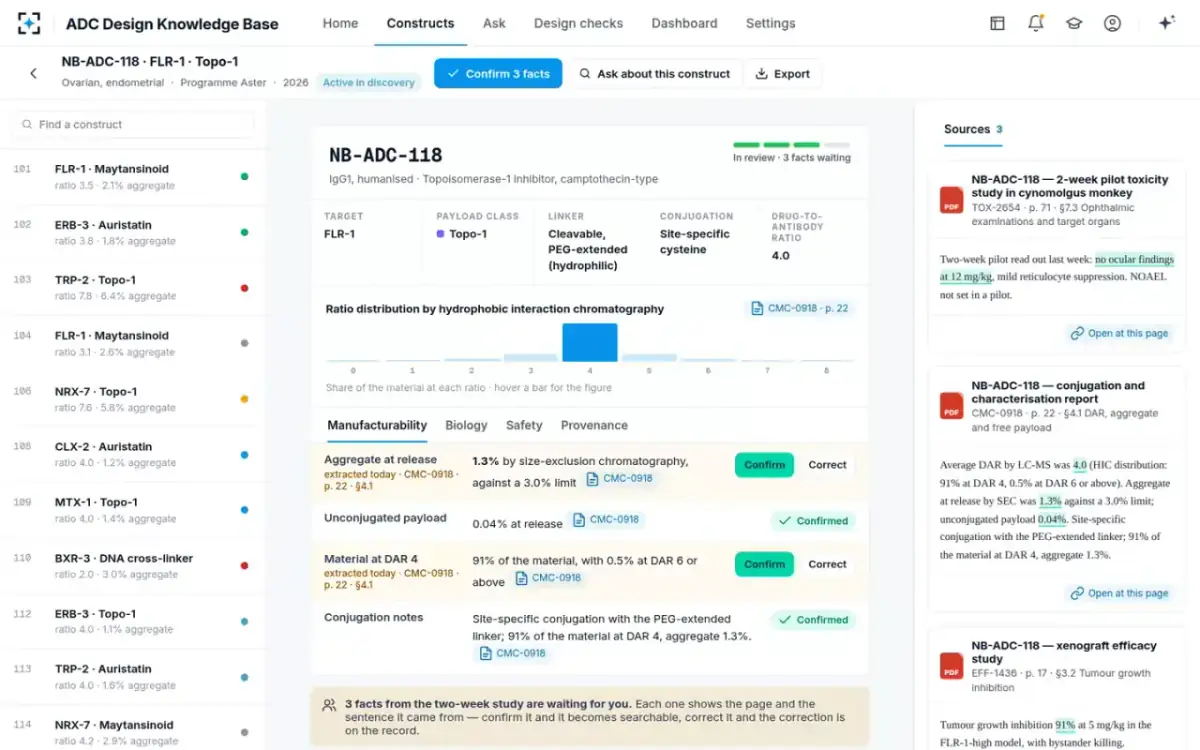
In the sample portfolio that comparison exists as a by-product of normal work: when a new report arrives, every fact it yields is compared with the construct's confirmed values. For one two-week pilot study, 34 facts came out of the report and 31 matched values already confirmed. The remaining three were new or disagreed, and went to the steward with their pages: aggregate at release of 1.3% by size-exclusion chromatography, no ocular findings at any dose including 12 mg/kg, and 91% of the material at a ratio of 4 by hydrophobic interaction chromatography.
Two cautions about the measure. A high match rate on fields that are easy to read — a date, a species, a dose level — tells you little; compute it per field, and look at the fields a decision actually turns on. And a match is not a proof of correctness: if the confirmed value was itself read wrongly two years ago, agreement with it is agreement with a mistake. That is why the second measure is about sentences rather than values.
What happens when an AI extraction has no source sentence behind it?
In this solution, the field stays empty. That is the construct extractor's stated limit — a field with no sentence behind it is left empty — and it converts the most dangerous failure into the most visible one. An empty field in a registry is a question. A plausible number with nothing behind it is a fact that will be quoted.
The second measure follows from it: the unsourced rate — of all the fields a system filled, how many cannot be opened at a sentence. It should be zero, and if a tool cannot report it at all, that is the finding. Ask for the number, then test it by opening fields at random: a citation that opens the report at the right page and section is the claim; a citation that merely names the document is not.
Every value opens the report at its page
What is a confidence floor in an AI system?
A confidence floor is a threshold below which the system declines to assert rather than asserting weakly. In this solution it is a setting — 0.85 in the sample group, adjustable to 0.75 or 0.90 — and below it an answer says the evidence is thin and names what is missing, instead of producing a fluent paragraph whose confidence the reader has to guess at. The third measure, the refusal rate, counts how often that happens.
Where that number should sit is a judgement, not a calculation, and NIST says as much: its framework leaves both the choice of trustworthiness metrics and their exact threshold values to human judgment (NIST AI RMF 1.0, AI Risks and Trustworthiness). The useful discipline is to set it deliberately, record who set it, and then watch what it does: a floor that never fires is decoration, and a floor that holds back a third of the answers is telling you that the documents, not the threshold, are the problem.
Where a fact can stop, and who is waiting at each stop
Agent
ReadIdentifies the document and the construct, keeping page and section.
Never: Stops and asks when two documents name one batch differently
Agent
ExtractWrites each field from a sentence, with the method named.
Never: Leaves the field empty when there is no sentence
Agent
CompareChecks the new value against the confirmed one for that field.
Never: Never averages, never resolves a disagreement
Agent
ScoreHolds back anything below the confidence floor and says what is missing.
Never: Never asserts below the floor to look more useful
A person decides
Confirm or correctA named specialist decides, against the page, and the correction stays on the record.
Never: The step that cannot be automated away
Measure four: the steward correction rate, tracked over time
The correction rate is the only measure that keeps working after go-live, which makes it the most valuable of the five. It counts how often a specialist had to change what was read, and its value is in the trend rather than the level.
A rate that climbs usually means something upstream changed: a contract laboratory moved to a new report template, a programme started recording free payload in a different unit, an inherited archive began arriving. A rate that falls to zero and stays there usually means confirmation has become a formality — somebody is clicking through. Both readings are useful, and neither is available from a one-off benchmark run before purchase.
Track it by report type as well as in total. In the sample portfolio the interesting split is between the group's own templates and the 34 inherited documents from the acquired programme, where the vocabulary differs and a steward is doing real work on each mapping.
Measure five: the conflict-raised rate on inherited and re-run studies
The fifth measure counts how often the system surfaces a disagreement between two documents about the same field — and it is the one people most often forget to ask for, because a conflict looks like a problem rather than an output.
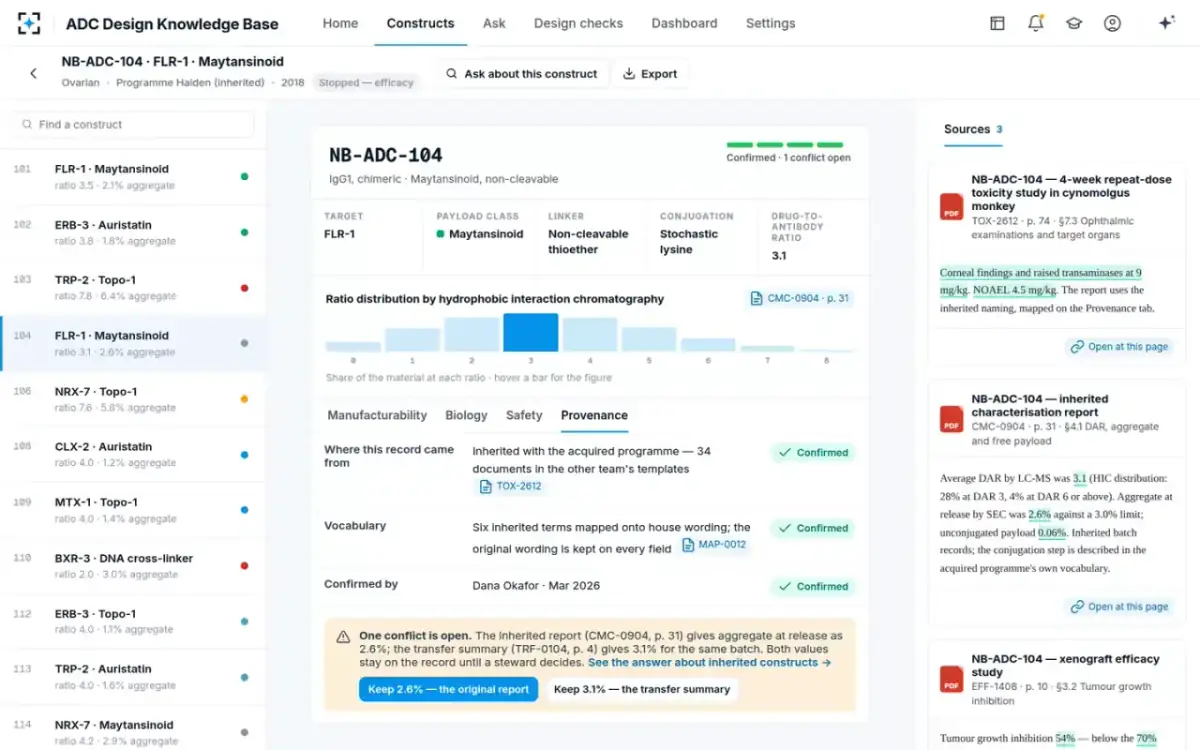
It is an output. The sample portfolio contains the canonical case: an inherited report gives aggregate at release as 2.6% for a batch the transfer summary reports at 3.1%. Both stay on the record with their sources until a steward keeps one. A system that had quietly taken the newer document, or averaged the two to 2.85%, would have produced a value that sits inside the group's 3.0% release limit and appears in no report at all.
"An extracted number nobody confirmed is not a fact."
Dana Okafor, the sample portfolio's knowledge steward
So measure the rate, and then read the conflicts. A low rate on an archive you know to be messy means the comparison tolerances are too loose, not that the archive is clean. Why the conflict checker never averages two numbers covers the rule itself.
A disagreement kept visible until a person decides
How do you measure AI hallucination in scientific data extraction?
By counting unsourced fields and refusals, not by importing a general language-model benchmark. Much of the published work on language-model hallucination measures free generation — a model asked to produce a passage, with no document in front of it and nothing to cite. Extraction with a citation requirement is a different task with a different failure mode, and the general numbers do not transfer in either direction.
Two different questions that both get called accuracy
A general generation benchmark: Whether a model produces true statements from what it has learned.
Cited extraction from your own reports: Whether a system reports what a specific document says, and declines when the document does not say.
A general generation benchmark: A confident false statement.
Cited extraction from your own reports: A filled field with no sentence behind it, a value attributed to the wrong construct, or a silent conversion.
A general generation benchmark: A reference answer written by the benchmark’s authors.
Cited extraction from your own reports: A page in your own report, and a specialist who has confirmed it.
A general generation benchmark: Anyone, on public data.
Cited extraction from your own reports: Only you, on reports you have already closed — which is why it has to be part of the evaluation.
A general generation benchmark: That the model is broadly reliable on that distribution of questions.
Cited extraction from your own reports: That this system reads your templates, your vocabulary and your units correctly.
There is a second reason to run the measurement on your own documents. Biomedical data is not uniformly well organised to begin with: a 2023 review in Scientific Data found that even data researchers routinely share is often not findable, accessible, interoperable or reusable, with metadata that is cursory and documents in formats a machine cannot read (Hughes et al., 2023). An internal archive assembled over a decade, across two companies and several contract laboratories, will not be tidier than that. What you are measuring is a system against your mess, which is the only mess that matters.
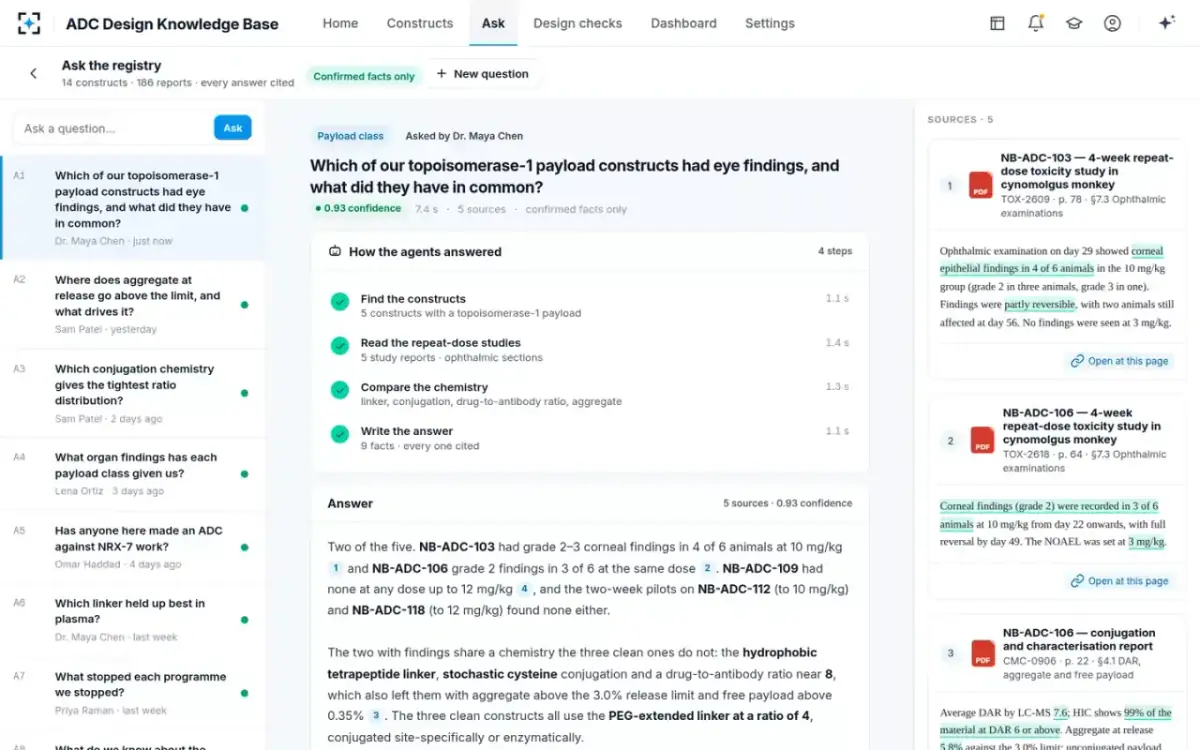
A cited answer, and the five reports behind it
What is the NIST AI Risk Management Framework's Measure function?
It is the part of the framework that deals with evidence. "The measure function employs quantitative, qualitative, or mixed-method tools, techniques, and methodologies to analyze, assess, benchmark, and monitor AI risk and related impacts," the framework states, and it is specific about timing: testing belongs both before a system is deployed and at regular intervals once it is running (NIST AI RMF 1.0, Core).
Two further points from the same section are worth putting in front of anyone designing an evaluation. The first: "processes developed or adopted in the measure function should include rigorous software testing and performance assessment methodologies with associated measures of uncertainty, comparisons to performance benchmarks, and formalized reporting and documentation of results." The second, which quietly rules out the most common evaluation design, is that independent review makes testing more effective and guards against internal bias and conflicts of interest.
Read together, they argue for exactly the shape this guide proposes — measures defined in advance, run before go-live and again in operation, documented, and scored by someone other than the person who most wants the project to succeed.
Can you back-test an AI extraction tool on your own closed study reports?
Yes, and it is the single most informative thing an evaluation can do. A closed study is one whose values a specialist has already argued about and agreed; the agreement is the comparison the measures need, and it costs nothing more to reuse it.
Running the back-test
- Choose reports across the variety, not the best ones
At least one from each report type the registry must handle: a repeat-dose study, a pilot study, a conjugation and characterisation report, a decision record, and something from an inherited archive in another team’s template.
- Fix the field list before the run
Name the fields a decision actually turns on — ratio and distribution, aggregate at release and its method, free payload, organ findings and their grades, the reason a construct stopped — and ignore the rest when scoring.
- Write the pass marks down first
An unsourced rate of zero, a per-field match rate you will accept, a correction rate you will accept, and what you expect the refusal rate to be. Agreeing them afterwards is not a test.
- Score it with someone who did not run it
The specialist who confirmed the original values is the right reader; the person who ran the pilot is not the right scorer.
- Open ten citations by hand
Pick ten extracted values at random and check that each opens its report at the page and section claimed. One that does not is worth more than any aggregate score.
- Keep the run
The back-test is the baseline the correction rate will be read against for the next two years, so record what was run, on what, by whom and when.
The whole method, including how long to run beside a live design board before deciding, is in piloting an ADC knowledge base on your own study, CMC and tox reports.
Is AI-extracted toxicology data defensible in a regulatory submission?
The extracted value is not the thing that gets submitted; the study is. A design registry's proper role is to get a scientist to the right study faster and to stop a group repeating a finding it already owns — and anything quoted onward should link back to the original study record rather than to the registry's reading of it. Held that way, the question of defensibility is about traceability, and traceability is exactly what a sentence-level citation gives.
The agency's direction of travel supports being able to show your working. "AI will undoubtedly play a critical role in the drug development life cycle," CDER's page states, "and CDER plans to continue developing and adopting a risk-based regulatory framework that promotes innovation and protects patient safety" (FDA/CDER). A January 2025 draft guidance, Considerations for the Use of Artificial Intelligence To Support Regulatory Decision-Making for Drug and Biological Products, sets out what the agency expects where AI produces information intended to support a regulatory decision — which is a reason to know your five numbers rather than a reason to avoid the tools.
The seat that carries this in practice is the knowledge steward, and what a knowledge steward does on an ADC team describes the rest of it.
Questions people ask
How do you know if AI extracted the right number from a study report?
Open the citation. In a system built this way every value carries its document, page, section and the sentence it came from, so checking one number takes seconds rather than a re-read. At scale, the same property gives you the match rate: compare each extracted value against a value a specialist has confirmed on the same page, and compute it per field rather than in aggregate.
How many reports make a back-test meaningful?
Variety matters more than volume. Twenty to thirty reports that cover every template, every report type and at least one inherited archive will tell you more than two hundred copies of the same study format, because what you are testing is whether the system handles your range. The one quantity worth insisting on is that each report has values a specialist already confirmed, otherwise there is nothing to measure against.
Does a high match rate mean the registry is right?
No. It means the system agrees with what your group previously recorded, which is only as good as that record. A field that two scientists have always defined differently will show a high match rate against each of them separately and still be unusable across the portfolio. That is why the unsourced rate and the conflict-raised rate sit beside it: one checks that every value came from somewhere, the other that disagreements surface rather than disappear.
What should a validation team see before a registry is relied on?
The five measures with their definitions, the pass marks agreed before the run, the back-test results on the group's own closed reports, the record of who confirmed what, and the settings in force — the confidence floor, whether answers may draw on unconfirmed facts, and who is assigned to confirm which kind of fact. The audit trail of questions, extractions, confirmations and decisions is the evidence behind all of it.
How often should the measures be re-run?
The correction rate continuously, because it comes free from normal work and its trend is the early warning. The match rate and unsourced rate at every change that could move them: a new report template, a newly inherited archive, a change to the extraction configuration, or a new payload class. NIST's framing is the right instinct here — tested before deployment and regularly while in operation.
Who should own these numbers inside a research group?
The knowledge steward produces them and the design board chair reads them, because the chair is the person relying on the registry when a proposal arrives with a prior-art check attached. If no one seat owns the numbers, the usual outcome is that they are computed once, during the pilot, and never again — which is the one pattern that guarantees the registry's quality is unknown at the moment it matters.