Antibody-drug conjugate data management software is usually evaluated in the worst possible way: a demonstration on somebody else's data, followed by a procurement decision. The problem is that every system of this kind looks excellent on documents it was prepared against. What a research group actually needs to know is whether it reads your conjugation reports, in your templates, using your vocabulary — including the archive you inherited from an acquisition, where the words are not yours at all. The method below replays reports your group has already closed, then runs beside a live design board, and asks for a decision only at the end, against checks agreed in advance. It is how we would run a pilot of ADC Design Knowledge Base, and it is equally a method for testing anything else in the category.
The worked figures come from a fictional sample group, Northwind Bio: 14 constructs, 186 reports, 34 of them inherited with an acquired programme. The published material is linked where it appears.
Six weeks, and where the evidence actually comes from
- Prepare1 week
- Replay on closed reports2 weeks
- Beside the live board2 weeks
- Decide1 week
- Load3 d
- Extract4 d
- Score3 d
Why a pilot starts with reports you have already closed
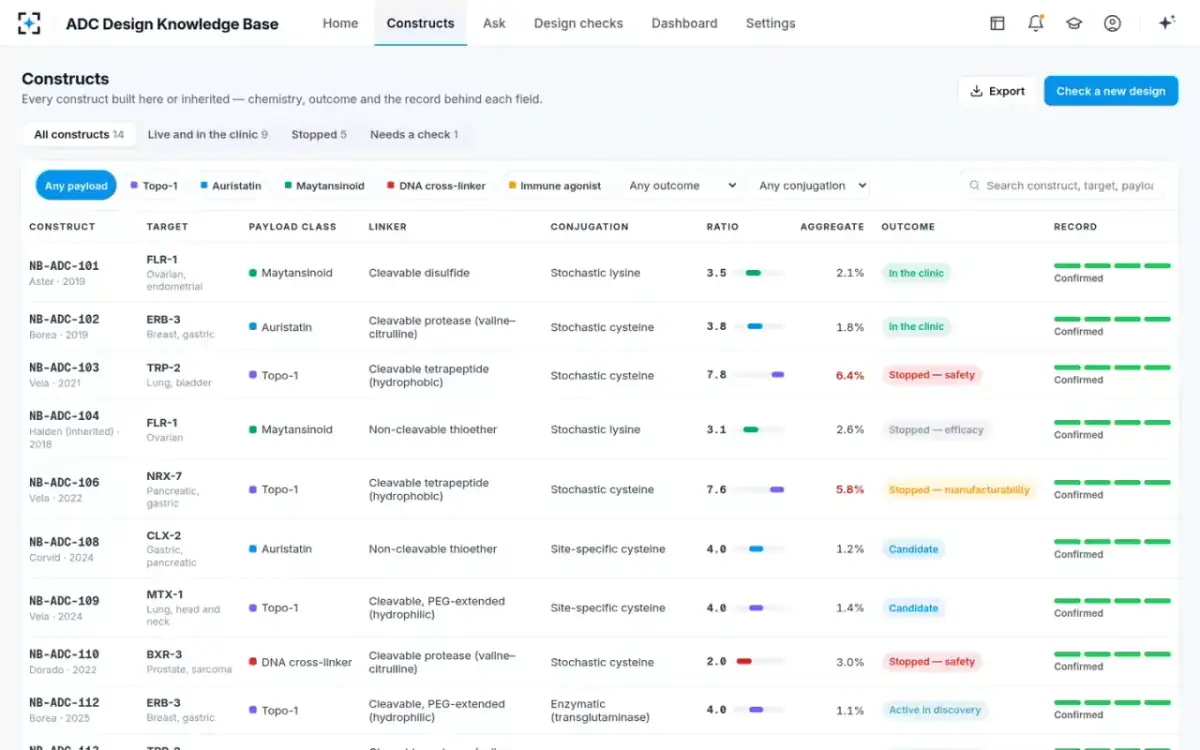
A closed report is one whose values a specialist has already argued about and agreed. That agreement is free ground truth: you do not have to construct an answer key, because your own group built one when it accepted the numbers the first time. Nothing else available to a pilot has that property.
It also tests the right thing. A system that reads a report correctly where you already know the answer will read the next report correctly for the same reasons — the templates, the units, the section names and the vocabulary are the same. A demonstration on prepared data tests none of that, and a pilot on reports still open tests it without a way to score the result.
A demonstration and a replay answer different questions
A demonstration: That the software can do the category of work, fluently.
A replay on your closed reports: That it reads your templates, your units and your words.
A demonstration: Prepared by the vendor.
A replay on your closed reports: Values your own specialists confirmed when the study closed.
A demonstration: Rare, and explained away.
A replay on your closed reports: A specific field, in a specific report, read wrongly — which is diagnosable.
A demonstration: Everyone, because nobody owns the data.
A replay on your closed reports: Nobody, because the toxicologist who signed the study is reading the output.
A demonstration: Little about your archive.
A replay on your closed reports: Most of what go-live will be like, except adoption.
How do you test AI data-extraction software before relying on it?
By defining the measures first, running them on documents whose answers you already hold, and having someone other than the pilot's sponsor score the result. The five measures worth running are the match rate against confirmed values, the unsourced rate, the refusal rate below the confidence floor, the rate at which a specialist has to correct what was read, and the rate at which disagreements between documents are raised — all set out, with how to compute each one, in whether you can trust AI to read your ADC study reports.
The framing is not ours. NIST's AI Risk Management Framework is voluntary and exists to help organisations build trustworthiness into how AI systems are designed, used and evaluated, and it notes that "identifying and managing AI risks and potential impacts requires a broad set of perspectives and actors across the AI lifecycle" (NIST AI RMF 1.0). A pilot run by one enthusiast, scored by the same enthusiast, satisfies neither half of that.
Regulators have begun saying something similar in their own register. Among the ten guiding principles for AI in drug development published by CDER and CBER with the European Medicines Agency in January 2026 are "risk-based performance assessment" and "life cycle management" (FDA, January 2026) — both of which describe a pilot that measures against a stated risk and expects to be re-measured later, rather than a one-off trial that is never repeated.
How many of your own reports do you need for a fair pilot?
In our view twenty to thirty is enough, and variety decides the answer far more than volume. The question a pilot answers is whether the system handles the range of documents your archive actually contains, so the selection should be built deliberately rather than by convenience.
What to bring, and why each one is there
- Two repeat-dose toxicology studies, from different years
The full-length documents, not the summaries. They test whether findings, grades, dose levels and the ophthalmic or other payload-specific sections are read in context.
- Two or three conjugation and characterisation reports
Where ratio, drug-load distribution, aggregate at release, free payload and the method behind each value live. This is where silent unit conversion shows up.
- A pilot or dose-range-finding study
Shorter, differently structured, and usually written to a different template than the definitive studies.
- Efficacy and plasma-stability studies
They carry the model, the antigen density and the comparison across constructs that design questions most often turn on.
- At least five decision records
Why a construct stopped, and at which point. Without these a registry can tell you what was built but not what was learned.
- Ten or more documents from an inherited archive
Another team’s templates and another team’s words. If you have an acquired programme, this is the hardest part of your archive and the most informative part of the pilot.
- The confirmed values your group already agreed
The answer key. Without it the replay produces output nobody can score.
One rule about selection is worth stating because it is so often broken: do not hand over your cleanest reports. The pilot's value is concentrated in the awkward ones — the study with a handwritten correction, the report whose construct code changed mid-programme, the inherited document that calls the ratio something else.
What a replay on closed reports proves, and what it does not
It proves reading. At the end of a replay you know, per field, how often the system agreed with your specialists, how many fields it filled without a sentence behind them, how often it held back, and what it did with documents that disagree. In the sample portfolio the replay surfaced the case worth looking for: an inherited report giving aggregate at release as 2.6% for a batch the transfer summary reports at 3.1%, kept as a conflict with both sources rather than resolved.
It does not prove three other things, and a pilot that claims otherwise is overselling. It does not prove that the prior-art check is useful, because that depends on whether proposals actually repeat precedents in your group. It does not prove adoption. And it does not prove the registry stays good, which is a question about the correction rate over months rather than a question a replay can reach.
What the replay does do, beyond the measurements, is force a conversation your group may not have had: what the fields mean. The mAbs analytical review is blunt that this comes first in ADC development generally — "one of the most impactful steps in ADC development is the identification of critical quality attributes to determine product characteristics that may affect safety and efficacy" (Wagh et al., 2018). A pilot can easily lose a day to whether aggregate at release means the same thing in two programmes. That day is worth more than the software.
One replayed report, its facts beside the original
Running two weeks beside a live design board
The second half of the pilot is the half that predicts whether anything changes. For a fortnight, every proposal going to the design board gets a prior-art check attached — and the board carries on exactly as before. Nobody is asked to follow the check. The question being answered is narrower and more honest: when a scientist who knows this portfolio better than anyone reads what the system produced, do they learn anything?
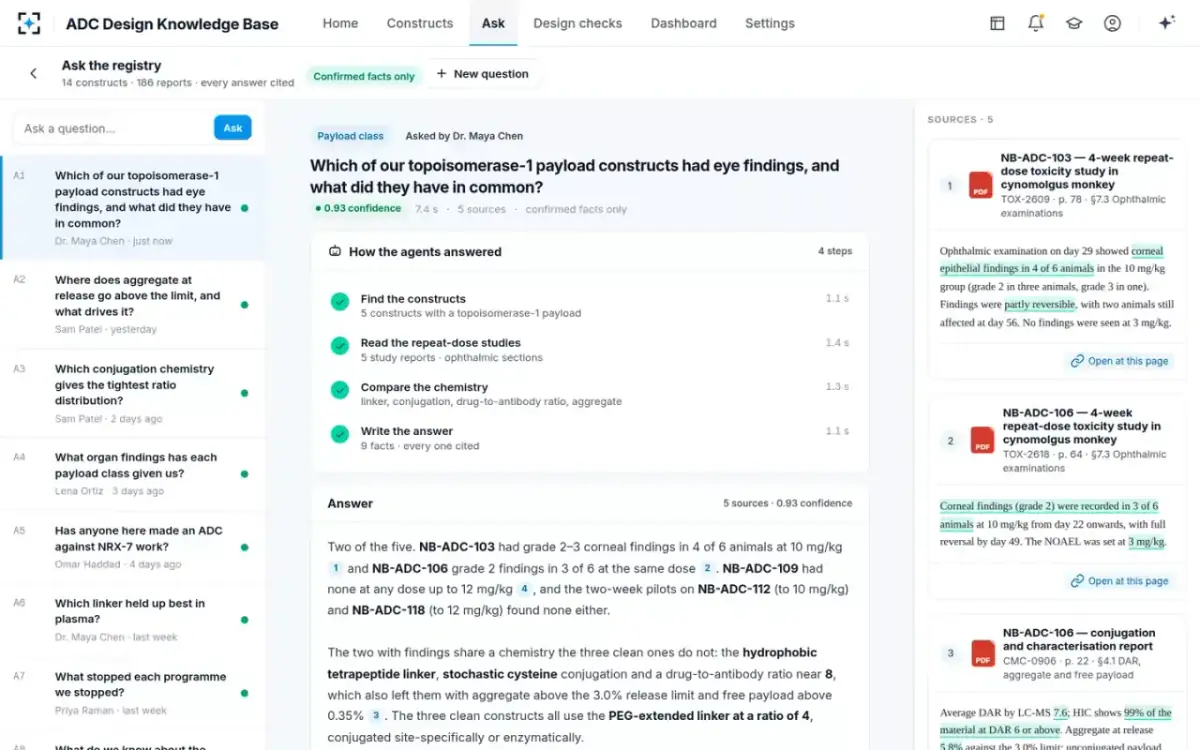
Three observations are worth recording during that fortnight, and all three are qualitative. Did the check name a precedent the proposer had not mentioned? Did it miss one the toxicologist knew about? And did the board's discussion change shape — fewer minutes spent reconstructing what happened in 2021, more spent on what to do about it?
In the sample portfolio that fortnight produced the case the whole registry exists for: a proposal scored at repeat risk 78 because two constructs with the same payload class, linker and ratio band had already been stopped, one on safety and one on manufacturability, neither mentioned in the proposal as written.
The question a design lead actually asks
What pass/fail checks should a pilot agree on before it starts?
Written down, in advance, by the people who will be asked to rely on the result. A check agreed afterwards is a negotiation, not a test. These are the checks we would put on the page, with the numbers left for the group to set.
Checks worth agreeing before anything is loaded
| Check | How it is measured | Who signs it off |
|---|---|---|
| No field is filled without a sentence behind it | Unsourced rate across every field written during the replay | Knowledge steward |
| Ten citations open at the page and section claimed | Opened by hand, chosen at random after the run | Whoever did not run the pilot |
| Per-field match rate on the fields decisions turn on | Ratio, distribution, aggregate and its method, free payload, findings and grades, stop reason | CMC scientist and toxicologist, each in their own fields |
| Every disagreement between two documents is raised, not resolved | Conflicts raised ÷ conflicts the group knows exist in the sample | Knowledge steward |
| Inherited vocabulary is proposed, never assumed | Mappings proposed ÷ unfamiliar terms; original wording retained on every mapped value | Knowledge steward |
| Nothing advances without a person | No change of construct state in the system without a named decision behind it | Design board chair |
| The board learned something it did not know | Precedents named during the fortnight that the proposer had not cited | Design board chair |
One check deserves its own sentence, because it is the one that separates a research tool from a liability: nothing advances without a person. A pilot should confirm that no construct changes state, and no proposal reaches a board as approved, without a named human decision recorded against it.
What happens to inherited or acquired archive data in a pilot?
It should be in the pilot, and it should be the part you watch hardest. An acquired programme arrives in another company's templates with another company's vocabulary — "conjugate load" for the drug-to-antibody ratio, "monomer loss" for aggregate at release — and until that vocabulary is mapped, those constructs are invisible to every question the group asks.
What to look for is the shape of the mapping rather than its speed. A term that is not already known should be proposed to a steward, not silently translated, and the original wording should stay beside every mapped value so that anybody can see what the source document actually said. In the sample portfolio one inherited construct arrived with 34 documents and six mapped terms, each one accepted by a named steward.
This is also where the published literature on data practice is most directly useful. A 2023 review in Scientific Data argues that "more tools are needed which merge human and automated curation to offload the burden of metadata creation from data creators" (Hughes et al., 2023) — which is a precise description of what a vocabulary mapper with a steward's acceptance step is for, and of what a fully automatic one would get wrong.
The rules a group sets before go-live
What a fair pilot never promises
Four things, and saying them out loud at the start makes the rest of the pilot more useful rather than less.
Four honest limits
- It will not find what is not in the documents. A decision taken in a corridor and never written down is outside the archive, and no system recovers it. The pilot measures reading, not institutional memory.
- It will not settle a scientific disagreement. Where two reports disagree, the output is a conflict with both sources. Deciding it is a specialist's job, and the pilot should count how often that is needed rather than treat it as a defect.
- It will not prove the prior-art check pays for itself. Two weeks is enough to see whether the check tells the board something it did not know. It is not enough to observe a repeat being avoided, which happens on the timescale of programmes.
- It will not predict adoption from a volunteer. The scientist who ran the pilot is not evidence that the group will use it. The board chair reading an unfamiliar check is better evidence, and is the reason for the fortnight.
What should a validation team see before a knowledge base goes live?
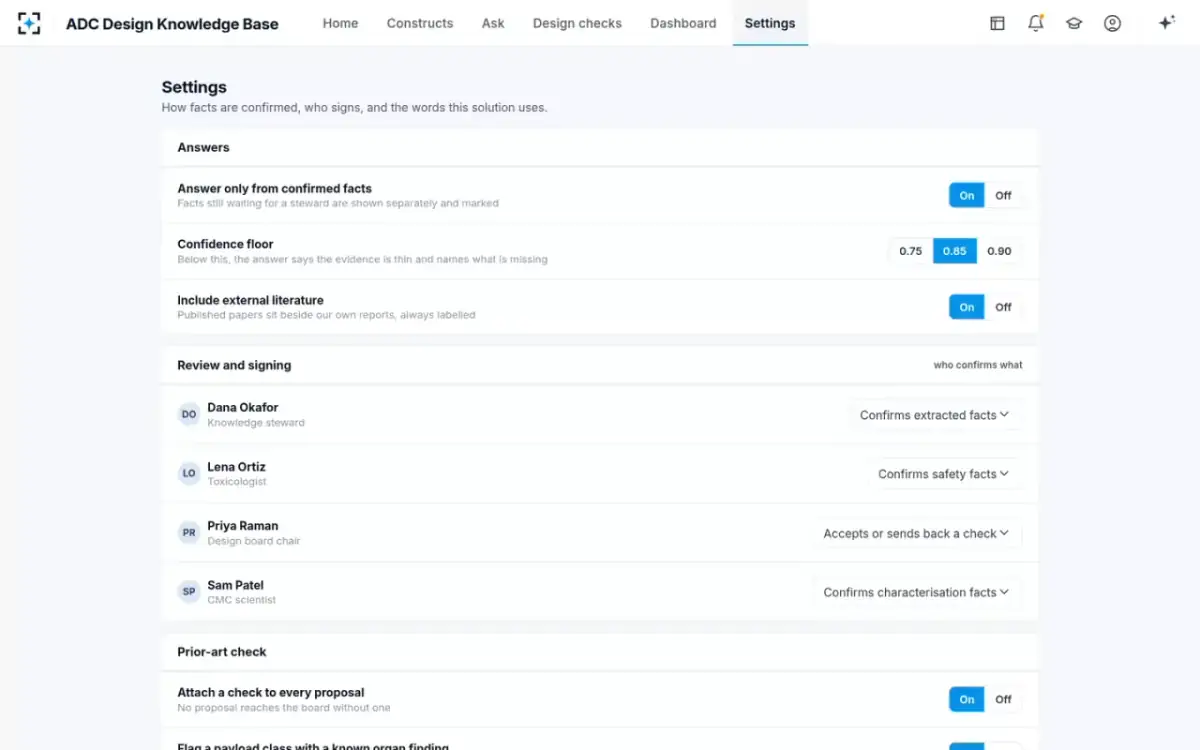
A file of evidence, not a recommendation. The replay results against the pass marks agreed in advance; the ten citations opened by hand and who opened them; the settings in force, including the confidence floor and whether answers may draw on unconfirmed facts; the assignment of who confirms which kind of fact, by name; and the audit trail showing that every question, extraction, confirmation, mapping and decision is recorded with who and when.
It is worth knowing that this kind of evidence-before-rule sequencing is normal in this field rather than exceptional. A 2025 review of every ADC approved by March that year found that "all 6 clinical pharmacology considerations were consistently applied throughout ADC approval history, well before the issuance of formal guidance" — the guidance itself having been "released in February 2022 and finalized in March 2024, outlining expectations across six key domains: bioanalytical approach, exposure–response (E–R) evaluation, intrinsic factors, drug–drug interactions (DDIs), immunogenicity, and QTc assessment" (Translational and Clinical Pharmacology, 2025). Groups that could show their working were ready when the expectation was written down.
The decision at the end of the six weeks
A person decides
Steward and specialistsScore the replay against the pass marks agreed in week one, in their own fields.
Never: Never renegotiates a pass mark after seeing the result
A person decides
Independent readerOpens ten citations by hand and reports what they found.
Never: Never the person who ran the pilot
A person decides
Design board chairSays whether the fortnight of checks told the board anything it did not know.
Never: Never asked to judge the software, only the output
A person decides
R&D informaticsPrices the archive work, the ongoing effort per review and the licence.
Never: Never counts recovered hours as the whole case
A person decides
Research leadershipDecides: go live, extend the pilot to a second archive, or stop.
Never: Never decides without the scored results in front of it
What happens after the pilot passes
Three things, in a deliberate order. The archive is brought in beyond the pilot's twenty-five documents, which is the longest task and the one to schedule honestly — an inherited programme's vocabulary takes a steward real hours. The rules are set as the group wants them rather than as the pilot left them: the confidence floor, whether answers may draw on unconfirmed facts, who confirms which kind of fact, and which flags every check raises. And the correction rate starts being tracked from day one, because its trend is the only measure that keeps telling you something after go-live.
The last of those is the one most often forgotten, and the cheapest to set up. It comes free from normal work, it needs no instrumentation, and in two years it will be the first thing a validation team asks for.
If the arithmetic behind the decision is the part still open, what repeating a stopped ADC design really costs builds a return you can fill in with your own numbers, and how to evaluate ADC knowledge-management software covers the questions to ask before a pilot is even scheduled.
Questions people ask
How long does it take to go live with an R&D knowledge base?
The pilot is about six weeks: a week to prepare, two to replay closed reports, two beside a live design board and one to decide. Going live afterwards depends almost entirely on the archive rather than the software — bringing in a decade of reports and agreeing the vocabulary for an inherited programme is the long pole, and it is a steward's time rather than an installation. A group that has already done the vocabulary work during the pilot is much closer than one that deferred it.
What does a pilot on your own study reports actually involve?
Choosing twenty to thirty documents that cover the range of your archive, agreeing the field list and the pass marks, handing over the confirmed values your group already holds, and then reading the output as a specialist rather than as a buyer. The effort is concentrated in two places: selecting the awkward documents, and having the right people score the result in their own fields.
Who should run the pilot inside the group?
A knowledge steward or research informatics lead runs it; the CMC scientist and toxicologist score their own fields; the design board chair judges the fortnight beside the board; and somebody who did not run it opens the citations. That separation is the point — NIST's framing about needing a broad set of perspectives across the lifecycle is exactly the failure mode of a pilot run and marked by one person.
Should published literature be included during the pilot?
Include it, and keep it labelled. A pilot is a good moment to see whether external papers are clearly distinguished from your own studies everywhere they appear, because the confusion is cheap to create and expensive to unwind. In the sample group it is a setting, on by default and always labelled as external.
Can a pilot run on one programme rather than the whole archive?
Yes, and for a first pilot it is often better — one programme with a complete document set, plus a slice of an inherited archive, gives both the depth to score reading and the awkwardness to test vocabulary. What a single-programme pilot cannot show is the cross-programme comparison that makes a registry valuable, so expect to extend it before relying on a prior-art check.
What does the pilot cost in people's time?
Mostly specialist hours rather than money: a day or two from the CMC scientist and the toxicologist to score their fields, a few days from whoever assembles the documents and the confirmed values, and an hour from the board chair at the end. The largest single item is usually the vocabulary work on an inherited archive, which is work a group needs to do eventually in any case.