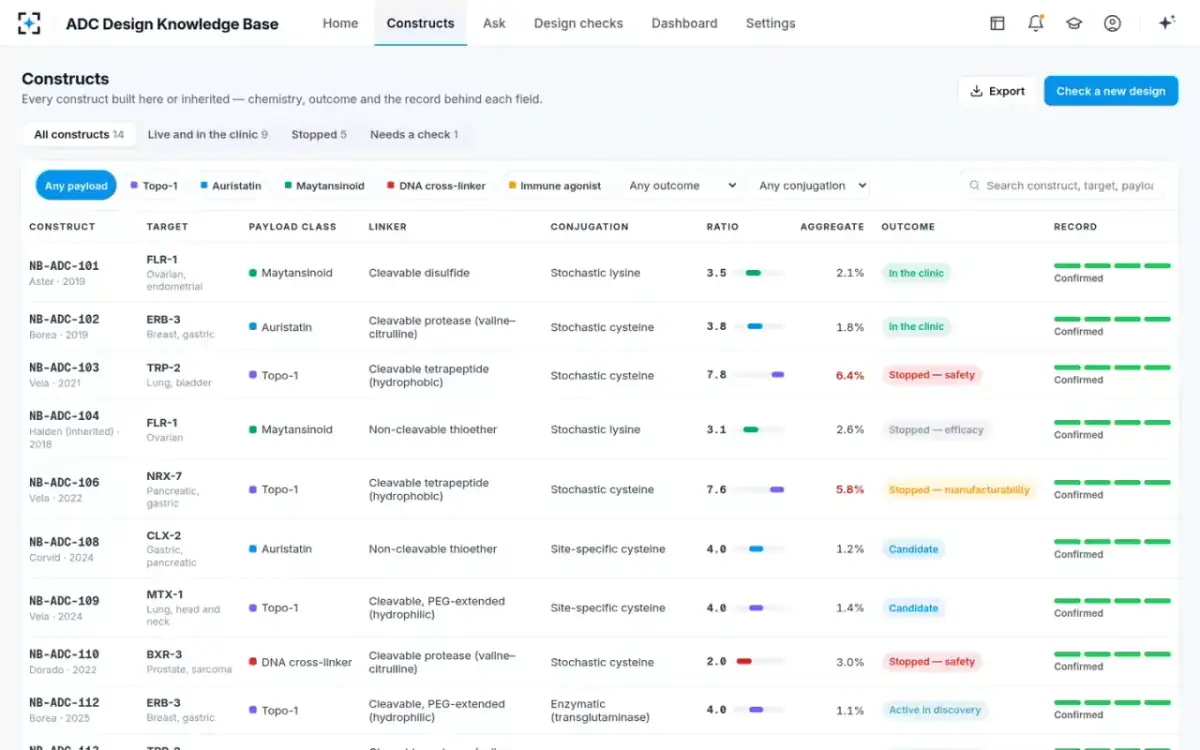
An antibody-drug conjugate development team is five roles deep by the time one design decision is made. A design lead proposes the construct — target, antibody format, linker, payload class, conjugation chemistry and drug-to-antibody ratio. A CMC scientist has to make that construct twice to the same specification. A toxicologist reads what it does to an animal over four weeks. A knowledge steward decides when an extracted number counts as a fact. A design board chair accepts the proposal or sends it back. The work is hard because the answer to "has this been tried here?" is spread across all five, in reports none of the others has reason to open. ADC Design Knowledge Base is Botminds' agentic solution for exactly that: it reads a group's own study, conjugation and decision reports into one structured registry of every construct ever built, each field carrying the page it came from, and checks each new design against all of them.
The worked examples below come from a fictional sample portfolio as it runs through the solution: Northwind Bio, 14 constructs across five payload classes, 186 reports, 34 of them inherited with an acquired programme. The people, companies and constructs are invented. The research figures come from government statistics and peer-reviewed journals, linked where they appear.
The seats are scarce, and the field they work in is not small
33,180
biochemists and biophysicists employed in the United States, May 2023
$107,460
median annual wage for that occupation — about $52 an hour
5,970
of them inside pharmaceutical and medicine manufacturing, at a mean of $109,270
>300
ADCs in clinical trial pipelines, with more than 500 in nonclinical tests
The five seats around one antibody-drug conjugate design decision
Job titles vary between companies; the decisions do not. Somebody has to propose a construct, somebody has to be able to make it, somebody has to read what it does to an animal, somebody has to decide what the reports actually say, and somebody has to say yes or no. In a small group one person holds two of those seats. In a large one each seat is a department. The number that matters is five, because that is how many times a design decision changes hands before it is made.
Five seats, and what each week holds before and after
Today
Answers "has this been tried here?" by re-reading PDFs from three programmes ago, and by memory where the PDFs run out.
With agents
Asks the portfolio in plain words, sees which constructs the answer rests on, and attaches a prior-art check to every proposal.
Still theirs: Proposing the construct: target, format, linker, payload class, conjugation, ratio.
Today
Knows which campaign held its ratio — the one they ran. The other eleven are in reports they never had reason to open.
With agents
Reads ratio, drug-load distribution, aggregate and free payload for every construct side by side, and confirms each characterisation fact against its page.
Still theirs: Whether the chemistry can be made twice to the same specification.
Today
Re-derives a payload class’s signature finding each time a new proposal arrives, from the studies they happen to remember.
With agents
Sees organ findings counted by payload class across the whole portfolio, with the study behind each one attached to the proposal.
Still theirs: What the four-week study means, and what dose a person could be given.
Today
Watches two teams write the same number two ways, and an inherited archive arrive in a third vocabulary.
With agents
Confirms or corrects each waiting fact against its page, decides conflicts with both sources in view, and accepts proposed vocabulary mappings.
Still theirs: The judgement that an extracted number is, or is not, what the report says.
Today
Chairs an argument from memory: three scientists, three recollections of what the 2021 construct showed.
With agents
Receives every proposal with its repeat-risk score, nearest precedents, risks with their sources, and the changes the portfolio shows work.
Still theirs: Accepting the proposal, or sending it back.
Read down the "keeps" column and the division is clear enough: proposing, making, interpreting, confirming, deciding. Read down the "before" column and the common thread is reading — each seat spends its week re-reading documents the seat beside it has already read, because nobody can see what the others confirmed.
The ADC design lead: proposing the next construct
The design lead's output is a proposal, and a proposal is six choices made together: which antigen to target, which antibody format to use, which payload class, which linker, which conjugation chemistry, and at what drug-to-antibody ratio. None of the six is independent of the others, which is why the seat exists as a seat rather than as a committee of specialists.
The first choice sets the ceiling on the rest. "An ideal target antigen for ADCs is highly expressed in a tumor and has low or no expression in normal tissues," the 2025 review in Antibody Therapeutics puts it (Cheng et al., 2025). That is a statement about the patient, not the chemistry, and it is the reason a design lead's second question is always about antigen density. In the sample portfolio the target NRX-7 has been tried twice and landed neither time: one construct reached only 48% tumour growth inhibition in a model carrying 40,000 copies per cell, and the other reached 79% in the antigen-high model only. The registry's answer to "has anyone here made an ADC against NRX-7 work?" is two sentences long and names both.
What the seat cannot do alone is know what the group already learned. That is not a failure of diligence. In the sample portfolio, 186 reports stand behind 14 constructs — thirteen reports per construct, of which a design lead reads the two or three that were written while they were in the room.
Every construct ever built, in ADC Design Knowledge Base
What does a CMC scientist do on an antibody-drug conjugate team?
A CMC scientist owns the question of whether the molecule on the proposal can be manufactured to a specification, repeatedly, and characterised well enough that a regulator can see what was in the vial. For an ADC that is harder than for the parent antibody, because conjugation makes one molecule into a mixture.
The analytical review in mAbs names the attribute at the centre of the seat: "One of the most important of these attributes is DAR heterogeneity, which necessitates determination of total drug load, drug load distribution, level of unconjugated antibody/linker/drug, and sites of conjugation" (Wagh et al., 2018). Four measurements, not one — and a design proposal that names only an average ratio has not told the CMC seat what it needs to know.
In the sample portfolio that shows up as a spread. Enzymatic conjugation holds 95% of the material at a ratio of 4; site-specific cysteine holds 91%; stochastic cysteine puts material on the even ratios only, and at an average ratio of 2 leaves about a third of the antibody carrying no payload at all. Three constructs with the same average ratio on the datasheet are three different mixtures at the bench. How drug-to-antibody ratio is calculated, and why an average hides a distribution, is worked through separately.
The second half of the seat is release. The sample group's limit is 3.0% aggregate at release, and two constructs sit above it: one at 6.4% and one at 5.8%, both carrying a hydrophobic payload on a hydrophobic linker at a ratio near 8. A third runs at a ratio of 7.8 on a PEG-extended linker and sits at 2.3%, with free payload at 0.07% and clearance within 15% of the unconjugated antibody. The CMC scientist who has seen all three knows that hydrophobicity carried at a high ratio, not the ratio itself, is what pushed the first two out of specification. The one who has only run the latest campaign does not.
"Tell me which chemistry held the ratio, across every campaign, not the one I remember."
Sam Patel, the sample portfolio's CMC scientist
What does an ADC toxicologist look for in a repeat-dose study?
A toxicologist is looking for the dose-limiting finding and the organ it belongs to — and, before the study is even designed, for the finding this payload class is known to produce. The published evidence says that expectation is well founded. "Analysis of the clinical data has demonstrated that dose-limiting toxicities (DLTs) are often shared by different ADCs that deliver the same cytotoxic payload, independent of the antigen that is targeted and/or the type of cancer that is treated," the 2023 review in Cancers states, adding that such toxicities "are commonly associated with cells and tissues that do not express the targeted antigen" (Nguyen et al., 2023).
The same review sets out the signatures by class: anaemia, neutropenia and peripheral neuropathy for MMAE conjugates; low platelets and liver toxicity for DM1; severe eye toxicity for MMAF and DM4. A toxicologist reading a new proposal therefore knows which section of the four-week study to read first, and which examination the protocol must include. In the sample portfolio that is the ophthalmic examination: two topoisomerase-1 constructs on the hydrophobic tetrapeptide linker showed corneal findings — grade 2 to 3 in four of six animals at 10 mg/kg in one, grade 2 in three of six in the other — while the three on the PEG-extended linker at a ratio of 4 showed none.
That is the seat's real contribution, and it is a reading contribution: the finding is in a report's ophthalmic section, written years before the proposal that needed it. Why antibody–drug conjugates fail in clinical trials follows that argument through the published record.
What does a knowledge steward do in drug discovery?
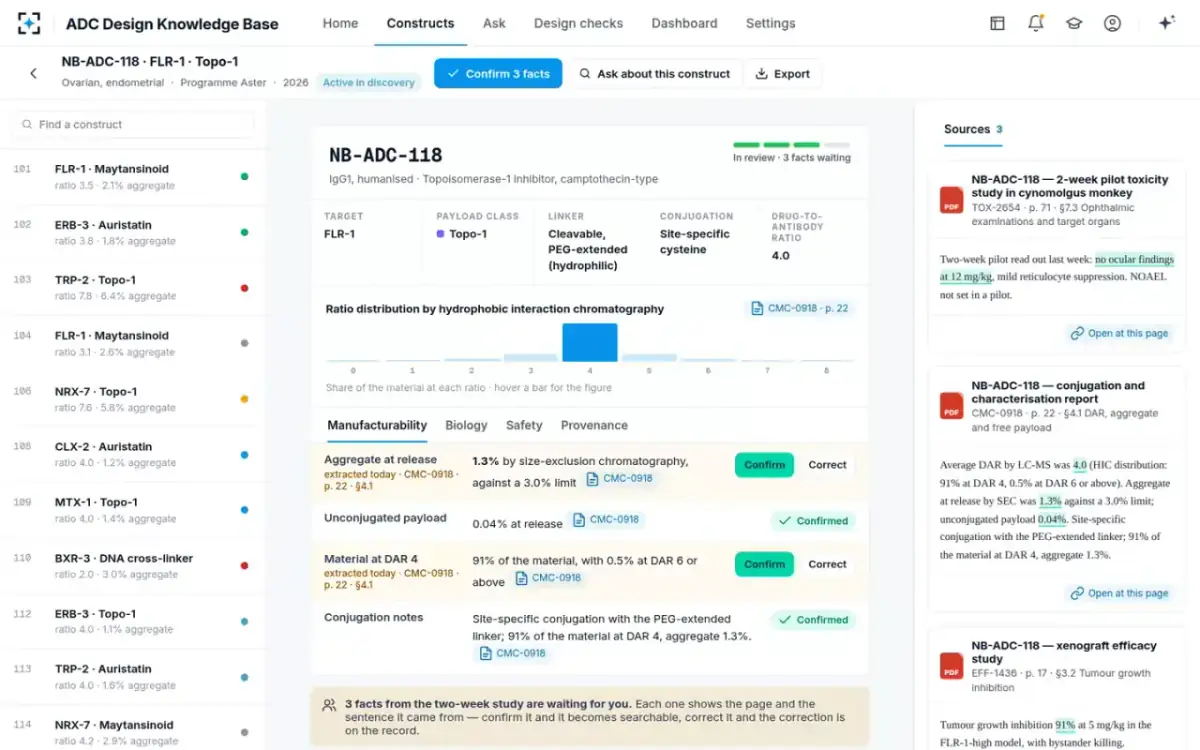
A knowledge steward decides when a number becomes usable. The seat is newer than the other four and often unnamed, but it is the one that makes the difference between an archive and a registry: somebody has to say that the aggregate value on page 19 of a conjugation report is this construct's aggregate at release, in this unit, for this batch.
The problem is not unique to ADCs. A 2023 paper in Scientific Data reviewing biomedical data practice found that "researchers routinely share data, but datasets are still not necessarily findable, accessible, interoperable, or reusable (FAIR)", and named three interdependent barriers: "(1) a lack of incentives, (2) little standardization in metadata collection and access, and (3) uncoordinated efforts" (Hughes et al., 2023). Inside one company all three are the steward's working week.
In the solution the seat has three jobs, and each one is a decision an agent is not allowed to make. The first is confirming: an extracted fact arrives with its document, page, section and sentence, and the steward confirms it or corrects it. In the sample portfolio a two-week pilot study produced 34 facts, of which 31 matched values already confirmed and three went to the steward — aggregate at release of 1.3% by size-exclusion chromatography, no ocular findings at any dose including 12 mg/kg, and 91% of the material at a ratio of 4. The second is deciding conflicts: where two reports give different values for one field, both stay on the record until the steward keeps one. The third is vocabulary: when an inherited archive calls the ratio "conjugate load", the mapping is proposed, with the original wording kept, and the steward accepts it.
Three facts waiting for a steward, each with its page
How well that confirmation step works is measurable, and should be measured rather than asserted — whether you can trust AI to read your ADC study reports sets out the five measures to run on reports your team has already closed.
The design board chair: accepting a proposal, or sending it back
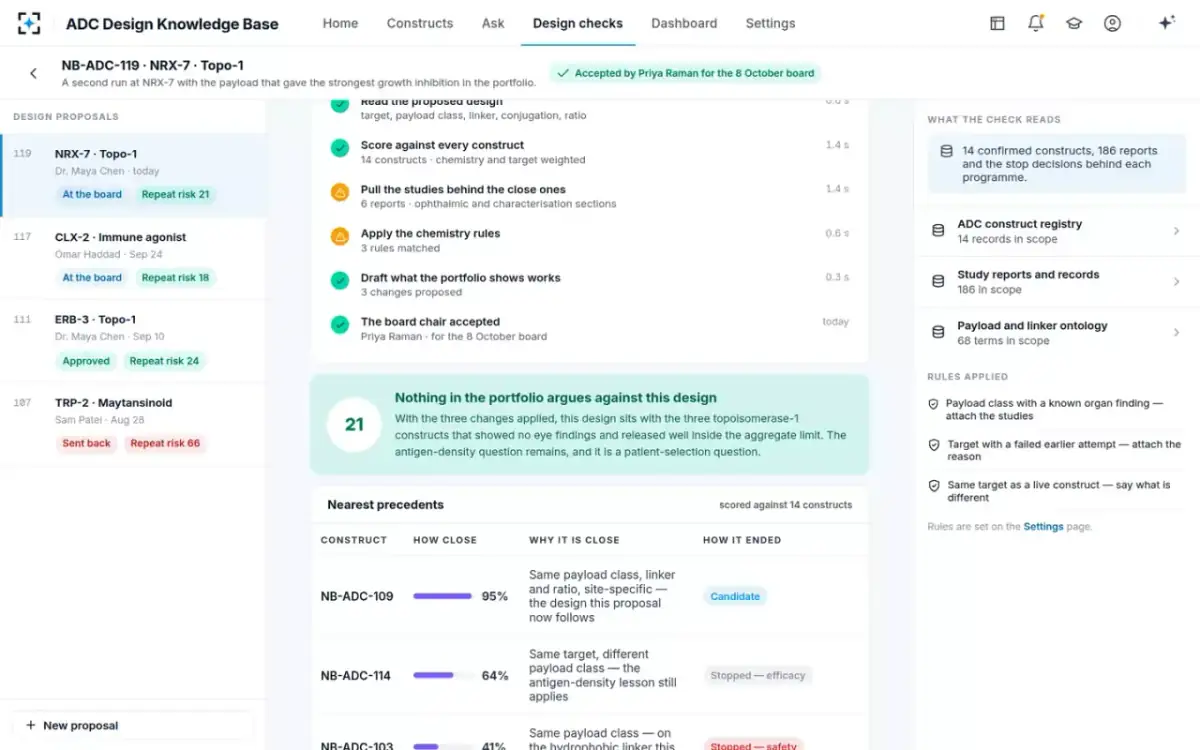
The chair's decision is binary and the chair's information is not. A proposal that arrives as a slide with a rationale invites an argument from memory; a proposal that arrives with its nearest precedents named and the studies behind them attached invites a decision. The seat's whole leverage sits in what reaches it.
One proposal crossing five seats
A person decides
Design leadProposes the construct: target, format, linker, payload class, conjugation, ratio.
Never: Cannot know, unaided, what the group learned before they joined it
Agent
Prior-art checkScores the proposal against every construct built before it, names the nearest precedents and how they ended, and proposes the changes the portfolio shows work.
Never: Never returns a score without the evidence; proposes, never decides
A person decides
CMC scientistJudges whether the chemistry can be made twice to specification, and confirms the characterisation facts behind the check.
Never: Never signs for a ratio distribution nobody measured
A person decides
ToxicologistReads the organ-finding risks against the studies attached to them, and says what the four-week study would have to show.
Never: Never infers a finding from a payload class alone
A person decides
Knowledge stewardConfirms or corrects each extracted fact, and decides any conflict between two reports.
Never: Never lets an unconfirmed number carry a conclusion
A person decides
Design board chairAccepts the checked proposal, or sends it back with the reason.
Never: Never delegates the decision to the score
In the sample portfolio the chair's agenda item was a second run at NRX-7 with the payload that gave the strongest growth inhibition anywhere in the portfolio. The first check scored its repeat risk at 78 and named two stopped constructs with the same chemistry: one stopped on safety, one on manufacturability. Three changes the portfolio shows work — the PEG-extended linker, a ratio of 4, site-specific conjugation — took the score to 21, and the proposal was accepted with one risk left open: NRX-7's apparent need for roughly 100,000 copies per cell, which is a patient-selection question and not a chemistry one.
What reaches the chair in ADC Design Knowledge Base
Who owns the registry when a programme is acquired from another company?
Nobody owns it by default, which is the problem. An acquired programme arrives as a folder of another team's reports, in another team's templates, using another team's words: "conjugate load" for the drug-to-antibody ratio, "monomer loss" for aggregate at release, "ocular surface finding" for what your own toxicologist calls a corneal finding. Until somebody maps that vocabulary, the inherited constructs are invisible to every question the group asks.
In practice the seat that ends up owning it is the steward, with the CMC scientist and toxicologist confirming the facts in their own fields. In the sample portfolio one inherited construct came across with 34 documents, six inherited terms mapped onto the house vocabulary with the original wording kept beside every mapped value, and one open conflict: its inherited report gives aggregate at release as 2.6% for a batch the transfer summary reports at 3.1%. Both values stay on the record, with both sources, until a steward keeps one. Nothing averages them, and the difference matters: one is inside the 3.0% limit and the other is not.
Five seats, five programme decisions
| Decision | Design lead | CMC scientist | Toxicologist | Steward | Board chair |
|---|---|---|---|---|---|
| Which target to go after | Proposes | Consulted | Consulted | — | Decides |
| Linker and payload class | Proposes | Must agree | Must agree | — | Decides |
| Drug-to-antibody ratio and conjugation | Proposes | Owns the evidence | Consulted | — | Decides |
| Whether an extracted number is a fact | Consulted | Confirms characterisation | Confirms safety | Confirms the rest | — |
| Whether an inherited term maps to ours | — | Consulted | Consulted | Accepts | — |
| Advancing or stopping the construct | Recommends | Can stop it | Can stop it | — | Decides |
Where the week goes, seat by seat
The checking work has a shape worth seeing, because it is where a tool either helps or does not. Estimated for the sample portfolio, one prior-art review before a design board takes about 23 hours spread across the seats: six hours finding every construct with similar chemistry or the same target, eight re-reading the tox and CMC reports behind the close ones, four reconciling inherited naming and values recorded twice, three writing up the risks and the changes that worked, and two in the board discussion itself.
Twenty-three hours of prior-art review, and what is left of it
By hand — about 23 hours
- Finding the constructs · 26%
- Re-reading reports · 35%
- Reconciling naming · 17%
- Writing it up · 13%
- Deciding · 9%
With the agents — about 4 hours
- Finding · 2%
- Re-reading · 12%
- Reconciling · 12%
- Writing it up · 25%
- Deciding · 49%
Two things change and one does not. The finding and re-reading hours collapse, because that is mechanical retrieval over documents somebody has already read. The board discussion does not move at all — two hours before, two hours after. What shifts is the ratio between them: deciding goes from under a tenth of the review to about half of it. What repeating a stopped ADC design really costs prices the same hours against what a repeated finding costs if the review is skipped.
Who decides the drug-to-antibody ratio?
The design lead proposes it, the CMC scientist and the toxicologist each hold a veto over it, and the board chair sets it. That sounds like a committee and it is not: the three constraints point in different directions, and somebody has to choose a number inside them.
The specification is the honest form of the choice. "The target product profile of an ADC must include a robust definition of DAR and degree of homogeneity," the mAbs review states (Wagh et al., 2018) — a definition, not a number, because the distribution and the unconjugated fraction are part of what is being specified. In the sample portfolio the second change applied to the NRX-7 proposal was exactly this: bringing the ratio from 8 to 4 took 18 points off its repeat risk, and conjugating site-specifically rather than stochastically took another 12 — two decisions about the same number, taken by two different seats. Whether a higher drug-to-antibody ratio means more toxicity looks at what the published and portfolio evidence supports here.
What can none of the five seats hand to an agent?
The decision, and the confirmation that a number is real. Everything between them is reading, retrieval, mapping and comparison, which is work an agent does better because it does it exhaustively rather than from memory.
NIST's AI Risk Management Framework puts the distinction in the language of configurations rather than capabilities: an AI system may be set up to decide on its own, to hand the decision to a human expert, or to serve a human decision maker as one more opinion. The same appendix on human-AI interaction warns that "representing complex human phenomena with mathematical models can come at the cost of removing necessary context" (NIST AI RMF 1.0, Appendix C). A repeat-risk score is a mathematical model of a judgement; what it removes is why a programme was stopped, which is why the score in the solution never arrives without its precedents and their reports attached.
So the six agents in ADC Design Knowledge Base are drawn tightly. The reader never infers a construct identity that is not written on the page. The extractor leaves a field empty when no sentence stands behind it. The vocabulary mapper never maps a term that is not in the table without a steward. The conflict checker never averages two values and never resolves a conflict. The prior-art reasoner proposes, and the chair decides. What each of the six agents may and may not do is set out agent by agent.
Questions people ask
How many people does it take to run an ADC design review?
Three in the room is usually enough to decide — the design lead who proposes, one of the CMC or toxicology seats depending on what the risk is, and the chair — provided the reading has been done before the meeting. The five seats are five decisions, not five attendees. In the fictional sample portfolio the board discussion itself is about two hours whether the 21 hours of preparation were done by hand or with agents.
Does a data scientist replace any of these roles?
No, and the attempt usually produces a sixth seat rather than one fewer. The modelling work a data scientist does — structuring the registry, scoring similarity between designs, measuring extraction quality — sits underneath the five decisions rather than inside any of them. What it can remove is the retrieval: the six hours of finding every construct with similar chemistry, which no scientist should be spending their week on.
Is there a standard job title for the knowledge steward seat?
Not consistently. The same work appears as scientific data steward, research informatics lead, R&D data manager or simply the senior scientist who has been there longest. What identifies the seat is not the title but the authority: somebody must be able to say that an extracted number is or is not what the report says, and to decide between two reports that disagree.
Who is accountable if an ADC design repeats a known failure?
The board chair accepted the proposal, so the chair is accountable for the decision — which is precisely why the chair's seat is the one that should never receive a proposal without a prior-art check attached. In practice the useful question is not who to blame but what the chair could see: a stopped construct with the same linker, payload class and ratio either reached the board or it did not.
What does an ADC programme need before any of these seats can work from a registry?
Its own documents, mostly: repeat-dose and pilot toxicology studies, conjugation and characterisation reports, efficacy and plasma-stability studies, and the decision reports that say why each construct stopped and at which point. Inherited archives count, in their original templates. What a registry cannot be built from is summary slides, because a field with no sentence behind it is a field the steward cannot confirm.
How does the toxicologist's seat change when a payload class is new to the group?
It gets harder rather than easier, because the portfolio has no precedent to offer and the published class signature has to carry more weight. The 2023 Cancers review's point — that dose-limiting toxicities travel with the payload rather than the target — is what makes the external literature worth holding beside your own reports for a first-in-class payload, clearly labelled as external so that nobody mistakes a published finding for one of your own studies.