Most questions about AI for antibody-drug conjugate design are really questions about two different jobs. One is generating a molecule — predicting activity from structure, proposing a linker nobody has made. The other, far less discussed and far more immediately useful, is reading: turning a group's own toxicology, conjugation and decision reports into a structured record of every construct it has built, so that the next design can be checked against all of them. ADC Design Knowledge Base does the second job, and it does it with six specialist agents whose limits are written as tightly as their duties. The reader never invents a construct identity. The extractor leaves a field empty rather than guess. The conflict checker never averages. The reasoner scores a design and never approves one.
That division is not a design preference. It is what makes agent output usable where a regulator may eventually read it, and it is the difference between a registry a toxicologist will cite and a summary nobody trusts. The examples below use a fictional sample portfolio — Northwind Bio, 14 constructs, 186 reports, 34 of them inherited with an acquired programme — and the research is linked where it appears.
What a regulator already sees arriving
10
guiding principles for AI in drug development, published by CDER and CBER with the European Medicines Agency in January 2026
13
FDA-approved ADCs reviewed against six clinical pharmacology considerations, as of March 2025
6
specialist agents in the solution; none of them confirms a fact or takes a decision
Six agents, one human decision
The sequence runs in one direction and ends at a person. A document arrives. The report reader works out what it is and which construct it belongs to. The construct extractor pulls the construct-level facts out of it, each tied to the sentence it came from. The vocabulary mapper reconciles the words used against the group's own. The conflict checker compares each new value against what is already confirmed. A steward confirms or corrects. Only then can the prior-art reasoner score a new design against the portfolio, and only then does the answer writer draw on those facts. The design board chair accepts the proposal or sends it back.
A report in, a decision out
Agent
Report readerIdentifies the document and the construct it belongs to, keeping page and section for every sentence.
Never: Never infers an identity that is not written on the page
Agent
Construct extractorPulls the construct-level facts, each with its page, section and sentence.
Never: A field with no sentence behind it is left empty
Agent
Vocabulary mapperMaps inherited and published wording onto the house vocabulary, keeping the original.
Never: Never maps an unlisted term without a steward
Agent
Conflict checkerCompares each new fact with the confirmed value and raises a conflict with both sources.
Never: Never averages two values; never resolves a conflict
A person decides
Knowledge stewardConfirms or corrects each waiting fact against its page, and decides conflicts.
Never: The one step no agent performs
Agent
Prior-art reasonerScores a new design against every construct before it and names the risks with their sources.
Never: Never returns a score without the evidence
A person decides
Design board chairAccepts the checked proposal, or sends it back.
Never: Never delegated
The order matters more than it looks. Because confirmation sits in the middle rather than at the end, nothing downstream ever runs on an unconfirmed number by accident: the answer writer draws on confirmed facts by default, and facts still waiting are shown separately and marked. An architecture that extracted, scored and answered first, and asked a human to audit afterwards, would have the same six capabilities and none of the same guarantees.
Can AI design an antibody-drug conjugate?
Not end to end, and the honest version of the answer is more useful than the slogan. An ADC design is six choices made together — target antigen, antibody format, payload class, linker, conjugation chemistry and drug-to-antibody ratio — and each is constrained by evidence from a different discipline. Models that predict ADC activity from structure exist and are improving. What none of them does is tell you that your own group stopped a construct with this chemistry in 2021, and why.
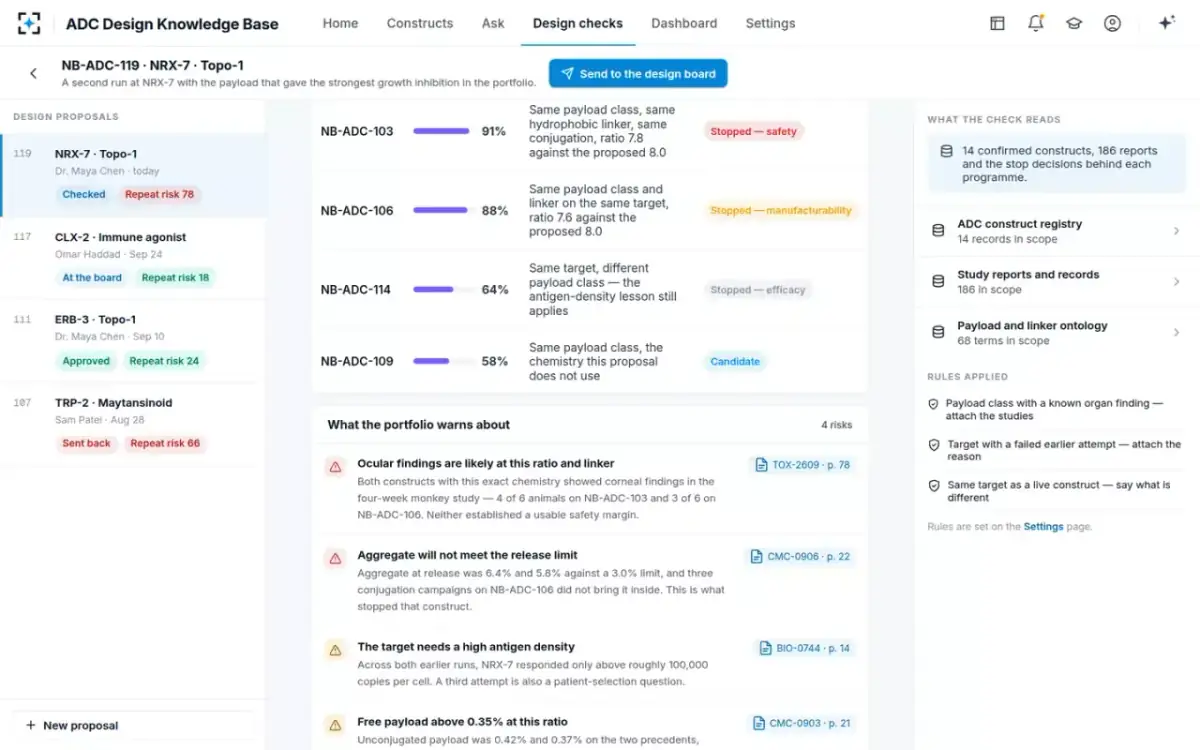
That gap is the whole argument for a registry. In the sample portfolio a new proposal against the target NRX-7 — topoisomerase-1 payload, hydrophobic tetrapeptide linker, stochastic cysteine, ratio 8.0 — scores a repeat risk of 78 in 4.3 seconds, because two constructs with that exact chemistry already exist in the portfolio: one stopped on safety after corneal findings, one stopped on manufacturability after releasing at 5.8% aggregate against a 3.0% limit. No structural model produces that sentence. It is retrieval over documents the group already owns, and it is the part that is currently done from memory.
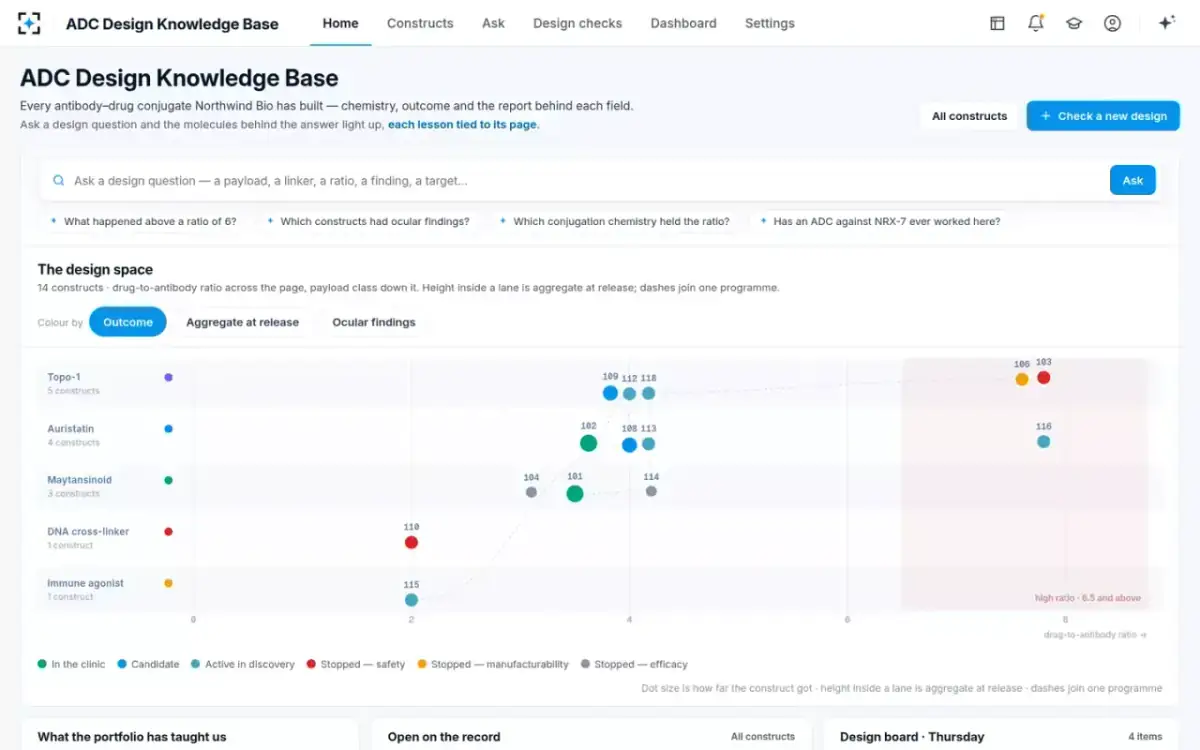
Every construct as a design space, in ADC Design Knowledge Base
What the report reader may and may not infer
The first agent has the least glamorous job and the strictest rule. A conjugation and characterisation report refers to its construct by an internal code, sometimes two codes, sometimes a batch number that belongs to a campaign rather than a molecule. Getting that wrong contaminates everything downstream: a tox finding filed against the wrong construct is worse than a tox finding nobody filed.
So the rule is that the reader never infers a construct identity that is not written on the page, and stops and asks when two documents name the same batch differently. That produces more questions than a looser agent would, and the questions are the point. In the sample portfolio's inherited archive — 34 documents from an acquired programme — the identities had to be established before a single fact was extracted, because the other team's codes did not match the house scheme.
How does AI extract data from toxicology and CMC reports?
Field by field, from a sentence, with the page and section kept. The construct extractor's output is not a summary of the report; it is a list of values, each one carrying the document, page, section and the sentence it was read from. A reader can open any number and land on the paragraph behind it.
What has to be extracted is more than an average. ADCs, the mAbs analytical review notes, are not single molecules: because an antibody offers many attachment sites, a batch is a highly heterogeneous mixture of species carrying different numbers of drugs at different sites (Wagh et al., 2018). An extractor that captured only "DAR 4" from a conjugation report would discard the distribution that makes two constructs with the same average behave differently — which is why the fields include the drug-load distribution, the unconjugated fraction and the method each was measured by.
The second rule follows from the first: numbers are never rounded or converted silently. If a report gives aggregate at release as 1.3% by size-exclusion chromatography, that is what the field holds, with the method named — not a tidied 1% and not a value translated into another unit because the house template prefers it.
The six agents: what each reads, what it writes, and where it stops
| Agent | Reads | Writes | Never |
|---|---|---|---|
| Report reader | Study reports, conjugation records, published papers | Which construct and which study each document is, with the page and section kept for every sentence passed on | Never infers a construct identity that is not written on the page; stops and asks when two documents name one batch differently |
| Construct extractor | One identified document at a time | Target, format, linker, payload class, conjugation, ratio and distribution, aggregate, free payload, efficacy, findings — each with its sentence | Leaves a field empty when no sentence stands behind it; never rounds or converts a number silently |
| Vocabulary mapper | Inherited and published naming | A mapping onto the house vocabulary, with the original wording kept beside the mapped value | Never maps a term outside the table without a steward accepting it |
| Conflict checker | Every new fact, against the confirmed value | A conflict with both sources attached when two values disagree beyond the tolerance for that field | Never averages two values; never resolves a conflict itself |
| Prior-art reasoner | A proposed design, against every construct built before it | A repeat-risk score, the nearest precedents and how they ended, the risks with their sources, and the changes the portfolio shows work | Never returns a score without the evidence; proposes, and does not decide |
| Answer writer | Confirmed facts only, unless told otherwise | A direct answer first, a citation on every claim, and a comparison where it helps | No claim without a source; below the confidence floor it says so and names what is missing |
Why a vocabulary mapper, and not a find-and-replace
An acquired programme arrives in another team's words. "Conjugate load" means the drug-to-antibody ratio. "Monomer loss" means aggregate at release. "Ocular surface finding" may or may not mean what your toxicologist means by a corneal finding — and the difference between may and may not is exactly why a substitution rule is the wrong tool.
The mapper proposes, keeps the original wording beside every mapped value, and refuses to map a term that is not already in the table without a steward accepting it. The result is that an inherited construct becomes searchable alongside your own without its history being overwritten: the inherited report still says "monomer loss", and the registry field still says aggregate at release, and anyone can see both. In the sample portfolio six inherited terms were mapped that way for one acquired construct.
Why does the conflict checker never average two numbers?
Because an average of two disagreeing measurements is a number that appears in no report, and the whole value of the registry is that every number appears in a report. The sample portfolio has a clean illustration: an inherited construct's own report gives aggregate at release as 2.6% for a batch the transfer summary reports at 3.1%. The mean, 2.85%, would sit comfortably under the group's 3.0% release limit. One of the two real values does not.
So both stay, with both sources attached, until a steward keeps one — and the value not kept stays on the record with the reason. This is the agent behaviour that most often surprises people evaluating such a system, and it is the one worth insisting on: a conflict is information about the archive, and resolving it quietly destroys that information.
A new design scored against every construct before it
The prior-art reasoner: scoring a design, not approving it
The reasoner compares a proposed construct against every construct built before it on target, payload class, linker, conjugation chemistry and ratio, and returns four things: a repeat-risk score, the nearest precedents and how each ended, the risks those precedents carry with the studies behind them, and the changes the portfolio shows work.
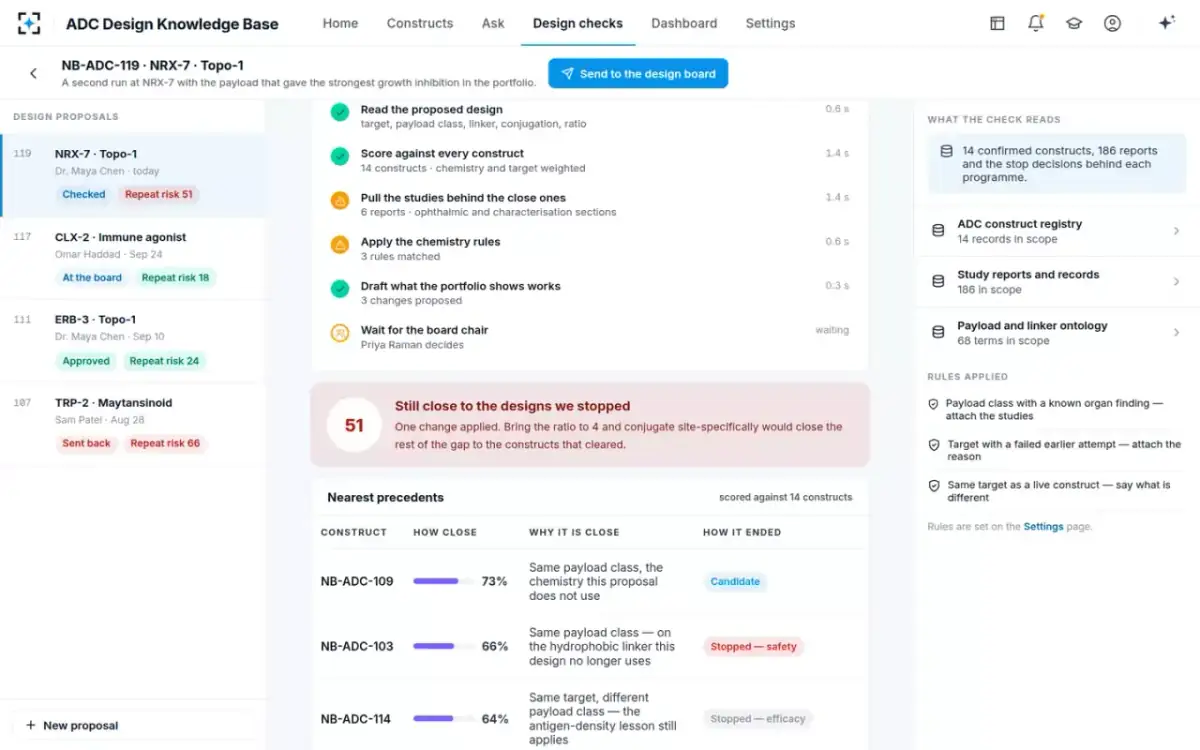
The fourth output is the one that makes the first useful. A score alone invites an argument about the score. In the sample portfolio the proposal at repeat risk 78 came with three changes: the PEG-extended cleavable linker, on which no construct in the portfolio had ocular findings and aggregate stayed between 1.1% and 2.3% even at a ratio of 7.8; a ratio of 4; and site-specific conjugation. Applying the first re-scored the design to 51 and re-ordered the precedents, with the verdict still reading that it sat close to the designs the group had stopped. Applying all three brought it to 21.
Apply a change, and the score moves with its evidence
What should an AI agent never be allowed to do in drug development?
Four things, in our reading, and each maps to a failure that is hard to detect after the fact rather than merely embarrassing.
Four limits worth writing into a contract
- Never fill a field it cannot cite
An extracted value with no sentence behind it is a guess wearing a number’s clothes. The honest output is an empty field and a question.
- Never reconcile a disagreement on its own
Averaging, preferring the newer document or preferring the longer one are all policy decisions. They belong to a named person, with both values visible.
- Never translate a term it has not been given
Inherited vocabulary is where silent errors enter a merged archive, because a plausible synonym reads like a correct one.
- Never advance a design
Scoring a proposal and approving it are different acts. The second creates an obligation a system cannot hold.
The common thread is that each limit keeps a human obligation attached to a human. That principle is now explicit in regulators' own language: the first of the ten guiding principles CDER and CBER published with the European Medicines Agency in January 2026 is "Human-centric by design", alongside a risk-based approach, clear context of use, data governance and documentation, and life cycle management (FDA, January 2026).
Does the FDA allow AI-assisted data extraction from study reports?
There is no prohibition, and the agency is explicit that AI is already arriving in submissions. "FDA recognizes the increased use of AI throughout the drug product life cycle and across a range of therapeutic areas," CDER's own page states, adding that it "has seen a significant increase in the number of drug application submissions using AI components over the past few years" and that "these submissions traverse the drug product life cycle, which includes nonclinical, clinical, postmarketing, and manufacturing phases" (FDA/CDER). A draft guidance published in January 2025, Considerations for the Use of Artificial Intelligence To Support Regulatory Decision-Making for Drug and Biological Products, sets out what the agency expects when AI produces information intended to support a regulatory decision.
The practical consequence for a design registry is about traceability rather than permission. An ADC group's internal registry is research infrastructure, not a submission; but the moment a number travels from it into a document a regulator reads, somebody has to be able to show the study it came from. That is why every field in the solution carries its document, page, section and sentence, and why anything quoted onward links back to the original study record rather than to the registry's summary of it.
It is also worth knowing that regulators do their own arithmetic. A 2025 review of all thirteen ADCs approved by March that year found that "FDA reviews often extended beyond sponsor-generated analyses, re-examining E–R relationships and DDI risks with alternative models and endpoints" (Translational and Clinical Pharmacology, 2025). A registry whose numbers cannot be traced back to their studies is a poor foundation for a conversation of that kind.
Where a risk framework's four functions map onto six agents
NIST's AI Risk Management Framework organises the work of managing an AI system into four functions — govern, map, measure and manage — and describes itself as voluntary: a way to build trustworthiness into how AI systems are designed, developed, used and evaluated (NIST AI RMF 1.0). It is not an ADC framework and makes no claim to be. What it offers a research group is a vocabulary for asking where each obligation sits.
Four functions, and what each asks of an agentic registry
- Govern
- The framework: cultivates a culture of risk management and "connects technical aspects of AI system design and development to organizational values and principles".
Here: who confirms what is a named setting — steward, toxicologist, CMC scientist, board chair — and every question, extraction, confirmation and decision is recorded with who and when. - Map
- The framework: establishes the context a system operates in, so risks can be identified before they are measured.
Here: each agent has one stated job and one stated limit, and the inherited vocabulary is mapped explicitly rather than assumed. - Measure
- The framework: analyses, benchmarks and monitors risk, through rigorous testing and performance assessment.
Here: match rate, unsourced rate, refusals below the confidence floor and steward corrections, run against reports the group has already closed. - Manage
- The framework: allocates resources to the risks that have been mapped and measured, and decides what to do about them.
Here: the rules themselves — the confidence floor, whether answers may draw on unconfirmed facts, which flags every check raises — are settings a group owns, not constants we ship.
The framework's appendix on human-AI interaction is blunter about the part that matters here: the people who make decisions and the people who oversee an AI system need roles that are clearly defined and kept distinct, and the aim is "to clarify and define the roles and responsibilities for the humans in the Human-AI team configurations and those who are overseeing the AI system performance" (NIST AI RMF 1.0, Appendix C). The five roles on an ADC development team is the other half of that sentence: six agents are only well defined against five seats that are.
Can an AI agent decide which ADC design to advance?
It can produce every input to the decision and none of the decision. The distinction is not squeamishness about automation; it is about what a decision is. Advancing a construct commits money, animals and eventually patients, and commits a named person to having judged that the evidence supported it. A score cannot hold that commitment, and a group that lets one try has moved the accountability without moving the capability.
What the check proposes, and what the chair decides
The prior-art check: Names it, with its similarity, its outcome and the reports behind it.
The design board chair: Judges whether that precedent is the same situation, or differs for a reason the registry cannot see.
The prior-art check: States the risk and attaches the study it comes from.
The design board chair: Decides whether the risk is acceptable for this programme at this stage.
The prior-art check: Proposes changes the portfolio shows work, and re-scores the design when one is applied.
The design board chair: Decides whether the changed construct is still the construct the programme wanted.
The prior-art check: Returns a score and a verdict line. Nothing advances.
The design board chair: Accepts the proposal for a board date, or sends it back with the reason. Either way it is on the record.
What this buys in practice is a shorter argument. In the sample portfolio the chair accepted a construct at repeat risk 21 with one open risk — the target's apparent need for roughly 100,000 antigen copies per cell, a patient-selection question the chemistry cannot answer. That is a better board conversation than the one that starts with three people remembering a 2021 study differently. What repeating a stopped design really costs puts a number on the difference, and how to measure whether the extraction can be trusted covers the step before it.
Questions people ask
What is a multi-agent system in drug discovery?
It is a system that splits one body of work across several specialised agents, each with a narrow job, rather than asking one general model to do everything. The practical benefit is not speed but auditability: when the agent that reads a document is separate from the agent that compares values, you can say which step produced a given number, and you can forbid one step without disabling the rest. The six agents here divide reading, extraction, vocabulary, conflict, scoring and answering.
Who checks an AI's extracted scientific facts?
A named knowledge steward, with the relevant specialist confirming facts in their own field — the toxicologist for safety findings, the CMC scientist for characterisation values. An extracted fact is shown with its document, page, section and sentence, and is confirmed or corrected against that page. Until it is confirmed it is marked as waiting and does not carry a conclusion.
Does the answer writer ever say it does not know?
Yes, and it is configured to. The solution has a confidence floor, set at 0.85 by the fictional sample group and adjustable between 0.75 and 0.90. Below it the answer says the evidence is thin and names what is missing rather than producing a fluent paragraph with nothing behind it. It also makes no claim without a source, and marks any unconfirmed fact rather than mixing it in silently.
Can the agents read an inherited archive in another company's templates?
That is the case the vocabulary mapper exists for. An acquired programme's reports are read in their own templates, its terms are mapped onto the house vocabulary with the original wording kept beside every mapped value, and a term with no mapping is proposed to a steward rather than invented. In the fictional sample portfolio, 34 of the 186 reports arrived that way.
Do the agents learn from the corrections a steward makes?
A correction is recorded as a correction — the original extracted value, the corrected value and who changed it all stay on the record — which is what makes the steward correction rate measurable over time. That record is the honest basis for improvement, and it is also what a validation team will ask to see. What should never happen is a silent adjustment that leaves no trace of what the report actually said.
Does published literature sit alongside a group's own reports?
It can, as a setting, and it is always labelled as external. The value is clearest for a payload class the group has not worked with, where there is no internal precedent and the published class behaviour has to carry the weight. The risk, which the labelling exists to prevent, is a published finding being read a year later as one of the group's own studies.