Evaluate ADC knowledge-management software on what it can show you about one fact, not on what it says about its model. Every product in this category promises to read your study, CMC and tox reports and turn them into a searchable history of every construct you have built; the ones worth buying can put a number on how accurately they do it, open the sentence behind any value, name what a person still has to decide, and point at a governance framework they map to. This guide is the question set to take into an evaluation, with the answers ADC Design Knowledge Base — Botminds' ADC design knowledge base — gives to each, and the places where it is the wrong tool.
Two notes before the questions. The screens below show sample data on a fictional company inside the solution, not a customer's results. And the standards cited are public: a buyer can hold any vendor, including us, to them.
Start with one fact, not the model
The shape of a good evaluation follows from what the system is for. An ADC knowledge base exists so that a design decision taken in three years' time can be traced back to the repeat-dose study, the conjugation and characterisation report and the stop decision it rests on. Everything that matters is therefore a property of the stored facts: does a value carry its sentence, does an unconfirmed value look different from a confirmed one, does a disagreement survive long enough for a person to settle it.
The model is an implementation detail that will be replaced twice before the registry is. A vendor who answers model questions fluently and questions about the stored facts vaguely has built the thing that is easy to build.
Regulators are converging on the same emphasis. The FDA's draft guidance on artificial intelligence in drug development "provides recommendations to industry on the use of AI to produce information or data intended to support regulatory decision-making regarding safety, effectiveness, or quality for drugs" (FDA, CDER) — the subject is the information produced, and the credibility of that information for a defined use, rather than the technique that produced it.
The evaluation question set, grouped by what goes wrong
- Accuracy — how is it measured, against what truth, on whose documents?
Ask for the denominator and the method, and insist the measurement be re-run on a sample of your own reports.
- Sourcing — can every value open the page it came from?
Not a document link. The page, the section and the sentence, for a value you choose at random in the demonstration.
- Refusal — what happens to a field with no sentence behind it?
The right answer is that it stays empty and is visible as empty. The wrong answer is a plausible value.
- Conflict — what happens when two reports disagree?
Both values kept, both sources attached, no averaging, and a named person decides.
- Vocabulary — what happens to an inherited term with no mapping?
It should be proposed to a steward, never invented, and the original wording kept beside whatever it maps to.
- Audit — can you export the full history of one field?
Who extracted it, who confirmed or corrected it, when, and what it was before.
- Scoring — can a prior-art score be re-run on your own history?
And can every risk in the result name the precedent and the study page it rests on?
- Governance — which published framework does the system map to?
A specific framework and a specific mapping, not a reassurance.
- Decision rights — what does the system never do without a person?
A vendor who cannot name the limits has not thought about them.
The questions to ask an AI vendor about data extraction accuracy
Accuracy claims in this category are usually unfalsifiable as stated. "Around 95%" has no meaning without three things: the truth set it was scored against, the denominator, and whose documents were used. Ask for all three, and ask for the measurement to be repeated on a sample of your own reports during the evaluation — a model that has seen a vendor's demonstration corpus many times is not being tested by it.
Then ask what the number excludes. The more useful figures in practice are not a single accuracy score but a small family: the share of extracted values a reviewer accepted unchanged, the share corrected, the share the system declined to extract at all, and the share it flagged as below its own confidence threshold. A product that declines often and is right when it does not is a better instrument than one with a higher raw score and no refusals.
In ADC Design Knowledge Base the answer to the first question is a design target rather than a customer result: 93% of extracted facts accepted as read by the reviewer, each tied to its page. The answer to the second is a setting — a confidence floor, shown on screen at 0.85 with 0.75 and 0.90 as the alternatives — below which an answer says the evidence is thin and names what is missing instead of proceeding. How that measurement is constructed is set out in measuring extraction accuracy.
What a vendor has to show about audit trails for extracted facts
An audit trail for a scientific record has to answer four questions about any single value: where it came from, who accepted it, when, and what it was before. Ask the vendor to demonstrate all four on a field you pick, in the product, during the evaluation.
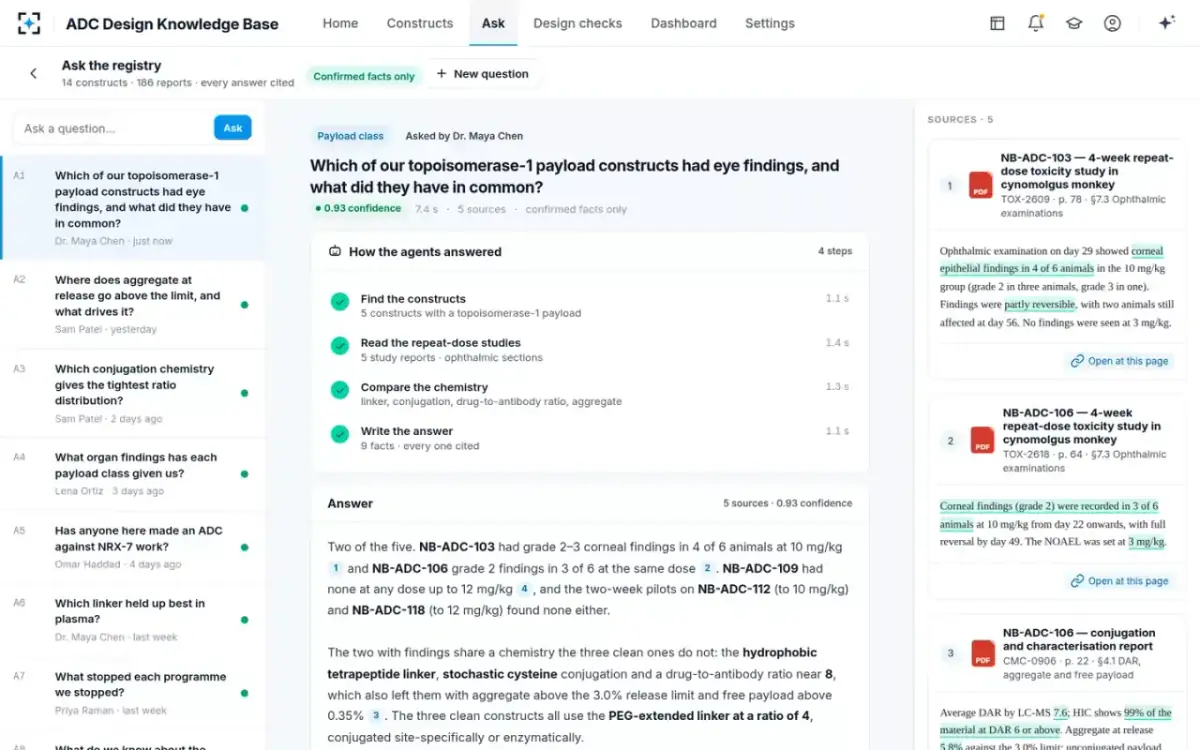
The first of the four is the one most often half-built. A link to a 180-page study report is not a source; a link that opens that report at page 78, section 7.3, with the sentence marked, is. The difference matters because the whole value of the registry is realised two years later, when somebody has to check a claim rather than trust it.
The second and third are about people. Extraction is a proposal; a named scientist accepting it is what makes it a fact. A system that cannot tell you who accepted a value is asking you to treat a model output as an established fact. The fourth — what the value was before — is what makes a correction visible rather than silent, and it is the one that keeps an inherited data set honest.
Who confirms what, and the thresholds that decide when an answer is allowed
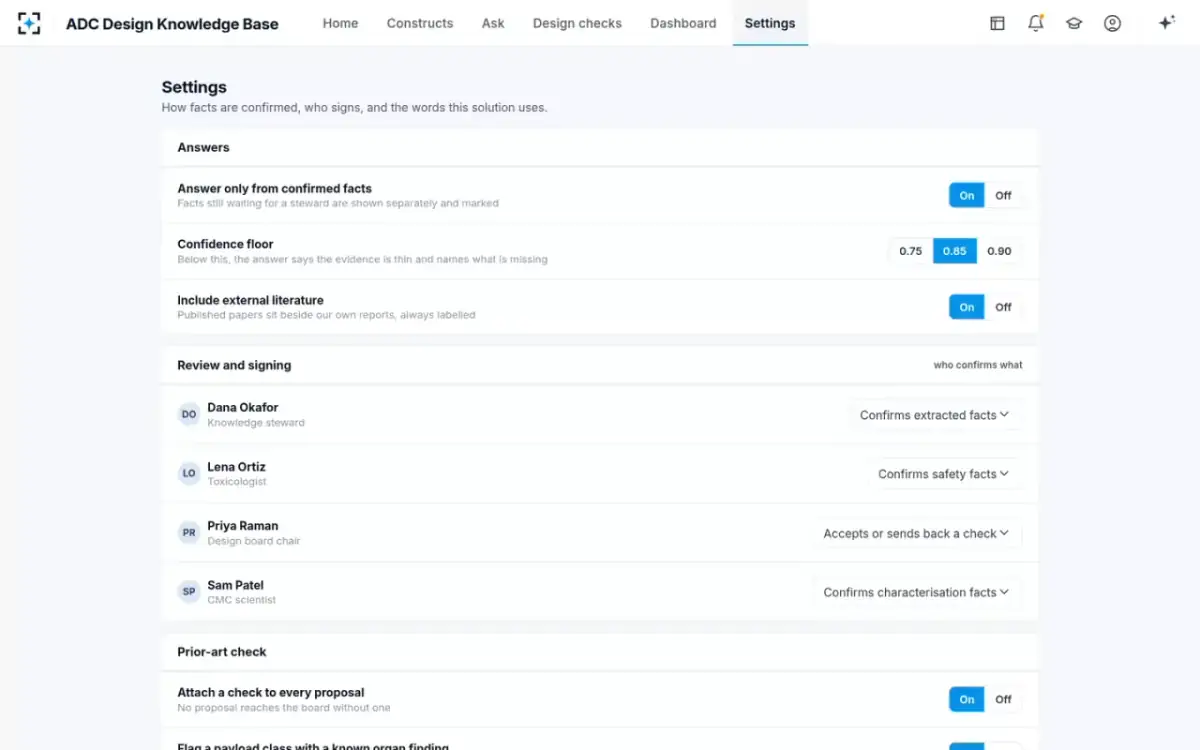
Can a vendor's AI invent a vocabulary mapping on its own?
It should not be able to, and this is a question with a right answer. An ADC group that has acquired a programme inherits another team's words — "conjugate load" for drug-to-antibody ratio, "monomer loss" for aggregate at release, "ocular surface finding" for a corneal observation. Mapping those onto the house vocabulary is necessary and useful. Inventing a mapping that nobody checked is how a registry quietly becomes wrong.
The behaviour to insist on has three parts: a term that is in the mapping table is mapped; a term that is not is proposed to a named person and waits; and the original wording is kept beside every mapped value, permanently. The last part is what lets somebody re-derive the mapping later when it turns out to have been subtly wrong.
There is a wider reason to care, which the data-sharing literature states more sharply than most vendors will. Reviewing biomedical data practice in Scientific Data, the authors note that "merely sharing data does not ensure that the data are FAIR" — findable, accessible, interoperable and reusable — and that in practice "metadata is often cursory and incomplete, and data is often provided in non-machine readable formats (e.g., .pdf, Microsoft Word, or free text) without associated documentation to support reuse" (Scientific Data, 2023). An archive is not a registry. The work of making the inherited material usable is the product.
How to tell whether a knowledge-management tool handles inherited or acquired data correctly
Bring the inherited material to the evaluation. This is the single most informative thing a buyer can do, because a product of this kind is likely to perform well on documents written in its own demonstration vocabulary, and the differences tend to show on documents that were not.
Four behaviours to watch while it reads them. Does it recognise that two documents are describing the same batch when they name it differently — and does it stop and ask rather than guess? Does the inherited term survive next to the mapped one? When the inherited report gives aggregate at release as 2.6% and the transfer summary gives 3.1% for the same material, does the disagreement appear as a disagreement? And is the inherited material visibly marked as inherited, so a later reader knows which conventions produced it?
That last point is the quiet one. Five years on, a value's origin is part of its meaning: a number measured under another company's method is not the same evidence as one measured under yours, even when the units match.
What happens to a field with no sentence behind it, and to two values that disagree
These are two questions with one principle behind them: the system should be willing to produce less. A field with no sentence behind it should be empty, and visibly empty, not filled with the most probable value. Two values that disagree should both remain, with both sources attached, until a person chooses — and no component should average them, because the average of two measurements of the same batch is a third number that was never measured.
Ask the vendor to demonstrate both. The demonstration is cheap: hand over a report with a field genuinely missing, and a pair of documents that disagree on one number.
The same question, answered well and answered evasively
A good answer: "Here is the measure, the truth set it was scored against and the denominator — and here it is re-run on twenty of your own reports."
An evasive one: "Accuracy is high. The model is state of the art and improves continuously."
A good answer: "Click it. That opens report CMC-0918 at page 22, section 4.1, with the sentence marked."
An evasive one: "It links to the source document." (One link, 180 pages, no page.)
A good answer: "It stays empty and is shown as empty. Nothing infers a value that has no sentence behind it."
An evasive one: "The model fills gaps using context from the rest of the document."
A good answer: "Both values stay, with both sources, and a named person keeps one. Nothing averages them."
An evasive one: "Conflicts are resolved automatically using confidence weighting."
A good answer: "It is proposed to the steward and waits. The original wording stays beside the mapped value."
An evasive one: "Vocabulary normalisation is automatic."
A good answer: "Here is the framework we map to, function by function, and here is what the system never does without a person."
An evasive one: "We follow industry best practice and are fully compliant."
Which governance framework should an AI vendor be able to point to?
A specific one, named, with a mapping rather than a slogan. Two are directly relevant here and both are public.
The first is the NIST AI Risk Management Framework, which describes itself as voluntary, a way to build trustworthiness into how AI systems are designed, developed, used and evaluated (NIST AI RMF). Voluntary is the operative word: a vendor cannot be certified against it, so what you are testing is whether they can walk you through their system function by function. The framework also makes the standard explicitly plural — "For AI systems to be trustworthy, they often need to be responsive to a multiplicity of criteria that are of value to interested parties" — which is why a single accuracy number is never a sufficient answer.
The second is the FDA's own direction of travel for drug development. CDER published a draft guidance in January 2025, Considerations for the Use of Artificial Intelligence To Support Regulatory Decision-Making for Drug and Biological Products, and says it intends to keep building a risk-based regulatory framework that encourages innovation while protecting patient safety (FDA, CDER). Risk-based is the word to hold on to: the scrutiny a system deserves depends on what its output is used for, and a registry that informs a design board is in a different class from one that supports a submission.
It is worth asking a vendor how they expect their output to be used in a regulatory context, and listening for whether they distinguish the two. A review of the FDA's clinical pharmacology assessments across thirteen approved conjugates found, among its recurring themes, "the FDA's reliance on independent analyses beyond sponsor submissions" (Translational and Clinical Pharmacology, 2025) — the agency re-derives. A knowledge base whose numbers cannot be traced to their source documents is of no help when that happens.
How to test a vendor's prior-art scoring before you rely on it
A similarity score over your own constructs is the most seductive feature in this category and the easiest to fake. Three tests separate a reasoned score from a plausible one, and all three can be run in an afternoon.
The first is the retrospective test. Take a construct your team stopped, two or three programmes ago, and present its design as if it were new. A system with a usable prior-art capability should surface the earlier construct, name the reason it stopped, and attach the study. If it returns a number without the precedent, the number is decoration.
The second is the explanation test. For each risk in the result, ask which construct it came from and which page of which report supports it. A risk that cannot name its precedent is a prediction, not a finding.
The third is the counterfactual test. Change one attribute of the proposal — the linker, the ratio, the conjugation chemistry — and watch what moves. The score should change by an amount the system can explain in terms of specific constructs, and the nearest precedents should re-order. If a change to the linker moves the score by the same amount as a change to the ratio, nothing underneath is weighted by evidence.
An answer with its working: which agents ran, and every claim tied to a page
What a red flag sounds like in a vendor's answer about a fact's source
Evasion in this category has a small vocabulary, and it is worth recognising by ear. Each of the six below is our own illustration of an answer that sidesteps the question; each is a signal to ask the question again, more narrowly.
Six answers that should slow an evaluation down
"The model is state of the art."
The question was about the facts, and the answer was about the engine. Ask again: what does a user see behind a value?
"Accuracy is around 95%."
Against what, measured how, on whose documents? A number with no truth set and no denominator is not a measurement.
"It normalises the vocabulary automatically."
Find out what happens to a term that is not in the mapping table. Silent invention is the failure mode; a proposal to a named person is the fix.
"Conflicts are resolved intelligently."
Ask whether two disagreeing values are ever averaged, and who decides which survives. Resolution is a human act.
"Everything is logged."
Logged where, kept how long, and can you export the trail for one field? A log you cannot read in a review is not an audit trail.
"We can show you that in a later phase."
Extraction accuracy, source links and conflict handling are the product. If they are not demonstrable now, they are not finished.
A demo test you can run in the room
Bring four documents and ninety minutes. The test below needs no preparation from the vendor, which is the point: it asks the product to behave on material it has not seen.
Four documents, six steps, and what each step is really testing
| Step | What to do | What a good result looks like |
|---|---|---|
| 1 · A report in your own templates | Hand over one conjugation and characterisation report and let it read. | Ratio, distribution, aggregate and free payload extracted as separate fields, each with its page and section — and the ones it is unsure about marked rather than guessed. |
| 2 · A report with a genuinely missing field | Use a study where one expected value simply is not reported. | The field stays empty and is shown as empty. No plausible number appears. |
| 3 · Two documents that disagree | Supply a pair giving different values for the same batch. | A disagreement raised with both sources attached, both values kept, and a named person asked to decide. Nothing averaged. |
| 4 · An inherited report in another team's words | Use something from an acquired programme, in its own vocabulary. | Known terms mapped, the original wording kept beside each mapped value, and unknown terms proposed rather than invented. |
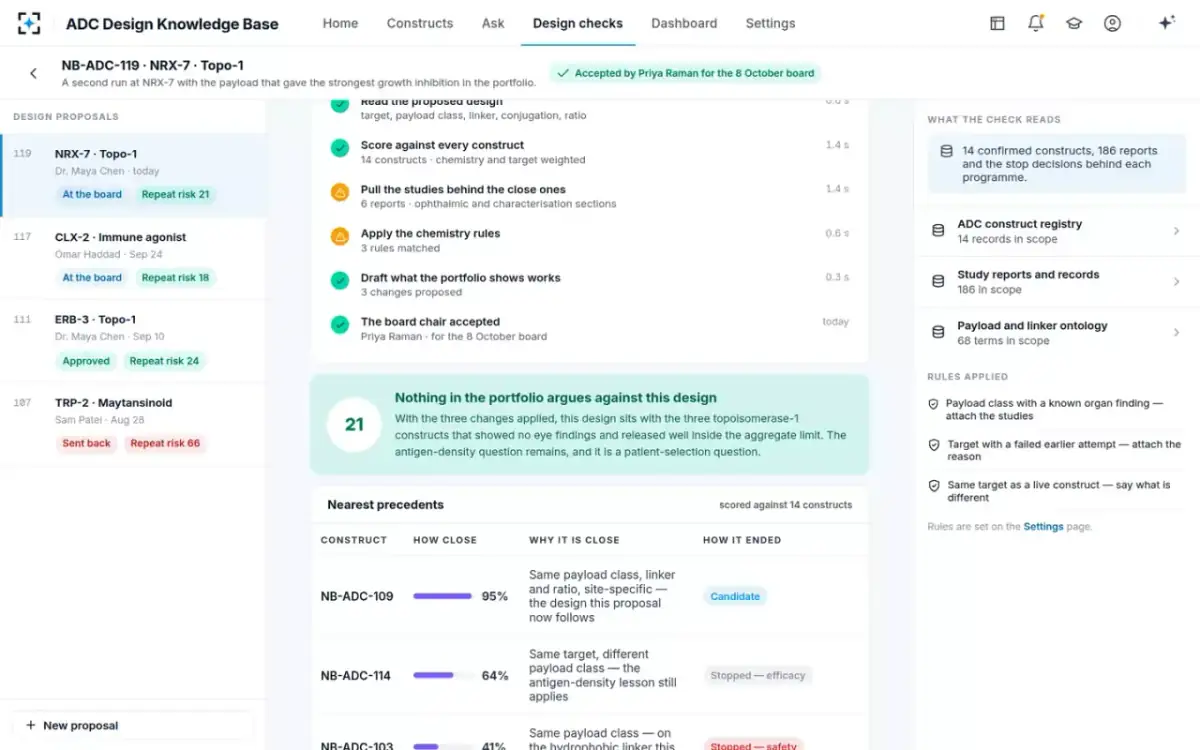
| 5 · A stopped design, re-proposed | Present the design of a construct you stopped as though it were new. | The earlier construct surfaces as a near precedent, with the reason it stopped and the study behind it. |
| 6 · One attribute changed | Alter the linker, then the ratio, and re-run the check. | The score moves by different amounts, the precedents re-order, and the system can say which constructs drove each change. |
What a scored proposal looks like when it reaches the people who decide
Where this kind of system does not help
Three limits are worth stating, because a vendor who does not state them is selling something else. First, a registry built on your own documents cannot warn you about a failure mode nobody in your company has ever seen; it catches repeats, and the published literature has to cover the rest. Second, it does not improve the underlying reports — a study that never measured unconjugated payload stays a study that never measured it, and a registry simply makes the gap visible sooner. Third, it does not make the decision. A prior-art check proposes; a design board chair accepts it or sends it back.
There is also a precondition. If the documents are not there — if the stop decisions were taken in meetings and never written down — then no amount of reading will recover the reasoning. The honest version of the pitch is that this kind of system makes an existing written record usable, and a pilot on your own reports is the only reliable way to find out how much of a record you have.
Against those limits, the question a buyer is really settling is narrow and answerable: when this system tells my design board something, can my design board check it? Everything in this guide is a way of asking that. ADC Design Knowledge Base is built to answer yes, and the fastest way to test the claim is to bring four of your own documents.
Questions people ask
What should an ADC knowledge-management evaluation actually score?
Score behaviours rather than features: extraction accuracy measured on your own documents with the truth set and denominator stated, the ability to open the page behind any value, what happens to a missing field, what happens to two disagreeing values, what happens to an unmapped inherited term, the exportable history of one field, and whether a prior-art score names the precedent behind every risk. A feature list that does not survive those tests is a demonstration, not a product.
Is there a standard an AI vendor in drug development can be certified against?
Not in the sense of a certificate. The NIST AI Risk Management Framework is explicitly voluntary and organised around incorporating trustworthiness into the design, development, use and evaluation of AI systems, and the FDA's 2025 draft guidance sets out recommendations for AI used to produce information supporting regulatory decisions. What a buyer can reasonably demand is a specific mapping to a named framework and a demonstration of each claim.
How much should a buyer worry about the underlying model?
Less than vendors would like. Models are replaced on a cycle far shorter than the life of a scientific record, and the properties that survive a model change are the ones in the stored facts: sourcing, refusal behaviour, conflict handling, vocabulary control and the audit trail. A system whose correctness depends on which model is behind it will have to be re-evaluated every time that changes.
Can a vendor's accuracy figure be trusted at all?
Only as a starting point for a question. Ask what was scored, against what truth set, on whose documents, and what the figure excludes — in particular the share of values the system declined to extract and the share it flagged as below its own confidence threshold. Then have it re-run on a sample of your own reports during the evaluation. A figure that cannot survive that is marketing.
What does good handling of inherited data look like in practice?
Known terms mapped onto your vocabulary with the original wording kept beside every mapped value; unknown terms proposed to a named person rather than invented; documents from an acquired programme visibly marked as inherited; and disagreements between an inherited report and a transfer summary raised rather than reconciled. Bring real inherited material to the evaluation — it is the fastest way to tell these products apart.
Who should be in the room for the evaluation?
Someone who will have to confirm extracted facts, someone who owns the characterisation numbers, someone who reads the repeat-dose studies, and whoever chairs the design board. Each of them will ask a question the others will not, and the four together are the people whose work the system either fits or does not.