Ask what the cost of antibody-drug conjugate development failure is and you will be handed a very large number that answers a different question. The published figures price a whole portfolio's worth of attrition across an industry; they cannot tell a research head what one avoidable repeat costs their own programme. That number is smaller, much more specific, and far more decidable: it is what a group has already spent on a construct before the finding that stops it, multiplied by the number of times the same chemistry comes back to the design board because nobody could see the first attempt. ADC Design Knowledge Base exists to make that second number zero, and this guide works out how to price it honestly — including the parts that have no public benchmark at all.
The portfolio figures below come from a fictional sample group, Northwind Bio, with 14 constructs and 186 reports. The research figures come from peer-reviewed journals and government statistics, linked where they appear. Every piece of arithmetic we do ourselves is labelled as ours.
The published cost of developing a drug, and what it already includes
$1,395M
estimated average out-of-pocket cost per approved new compound, 2013 dollars
$2,558M
capitalised to approval at a 10.5% real discount rate
$2,870M
adding an estimate of post-approval research and development
8.5%
annual growth in total capitalised cost above general price inflation, against the previous study
Why "cost to develop a drug" is the wrong number to start from
The headline estimate is sound and widely cited, and it is still the wrong place to begin, for a reason stated in its own abstract: "the costs of compounds abandoned during testing were linked to the costs of compounds that obtained marketing approval" (DiMasi et al., 2016). Failure is not an extra you add on top of $2.6 billion. It is already inside it. A business case that takes the published figure and then adds a cost of failure has counted the same money twice.
The second problem is that the figure describes an average across a whole industry's portfolio, including compounds abandoned at every stage from discovery to late clinical work. No research head decides anything with it. The decidable question is narrower: given the constructs this group has already built and stopped, what does it cost when the next proposal is one of them again?
How much does it cost to develop an antibody-drug conjugate?
There is no published, ADC-specific equivalent of the figure above, and we are not going to invent one. What can be said with confidence is which cost drivers are specific to this modality, and a group can price each of them from its own finance records far better than any benchmark can.
An ADC carries the cost of three development programmes that interact: an antibody, a highly potent small molecule, and the conjugation chemistry that joins them. Each construct needs its own conjugation campaign and its own analytical characterisation, and the characterisation is unusually demanding, because conjugation turns one molecule into a mixture whose drug-load distribution, unconjugated fraction and aggregate all have to be measured. Add the handling requirements that come with a cytotoxic payload, and a repeat-dose toxicology study whose endpoints are set by the payload class. The honest form of the question is not "what does an ADC cost" but "what does one more construct cost us", and that is a number your own programme already knows.
What a stopped programme has already spent before it stops
The cost of a stop is the cost of everything that came before it, and in ADC work the stop often arrives late in the preclinical sequence — after the antibody, after the conjugation campaign, after characterisation, and in the four-week repeat-dose study where the payload's signature finding appears.
Where the same finding costs three different amounts
Caught at the design board
Hours of reading, and a different proposal
The prior-art check names two stopped constructs with this exact chemistry, and three changes the portfolio shows work. Nothing is made.
Caught at characterisation
An antibody batch, a conjugation campaign and an analytical package
The construct releases at 5.8% aggregate against a 3.0% limit, as a hydrophobic linker at a ratio near 8 did twice before. The chemistry is already made.
Caught in the repeat-dose study
All of the above, plus the study and the animals, plus eighteen months
Corneal findings appear in four of six animals at 10 mg/kg — the same finding, for the same physical reason, as a construct stopped years earlier.
Two things are worth saying plainly about that third row. The first is that the money is the smaller loss; the eighteen months are the larger one, and they are not recoverable. The second is that the finding was knowable. It was in a report the group already owned.
Why do ADC programmes repeat the same chemistry mistake?
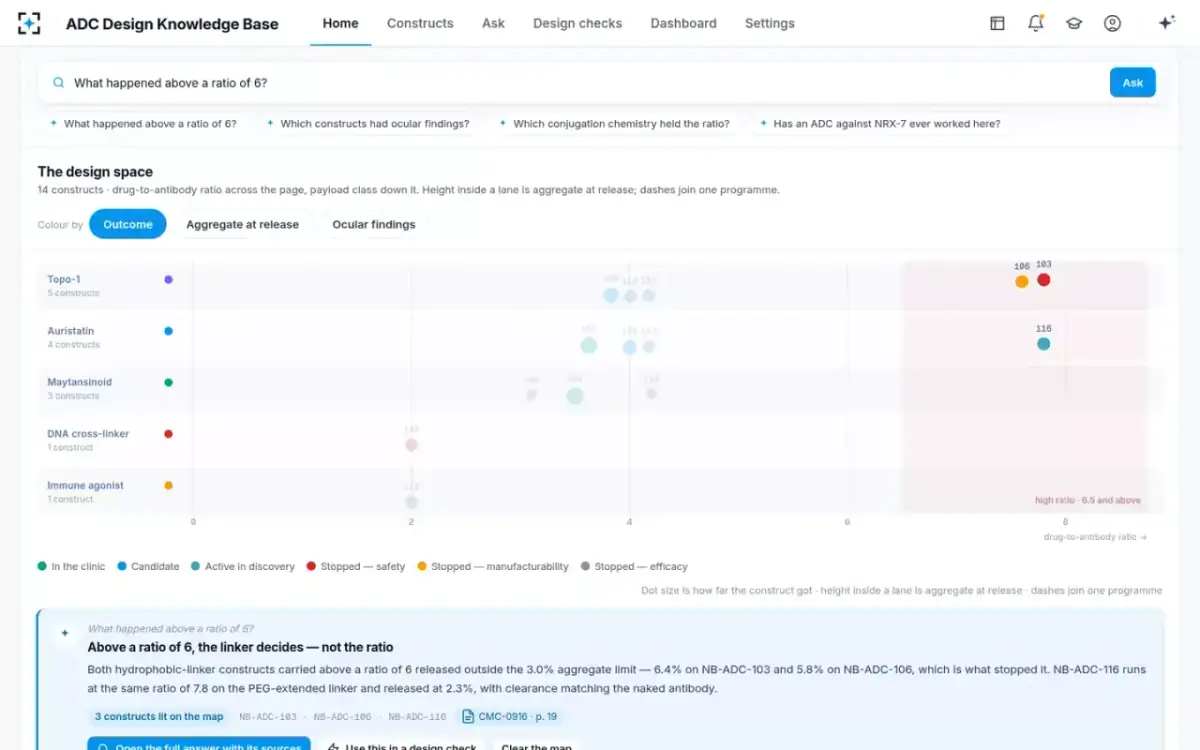
Because the evidence that would prevent it is filed by study rather than by design, and because the published literature says the risk travels with a combination most people describe informally. A detailed review of preclinical and clinical data from twenty investigational new drug applications for ADCs filed between 2012 and 2013 found "that ADCs with the same class of linker/payload typically shared highly similar toxicity profiles, DLTs, and maximum tolerated doses (MTDs), regardless of the antigen targeted and regardless of the extent of the antigen's expression in healthy tissues" (Nguyen et al., 2023, reviewing Saber and Leighton). The same review notes that eight different ADCs in clinical development carrying the same valine-citrulline MMAE linker-payload were all advanced to phase II at closely similar doses.
Read that sentence as a research head rather than as a scientist and it is a statement about predictability. If the dose-limiting toxicity of a linker-payload class is largely independent of the target, then a group that has built with that class already knows what the next construct will do — provided it can find out what it knows. The failure is retrieval, not science.
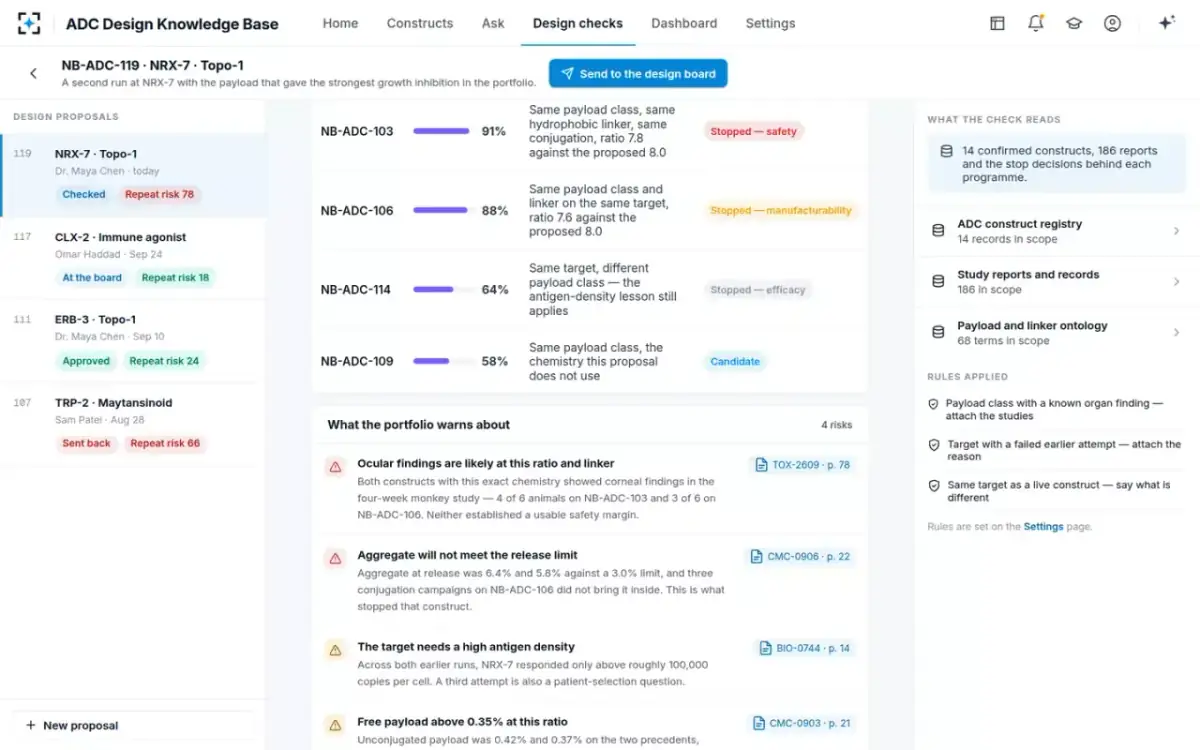
The sample portfolio shows the shape. Two constructs on the same hydrophobic tetrapeptide linker at a ratio near 8 both released outside the aggregate limit, at 6.4% and 5.8%, and both showed corneal findings; a third at a ratio of 7.8 on a PEG-extended linker released at 2.3% with no eye findings. When a new proposal arrived with the first chemistry, the question "has this been tried here?" had a two-sentence answer — and the group that cannot produce that answer in an afternoon will make the molecule instead. Why antibody–drug conjugates fail in clinical trials sets out the published record behind this.
The repeat named, and scored, in ADC Design Knowledge Base
How many hours does a manual literature review take before a new ADC design?
Estimated for the sample portfolio, about 23 hours — and the estimate is worth breaking apart, because only some of those hours are the kind a tool can remove.
Twenty-three hours before one design board, by hand and with the agents
Six hours of finding and eight of re-reading are mechanical retrieval over documents somebody has already read. Four hours of reconciling inherited naming is the acquired archive. Three hours of writing up is partly judgement. Two hours of board discussion is entirely judgement, and does not move at all. About 19 of the 23 hours are addressable, which at the published median wage for biochemists and biophysicists — $107,460 a year, about $52 an hour before any employer loading (BLS OEWS, May 2023) — is roughly $980 of direct labour per design review.
That figure is deliberately unimpressive. A group running twelve design reviews a year recovers something like $12,000 of time, which does not pay for anything. The hours are not the case, and a business case built on them will not survive contact with a finance team. They matter for a different reason: a 23-hour review is one a scientist skips when the board is on Thursday, and the review that is skipped is the one that would have caught the repeat.
Pricing a repeated finding against a caught one
The real return has one term that dominates. Write it as the cost of the work that would have been done on a construct destined to stop for a reason already in your archive, multiplied by how often that happens, minus the cost of the checking itself.
A return you can fill in with your own numbers
Avoided repeats
P(repeat) × constructs per year × cost to the point it stops
The only term large enough to matter. Price the third component from your own finance records: antibody, conjugation campaign, characterisation and, where it reaches one, the repeat-dose study.
Head of research with finance
Time recovered
≈19 h × reviews per year × fully loaded hourly cost
Real, and small. At the published median wage it is of the order of $1,000 per review before employer loading.
CMC and discovery leads
Months not lost
Months a stopped construct consumes × what a month of programme time is worth to you
Usually larger than the money and almost never priced. Most groups can state what a month of delay costs on a lead programme.
Programme leadership
The checking itself
Licence + the archive work + ≈4 h per review
Includes the one-time effort of bringing reports in and agreeing the vocabulary for an inherited archive — the part most business cases forget.
R&D informatics
The arithmetic that follows is a group's own. What this guide can do is point at which term is doing the work: for any plausible cost of a stopped construct, the avoided-repeat term is an order of magnitude or more above the time term. If the probability of a repeat in your group is genuinely zero, the return is the $12,000 of time and you should not buy anything.
What is the ROI of a prior-art check before a design board?
It depends almost entirely on one input you can estimate honestly: how often a proposal that reaches your board is substantially a construct you have built before. In our view, groups that have inherited an archive, changed leadership, or run more than about ten constructs are the ones most likely to find it is not zero.
A cheap test is available without buying anything. Take the last ten proposals your board accepted and ask, for each one, whether a construct with the same payload class, linker family and ratio band already exists in your archive — and if it does, whether the person who proposed it said so. In the sample portfolio that question had a sharp answer: a new design against the target NRX-7 matched a stopped construct at 91% and another at 88%, and the proposal as written mentioned neither.
The cited lesson behind the risk
What toxicity failures cost at the late end, by the published rates
Repeats that are not caught early do not merely cost a construct. A systematic review and meta-analysis of 169 ADC clinical trials covering 22,492 patients found that "ADC regimens also resulted in a higher incidence of serious toxic events leading to treatment cessation, with treatment-related discontinuation occurring in 13.2% of all treated patients (2132 of 16,126)", and that "treatment-related deaths occurred in 1.3% of all treated patients (204 of 15,340)", with respiratory disease — pneumonitis, at 12.4% incidence — "the most common cause of treatment-related death in patients treated with ADCs" (Zhu et al., Cancer, 2023).
Those are patient outcomes rather than line items, and they are the reason the preclinical reading matters commercially as well as ethically. Safety signals that survive into clinical development become dose-level restrictions, extra studies and post-marketing obligations: a 2025 review of approved ADCs records that clinical pharmacology has "not only guid[ed] initial approval but also prompt[ed] a significant proportion of postmarketing requirements and commitments", and gives the case of one ADC that "showed strong exposure–toxicity associations (VOD) but limited dose-level exploration, prompting an FDA PMR despite reasonable efficacy" (Translational and Clinical Pharmacology, 2025).
Which input moves the number most?
Run the sensitivity before the business case, because three of the four inputs barely matter.
What each input does to the return
| Input | Plausible range | Effect on the return |
|---|---|---|
| How often a proposal repeats a stopped design | Zero to a few per year | Dominant. Below roughly one repeat every two years, nothing else rescues the case; above one a year, nothing else matters |
| What a stopped construct has cost by the time it stops | Your own finance records | Dominant, and the term most worth getting right. The range between stopping at characterisation and stopping in a four-week study is large |
| Hours per prior-art review | Our estimate: about 23 by hand | Small. Worth perhaps $1,000 a review, which is a rounding error against either term above |
| How many design reviews a year | Four to twenty, say | Small on its own, and only multiplies the time term |
| Months of programme time lost per repeat | Twelve to twenty-four | Large if you price it, and most groups can. Often decides the case on its own |
The three numbers we will not make up
Three numbers that a business case would like to quote do not exist in any independent, published source we found, and we would rather say so than manufacture them.
There is no published cost for an IND-enabling toxicology package for an ADC specifically. There is no published rate at which design proposals repeat an organisation's own stopped designs — by its nature it is internal, unflattering and unmeasured. And the published cost-of-development figures, including the one at the top of this guide, are per approved compound across a portfolio and cannot be allocated to a single construct. Where you see those numbers supplied with confidence, ask whose data they come from.
What is publicly supportable is the chain of reasoning: that toxicity profiles travel with the linker-payload class rather than the target, that treatment-related discontinuation and death rates for ADCs in trials are substantial, and that the published cost of development is already net of attrition. From there, a group's own numbers finish the case. The method for testing it on your own archive before committing is in piloting an ADC knowledge base on your own reports, and the questions to put to any vendor are in how to evaluate ADC knowledge-management software.
What the decision looks like when the check is attached
Questions people ask
What percentage of ADC development cost is lost to toxicity failures?
No published figure answers this, and the ones usually offered conflate two different things: the share of candidates that fail for safety reasons, and the share of spending those failures represent. What is well supported is that toxicity often caps the dose below what efficacy needs, and that the dose-limiting finding usually belongs to the payload and the linker chemistry rather than to the target. A group can compute its own share from its decision records, which is the number that would actually inform a budget.
How much does a failed repeat-dose toxicology study cost?
We found no published, independent benchmark for an ADC-specific package, so treat anyone quoting one with care. What can be said is what drives it: the species and duration, the number of dose levels, the endpoints the payload class forces into the protocol — ophthalmic examinations for payload classes with a known ocular signature, for instance — and the material that has to be made to supply it. Your own contract research invoices are a better source than any published average.
What does catching a repeat risk early actually save?
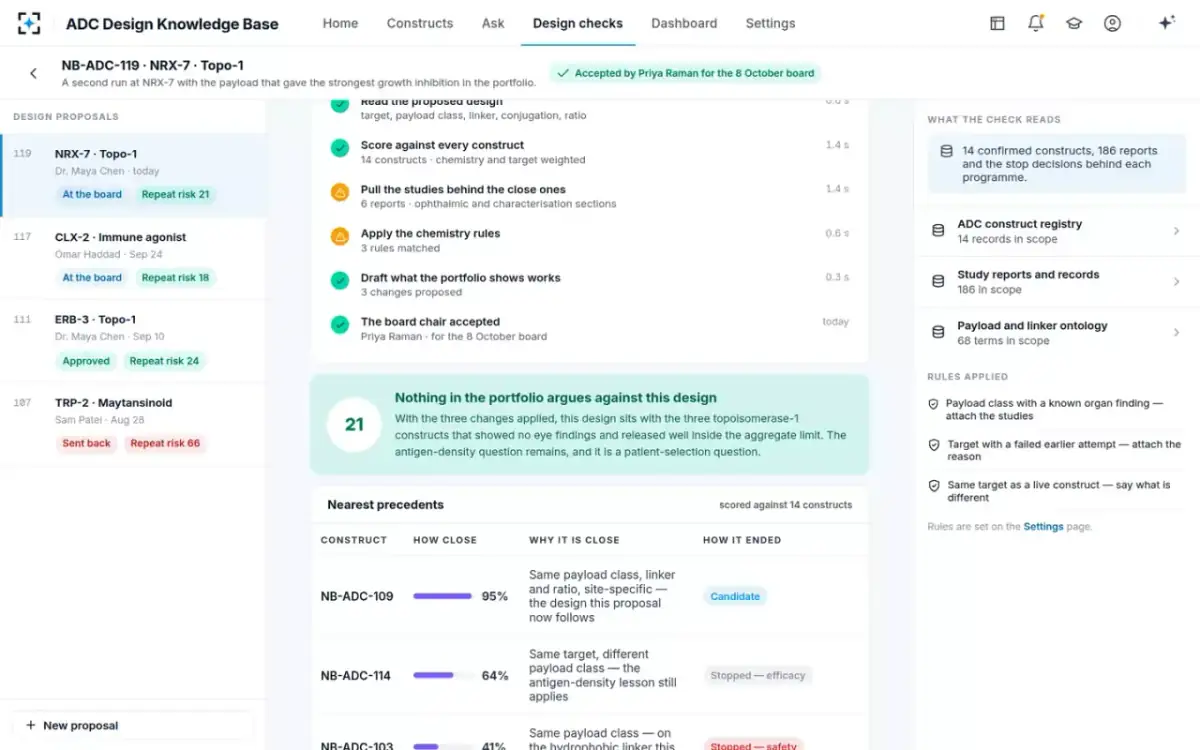
Everything downstream of the design board for that construct: the antibody batch, the conjugation campaign, the analytical package and, if it would have reached one, the repeat-dose study — plus the programme months. What it does not save is the design work itself, because the group still has to propose something. In the sample portfolio the check did not end the proposal; it changed it, with three changes that took the repeat-risk score from 78 to 21.
Is the $2.6 billion figure the right one to budget against?
Not for this decision. It is a capitalised, per-approved-compound estimate across a portfolio of 106 drugs surveyed from ten firms, and it already includes the cost of compounds abandoned during testing. It is useful for arguing about the economics of the industry and nearly useless for sizing one group's avoidable rework. Use it for context, and your own records for the case.
Does any of this apply to a group with only a handful of constructs?
Less so, honestly. With four or five constructs, one scientist can hold the portfolio in their head and the retrieval problem is small. The arithmetic turns somewhere around the point where a group inherits an archive, changes a design lead, or passes roughly ten constructs — which is also where the first "didn't we try this?" usually goes unanswered. The fictional sample portfolio at 14 constructs, 34 of its 186 reports inherited, is drawn at that point deliberately.
What would make the return negative?
Three things. A genuinely zero repeat rate. An archive so thin that there is nothing to check against — a registry of five constructs tells you little. Or a deployment where nobody confirms the extracted facts, in which case the check runs on numbers nobody stands behind and the board learns to ignore it. The third is the common failure, and it is a staffing decision rather than a software one.