The SBA underwriting guidelines for 7(a) loans are not a separate manual. They are SOP 50 10 8.1, read with the regulations: 13 CFR 120.150 requires "appropriate and prudent generally acceptable commercial credit analysis processes and procedures consistent with those used for their similarly-sized, non-SBA guaranteed commercial loans", and the SOP sets the floors on top, from 1.15x debt service coverage on a standard loan to 1.25x on an acquisition. What the SOP does not contain is guidance on applying those rules to a complex file, and in August 2026 SBA's Inspector General found that SBA's own purchase reviewers had none either. Half of the overturned denial decisions it sampled were unsupported. Botminds' SBA SOP Guideline Search gives a lender what the reviewers lacked: each answer tied to the clause and the version that govern the loan, confirmed by an underwriter and kept.
What SBA decided on 545 loans its servicing centers had recommended for repair or denial
Final decisions, Oct 2021 to Mar 2025
- Denial upheld · 45%
- Repair upheld · 19%
- Overturned: guaranty honored · 36%
What are the SBA underwriting guidelines?
They are the credit rules in SOP 50 10 8.1 and Part 120 of SBA's regulations, applied by the lender for delegated loans and by SBA for non-delegated ones. The regulation sets the standard: the applicant "must be creditworthy", and loans "must be so sound as to reasonably assure repayment" (13 CFR 120.150). Submitting an application certifies that the lender "has examined the availability of credit to the applicant" and has "substantiation in its file to support the certification" (13 CFR 120.101).
The SOP then supplies the detail. Section A carries the core requirements for every 7(a) and 504 loan: eligibility, size, citizenship, credit elsewhere, guaranties, tax transcript verification. Section B carries the underwriting for each delivery method: Standard 7(a) loans above $350,000 in Chapter 1, 7(a) Small and SBA Express in Chapter 2. Appendix 15 now holds changes of ownership, and Appendix 19 collateral (SOP 50 10 8.1). The starting principle is stated plainly: "The cash flow of the Applicant is the primary source of repayment, not any expected recovery from the liquidation of collateral."
What are the SBA 7(a) underwriting guidelines for debt service coverage?
For a Standard 7(a) loan, coverage "must be equal to or greater than 1.15 on a historical and/or projected cash flow basis and 1:1 on a global basis" (SOP 50 10 8.1, Section B, Ch. 1). For a change of ownership the floor depends on the type of deal: 1.25:1 for an initial acquisition, owner buyout or ESOP, 1.15:1 for a business expansion, on historical or adjusted results, and projections may not be relied on to meet it. For 7(a) Small loans, since the SBSS credit score was retired on March 1, 2026, the lender needs coverage of "at least 1.10:1 on a historical or projected basis" and two months of bank activity to confirm the debts in it (SBA Information Notice 5000-877673).
The figures are the easy part. The hard part, and where reviewers disagree, is what goes into them: which add-backs are supported, whether a seller note is debt service, whether a merchant cash advance hides in the bank statements, and whether the QoE's normalized earnings or the tax return's should be used. SOP 50 10 8.1 answers some of these directly; "adjustments to cash flow without the Lender's supporting analysis and justification will be ineligible". For the rest, the lender's own reasoning has to be on the file.
Credit elsewhere: the guideline written into every application
Every 7(a) application certifies that the borrower cannot get the credit on reasonable terms without SBA, and the SOP says what may and may not support that certification. The lender must show "an identifiable weakness in the credit" and put "the specific reasons why the Applicant does not meet conventional loan policy requirements" in the credit memorandum (SOP 50 10 8.1, Section A, Ch. 1). Acceptable reasons include a maturity longer than the lender's policy allows, a request above its limit to one customer, collateral short of its policy, or a business too new for its conventional lending.
Some reasons may never stand alone: the borrower's failure to meet the lender's credit score policy, the lender's reliance on selling the guaranteed portion, or SBA participation letting it exceed its legal lending limit. Two may not be used at all: the effect on its Community Reinvestment Act rating, and a better lien position. The SOP is explicit about the cost of getting it wrong: failing to address the need for the credit "may result in SBA declining the application submitted under non-delegated processing or denying liability on the guaranty if the application is approved by a 7(a) Lender under its delegated authority". Credit elsewhere is the clearest case of a guideline that is simple to state and easy to document badly.
What did SBA OIG report 26-12 find?
That SBA's final decisions on guaranty purchases "previously recommended for repair or denial were not always appropriate". Of 545 such decisions between October 2021 and March 2025, SBA upheld 247 denials and 101 repairs and overturned 197, honoring about $168 million of guaranties. The OIG reviewed 32 overturned decisions from high-risk categories and found "SBA did not have sufficient evidence to support its loan review decisions" on 16, about $11.5 million in potential improper payments (SBA OIG Report 26-12).
Where SBA's overturned decisions lacked support: potential loss by category
Time compounded the problem. Decisions averaged 808 days across all 545 loans, and 1,156 days for the 306 that entered review before October 2021, against 362 for those after. For 13 loans, about $5.4 million, SBA did not seek repair or denial at all because the six-year statute of limitations had run. A lender's purchase package is read, on average, more than two years after it is filed, by someone who has only the file.
Does SBA have an underwriting desk guide?
Not for its purchase reviewers, according to its Inspector General. SBA used the SOPs to decide repair and denial cases, "however, the agency did not have supplemental guidance, such as desk guides or manuals, to apply the criteria in complex, high-risk loan scenarios" (OIG 26-12). As a result, reviewers "did not consistently have the necessary supporting documentation to analyze or resolve the material issues", and in some cases leadership "overturned PMQC's decisions without resolving the material issue or documenting their rationale". The OIG's second recommendation is to "update guidance and procedures for the repair and denial process" so that final decisions are "documented with properly supported rationale".
The finding is about SBA, but the gap it describes is general. An SOP states rules; a desk guide states how the institution applied them to hard cases, and why. Without one, two careful reviewers reading the same file reach different answers, and neither leaves a trail the other can test.
The SOP tells you the rule. A desk guide tells you how your institution applied it to the last hard file, under which version, and who agreed. The OIG found SBA's reviewers had the first and not the second.
The same gap at lenders, in SBA's own reviews
Lender reviews show the same pattern from the other side. In fiscal 2016, "over 40 percent (17 of 40)" of SBA's on-site lender reviews found lenders not complying with the credit elsewhere requirement, the certification every application carries (GAO-18-421). In the OIG's high-risk loan program, SBA paid the guaranty on eight early-defaulted loans worth $10.8 million; the OIG found deficiencies "that justified denial of the guaranty for five of the eight, totaling approximately $8.7 million", across eligibility, repayment ability, equity injection, business valuations and more. "SBA staff completed purchase and quality control reviews on these eight loans but did not identify or fully address the material deficiencies" (SBA OIG Report 19-22).
Three reviews, one finding: the rule was there, the applied reasoning was not
17 of 40
SBA on-site lender reviews in FY2016 found credit-elsewhere noncompliance
GAO-18-421
5 of 8
early defaults SBA paid that the OIG said should have been denied, $8.7M
OIG 19-22
16 of 32
overturned repair or denial decisions without sufficient evidence, $11.5M
OIG 26-12
808days
average to a final repair or denial decision
OIG 26-12
How do I document an SBA policy interpretation?
As a dated entry tied to a loan: the question, the version that governed, the clauses relied on, the bank's own policy where it applies, the answer, and who confirmed it. That is a desk guide built one question at a time, and it is what a purchase reviewer can test. An email that says "seller note is fine" is not.
One desk-guide entry: what a documented SBA interpretation holds
| Field | Example from a sample file |
|---|---|
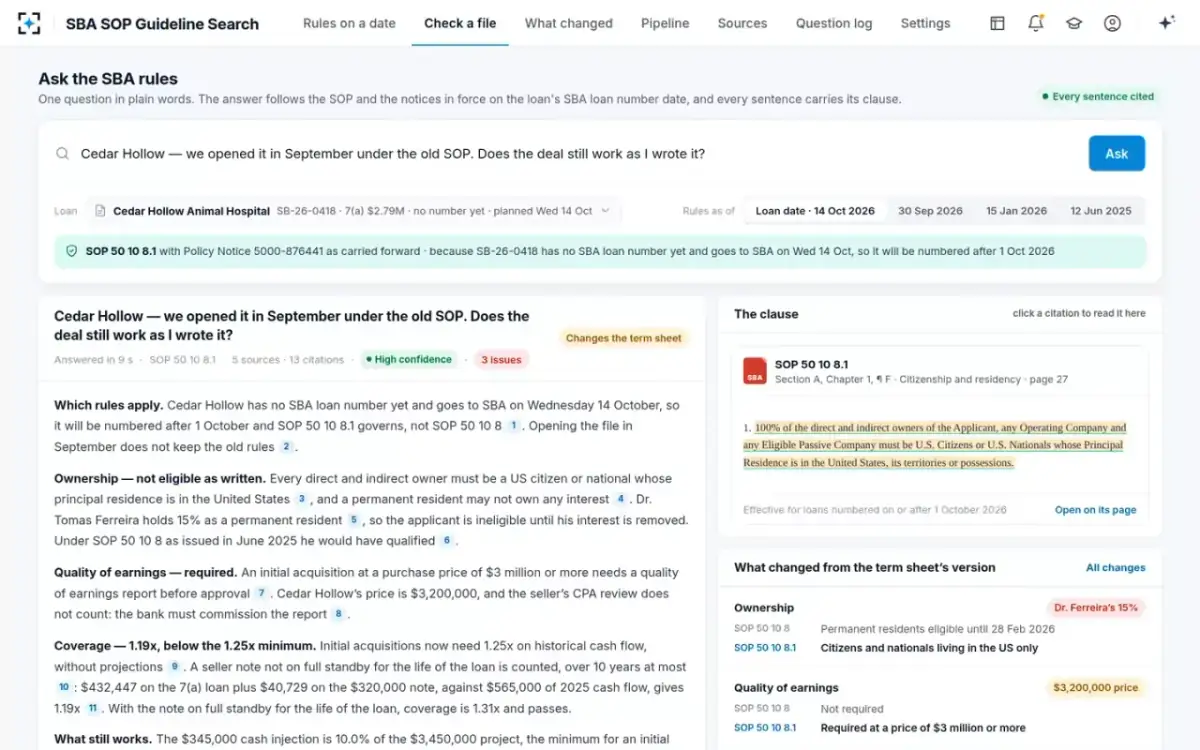
| Question | Does Cedar Hollow’s coverage meet the minimum once the seller note is counted? |
| Loan and date that governs | SB-26-0418, no SBA loan number yet; planned submission Wed 14 Oct 2026 |
| Version in force | SOP 50 10 8.1, Appendix 15, Credit Standards: coverage by transaction type |
| Clause relied on | Initial acquisition 1.25:1 on historical or adjusted results; seller debt not on full standby counted |
| Bank policy beside it | SBA Credit Policy § 5.2 says 1.20x; SBA’s 1.25x is stricter and governs; policy flagged |
| Arithmetic | $565,000 ÷ ($432,447 + $40,729) = 1.19x, below 1.25x; with the note on full standby, 1.31x |
| Answer | Does not meet as written; meets if the seller note goes on full standby for the term |
| Confirmed by | Senior SBA underwriter, with the time, and sent to the officer and the closer |
Each field answers a question the OIG says reviewers could not answer from SBA's own files. Which rule? Which version? What did the lender rely on? Who decided, and on what? An entry with those fields is also reusable: the next officer with an acquisition at 1.2x coverage starts from it rather than from the SOP's table of contents.
A cited answer is a desk-guide entry: question, version, clauses, the bank's policy and a decision
How do lenders build an SBA policy manual?
Most do it as an overlay: the bank's own SBA credit policy states where it is stricter than SBA, and points to the SOP for the rest. The weakness of an overlay is drift. When SBA raised acquisition coverage to 1.25x on October 1, 2026, any bank policy that still said 1.20x became looser than SBA overnight, and an officer reading the policy would structure to a number SBA would reject. A policy manual needs a review trigger tied to each SBA notice, and a rule for conflicts: the stricter of the two governs.
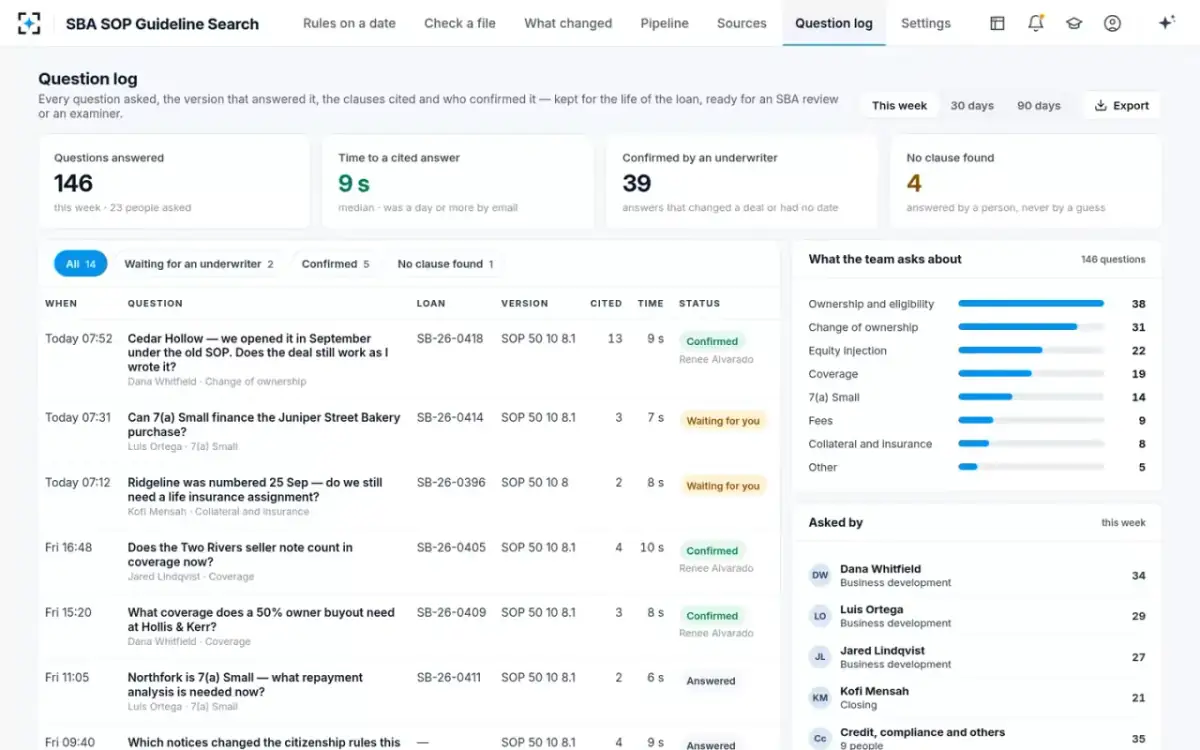
The second half of a manual is the interpretations: how the bank reads the rules where the SOP leaves room. That half is rarely written, because writing it is slow. A question log that keeps every cited, confirmed answer writes it as a side effect. Over a quarter it shows which rules generate the most questions, where answers needed an underwriter, and which questions had no clause behind them and went to a person.
A week of questions, versions and confirmations: the bank's own desk guide, accumulating
What a lender's SBA desk guide should hold
Enough to let a reviewer reconstruct each decision without the people who made it. The test is the one SBA's purchase reviewers face: a file read two years later by someone else. Interpretations that pass that test protect the guaranty; those that do not are opinions.
Eight things an SBA underwriting desk guide must let a reviewer see
- The rule, quoted from the version that governed
Not today’s SOP: the one in effect for the loan when it was approved.
- The date that chose that version
Loan number, SBA approval, R1 status or receipt by SBA, as the notice words it.
- The bank’s own policy beside it
And which governed when they differed.
- The figures from the file and the arithmetic
Coverage, injection, ownership percentages: computed, not asserted.
- The judgement calls, with reasons
Add-backs, standby terms, a seller’s role after the sale.
- Who decided, and when
A named underwriter or credit officer, at the time.
- What the SOP did not answer
And how the bank answered it, so the next case starts there.
- Where it was used again
Every later answer that relied on the same interpretation.
Built this way, the guide does what the OIG asked of SBA: decisions "documented with properly supported rationale". It also feeds the purchase package directly. The binding status of the SOP, the notices and the forms, and what breaking them costs under 13 CFR 120.524, is in SBA 7(a) loan program requirements; one hard question traced from the officer's desk to credit committee is in SBA 7(a) guidelines at 4:40 pm.
Questions people ask
What are the SBA underwriting guidelines?
SOP 50 10 8.1 and Part 120 of SBA's regulations. The regulation requires prudent commercial credit analysis consistent with the lender's similar non-SBA loans; the SOP adds the floors, such as 1.15x coverage and 1:1 global coverage for a Standard 7(a) loan and 1.25x for an initial acquisition.
Does SBA have an underwriting desk guide?
SBA's Inspector General found in August 2026 that SBA's purchase reviewers had none: they worked from the SOPs without supplemental guidance for complex, high-risk files. The OIG recommended SBA update its guidance so final decisions are documented with supported rationale.
How often does SBA overturn repair and denial recommendations?
In 197 of 545 final decisions between October 2021 and March 2025, or 36%, SBA honored a guaranty its servicing center had recommended repairing or denying, paying about $168 million. The OIG found half of the 32 overturns it reviewed insufficiently supported.
What are the 7(a) Small underwriting guidelines after the SBSS sunset?
Since March 1, 2026, a 7(a) Small loan needs debt service coverage of at least 1.10:1 on a historical or projected basis, with two months of commercial bank activity used to confirm the debts in the calculation, including any merchant cash advances.
How long does SBA take to decide a guaranty purchase on a disputed loan?
In the OIG's review, final decisions on loans recommended for repair or denial averaged 808 days, and 1,156 days for loans that entered review before October 2021. Thirteen loans, about $5.4 million, passed the statute of limitations before SBA sought repair or denial.