SBA SOP 50 10 8.1 changes how 7(a) lenders finance a change of ownership more than anything else. It took effect on October 1, 2026, replacing SOP 50 10 8 for applications SBA receives from that date. The headline changes sit in a new Appendix 15: acquisitions and owner buyouts now need 1.25x debt service coverage on historical cash flow, without relying on projections; a quality of earnings report is required at a business purchase price of $3 million or more; seller debt counts as equity only on full standby, and counts in debt service when it is not. Around those, 8.1 folds in nine notices issued since SOP 50 10 8, tightens trust guaranties and reopens SBA Express and 7(a) Small to acquisitions under the same appendix. For an underwriter the work is not reading the changes once; it is applying the right side of each change to each file, which is what Botminds' SBA SOP Guideline Search does, with the clause cited.
SOP 50 10 8.1 in four numbers
1.25x
minimum coverage for an initial acquisition, owner buyout or ESOP, on historical cash flow
Business expansion: 1.15x
$3M
business purchase price at which a quality of earnings report is required
Initial acquisitions and business expansions
24
months: the longest a seller may stay, and only as a consultant
Initial acquisitions and expansions
9
SBA notices folded into the SOP text
Four policy, five procedural
When is SOP 50 10 8.1 effective?
October 1, 2026. SBA's final notice says the SOP "will apply to all applications received by SBA on or after that date", and that lenders "must continue to use SOP 50 10 8 for 7(a) and 504 applications submitted through September 30, 2026" (SBA Information Notice 5000-882227). That wording differs from the August notice that first issued 8.1, which keyed it to applications "issued an SBA loan number on or after" October 1 (IN 5000-880695). For most files the two point the same way. For a delegated file whose number issued after October 1, or a file submitted in the last days of September, they can diverge, and the choice should be written on the file; the four dates that decide works through each case.
What are the SOP 50 10 8.1 technical updates?
They are a reissue of SOP 50 10 8.1, published September 25, 2026, that "supersedes the version previously published but not yet effective" (IN 5000-882227). SBA published 8.1 in August, took feedback, and replaced it before October 1, so the August text never governed a loan. The notice lists the principal changes; the ones that move deals are below.
Trusts: when trusts together own 20% or more of the applicant, "each trust must provide an unlimited full guaranty", the trustor must also guarantee personally, and "all donors to the trust will be deemed to have Trustor status for eligibility purposes". SBA Express and 7(a) Small: their use for changes of ownership "is permitted, subject to requirements in Appendix 15", with an internal business valuation allowed at a purchase price of $350,000 or less and "no reduced or alternative DSC standard" because the loan is small. Quality of earnings: a report already prepared for the applicant may be used "if accompanied by a reliance letter or secondary review by a different firm", but "may not be prepared by or for the seller". Working-capital true-ups in a purchase agreement are not seller rebates. Owner-occupied special purpose property acquired with its business may amortize up to 25 years. On the 504 side, the third-party lender may submit its underwriting directly, and its loan may now amortize beyond the debenture term.
What changed in SOP 50 10 8.1, rule by rule
Most of the substantive change is in acquisitions, and most of it tightens. The table compares SOP 50 10 8 as it stood on September 30, 2026, notices included, with SOP 50 10 8.1.
SOP 50 10 8 beside SOP 50 10 8.1: the changes that move an SBA deal
| Topic | SOP 50 10 8, through Sep 30, 2026 | SOP 50 10 8.1, from Oct 1, 2026 | Where |
|---|---|---|---|
| Where acquisition rules live | Spread through Section B chapters by delivery method | One appendix with four transaction types: initial acquisition, business expansion, owner buyout, ESOP and cooperative | Appendix 15 |
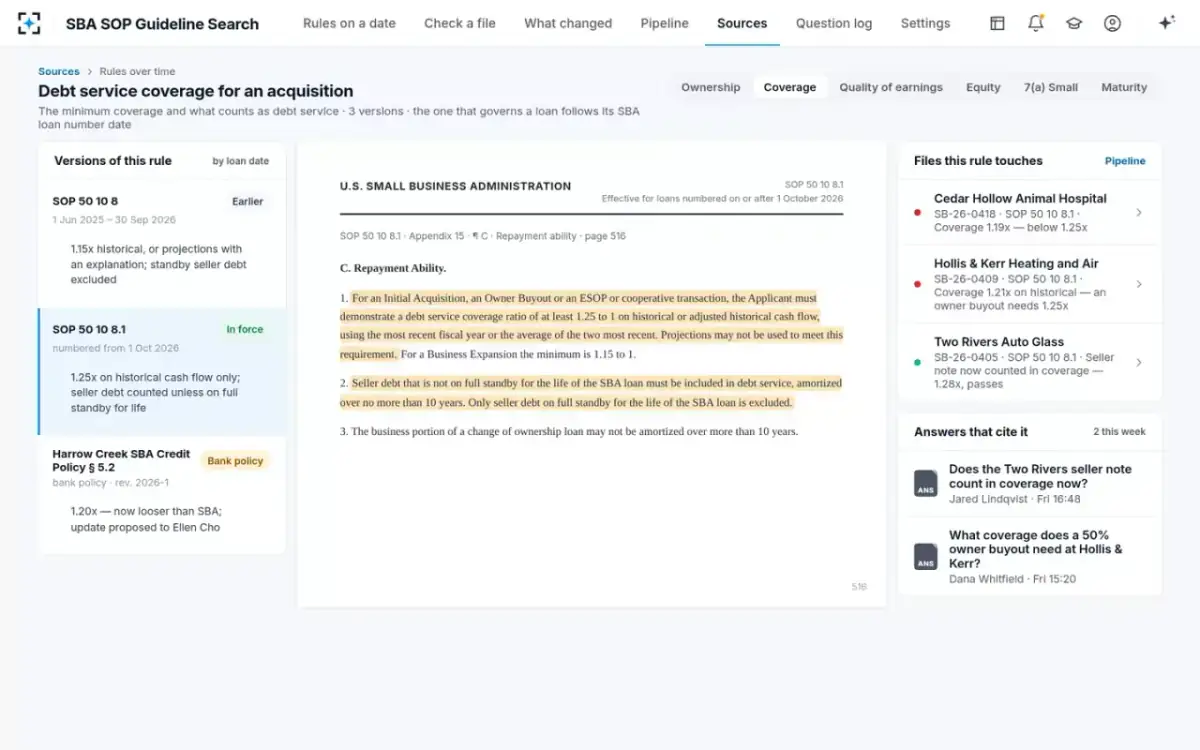
| Coverage for an acquisition | 1.15:1, the same as other Standard 7(a) loans | 1.25:1 for initial acquisitions, owner buyouts and ESOPs; 1.15:1 for business expansions; on historical or adjusted results, not projections; seller debt not on full standby counted, interest-only debt amortized over 10 years at most | App. 15, C |
| Seller debt as equity | Full standby for the life of the loan, no more than half the injection | Full standby for the term, within limited sources that together provide no more than half | App. 15, C |
| Equity for an initial acquisition | 10% of total project cost | 10%, which "cannot be reduced or eliminated"; may be reduced for expansions and buyouts with adequate liquidity | App. 15, C |
| Quality of earnings | Not required | Required at a business purchase price of $3 million or more for initial acquisitions and expansions, with a cash proof | App. 15, C.1 |
| Trusts owning 20% or more | Earlier trust guaranty rules | Each trust gives an unlimited guaranty; the trustor guarantees; donors treated as trustors | Sec. A, Ch. 5 |
What is Appendix 15 in SOP 50 10 8.1?
Appendix 15, "7(a) Changes of Ownership", is where SOP 50 10 8.1 now keeps nearly every rule for financing the purchase of a business: the four transaction types, guaranties, use of proceeds, maturities, financial due diligence, equity and coverage. The SBA notice issuing 8.1 describes it as "updates to change of ownership lending which are now found within Appendix 15" (IN 5000-880695).
The appendix begins by classifying the deal, and the class drives everything after it. "Initial Acquisition is the default category"; a lender that wants the lighter treatment of a business expansion, owner buyout or ESOP must "document how the Applicant satisfies the requirement in their credit memorandum", and must enter the type into the SBA Loan System (SOP 50 10 8.1, Appendix 15). A business expansion needs a buyer that has operated for at least two full fiscal years under current ownership, buying 100% of a business in the same four-digit NAICS industry group. In an owner buyout, people who have not worked in the business for 24 months "may only acquire less than 50% of the total equity and may not become the largest direct or indirect shareholder".
Coverage: 1.25x on what the business has already earned
The biggest single change for acquisitions is coverage. SOP 50 10 8 applied 1.15:1 across Standard 7(a) loans (SOP 50 10 8). SOP 50 10 8.1 sets the minimum by transaction type, measured on "either the last fiscal year-end or an average of the last two fiscal year-end statements on either a historical or adjusted basis", and says the lender "must evaluate the Applicant's post-closing financial projections but may not rely on them to meet the DSC requirement" (SOP 50 10 8.1, Appendix 15). The only exception is an owner-occupied special purpose property, such as a hotel or storage facility, where the real estate fully secures the loan.
Minimum debt service coverage by deal type under SOP 50 10 8.1
Two further lines change the arithmetic. Seller debt that is not on full standby is debt service, and "when a change of ownership transaction includes additional debt to support the purchase that is not on full standby and is structured with interest-only payments, the Lender must apply an amortization that does not exceed 10-years". And where a quality of earnings report is required, "the Lender must use the earnings from the QoE in the Debt Service Coverage (DSC) determination". A deal that cleared 1.15x on the seller's projections can fail 1.25x on the QoE's normalized history with the seller note counted.
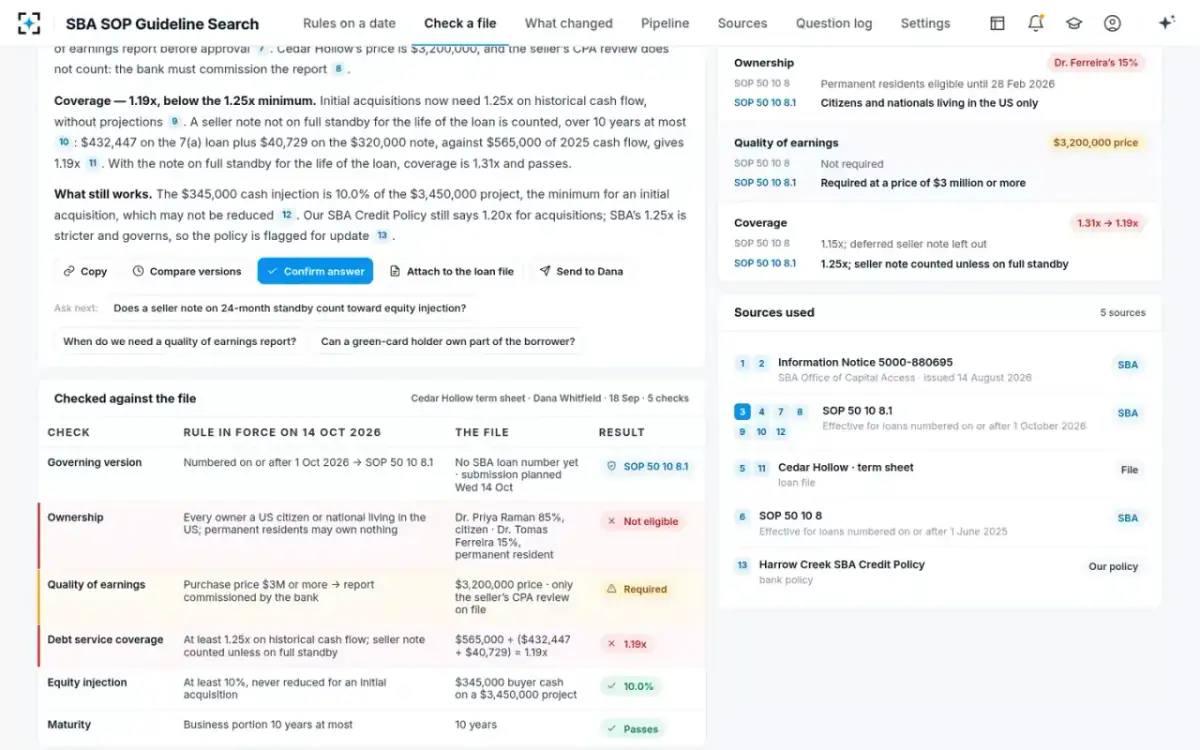
The same acquisition, written under SOP 50 10 8 and checked under 8.1
Written under SOP 50 10 8 in September: 1.15x minimum; the deferred seller note left out of debt service.
Checked under SOP 50 10 8.1 in October: 1.25x minimum on 2025 results; the note counted: $565,000 ÷ ($432,447 + $40,729) = 1.19x.
Written under SOP 50 10 8 in September: Not required; the seller’s CPA review on file.
Checked under SOP 50 10 8.1 in October: Required at a $3,200,000 purchase price; a report prepared for the seller does not count.
Written under SOP 50 10 8 in September: A 15% owner who is a permanent resident, eligible under the text the term sheet assumed.
Checked under SOP 50 10 8.1 in October: Ineligible: owners must be 100% U.S. citizens or nationals, unless the 15% is divested before the loan number.
Written under SOP 50 10 8 in September: $345,000 cash, 10.0% of a $3,450,000 project.
Checked under SOP 50 10 8.1 in October: Still 10.0%, which may not be reduced for an initial acquisition; the deferred note counts $0.
Written under SOP 50 10 8 in September: None needed.
Checked under SOP 50 10 8.1 in October: Put the note on full standby for the term: $565,000 ÷ $432,447 = 1.31x.
Quality of earnings, valuation and the $3 million line
At a business purchase price of $3 million or more, initial acquisitions and business expansions need a quality of earnings report on top of the business valuation, and the threshold "is determined before the application of buyer equity, seller debt, or other financing sources" (SOP 50 10 8.1, Appendix 15). The report must include a cash proof, reconciling bank statements to the income statement and tax return on a trailing twelve months and the last two fiscal years, and must be "conducted for the benefit of the Lender". Owner buyouts and ESOPs are exempt, because the existing owners stay.
The business valuation must be "requested by and prepared for the Lender. The Lender may not use a business valuation prepared for the Applicant or the seller." If the price exceeds the valuation, "the difference must be made up by equity", and total debt, including seller debt not on full standby, "is limited to the business valuation amount". For a delegated lender the valuation and QoE must be formally engaged by the time the SBA loan number is issued.
Coverage across its versions, with the bank's own policy beside SBA's figure
Can SBA Express finance a change of ownership now?
Yes, under SOP 50 10 8.1 as reissued. The technical updates say "the use of 7(a) Small and SBA Express loans for changes of ownership is permitted, subject to requirements in Appendix 15" (IN 5000-882227). The small-loan flexibilities are narrow: an internal valuation at a purchase price of $350,000 or less, and a lighter fully-secured analysis. Coverage is not one of them: "No reduced or alternative DSC standard applies solely because the loan is a 7(a) Small or SBA Express loan." A $300,000 initial acquisition under 7(a) Small needs 1.25x on history like a $3 million one.
This is a place where the August text and the September reissue matter. Anyone who read the first version of 8.1 and stopped there would be working from a text SBA withdrew before it took effect.
What changed for trusts in SOP 50 10 8.1?
Trust owners now carry the guaranty, and so do the people behind them. When one or more trusts own 20% or more of the applicant in aggregate, each trust gives an unlimited full guaranty executed by the trustee; the trustor must also personally guarantee, and every donor to the trust is treated as a trustor for eligibility purposes (IN 5000-882227). The last clause reaches into citizenship: a donor who would be an Ineligible Person as an owner is now an eligibility question for the loan.
The notices SOP 50 10 8.1 carries in
SOP 50 10 8.1 also absorbs nine notices that had already changed SOP 50 10 8 (IN 5000-880695). Three matter on almost every file. The citizenship rule of March 2026, 100% U.S. citizen or national ownership, is now SOP text. The SBSS credit score screen for 7(a) Small loans was sunset on March 1, 2026; those loans now need coverage of at least 1.10:1 and two months of bank statements to confirm the debts in it (SBA Procedural Notice 5000-875701). And from July 4, 2026 a borrower can combine up to $5 million of 7(a) with up to $5 million of 504, $10 million in all, when the 7(a) loan is approved first (SBA, July 7, 2026). The full list, and how one of those rules changed five times, is in SBA procedural notices.
Two smaller changes affect how lenders read the SOP itself. The authorization lenders close to is now "SBA Terms and Conditions" held in the SBA Loan System, and "SBA Loan System" replaces most references to E-Tran, defined to include "all current and future SBA designated electronic loan systems" (SOP 50 10 8.1, Appendix 3).
Is there a summary of changes for SOP 50 10 8.1?
SBA's two notices are the official summaries: Information Notice 5000-880695 lists the notices folded in and names the themes (Appendix 15, SBA Express flexibilities, same-institution debt refinancing), and Information Notice 5000-882227 lists the technical updates by section. Neither is a redline. SBA's own advice in both is that "users are advised to fully read SOP 50 10 8.1 to ensure understanding of all changes".
For a lender the useful summary is per file: which of my loans cross from 8 into 8.1, and what each must change. The file checker in SBA SOP Guideline Search tests a term sheet against the version in force for it and shows the arithmetic; on the sample Cedar Hollow file it found the three changes in the comparison above.
A term sheet written under SOP 50 10 8, checked against SOP 50 10 8.1
Why the changes matter years from now
Because SBA will judge each loan at guaranty purchase by the SOP in effect when it was approved, and the change-of- ownership rules are where reviewers find problems. In the overturned purchase decisions SBA's Inspector General reviewed, equity injection and eligibility were two of the five high-risk categories, and one denial recommendation turned on a seller who had stayed on in the business after the sale (SBA OIG Report 26-12). An acquisition written in September and numbered in October will be read against Appendix 15 in 2029 or 2030, by someone who did not see the term sheet.
For every file crossing from SOP 50 10 8 into 8.1
- Write down which SOP governs, and the date and notice that decided it
SBA’s two notices for 8.1 use different triggers; write down the one you applied.
- Classify the change of ownership
Initial acquisition unless the file documents why it is an expansion, owner buyout or ESOP.
- Re-run coverage at the 8.1 minimum, on history
1.25x for initial acquisitions and buyouts; count seller debt not on full standby, amortized over ten years at most.
- Check the purchase price against $3 million
Before buyer equity and seller debt. Above it, order a quality of earnings report for the lender.
- Re-test every owner and every trust
100% citizens or nationals; trusts at 20% or more guarantee, and their donors count as trustors.
- Re-read the seller’s role
Consultant for 24 months at most in an initial acquisition or expansion; no earnout.
Questions people ask
What changed in SOP 50 10 8.1?
Change-of-ownership lending moved into Appendix 15, with coverage of 1.25x on historical results for initial acquisitions, owner buyouts and ESOPs, a quality of earnings report at a $3 million purchase price, and seller debt counted in debt service unless on full standby. Nine notices issued since SOP 50 10 8 became SOP text, and the September technical updates changed trusts, SBA Express acquisitions and the quality of earnings rules.
When is SOP 50 10 8.1 effective?
October 1, 2026. SBA's September 25 notice applies it to applications received by SBA on or after that date and keeps SOP 50 10 8 for applications submitted through September 30, 2026; its August notice had used the SBA loan number date instead.
Can I use projections to meet coverage on a business acquisition?
Not under SOP 50 10 8.1. The lender must evaluate post-closing projections but may not rely on them to meet the coverage requirement; the exception is an owner-occupied special purpose property acquired with its business where the appraised real estate fully secures the loan.
When can an SBA seller note be refinanced under SOP 50 10 8.1?
After it has been in place and current for 36 months following the change of ownership, and only if the refinancing meets SBA's 10% improvement in installment payment and does not reduce the lender's exposure.
Does SOP 50 10 8.1 change 504 rules?
Yes, though less than 7(a). The technical updates let a third-party lender submit its underwriting directly and remove the bar on its loan amortizing beyond the debenture term, and SOP 50 10 8.1 carries the $10 million combined 7(a) and 504 limit that took effect on July 4, 2026.