The SBA 7(a) guidelines on changes of ownership answer a question that comes up in almost every acquisition: can the seller stay on? Under SOP 50 10 8.1, in an initial acquisition or a business expansion, the seller "may not remain as an officer, director, stockholder, or employee of the business"; if the business needs a transition, it may hire the seller "as a consultant for a period not to exceed 24 months (in aggregate, including any extensions)" (SOP 50 10 8.1, Appendix 15). That is the answer. Getting to it under deadline, for the right loan under the right version, with the clause on the file, is the work. This case follows one such question at a fictional SBA lender, from the officer's message at 4:40 pm to the credit committee at 5:00, first as it usually goes by hand and then with Botminds' SBA SOP Guideline Search.
The bank, the people and the deal are fictional sample data: Harrow Creek Bank, and its Cedar Hollow Animal Hospital acquisition. The question is a scenario we built on that file. The rules are SBA's.
Twenty minutes to committee: where the time goes on one SBA question
- Email waits for the underwriter16 min
- Which SOP governs?12 min
- Find the seller rule18 min
- Check bank policy6 min
- Write the committee note10 min
- Answer, cited
- Underwriter reads and confirms7 min
- Note from the saved answer
4:40 pm: the question that arrives before committee
Dana Whitfield, the business development officer, has the Cedar Hollow acquisition on the 5:00 pm credit committee agenda. At 4:40 the buyer's adviser calls: the seller, Dr. Pruitt, has agreed to stay for a year as a staff veterinarian on salary, to keep the clients who know him, and would like a bonus if revenue holds. The buyer, Dr. Priya Raman, sees it as risk reduction. Dana's message to the underwriter is one line: "Can the seller stay on as an employee for a year after closing? Committee at 5."
It is the kind of question that feels like judgement and is in fact a rule. It is also a rule that changed. The file was opened in September under SOP 50 10 8, and goes to SBA after October 1. Before anyone can answer, someone has to decide which book the answer comes from.
4:41 to 5:43: the same question, by hand
By hand the email waits sixteen minutes while the underwriter, Renee Alvarado, finishes another file. When she opens it at 4:57, the next twelve minutes go on the version. She knows SOP 50 10 8.1 took effect on October 1, and remembers SBA reissued it in September. She opens both SBA notices to check the trigger: the August notice keys 8.1 to the loan number date, the September reissue to the date SBA receives the file. Cedar Hollow has no loan number and will be submitted on October 14. Either way, 8.1 governs.
The next eighteen go on finding the rule. In SOP 50 10 8.1 the seller rule now sits in Appendix 15, beside the rules on earnouts and rebates, not under eligibility where she looked first. She checks whether the deal could be read as an owner buyout or a partial change, where the rule differs; it cannot, because Dr. Raman is buying 100%. She checks the bank's SBA credit policy, which says nothing on the point. At 5:33 she replies to Dana. Dana writes a note for committee. The committee has moved on; the item rolls to Thursday.
Nothing in that hour was wrong. It was simply spent on lookup, and it left behind two emails and a committee note that say "per SOP" without saying which one, or where.
The answer took one paragraph. Finding the paragraph, in the version that governed this loan, took the hour.
Can a seller stay on after an SBA acquisition?
In an initial acquisition or business expansion, only as a consultant, and only for up to 24 months. The full text reads: "Except as provided below, the seller in a Business Expansion or Initial Acquisition change of ownership transaction may not remain as an officer, director, stockholder, or employee of the business. If a transitional period is needed to assist the business, the small business may contract with the seller as a consultant for a period not to exceed 24 months (in aggregate, including any extensions)" (SOP 50 10 8.1, Appendix 15).
The exceptions matter, because they decide whether the rule applies at all. In an owner buyout that is a partial change of ownership, where at least one original owner stays, "the seller may stay on as an owner, officer, director, stockholder, Key Employee, or employee of the business". When an ESOP or cooperative buys a controlling interest, or a buyer acquires a business owned by an ESOP, employees may stay. Cedar Hollow is an initial acquisition of 100%, so the rule applies in full: Dr. Pruitt can be a consultant, under contract, for no more than 24 months. He cannot be a staff veterinarian.
What the buyer proposed at 4:40, and what SOP 50 10 8.1 allows
Proposed by the buyer's adviser: Staff veterinarian, on the payroll, for a year.
Allowed for an initial acquisition: Consultant under contract; not an officer, director, stockholder or employee.
Proposed by the buyer's adviser: Twelve months, "extendable if it works".
Allowed for an initial acquisition: No more than 24 months in aggregate, extensions included.
Proposed by the buyer's adviser: Salary plus a bonus if revenue holds.
Allowed for an initial acquisition: A consulting fee; a payment that depends on post-sale results invites reading as an earnout, which is prohibited.
Proposed by the buyer's adviser: None after closing.
Allowed for an initial acquisition: None: the rule bars the seller as a stockholder too.
Proposed by the buyer's adviser: $320,000, payments deferred for 24 months.
Allowed for an initial acquisition: Counts as equity only on full standby for the loan’s term; otherwise counted in debt service.
How long can a seller be a consultant after an SBA loan?
Twenty-four months at most, counted in aggregate, so an extension does not restart the clock. The consulting contract belongs in the loan file with the purchase agreement: SOP 50 10 8.1 requires the lender's documentation to include "all related business, stock, and asset purchase agreements, including all schedules, and amendments". A transition plan that runs past 24 months, or a consultant who in practice runs the business, is a structuring problem to fix before closing, not at purchase review.
Are earnouts allowed in SBA loans?
No. Appendix 15 states it plainly: "Seller earnouts are prohibited; however, buyer rebates based on business performance are allowed because this is a benefit to the Borrower." A rebate the buyer receives must be applied to pay down the 7(a) loan's principal. SBA's September 2026 technical updates added that a working-capital true-up in the purchase agreement is not a rebate and "may be treated as cash to the Borrower" (IN 5000-882227). A revenue bonus to the seller sits uncomfortably close to the prohibited side of that line, which is why the underwriter in this scenario took it out.
What happens if the seller becomes an employee?
The loan carries a defect that SBA's purchase reviewers look for, and the guaranty can be denied or repaired for it. SBA's Inspector General described exactly this case among the overturned decisions it reviewed: one loan "was recommended for denial because the seller of a business stayed on as a key employee in violation of 7(a) change of ownership requirements". Four SBA offices concurred with the denial; leadership overturned it at final approval, but "SBA's explanation that the key employee was an unpaid volunteer was not supported" (SBA OIG Report 26-12).
A lender should not count on that kind of overturn, and the OIG has recommended SBA seek recovery on the unsupported ones. The rule underneath is 13 CFR 120.524: material failure to comply with a Loan Program Requirement releases SBA from the guaranty, in whole or part, and SBA may recover what it paid "at any time" (13 CFR 120.524). At purchase review SBA applies "SOP 50 10 in effect when the Loan was approved" (SOP 50 57 4), so the seller rule of SOP 50 10 8.1 is the rule this file will be read against in 2029, whoever reads it.
The seller rule in numbers
24
months: the longest a seller may stay, as a consultant only, in an initial acquisition or expansion
0
earnouts allowed; buyer rebates go to principal
4 of 12
“other eligibility” overturns the OIG found unsupported, $2.71M; the seller case was one
SBA OIG 26-12
9 s
median to a cited answer in a sample week of the solution
Fictional sample data
4:41 to 4:52: the same question, with cited search
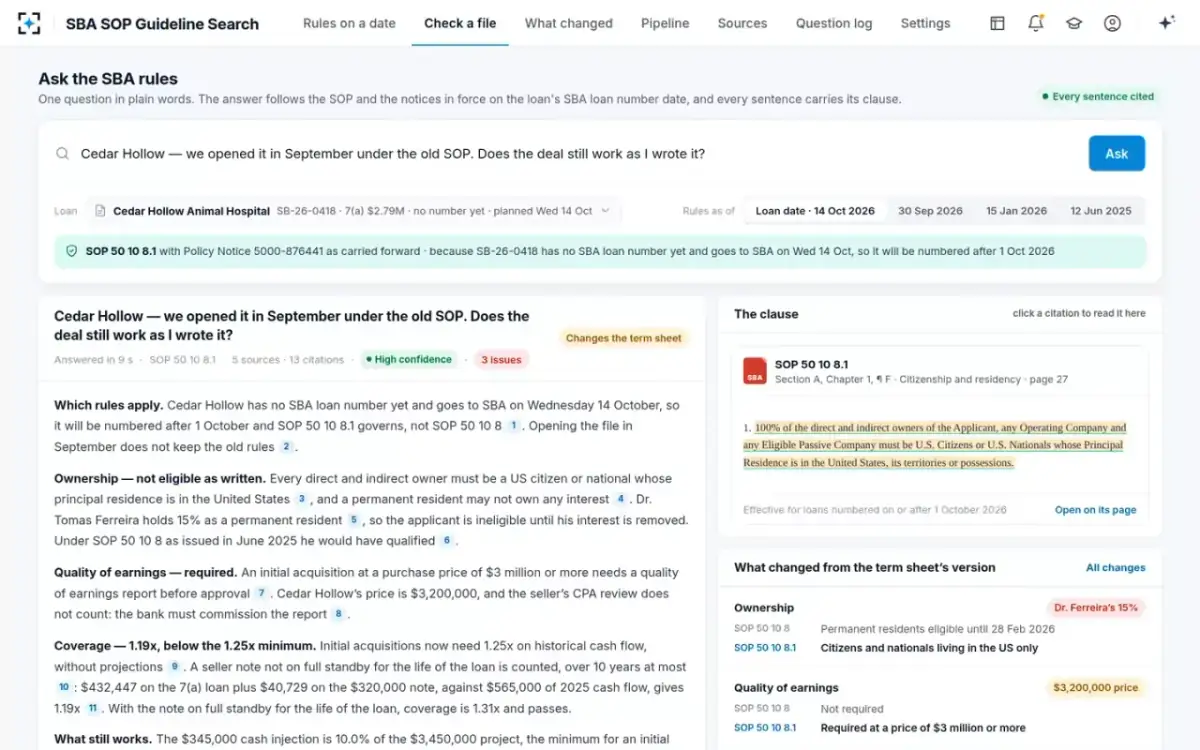
With SBA SOP Guideline Search, Dana asks the question with the loan selected. The agents settle the version first: no SBA loan number, submission planned for October 14, so SOP 50 10 8.1 governs, and the answer says so. They find the seller paragraph in Appendix 15 and the exceptions beside it, note that the file is an initial acquisition of 100%, and write the answer: consultant only, 24 months at most, no employee or officer role, no earnout. Every sentence cites its clause; because the answer changes the term sheet, it goes to Renee before it goes back to Dana.
Renee spends her seven minutes on the part that needs her: reading the clauses, deciding that the revenue bonus should come out, and confirming. The answer is saved to the loan file with its version and clauses, and Dana's committee note is three lines that point to it. On the sample file, the same answer view had already flagged three other issues for Cedar Hollow that morning: a 15% owner who is a permanent resident, a quality of earnings report due at a $3.2 million price, and coverage of 1.19x against 1.25x.
A cited answer on the Cedar Hollow file, marked as changing the term sheet
How do underwriters research SBA questions before committee?
The good ones work in a fixed order, because the order prevents the expensive mistakes: first the version, then the transaction type, then the rule and its exceptions, then the bank's policy, then the file's own figures. Skipping the first step is how a correct rule gets applied to the wrong loan. Skipping the second is how an owner-buyout exception gets applied to an initial acquisition.
Before committee: six checks on any question about the seller
- Which SOP governs this file, and by which date?
A file opened under SOP 50 10 8 and submitted after September 30, 2026 is under 8.1.
- Which of the four transaction types is it?
Initial acquisition is the default; an owner buyout or ESOP must be documented as such.
- What role will the seller have, and for how long?
Consultant only, up to 24 months in aggregate, in an initial acquisition or expansion.
- Does any payment to the seller depend on post-sale results?
Earnouts are prohibited; buyer rebates must go to principal.
- Is the seller note on full standby for the loan’s term?
If not, it is not equity, and it is in debt service at no more than a 10-year amortization.
- Is the answer on the file with its clause?
Version, paragraph and who confirmed it: what a purchase reviewer will need.
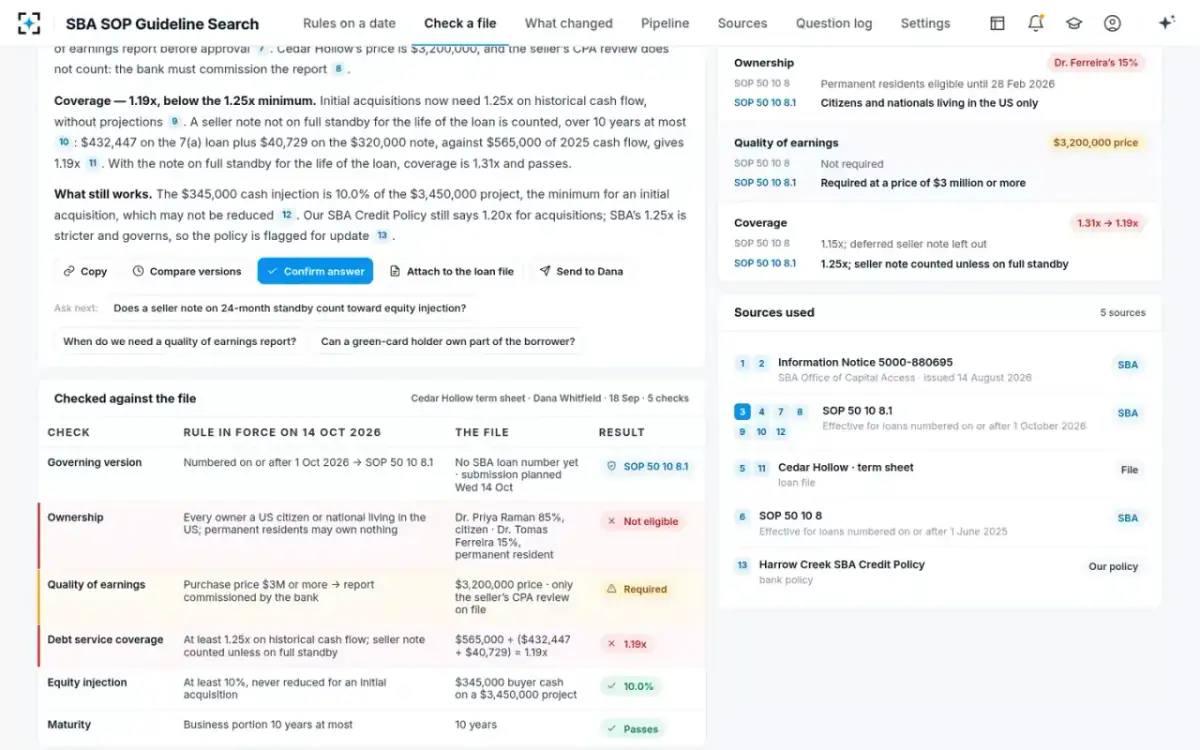
The file checker then tests the rest of the term sheet against the same version, with the arithmetic shown, so the committee sees the seller question in the context of the deal.
The rest of the deal, checked against the same version before committee
What went to committee at 5:00
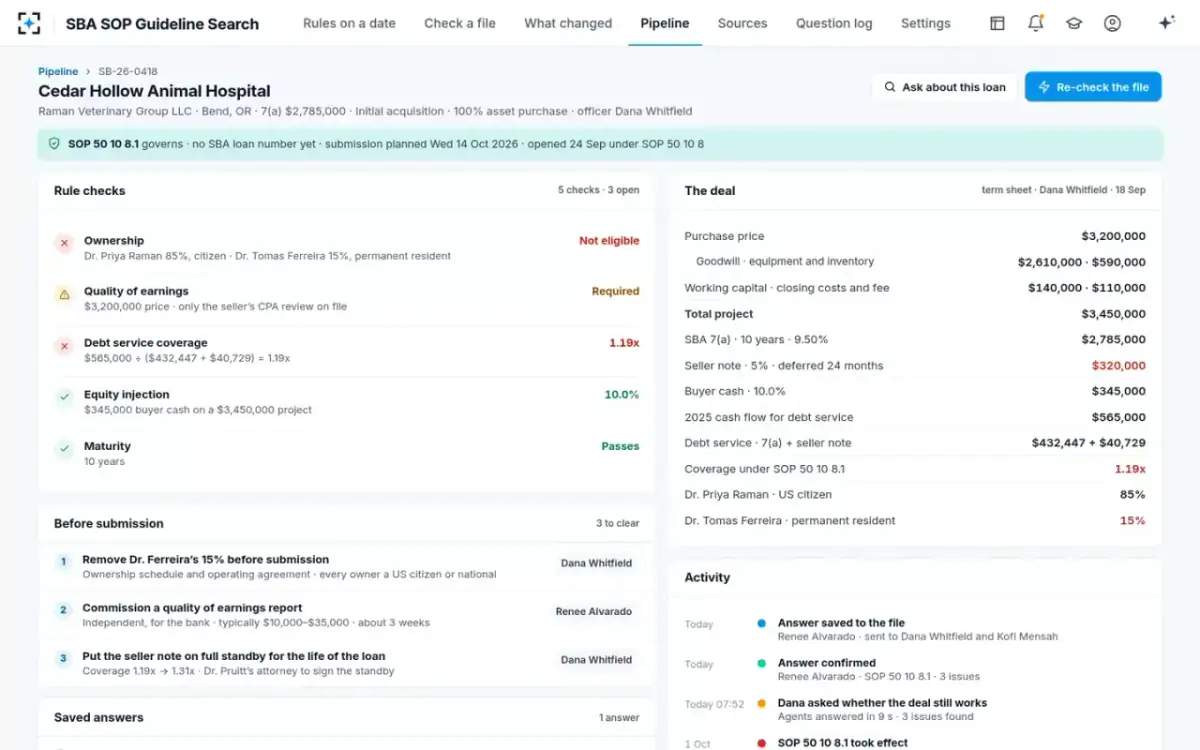
A one-paragraph note: the seller may stay as a consultant under a written contract for no more than 24 months, not as an employee; the revenue bonus is removed; the seller note goes on full standby for the term, which also lifts coverage from 1.19x to 1.31x; the clause and version are on the file. The committee approved subject to the three open items from the morning's check. The loan file now carries the question, the answer, the version and the confirmation, dated.
The loan file after committee: governing version, items to clear, and the saved answer
What the case shows is not speed for its own sake. It is that the hour by hand was spent on the two steps a person is worst placed to do under pressure, the version and the lookup, and left no trace of either. Why version questions are harder than they look is in the four dates that decide; what else Appendix 15 changed for acquisitions is in SBA SOP 50 10 8.1 changes.
Questions people ask
Can a seller stay on after an SBA acquisition?
In an initial acquisition or business expansion under SOP 50 10 8.1, only as a consultant, for no more than 24 months in aggregate including extensions, and never as an officer, director, stockholder or employee. In a partial owner buyout the seller may stay in any role, and ESOP transactions have their own rules.
How long can a seller be a consultant after an SBA loan?
Up to 24 months, counted in aggregate, so extensions count toward the limit. The consulting agreement, like all purchase agreements and schedules, belongs in the lender's loan file.
Are earnouts allowed in SBA loans?
No. SOP 50 10 8.1 prohibits seller earnouts in change-of-ownership transactions. Buyer rebates based on business performance are allowed, but must be applied to the 7(a) loan's principal; working-capital true-ups are not treated as rebates.
What happens if the seller becomes an employee after an SBA loan?
The lender has breached a change-of-ownership requirement, and SBA can deny or repair the guaranty under 13 CFR 120.524. SBA's Inspector General reported a 2026 case where a seller stayed as a key employee and found SBA's decision to honor the guaranty anyway unsupported.
What are the SBA 7a guidelines for change of ownership?
Under SOP 50 10 8.1 they sit in Appendix 15: four transaction types, a 10% equity injection that cannot be reduced for an initial acquisition, coverage of 1.25x on history for acquisitions and buyouts, a quality of earnings report at a $3 million purchase price, seller debt as equity only on full standby, and the seller as consultant for 24 months at most.