SBA 7(a) loan program requirements are not a summary on a website; they are a defined term in SBA's regulations, and the definition decides what a lender is bound by. Under 13 CFR 120.10, "Loan Program Requirements" are "requirements imposed upon Lenders ... by statute; SBA and applicable government-wide regulations; any agreement the Lender ... has executed with SBA; SBA Standard Operating Procedures (SOPs); Federal Register notices; and official SBA notices and forms", "as such requirements are issued and revised by SBA from time to time" (13 CFR 120.10). Failing materially to comply with any of them can release SBA from its guaranty. The definition is also why rule questions are hard: the answer may sit in a notice, a form or the loan's own SBA Terms and Conditions rather than the SOP. Botminds' SBA SOP Guideline Search answers from the SOPs, the notices and the bank's own SBA credit policy together, each with its dates.
What binds a 7(a) lender: the layers of SBA's Loan Program Requirements
| Layer | Examples | How it binds the lender |
|---|---|---|
| Statute | Small Business Act section 7(a); for example, the ESOP seller-guaranty rule at 15 U.S.C. 636(a)(15) | Directly; SBA cannot grant an exception to policy inconsistent with it |
| Regulations | 13 CFR Part 120 (eligibility, lending criteria, the $5 million loan cap, release events); Part 121 (size) | Directly, and by the lender’s agreement |
| The lender’s agreement | SBA Form 750, Loan Guaranty Agreement; PLP and Express supplemental agreements | By contract: Form 750 requires compliance with all Loan Program Requirements |
| SOPs | SOP 50 10 8.1 (making and closing), SOP 50 57 4 (servicing and liquidation), SOP 50 53 (lender oversight) | Named in 13 CFR 120.10; SBA reviews the loan against them at purchase |
| Federal Register notices | The 7(a) alternative base rate rule, effective March 1, 2026; information-collection notices for SBA forms | Named in 13 CFR 120.10 |
| Official SBA notices | Policy, procedural and information notices, such as the nine SOP 50 10 8.1 absorbed | Named in 13 CFR 120.10, from their effective date to the loans they reach |
| Forms | SBA Forms 1919, 1920, 155 standby agreement, 159 fee disclosure, 1050 settlement sheet | Named in 13 CFR 120.10; using the wrong form is itself a release event |
| The loan’s own terms | SBA Terms and Conditions for the loan, in the SBA Loan System | SOP 50 10 8.1: the guaranty is subject to them, and the lender must close in accordance with them |
What are SBA loan program requirements?
Everything in that table, as it stood when the relevant act was done. SOP 50 10 8.1 opens its core requirements by restating the definition, and extends it: "For all 7(a) and 504 loans, the Applicant and project must meet all Loan Program Requirements", including "the SBA Terms and Conditions issued and revised by SBA from time to time" (SOP 50 10 8.1, Section A). The word that carries the weight is "revised". The requirements are a moving set, and the set that applies to a loan is fixed by dates in that loan's life.
For a business owner searching "SBA 7(a) loan requirements", the practical list is shorter: a for-profit business, small under SBA's size standards, operating in the United States, 100% owned by U.S. citizens or nationals, unable to get the credit on reasonable terms elsewhere, with enough cash flow to repay and, for an acquisition or start-up, a 10% equity injection. Every item on that list is a lender's obligation to verify and document, which is why the lender's view of the requirements is the longer one.
What is 13 CFR 120.10?
It is the definitions section of SBA's business loan regulations, and its definition of Loan Program Requirements is the hook that makes everything else enforceable. It also defines terms that recur through the SOP: "SBA Lender" means a 7(a) lender or a Certified Development Company; a "Service Provider" is "an entity that contracts with a Lender or CDC to perform management, marketing, legal or other services"; and "SOPs are SBA Standard Operating Procedures, as issued and revised by SBA from time to time" (13 CFR 120.10).
Are SBA SOPs legally binding?
On lenders, yes, three ways over. The regulation names them as Loan Program Requirements; the lender's Form 750 agreement commits it to comply; and by making 7(a) loans, lenders "automatically agree to the terms, conditions, and remedies in Loan Program Requirements, as promulgated or issued from time to time and as if fully set forth in the SBA Form 750", and agree "that a violation of Loan Program Requirements constitutes default under their respective agreements with SBA" (13 CFR 120.1400).
The SOP's binding force has limits that matter in practice. SBA can grant an exception to its own policy, case by case, but "may not approve an exception to policy if such exception would be inconsistent with a statute or regulation", and only for "a minor deviation from standard policy" (SOP 50 10 8.1). An exception approved by email binds only the loan it was asked about, and the lender must keep the email in that loan's file.
A lender cannot comply with "the SOP". It can only comply with the version of the SOP, and the notices on top of it, that governed a particular loan on a particular date.
What is SBA Form 750?
It is the Loan Guaranty Agreement between SBA and a 7(a) lender, and the contract through which the rest of the rulebook binds. SOP 50 10 8.1 describes it in one sentence: "The Lender's executed SBA Form 750 is the written agreement between the SBA and the Lender requiring the Lender to comply with all SBA Loan Program Requirements as defined in 13 CFR § 120.10, including but not limited to, the applicable statute, regulations, and SOP guidance" (SOP 50 10 8.1, Section B, Ch. 6). Delegated lenders sign supplemental agreements for PLP and SBA Express authority on top of it.
Because the agreement incorporates requirements "as promulgated or issued from time to time", a lender signs once and is bound to every later notice from its effective date. That is efficient for SBA and demanding for lenders: the duty to know the current requirement is continuous, and so is the duty to know which requirement applied to each older loan.
Do Federal Register notices bind SBA lenders?
Yes; 13 CFR 120.10 names them. In practice most 7(a) changes in 2025–26 came by SOP and SBA notice rather than by Federal Register rule, but the Federal Register still carries binding changes and the information collections behind SBA's forms. The 7(a) alternative base rate final rule, published February 10, 2026 and effective March 1, introduced "alternative base rate options for use with variable interest rate loans made under the 7(a) Loan Program" (Federal Register, 2026-02660), and SBA carried it into the SOP by procedural notice. The regulation's own lending-criteria text, 13 CFR 120.150, still dates from April 2023.
What is the prudent lender standard?
It is SBA's requirement that lenders treat SBA loans at least as carefully as their own. For making loans, lenders "must use appropriate and prudent generally acceptable commercial credit analysis processes and procedures consistent with those used for their similarly-sized, non-SBA guaranteed commercial loans" (13 CFR 120.150). For servicing, they "must service 7(a) and 504 loans in their portfolio no less diligently than their non-SBA portfolio, and in a commercially reasonable manner, consistent with prudent lending standards" (13 CFR 120.535).
Prudence is also a release event: SBA is released if the lender "has failed to make, close, service, or liquidate a loan in a prudent manner". The standard therefore works as a floor under the specific rules. A file can meet every numbered requirement in the SOP and still fail prudence if the lender ignored what its own credit policy would have caught on a conventional loan.
What does 13 CFR 120.524 say?
It lists ten events that release SBA from its guaranty, "in whole or in part, within SBA's exclusive discretion", and gives SBA the right, "at any time", to "recover any moneys paid on the guarantee plus interest from the Lender" (13 CFR 120.524). Most of the ten are about the lender's conduct, and the first is the widest: material failure to comply with any Loan Program Requirement.
The ten events that release SBA from a 7(a) guaranty, 13 CFR 120.524(a)
- Material failure to comply with any Loan Program Requirement
Statute, regulation, agreement, SOP, notice or form: the full 120.10 list.
- Failure to make, close, service or liquidate the loan prudently
The prudent lender standard, enforced through the guaranty.
- Improper action or inaction that placed SBA at risk
Including failures to act during servicing and liquidation.
- Failure to disclose a material fact to SBA in a timely manner
About the guaranteed loan.
- Misrepresentation of a material fact to SBA
About the guaranteed loan.
- A written request from the lender to terminate the guaranty
The lender gives it up.
- The guaranty fee not paid on time
Within the period SBA’s rules require.
- No purchase request within 180 days after maturity
Or after completing liquidation or litigation on a matured loan.
- Required SBA forms, or exact electronic copies, not used
Forms are Loan Program Requirements in their own right.
- The borrower paid the loan in full
The guaranty ends with the debt.
When SBA tests the requirements, and against which version
Mostly at guaranty purchase, years after the loan was made, and against the versions in force when each act was done. SBA "will apply the requirements of SOP 50 10 in effect when the Loan was approved for loan making, loan closing, and loan modifications that took place on the date of or prior to full disbursement", and the servicing SOP "in effect when the servicing action was taken" (SOP 50 57 4, Ch. 24). For delegated loans that review is the first time SBA reads the lender's analysis at all.
Outside purchase review, SBA's Office of Credit Risk Management supervises "over 3100 7(a) Lenders, Certified Development Companies ('CDCs'), and Microloan Intermediaries", with reviews that ask about credit scoring, risk rating and "loans approved as exceptions to policy" (90 FR 42496). The formal ladder runs from a portfolio guaranty limit, through suspension or revocation of delegated authority, to suspension or revocation from the program and immediate suspension (13 CFR 120.1500).
The scale behind the requirements
$163B
SBA’s guaranteed loan portfolio overseen for credit risk, June 2025
SBA OIG, FY2026 challenges
3,100+
7(a) lenders, CDCs and microloan intermediaries under SBA supervision
10
events that release SBA from a 7(a) guaranty
9
SBA notices absorbed into SOP 50 10 8.1, each binding before it was absorbed
Why a rule search that reads only the SOP gives incomplete answers
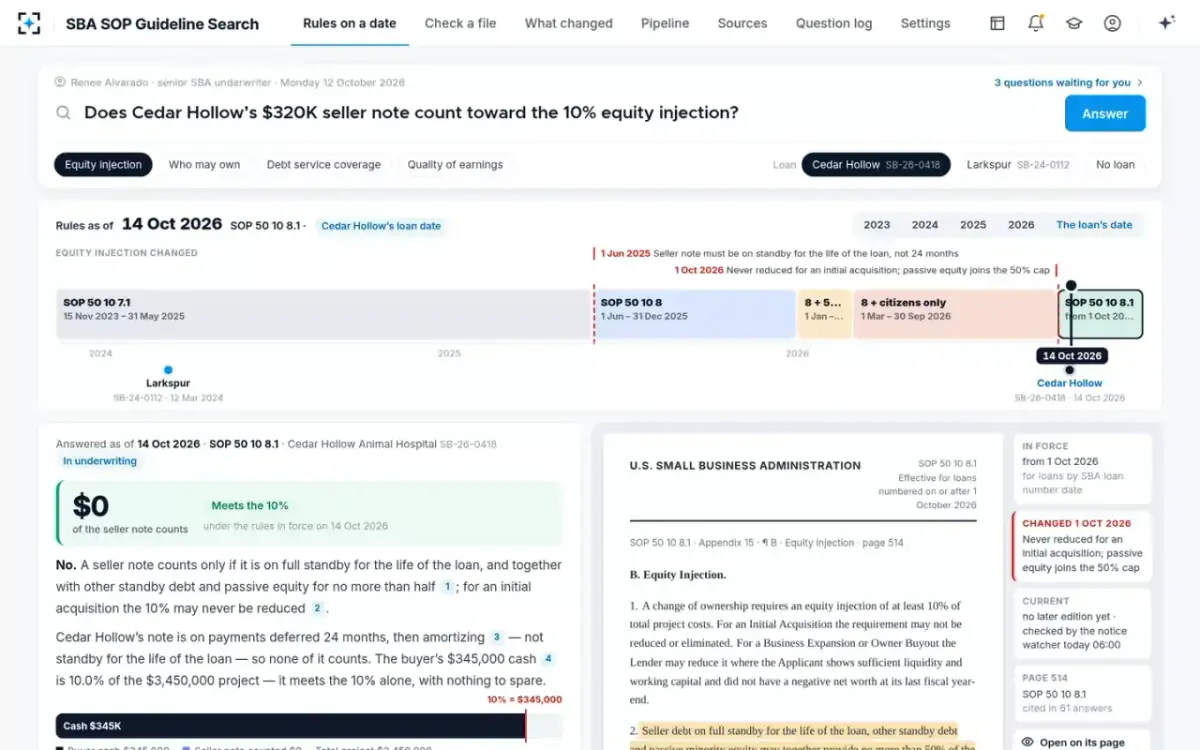
Because the SOP is one layer of eight, and the other layers change it between editions. Between June 2025 and October 2026 the ownership rule, the 7(a) Small credit test and the combined 7(a) and 504 limit all changed by notice, months before SOP 50 10 8.1 absorbed them (IN 5000-880695). A search over the SOP PDF alone would have answered those questions wrongly for most of 2026. And SBA's notices expire about a year after they take effect, by design, so a library has to know which have been absorbed, which rescinded and which still stand.
The same rule question, answered from the SOP alone or from the full set of requirements
A search over the SOP PDF: SOP 50 10 8 text as issued, before the citizenship notices.
An answer from all the requirements, dated: No: Policy Notice 5000-876441 and Procedural Notice 5000-876626 were in force.
A search over the SOP PDF: SOP 50 10 8 says a minimum score of 165.
An answer from all the requirements, dated: No: the score was retired on March 1, 2026; coverage of 1.10:1 and two months of bank statements instead.
A search over the SOP PDF: Today’s SOP, which did not govern it.
An answer from all the requirements, dated: SOP 50 10 7.1 for making and closing, the servicing SOP in force for each action.
A search over the SOP PDF: Not consulted.
An answer from all the requirements, dated: Shown beside the SOP; the stricter governs by default.
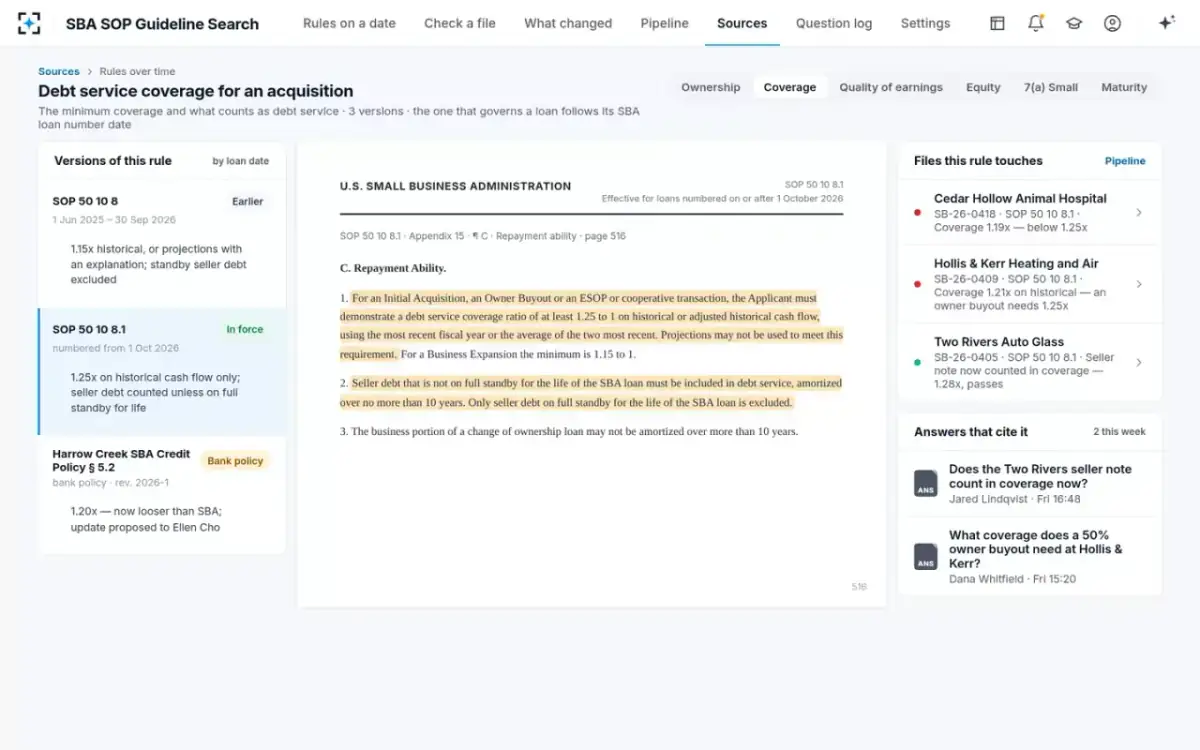
SBA SOP Guideline Search holds each layer as dated text. Its version strip puts every SBA edition and notice period on one axis with each loan pinned at its date, so the question "which requirement applied?" has a visible answer before the rule question is answered. The bank's own SBA credit policy is one more layer, shown beside SBA's.
Each layer of the rulebook on one time axis, with the loan pinned at its date
One rule across SBA's versions and the bank's own policy
Which version governs a given loan is its own question, with four possible answers; it is worked through in the four dates that decide. How a lender documents the way it applied the requirements, so a purchase reviewer can follow it, is in SBA underwriting guidelines even SBA's own reviewers lacked.
Questions people ask
What are SBA loan program requirements?
A defined term in 13 CFR 120.10: requirements imposed on lenders by statute, SBA and government-wide regulations, the lender's agreements with SBA, SBA's SOPs, Federal Register notices, and official SBA notices and forms, as SBA issues and revises them. SOP 50 10 8.1 adds the SBA Terms and Conditions for each loan.
Are SBA SOPs legally binding?
On participating lenders, yes. They are Loan Program Requirements under 13 CFR 120.10, the lender's Form 750 agreement requires compliance, and under 13 CFR 120.1400 a violation is a default under that agreement. SBA may grant case-by-case exceptions for minor deviations, never ones inconsistent with statute or regulation.
What is SBA Form 750?
The Loan Guaranty Agreement between SBA and a 7(a) lender. It requires the lender to comply with all Loan Program Requirements as defined in 13 CFR 120.10, including the statute, regulations and SOP guidance, as they are issued and revised.
What does 13 CFR 120.524 say?
It lists ten events that release SBA from a 7(a) guaranty in whole or part, starting with the lender's material failure to comply with any Loan Program Requirement, and lets SBA recover money already paid on the guaranty, plus interest, at any time it finds one occurred.
What is the prudent lender standard?
The rule that lenders must analyse SBA loans with prudent commercial credit processes consistent with their similar non-SBA loans, under 13 CFR 120.150, and service them no less diligently than their non-SBA portfolio, under 13 CFR 120.535. Failing to act prudently is also a release event under 120.524.
What are the basic SBA 7a loan requirements for a business?
A for-profit business, small under SBA's size standards, operating in the United States and owned 100% by U.S. citizens or nationals, that cannot get the credit on reasonable terms elsewhere and can repay from cash flow. Lenders verify each item against the SOP in force; acquisitions and start-ups also need at least a 10% equity injection.