An SBA business development officer finds small businesses that need an SBA-guaranteed loan, structures the deal to SBA's rules and carries it into underwriting. At a large SBA lender that officer sits beside underwriters, closers and a credit policy team who know SOP 50 10 8.1 paragraph by paragraph. At most lenders there is no such team: the SBA business development officer is the SBA desk, and every rule question about equity injection, seller notes, ownership or coverage lands on one person who structures the deal before anyone checks it. Botminds' SBA SOP Guideline Search was built for that seat: ask the rule question in plain words, and get the SOP paragraph in force for the loan's date, with each sentence cited.
The seat is harder than it was. SBA issued two Standard Operating Procedures for 7(a) and 504 lending in fifteen months, SOP 50 10 8 from June 1, 2025 and SOP 50 10 8.1 from October 1, 2026, and folded nine policy and procedural notices into the second (SBA Information Notice 5000-880695). A deal an officer structured in September can be judged under a different book in October.
Most SBA lenders make a handful of 7(a) loans a year
1,336
lenders made at least one 7(a) loan in fiscal 2025
Distinct lender names in SBA’s loan file
711
of them made five or fewer
More than half of all 7(a) lenders
50.2%
of 7(a) loans came from the top ten lenders
The top 100 made 82.5%
94
lenders made 100 or more
The lenders that can staff a specialist desk
What does an SBA business development officer do?
The SBA business development officer finds the borrower, shapes the request into something SBA will guarantee and keeps the deal moving until it closes. "Business development officer" is a lender's job title, not an SBA term: the SOP speaks of the Lender, its Agents, Lender Service Providers and Packagers. The Bureau of Labor Statistics files the work under loan officers, who held about 283,000 jobs in 2025 at a median wage of $76,690, with employment projected to grow 1% to 2035 (BLS Occupational Outlook Handbook). There is no SBA-specific occupation code, and none of O*NET's loan-officer tasks mentions SBA (O*NET 13-2072.00).
What sets the SBA seat apart is the rulebook it carries into every first meeting. Before a term sheet goes out, the officer has to know whether the buyer's equity injection meets the 10% floor for an initial acquisition, whether the seller's note can count toward it, whether every owner is eligible, which debt service coverage applies to this kind of deal and whether a quality of earnings report will be needed. A term sheet built on last year's rule costs the borrower weeks and the officer the deal.
In practice the week divides into three kinds of work: prospecting and referrals, structuring and pre-screening, and answering rule questions, the borrower's, the broker's and the officer's own. The first two are the job. The third grows each time SBA changes the book, and at a small lender nobody else absorbs it.
How many SBA loans does a typical lender make? Five or fewer, at most lenders
At more than half of all 7(a) lenders the answer is five or fewer a year. SBA's public loan file for fiscal 2025 lists 78,078 7(a) approvals across 1,336 lender names; the top ten made half the loans, and 711 lenders made five or fewer (SBA FOIA loan data). A lender that books four SBA loans a year cannot keep an SBA underwriter, an SBA closer and an SBA policy specialist busy. It keeps one officer who knows the program, and borrows the rest of the expertise one question at a time.
A specialist desk is the exception: 7(a) lenders by loans made in fiscal 2025
The concentration has a consequence that matters more than headcount. The top lenders built their desks around a volume that pays for specialists; the long tail runs SBA lending as a sideline of a commercial lending team. When SBA rewrote acquisitions in SOP 50 10 8.1, the top lenders' policy teams read the new Appendix 15 in August. At a five-loan lender the business development officer read it between client meetings, if at all.
Why the officer carries the rulebook: SBA reads a delegated file only after default
Under delegated authority SBA does not check the officer's structure before it issues a loan number, so the first reader who tests it against the SOP may be SBA's own purchase reviewer, years later. In fiscal 2025, 64.1% of 7(a) loans were made under Preferred Lender Program authority and 30.9% under SBA Express; 4.2% went through SBA's non-delegated review (SBA FOIA loan data). SOP 50 10 8.1 spells out what delegation means: "the Agency does not review the Lender's analysis of the credit or structure of the loan or line of credit prior to issuing a loan number", and the lender's analysis "is subject to SBA's review and determination of adequacy when the Lender requests SBA to purchase its guaranty" (SOP 50 10 8.1).
SBA also measures that file against the book in force when the loan was made, not today's: at purchase it will "apply the requirements of SOP 50 10 in effect when the Loan was approved" for loan making and closing (SOP 50 57 4, Ch. 24). The officer's answer in month one is the standard the file is held to in year four. Material non-compliance with any Loan Program Requirement can release SBA from the guaranty, in whole or in part (13 CFR 120.524).
Since June 1, 2025 the eligibility call itself is the lender's again. SOP 50 10 8 re-affirmed "that SBA Lenders determine whether the Applicant is eligible for a loan guaranteed by SBA" (SBA Information Notice 5000-866746). At a small lender, that determination starts with the officer's first read of the ownership chart.
The rule questions that reach one SBA business development officer in a week
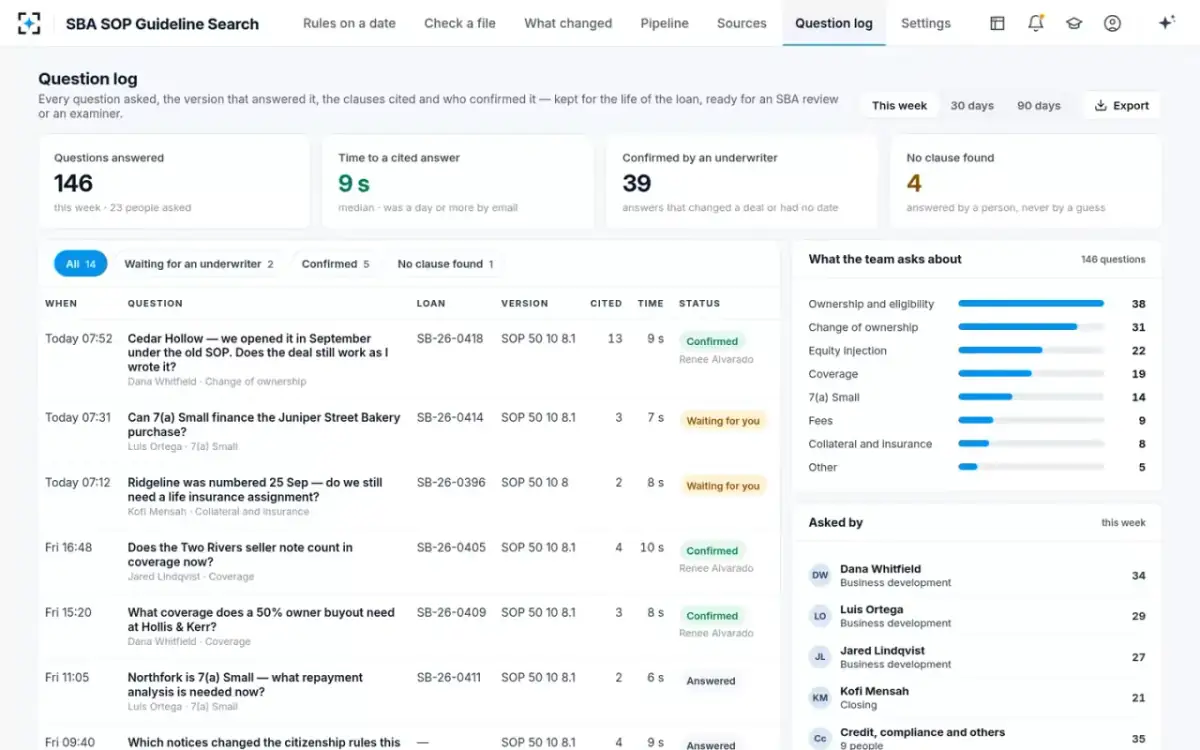
Most of them are about ownership and changes of ownership, and most have an answer that depends on a date. Take a sample week at Harrow Creek Bank, a fictional SBA lender whose people, borrowers and figures are all sample data in Botminds' SBA SOP Guideline Search: 146 questions from 23 people, led by ownership and eligibility (38), changes of ownership (31), equity injection (22) and debt service coverage (19). Three business development officers asked 90 of them.
Who asks the SBA rule questions, and what each needs from the answer
Today
Structures on the rule last heard at a webinar or in an email; waits a day for underwriting to confirm while the buyer waits on the officer.
With agents
Asks in plain words with the loan selected and gets the paragraph in force for its date, the figures from the term sheet checked against it.
Still theirs: The client relationship and the structure; an underwriter confirms anything that changes the deal.
Today
Fields 25 to 40 rule questions a week from six officers, each a search through the SOP, the notices and the bank’s own SBA credit policy.
With agents
Reads a cited answer under the right edition and confirms or corrects it.
Still theirs: The credit judgement, and the signature on any answer that changes a term sheet.
Today
Works out which SOP the loan was approved under before building the closing checklist.
With agents
Finds the governing version and the confirmed answer on the loan file.
Still theirs: The closing itself.
Today
Approves new SBA notices and answers the examiner with emails as the trail.
With agents
Approves each new source before it is used, and shows who asked what under which version.
Still theirs: What the bank treats as authority.
One sample week of SBA rule questions, by topic and by who asked
Who answers SBA policy questions at a small bank?
Usually the officer, then a colleague, then SBA's inbox. SBA runs two addresses, and the difference matters. General policy questions go to 7aQuestions@sba.gov. Lenders with delegated authority asking about a specific application, or requesting an exception to policy, write to 7aDelegatedLoanApps@sba.gov with the applicant, principals, project address, loan amount, delivery method and the policy at issue, and SBA "will not be reviewing the entire case file or multiple attachments" (SOP 50 10 8.1, User Tips).
Neither inbox is a desk guide. An exception "may only be used in situations where a minor deviation from standard policy is necessary", applies only to the request it answers, and cannot be granted where it "would be inconsistent with a statute or regulation" (SOP 50 10 8.1). An emailed reply to a general question does not travel with the loan unless someone files it. Most of what reaches the inbox is not an exception at all: it is a question whose answer is already in the SOP, if the officer knew where and which version.
The answers that do exist inside the bank sit in sent mail. The officer asks the underwriter; the underwriter searches, decides which version governs the loan and replies. The reply is right or wrong, but either way nothing on the loan file says which rule was used, which is the question SBA's purchase reviewer will ask.
What answering from memory costs the officer, and the lender, years later
It costs most when the guess was about a rule that changed. SOP 50 10 8.1 lets the seller in an initial acquisition or business expansion stay only as a consultant, for no more than 24 months, and not "as an officer, director, stockholder, or employee of the business" (SOP 50 10 8.1, Appendix 15). SBA's Inspector General reported a purchase file recommended for denial because the seller had stayed on as a key employee after the sale; SBA leadership overturned the denial on an explanation the OIG found unsupported (SBA OIG Report 26-12, August 2026).
The structure behind that file was set when the deal was written. Whoever told the buyer the seller could stay on created the denial risk; whoever reviewed it at purchase inherited it. Across the 32 overturned decisions the OIG reviewed, 16 lacked sufficient evidence, about $11.5 million in potential improper payments. Lenders do not get to count on an overturn: the same report shows SBA upheld 348 of 545 repair or denial recommendations.
The OIG's diagnosis applies to lenders as much as to SBA. Its reviewers had the SOPs, it found, but nothing written down on how to apply them to complex, high-risk files (OIG 26-12). A five-loan lender has the SOP and a business development officer, and the same gap. SBA underwriting guidelines even SBA's own reviewers lacked follows that finding into what a bank's own answer bank should hold.
Where SBA SOP Guideline Search fits in the business development officer's day
It takes the search and the version question off the officer and leaves the structuring with the officer and the approval with underwriting. The officer asks in plain words with the loan selected. Agents settle which date governs the loan, pull the paragraph in force on it from the SOP, the notices and the bank's own SBA credit policy, write an answer in which each sentence cites its clause, and test the term sheet's figures against the rule. Anything that changes the deal goes to an underwriter before it goes back to the borrower.
From the officer's question to an answer on the loan file
A person decides
Business development officerAsks in plain words, with the loan selected: "Does the seller note count toward the 10%?"
Agent
Loan date resolverFinds the date that decides the loan’s rules, or the planned submission date when there is no loan number yet, and says which it used.
Never: Never guesses a date
Agent
Rule finderSearches the SOP versions, the SBA notices and the bank’s SBA credit policy for the clauses in force on that date.
Never: Never cites a superseded or rescinded clause as current
Agent
Answer writer and file checkerWrites the answer, each sentence with its clause, and tests the term sheet’s figures against the rule with the arithmetic shown.
Never: Never changes the file or decides eligibility
A person decides
SBA underwriterConfirms any answer that changes a term sheet or has no loan number date, then saves it to the loan file.
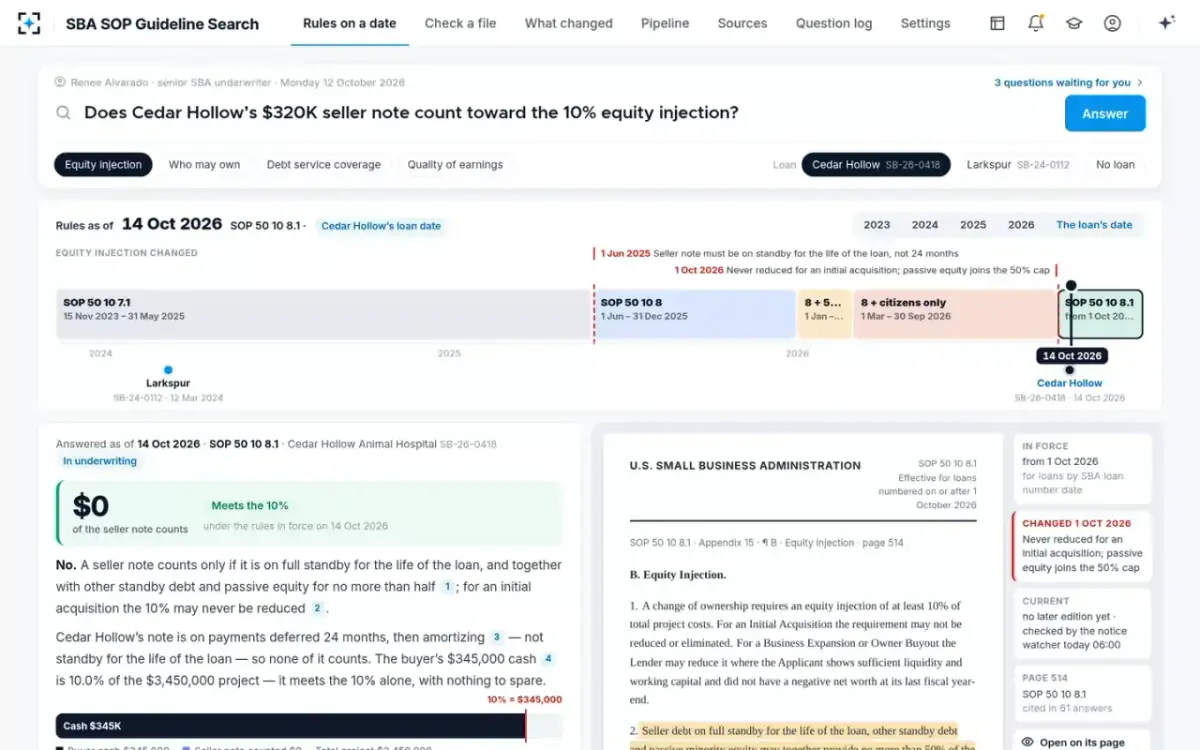
On the sample Cedar Hollow Animal Hospital acquisition, the officer's question about a $320,000 seller note came back in 9.1 seconds: under SOP 50 10 8.1 the note counts $0, because its payments are deferred for 24 months and then amortize, which is not full standby for the life of the loan. The buyer's $345,000 cash is exactly 10.0% of the $3,450,000 project, so the injection meets the floor with nothing to spare. The officer learns this before the term sheet goes out, not after underwriting sends it back.
The answer the officer reads: the verdict, the loan's figures and the paragraph beside them
Do small banks need an SBA department, or one officer with better answers?
A five-loan lender does not need a department; it needs every rule answer to be right for the loan's date and kept on the file. That is a smaller thing to buy than headcount, and a harder thing to get from training alone, because the book changes between sessions. The options, from SBA's own training to a lender service provider to cited search, are priced against each other in SBA lender training, an outside desk or agents.
Whatever the bank chooses, the liability stays where SBA put it. A lender service provider or a consultant can do the work, but SBA's Inspector General keeps asking the agency to oversee "third-party service providers, including loan agents who lenders place significant reliance on" (SBA OIG Report 26-01), and the guaranty is the lender's to lose. An officer who can show which rule was applied, from which version, on which date, is the cheapest control a small SBA lender can have.
Before the term sheet: what an SBA business development officer should be able to show
- Which SOP governs this loan, and why
The version and the date that chose it. A file opened under SOP 50 10 8 can be submitted under 8.1.
- Every owner, direct and indirect, to 100%
Since March 1, 2026, 100% of owners must be U.S. citizens or nationals with a principal residence in the United States.
- Equity injection, with what counts and what does not
Seller debt counts only on full standby for the life of the loan, and limited sources together provide no more than half.
- The coverage minimum for this kind of deal
1.25x on historical cash flow for an initial acquisition or owner buyout under SOP 50 10 8.1; projections may not be used to meet it.
- Whether a quality of earnings report is due
Required for an initial acquisition or business expansion at a business purchase price of $3 million or more.
- What happens to the seller
In an initial acquisition or expansion, a consultant for no more than 24 months, never an employee or officer.
- The clause behind each answer, on the file
An answer with its version and citation is what a purchase reviewer can test; an email reply is not.
Questions people ask
What does an SBA business development officer do?
The officer finds small businesses that need SBA-guaranteed credit, structures the request to SBA's rules and moves it through underwriting and closing. At most lenders the role also answers the borrower's and broker's SBA rule questions, because more than half of 7(a) lenders made five or fewer loans in fiscal 2025 and have no separate SBA policy staff.
How many SBA loans does a typical lender make?
Fewer than most people assume. Of 1,336 lender names in SBA's fiscal 2025 7(a) data, 711 made five or fewer loans, while the ten largest made 50.2% of all 7(a) loans and 94 lenders made 100 or more.
What is 7aQuestions@sba.gov?
It is the inbox SBA names in SOP 50 10 8.1 and in its notices for general 7(a) policy questions. Questions about a specific application from a delegated lender, and requests for an exception to policy, go to 7aDelegatedLoanApps@sba.gov instead, with the loan amount and delivery method.
How do delegated lenders ask SBA for an exception to policy?
By email to 7aDelegatedLoanApps@sba.gov with the applicant, principals, project address, loan amount, delivery method and the policy at issue. SBA decides case by case, only for minor deviations, never where the exception would conflict with a statute or regulation, and the lender must keep the approval email in the loan file.
Do small banks need an SBA department?
Not at five loans a year, but they need what a department provides: answers that are right for the loan's date and kept with the loan. Under delegated authority SBA reviews the lender's analysis only at guaranty purchase or in oversight, against the SOP in effect when the loan was approved.
Is an SBA business development officer the same as a loan officer?
For labour statistics, yes: there is no SBA-specific occupation, and the role is counted with loan officers, a group of about 283,000 jobs in 2025. In the SOP the word does not appear at all; SBA's rules speak to the Lender, which carries the responsibility for whatever the officer tells a borrower.