ChatGPT can explain what an SBA 7(a) loan is, what equity injection means and roughly how a seller note works. What a general chat assistant cannot do on its own is tell an SBA lender which rule governs a particular loan, because an SBA rule answer is only right for a date. SBA issued SOP 50 10 8 in June 2025 and SOP 50 10 8.1 in October 2026, and changed who may own a borrower three times in between, each change keyed to its own trigger. Ask "chatgpt sba" questions without the loan's date and you get an answer to the question as of whatever text the model read. Botminds' SBA SOP Guideline Search is built the other way round: its agents settle the loan's governing date first, then answer from the SOP and the notices in force for it, citing the clause behind every sentence.
This page is for the business development officer or underwriter weighing an AI tool for SBA questions: why the date matters, what an assistant should ask before it answers, how to test one on your own files, and where agents help and where they must stop.
Same SBA question, two kinds of assistant
A general chat assistant: Whatever SBA text it was trained on or finds in a web search, of any age.
An agent that asks for the loan's date first: The SOP versions, SBA notices and your own SBA credit policy, each held with its effective dates.
A general chat assistant: Unstated; often a blend of older and newer text.
An agent that asks for the loan's date first: The version in force for the loan, named on the answer with the date that chose it.
A general chat assistant: Sometimes a paragraph number, not checked against the text.
An agent that asks for the loan's date first: Each sentence tied to a clause you can open; a sentence it cannot cite is removed.
A general chat assistant: Only what you type into the chat.
An agent that asks for the loan's date first: Read from the loan file and tested against the rule, with the arithmetic shown.
A general chat assistant: Produces a plausible answer anyway.
An agent that asks for the loan's date first: Says no clause answers it and sends the question to an underwriter.
A general chat assistant: Nothing, unless someone pastes the chat into a memo.
An agent that asks for the loan's date first: The question, answer, version, clauses and who confirmed it.
Can ChatGPT answer SBA SOP questions?
It can answer the general ones and explain the vocabulary; it should not be trusted alone with a loan-specific answer. Ask what a Preferred Lender is, what a Form 155 standby agreement does, or why SBA wants a credit-elsewhere analysis, and a general assistant will usually give a sensible summary. Ask whether a 15% owner with a green card makes a borrower ineligible, and the correct answer depends on when the loan was approved, whether it was processed under delegated authority, and which notice was in force.
The problem is not intelligence; it is the shape of SBA's rulebook. The binding rules for a 7(a) loan include the SOP and "official SBA notices and forms", "as such requirements are issued and revised by SBA from time to time" (13 CFR 120.10). SOP 50 10 8.1 alone folded in four policy notices and five procedural notices issued after SOP 50 10 8 (SBA Information Notice 5000-880695). A model's knowledge is a snapshot; SBA's book is a sequence of dated layers.
Why do SBA rule answers depend on the date?
Because SBA decides which rules govern a loan by a date in that loan's life, and the date differs from change to change. SOP 50 10 8 applied to applications "issued an SBA loan number on or after" June 1, 2025 (IN 5000-866746). For SOP 50 10 8.1, SBA's August notice used the same loan-number wording (IN 5000-880695), but the September notice that replaced it says 8.1 applies to "all applications received by SBA on or after" October 1, 2026, and that lenders "must continue to use SOP 50 10 8 for 7(a) and 504 applications submitted through September 30, 2026" (IN 5000-882227).
The citizenship change of March 2026 used two triggers at once: the loan-number date for delegated loans, and for non-delegated applications the date they "enter R1 status (as indicated in E-Tran)" (Procedural Notice 5000-876626). And at guaranty purchase, SBA will "apply the requirements of SOP 50 10 in effect when the Loan was approved" for making and closing, and the servicing SOP in effect when each servicing action was taken (SOP 50 57 4, Ch. 24). An assistant that does not ask which of these dates applies is answering a different question from the one the lender has. The four dates that decide sets out each trigger and what to write on the file.
One question, three answers: a green-card owner under three texts
Take the question an officer might type: "Can a 15% owner who is a lawful permanent resident stay in the deal?" Under the texts SBA issued between December 2025 and March 2026, the answer changed twice. Each row below is right for its own loans and wrong for the others.
Can a green-card holder own 15% of the borrower? It depends on the loan's date
| Text in force | Applies to | Answer for a 15% lawful permanent resident owner |
|---|---|---|
| Procedural Notice 5000-872050 | Applications approved by SBA on and after January 1, 2026 | Yes, if the principal residence is in the United States: owners had to be citizens, nationals or permanent residents living in the U.S., with up to 5% allowed to others. |
| Policy Notice 5000-876441 | From March 1, 2026 | No. Permanent residents "will not be eligible to own any percentage interest", and the 5% exception is rescinded. |
| Procedural Notice 5000-876626, carried into SOP 50 10 8.1 Ch. 1 Para. F | Delegated loans numbered on or after March 1, 2026; non-delegated applications entering E-Tran R1 status on or after March 1 | No, unless the owner completely divests before the SBA loan number is issued. A permanent resident may still give a limited guaranty. |
A general assistant trained or searched mostly on 2025 text will tend to give the first answer. One that has read the March notices will give the last, and may apply it to a loan approved in January. Neither failure is visible in the answer itself, which is why the version and the date belong on the answer, not in the user's head. The full life of this rule, notice by notice, is in SBA procedural notices: one citizenship rule, five texts.
An SBA rule answer has three parts: the rule, the version and the date that chose the version. An assistant that gives you only the first has left the other two to you.
What an SBA rule assistant should ask before it answers
It should ask which loan, and then work out the governing date and version itself, saying how. In SBA SOP Guideline Search the officer types the question with the loan selected; the first agent reads the loan file and the E-Tran status, finds the SBA loan number date or, when there is none yet, the planned submission date, and states which it used. Which date counts is a setting the bank controls, because SBA's own notices differ.
Before writing a word, the agents settle the loan, the date and the version
A person decides
Officer or underwriterAsks in plain words with the loan selected, or asks about no loan at all for a general rule.
Agent
Loan date resolverReads the loan file and E-Tran status; takes the loan number date, or the planned submission date when there is no number, and says so.
Never: Never guesses a date
Agent
Rule finderPicks the SOP and notices in force on that date and searches them, with the bank’s SBA credit policy, for the clauses that answer.
Never: Never cites a superseded or rescinded clause as current
Agent
Version comparerShows what the clause said in earlier versions and whether the deal was written under one of them.
Never: Never merges two versions into one answer
Agent
Answer writerWrites the answer in plain words, each sentence with its clause; removes any sentence it cannot cite.
Never: Never writes a sentence without a clause
A person decides
SBA underwriterConfirms any answer that changes a term sheet, has no loan number date, or where bank policy and SOP differ.
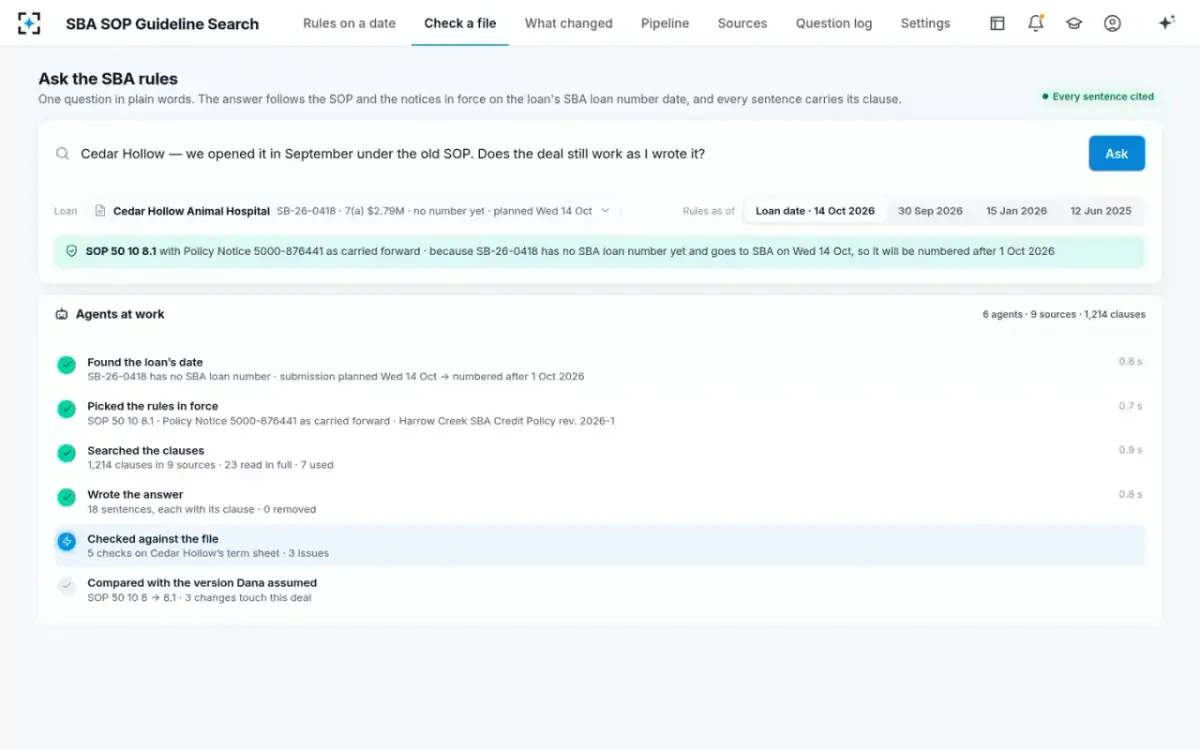
Take a sample run: on the fictional Cedar Hollow Animal Hospital acquisition at Harrow Creek Bank, a fictional lender whose people and figures are sample data, the officer opened the file in September under SOP 50 10 8 and asked on Monday 12 October whether the deal still worked as written. The file had no SBA loan number and was to go to SBA on Wednesday 14 October, so the agents placed it under SOP 50 10 8.1 and said why before answering anything else.
The date is settled, and stated, before the answer is written
Can AI cite the SBA SOP paragraph? Only if it reads the paragraph
Yes, if the citation is produced by retrieving the clause and checking the sentence against it; a citation produced from memory is decoration. The useful test is mechanical: click the citation and see whether the clause says what the sentence says, in the version the answer claims. In SBA SOP Guideline Search a sentence that cannot be tied to a clause is removed before anyone sees it, and the clause opens beside the answer.
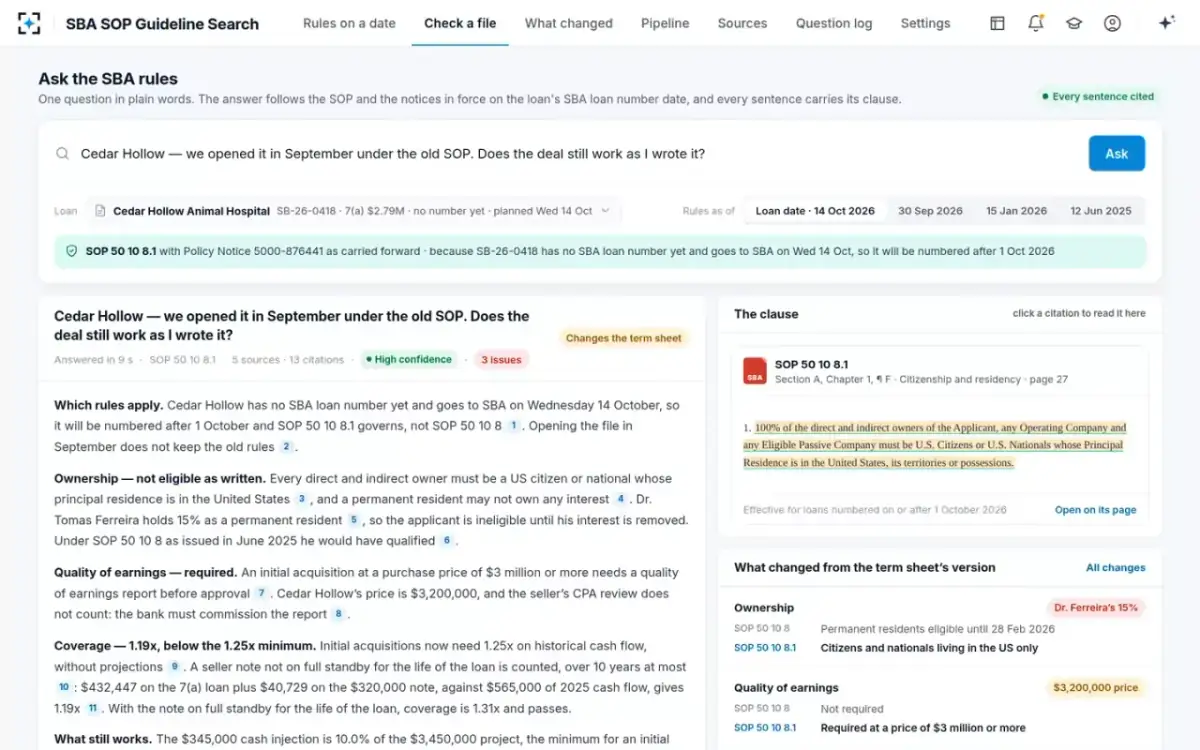
On the sample Cedar Hollow file the answer carried 13 citations from five sources: the SBA notice that set the version, SOP 50 10 8.1, SOP 50 10 8 for what the deal had been written under, the term sheet and the bank's own SBA credit policy. It found three issues. A 15% owner was a permanent resident, so the borrower was ineligible as written. At a $3.2 million purchase price a quality of earnings report was required, and the seller's CPA review would not do, since SBA says the report "may not be prepared by or for the seller" (IN 5000-882227). And coverage was 1.19x against the 1.25x that SOP 50 10 8.1 sets for an initial acquisition.
Every sentence with its clause, and what changed since the term sheet was written
What happens if a lender relies on the wrong SOP version?
The loan is judged against the right one anyway, usually years later. Under delegated authority SBA does not review the lender's credit analysis before issuing a loan number; it reviews it when the lender asks SBA to honor the guaranty (SOP 50 10 8.1), against the SOP in effect when the loan was approved (SOP 50 57 4). If the lender "failed to comply materially with any Loan Program Requirement", SBA is released from the guaranty in whole or part, and may recover money already paid "at any time" (13 CFR 120.524).
The error runs in both directions. Applying a newer, stricter rule to an older loan can kill a deal that was eligible; applying an older, looser one to a new loan builds a denial into the file. Either way, "the AI said so" is not a defense SBA recognizes. The lender certifies the file, and the lender's underwriter is the one who has to be able to show which rule was applied.
What SBA and its Inspector General have said about AI
Nothing that endorses AI for lender underwriting: SBA has issued no statement on lenders' use of AI to answer rule questions or make credit decisions. What exists points the same way as the design above. SBA's Inspector General found in September 2026 that the agency had no process to identify "high-impact" uses of AI, and noted that OMB presumes "any AI model that affects a person's request for critical federal services or benefits, to include loans" is high impact, requiring review and human oversight (SBA OIG Report 26-15). That guidance binds federal agencies, not banks, but it describes the standard an examiner will recognize.
The closest lesson is about automation that does not cover the rules. When SBA itself screened 7(a) eligibility through an automated framework from August 2023 to December 2024, the OIG found it "only screened for five of the 19 ineligible business types" across 73,302 loans worth about $32 billion (SBA OIG Report 26-07). A tool is only as good as the rules it actually checks, and only as current as the version it holds.
How should you test an AI tool on SBA rules?
Test it on questions whose answer changed, on loans either side of the change, and read every citation. A tool that answers well on stable rules tells you little; the failures live at the seams between versions. Run the same question against two of your own files numbered on different dates, and the right tool gives two different answers and says why.
Seven tests for any AI assistant you will use on SBA questions
- Ask about a 15% green-card owner on a loan approved in January 2026, then on one numbered in April 2026
The answers must differ, and each must name the notice in force.
- Ask about a seller note on interest-only payments for an acquisition
Under SOP 50 10 8 and 8.1 it is not full standby and cannot count as equity; check the citation says so.
- Ask which SOP governs a file submitted to SBA on September 29, 2026 and numbered in October
A good answer names the conflict between SBA’s two notices instead of hiding it.
- Ask something the SOP does not answer
The right behavior is "no clause found" and a hand-off to a person, not a fluent guess.
- Click every citation
The clause must say what the sentence says, in the version the answer claims.
- Put your bank’s SBA credit policy beside the SOP
Where they differ, the tool should show both and apply the stricter rule, or whichever rule your bank sets.
- Look for the trail
Who asked, about which loan, under which version, citing which clauses, confirmed by whom.
Where SBA SOP Guideline Search fits, and where it does not
It fits the questions an SBA desk answers every day: equity injection, seller notes, ownership and eligibility, coverage, quality of earnings, maturities, and which version governs. It does not decide eligibility, approve a loan or change a loan file; the agents are configured never to, and an underwriter confirms any answer that changes a term sheet. It is not legal advice, and it does not replace SBA's own channels: an exception to policy still goes to SBA by email, and a genuine gap in the SOP still goes to 7aQuestions@sba.gov.
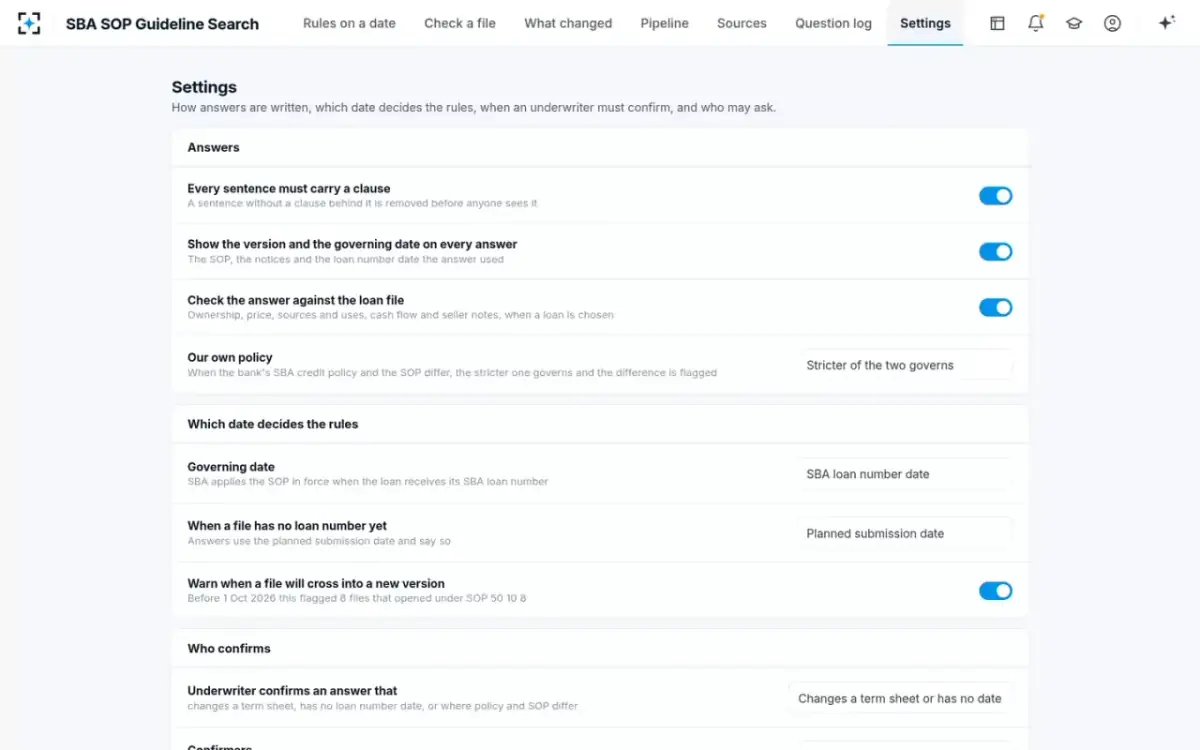
Its answers are only as current as its sources, which is why new SBA notices join the library only after the bank's compliance officer approves them, and why each answer names the version it used. Those choices are settings, not code: which date decides, what happens with no loan number, how your policy sits beside the SOP and who confirms.
Which date decides, who confirms, how your policy sits beside the SOP: settings the bank owns
For a side-by-side of this approach with an SOP PDF, a loan origination system's rule library and a chat assistant on one real question, see SBA lending software vs the SOP PDF.
Questions people ask
Can ChatGPT answer SBA SOP questions?
It can explain SBA concepts and summarize rules, but on its own it does not know which version of the SOP governs a given loan. SBA issued SOP 50 10 8 and 8.1 and at least nine binding notices within about fifteen months, each keyed to a date in the loan's life, so a loan-specific answer needs the loan's date first.
Which SOP applies to my SBA loan?
For loan making and closing, the SOP 50 10 in effect for that loan when it was approved; SBA applies the same one at guaranty purchase. For the October 2026 change SBA's final notice says SOP 50 10 8.1 applies to applications received by SBA on or after October 1, 2026, and SOP 50 10 8 to those submitted through September 30.
What is E-Tran R1 status?
It is an application status in SBA's E-Tran system that SBA used as the trigger for non-delegated applications in Procedural Notice 5000-876626. Non-delegated applications that entered R1 status on or after March 1, 2026 fell under the 100% U.S. citizen or national ownership rule; delegated loans were judged by their loan number date.
Can AI cite the SBA SOP paragraph?
Only reliably when it retrieves the clause from the right version and checks each sentence against it. Test it by opening every citation: the clause must say what the sentence says, and the answer must name the SOP version and the date that selected it.
Has SBA approved the use of AI by lenders?
No. SBA has made no statement endorsing or regulating lenders' use of AI for rule answers or credit decisions. The lender remains responsible for complying with every Loan Program Requirement under 13 CFR 120.10, whatever tool it uses, and SBA can deny or repair a guaranty under 13 CFR 120.524 if it did not.
Is it safe to paste a borrower's file into a public chatbot?
Treat it as you would any third-party service: a loan file holds tax returns, owners' personal information and citizenship status, which your information-security and vendor-management policies govern. A tool that reads the file inside the bank's own systems avoids the question rather than answering it.