SBA lender training is the usual answer when a bank's SBA team keeps getting rule questions wrong: send the officers and underwriters to a course on the SOP, and refresh them when the rules change. It works for the program's vocabulary and its logic. It works less well for the question a business development officer asks at 4 pm on a Tuesday, about one loan, under whichever version of the SOP governs that loan. A lender has three ways to buy SBA expertise: train its own people, hire an outside desk such as a lender service provider or a consultant, or give its people a search that answers each question from the text in force. Botminds' SBA SOP Guideline Search is the third. This page prices the three per answered question, using our estimates, and shows who carries the risk under each.
Why SBA expertise is bought one question at a time
711
of 1,336 7(a) lenders made five or fewer loans in fiscal 2025
SBA loan data, our count
Half
of 7(a) loans came from ten lenders: 50.2%
9
notices folded into SOP 50 10 8.1, on top of a new SOP fifteen months earlier
SBA IN 5000-880695
6 h
to answer one loan-level rule question by email, by our estimate
Under half an hour with cited search
How much does SBA lender training cost?
The course fee is the smallest part of it. The real costs are the hours people spend away from deals, and how quickly what they learned goes out of date. SBA published SOP 50 10 8.1 in August 2026, then replaced the text in September with a technical-updates version that changed, among other things, how trusts guarantee, when SBA Express and 7(a) Small may finance a change of ownership, and whose quality of earnings report counts (SBA Information Notice 5000-882227). A class held in early September taught a text that never took effect.
Training also does not scale down well. A lender making four SBA loans a year trains one or two people, who then carry the rulebook alone between sessions, and whose knowledge leaves with them. And a trained officer still has to find the clause, decide which version governs and write the answer down; training shortens that work but does not remove it.
None of this argues against training. People who understand why SBA requires a credit-elsewhere analysis or full standby on a seller note structure better deals and ask better questions. The argument is about what training is for: judgement, not lookup.
What does it cost to answer an SBA policy question?
About six hours of skilled time by email, by our estimate, most of it spent finding and dating the rule rather than applying it. The breakdown below is Botminds' estimate for one loan-level question at a small SBA lender, from the officer's email to the answer filed with the loan.
Where the six hours of one SBA rule question go, by email
By email today (6.0 h)
- Which SOP and notices govern · 17%
- Finding the clause · 33%
- Checking the term sheet · 25%
- Writing the answer · 17%
- Confirming and filing · 8%
Half the time goes on the two steps a person is worst placed to do quickly: deciding which version governs and finding the clause. Those are the steps a search can do in seconds, and the steps where a hurried person is most likely to be wrong. Checking the term sheet against the rule and confirming the answer are judgement, and stay with people.
Price it with your own wages. Credit analysts earned a median $83,510 a year in May 2025 (BLS OEWS, 13-2041), about $40 an hour before benefits. Six hours is roughly $240 of an underwriter's time per question; a hundred questions is about $24,000. At our estimate of 0.45 hours with cited search, the same hundred questions cost about $1,800 of staff time before the software itself. These are our estimates on assumed hours, not measured results; a bank should replace them with its own count of questions and hours.
Three ways to buy SBA expertise, side by side
Each option buys something different: training buys understanding, an outside desk buys capacity, and cited search buys a current, documented answer to each question. The comparison that matters is not the price list but what the lender still has to do, and what it can show afterwards.
Training, an outside desk or cited search: what each buys, and what the lender keeps
| SBA lender training | Outside desk: LSP, consultant or counsel | Cited search: SBA SOP Guideline Search | |
|---|---|---|---|
| What you pay for | Course fees and time away from deals, repeated when the rules change | Fees per loan, per question or on retainer | A licence, plus setup to connect your loan system and your SBA credit policy |
| What it covers | The program’s logic and the current text, as of the class | The work the contract names | Every question your people ask, answered from the version in force for the loan |
| How current | As current as the last session | As current as the provider | Each SBA notice added with its effective date once your compliance officer approves it |
| Cost per question, our estimate | About 6 hours of staff time, a little less for trained staff | The fee, plus your time to instruct and check | Under half an hour of staff time, plus the licence |
| What is left on the loan file | Whatever the officer writes down | The provider’s memo, if the contract requires one | The question, the answer, the version, each clause cited and who confirmed it |
| Who carries the risk | The lender | The lender | The lender |
What is a lender service provider?
A lender service provider is a firm a 7(a) lender contracts to carry out part of its SBA lending, from packaging and underwriting support to closing and servicing. SBA's regulations call the broader category a Service Provider, "an entity that contracts with a Lender or CDC to perform management, marketing, legal or other services" (13 CFR 120.10), and the SOP lists lender service providers and their employees among those a lender must screen before they work on SBA business. For a lender with a handful of SBA loans a year, an LSP can supply a whole SBA back office.
What an LSP cannot supply is a transfer of responsibility. SBA's Inspector General lists among SBA's top challenges the need to "enhance the oversight of third-party service providers, including loan agents who lenders place significant reliance on", and notes that "most loan documents and data reside only with the participating lender" (SBA OIG Report 26-01).
Is the lender liable for its LSP's mistakes?
Yes, as far as the guaranty is concerned. By making SBA loans, lenders "automatically agree to the terms, conditions, and remedies in Loan Program Requirements", and agree that "a violation of Loan Program Requirements constitutes default under their respective agreements with SBA" (13 CFR 120.1400). The events that release SBA from a 7(a) guaranty are framed as the lender's failures: failing "to comply materially with any Loan Program Requirement", failing "to make, close, service, or liquidate a loan in a prudent manner", misrepresenting a material fact (13 CFR 120.524). Who did the work inside the lender's process does not change whose guaranty it is.
The failure mode is not hypothetical. In 2021 four executives of Banc-Serv Partners, a lender service provider, were sentenced for a 13-year scheme in which they obtained SBA guarantees "for loans they knew to be ineligible", among other things by misstating what the loans would be used for and "unlawfully diverting previously denied loan applications into expedited approval channels at the SBA" (FDIC Office of Inspector General, December 2021). Fraud is the extreme case. The everyday case is an outside desk that applies last year's rule in good faith, and a lender that cannot see which rule was applied until purchase review.
Should a small bank outsource SBA underwriting?
It can outsource the work; it cannot outsource the judgement or the liability, so whatever it outsources it has to be able to check. At very low volume an LSP is often the only way to offer SBA loans at all: research on small business lending has long found that "the process of underwriting small business loans is often inherently inefficient" and that the higher transaction costs are "a structural barrier" (Mills and McCarthy, Harvard Business School, 2014). The question is how the lender keeps control of what the provider tells its borrowers and puts in its files.
Here the three options combine rather than compete. A cited answer, dated to the loan, is a way for a small lender to check its provider's structure in minutes: the officer asks the same question the provider answered, and either the clauses agree or there is something to raise. The same answer, saved with the loan, is what the lender shows SBA if the loan ever reaches purchase review.
The total cost of SBA expertise, written as a sum
Every option has the same four terms; they differ in size. Most lenders count only the fee line. The term that dominates is the cost of a wrong answer, because SBA prices it from the guaranty itself.
What SBA expertise really costs a lender, term by term
Staff time per answer
questions a year × hours per question × loaded hourly cost
Our estimate: about 6 hours a question by email, under half an hour with cited search. Count your own questions for a month.
Priced by the SBA lending manager
Cost of a wrong answer
share of answers wrong × loans affected × (loss × guaranty %)
SBA’s own repair example: a $50,000 loss on a 75% guaranty is a $37,500 repair; a full denial loses the whole guaranty.
Priced by the chief credit officer
Keeping knowledge current
training seats × refreshes a year, or provider fees, or a licence
Two SOPs and nine notices in about fifteen months is the recent pace of change.
Priced by finance
Oversight of whoever answers
time to check the provider, validate the tool or review the officer
Required whichever option you choose; the lender is accountable under 13 CFR 120.1400.
Priced by compliance
The second term explains why the cheapest option on paper is often the most expensive. SBA computes a repair "by multiplying the dollar amount of the loss on a Loan by SBA's guaranty percentage", and SOP 50 57 4 gives the example of "$50,000 loss x 75 percent guaranty = $37,500 Repair" (SOP 50 57 4). One wrong answer on one defaulted loan can cost more than a year of any of the three options. That is the case for whichever option leaves the clearest proof of which rule was applied, and for checking every answer that changes a deal.
How do small lenders keep up with SOP changes?
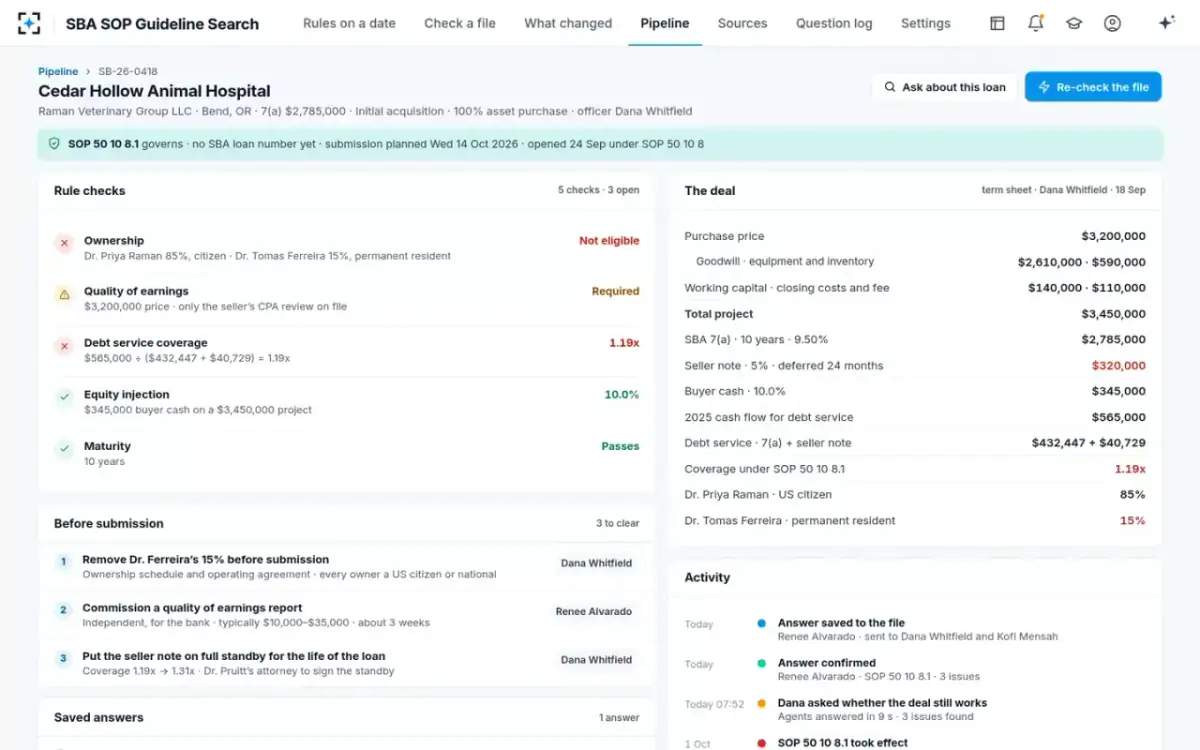
By treating each SBA notice as an event with a date and a list of affected files, not as reading material. When SOP 50 10 8.1 took effect, the useful question for a lending manager was not "what changed?" but "which of my files cross into 8.1, and what must each change before submission?" In the sample pipeline at Harrow Creek Bank, a fictional lender whose files and figures are sample data, eight files opened under SOP 50 10 8 were heading into 8.1. One of them, the Cedar Hollow Animal Hospital acquisition, had three things to clear before submission: a 15% owner who is a permanent resident, a quality of earnings report due at its $3.2 million purchase price, and coverage of 1.19x against 1.25x.
One file crossing into SOP 50 10 8.1, with what must change before submission
Before you buy training, a desk or a tool: six questions to settle
- How many rule questions do we actually get?
Count a month of emails and calls to underwriting. Volume decides which option pays.
- Who answers them today, and how long does it take?
If one person answers everything, that person is the risk.
- How do we learn of a new SBA notice, and who decides when it applies?
One named owner, and a date from which the bank’s answers change.
- What does the loan file show about the rule applied?
A purchase reviewer will ask which version governed and why; an email trail is a weak answer.
- How will we check an outside provider’s answers?
Spot-check structure against the clause, on loans either side of a rule change.
- Where does our own SBA credit policy sit beside the SOP?
When they differ, the stricter should govern, and someone should see the difference.
Is SBA SOP training enough?
Training is enough for people who answer rule questions occasionally and have time to look things up; it is not enough for a desk that answers dozens a week across loans on different versions. The two failures it cannot prevent are applying the right rule to the wrong loan, and leaving no trace of which rule was applied. Both are failures of lookup and documentation, not of understanding.
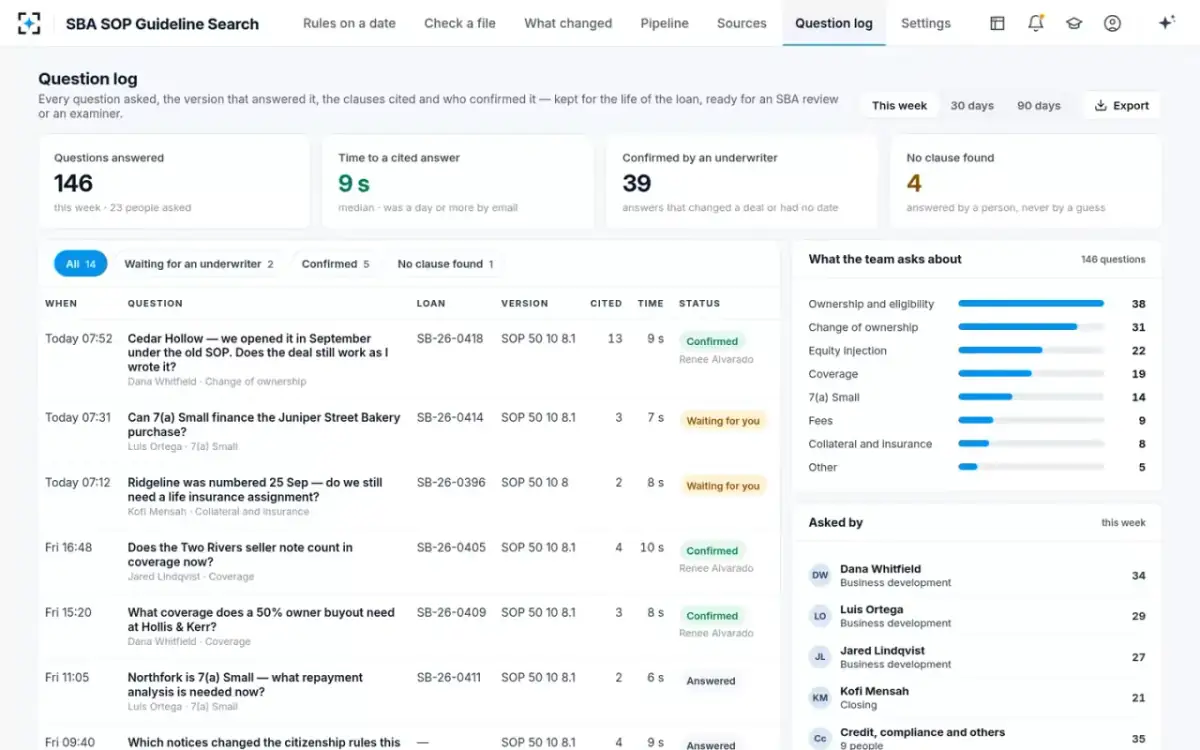
In Botminds' SBA SOP Guideline Search each answer names its version and cites its clauses, so a trained officer reads the reasoning instead of rebuilding it, and an underwriter confirms anything that changes a deal. The question log then becomes the bank's own training material: what people ask, which rules trip them up and where the bank's policy lags SBA. How the same question fares in an SOP PDF, a loan system's rule library and a chat assistant is in SBA lending software vs the SOP PDF; why a general assistant is not a shortcut is in ChatGPT for SBA rules.
The question log doubles as a map of what the team does not yet know
Questions people ask
How much does SBA lender training cost?
Course fees vary by provider and format, and are the smaller cost. The larger one is staff time and refresh: SBA issued two SOPs and at least nine binding notices in about fifteen months, and replaced the published text of SOP 50 10 8.1 once before it took effect, so training has to be repeated to stay current.
Is the lender liable for its LSP's mistakes?
For the guaranty, yes. Under 13 CFR 120.1400 a lender agrees that a violation of Loan Program Requirements is a default under its agreement with SBA, and 13 CFR 120.524 releases SBA from the guaranty for the lender's material non-compliance, regardless of who did the work.
What does it cost to answer an SBA policy question?
By our estimate about six hours of skilled time when it goes by email from officer to underwriter, half of it spent working out which version governs and finding the clause. At the May 2025 median credit analyst wage that is roughly $240 per question before benefits.
Should a small bank outsource SBA underwriting?
It can, and at very low volume a lender service provider may be the only practical way to offer SBA loans. It should keep the means to check the provider's answers against the SOP version in force for each loan, because the guaranty and the liability stay with the lender.
How do small lenders keep up with SOP changes?
By assigning one owner to approve each new SBA notice with its effective date, and by checking which pipeline files cross into each change before submission. SBA lists the notices each new SOP absorbs, as it did for SOP 50 10 8.1 in Information Notice 5000-880695.