SBA lending software usually means a loan origination platform with SBA built in: the application and SBA forms, the credit memo, submission to SBA's loan system, closing documents and the servicing reports. That software runs the workflow. What it rarely does is answer the rule question a business development officer or underwriter has about a specific loan, under the version of SOP 50 10 that governs it; for that most SBA teams still open the SOP, search it and ask a colleague. This guide puts one real question through four tools: Ctrl-F in the SOP, a loan system's rule library, a general chat assistant, and a dated, cited search, Botminds' SBA SOP Guideline Search. Only the last returns the version, the paragraph and the notices together; the others can each be made to work, at a cost the buyer should see before signing.
One SBA rule question, four tools: what each returns
| Ctrl-F in the SOP | Loan system rule library | General chat assistant | Dated, cited search | |
|---|---|---|---|---|
| Knows which SOP governs the loan | No: you choose the PDF | Only if it stores rule versions by date | No, unless told | Yes, and says which date chose it |
| Includes the notices laid over the SOP | No | Only those the vendor has encoded | Unknown | Yes, each with its effective date |
| Returns the paragraph | Yes, among many hits | Rarely: usually a rule, not the text | Sometimes, unverified | Yes, cited sentence by sentence |
| Applies it to the loan’s figures | No | Yes, for the rules it encodes | Only what you type | Yes, with the arithmetic shown |
| Shows your own SBA credit policy beside it | No | If configured | No | Yes; the stricter governs by default |
| Leaves an answer on the loan file | No | A pass or fail flag | No | Question, answer, version, clauses, who confirmed |
What is SBA lending software, and what does it actually check?
It is the software a lender uses to originate, submit, close and service SBA-guaranteed loans, and what it checks is mostly completeness and arithmetic: are the forms filled, do the sources and uses balance, does the guaranty percentage match the loan size, has the fee been calculated. Those checks matter, and they are stable: the 75% and 85% guaranty bands and the $5 million 7(a) maximum do not move with every notice.
The rules that do move are the judgement rules, and they are where SBA's purchase reviewers find problems. When SBA's Inspector General reviewed overturned repair and denial decisions, the categories were repayment ability, eligibility, equity injection, IRS tax verification and debt refinance (SBA OIG Report 26-12). SBA's own improper payment testing traced a root cause to cases where "the source of equity injection funds was not provided" (SBA Agency Financial Report, FY2025). None of these is a form-filling check. Each depends on reading the right paragraph of the right version against the loan's own details.
The test question, and why it is a good one
The question: on an initial acquisition, does a $320,000 seller note with payments deferred for 24 months, then amortizing, count toward the buyer's 10% equity injection? It is a good test because the answer changed in each of the last three SOPs.
Under SOP 50 10 7.1, seller debt could count if it had no balloon payment and, "for the first 24 months of the 7(a) loan", was on full standby, or on interest-only partial standby with at least a quarter of the injection from another source (SOP 50 10 7.1). SOP 50 10 8 required full standby "for the life of the SBA loan" and capped seller debt at "half of the SBA-required equity injection" (SOP 50 10 8). SOP 50 10 8.1 moved the rule into Appendix 15: seller debt "on full standby (no payments of principal or interest for the term of the 7(a) loan) may be considered as equity", and limited sources together "may provide no more than half of the required Equity Injection" (SOP 50 10 8.1, Appendix 15). A note deferred for 24 months counted under 7.1 and counts for nothing under 8 or 8.1.
The figures are from a sample file: Cedar Hollow Animal Hospital, a fictional acquisition at Harrow Creek Bank, a fictional lender, at a $3,450,000 total project with $345,000 of buyer cash. The file was opened in September 2026, under SOP 50 10 8, and goes to SBA in October.
Way 1: Ctrl-F in the SOP finds the words, not the version
Searching the SOP for "seller" finds the paragraph, eventually, in a document whose own table of contents starts Appendix 15 on page 371. What it cannot tell you is whether this loan is under SOP 50 10 8.1 at all. SBA's August 2026 notice said 8.1 would apply to applications "issued an SBA loan number on or after" October 1 (IN 5000-880695); the September reissue says "received by SBA on or after that date", with SOP 50 10 8 used for applications "submitted through September 30, 2026" (IN 5000-882227). The officer has to know both notices exist and which one replaced the other.
Ctrl-F also stops at the text. It does not read the term sheet, so the officer must know that "payments deferred 24 months" is not "full standby for the term of the loan". And it leaves nothing behind: the answer lives in the officer's head or an email.
Way 2: a loan system's rule library checks the rules it was given
A rule library in a loan origination system encodes SBA rules as checks on the loan's data: equity injection at least 10% of project cost, seller note flagged as standby or not, coverage above a threshold. Done well, it catches the arithmetic every time. The questions for a buyer are about time and text. When SBA changes a rule, who updates the check, and how fast? Does the system keep the old check for loans approved under the old SOP, or apply the new one to every file? And does the check cite the paragraph, or only show a pass or a fail?
On the test question, a typical check would read the seller note's standby flag. If the flag was set to "yes" because payments are deferred, the check passes a note that SOP 50 10 8.1 does not count. The error is in the mapping from the term sheet to the flag, which no rule can see. That is not a reason to avoid rule libraries; it is a reason to put the clause beside every flag.
Way 3: a general chat assistant answers fluently, from an unknown version
A general assistant will usually explain that seller notes can count toward equity if on standby. Whether it says "for 24 months" or "for the life of the loan" depends on which SOP text it learned from, and it has no way to know that this loan sits on the September 2026 seam unless the officer tells it. Its citations, if any, need checking by hand. The design differences are set out in ChatGPT for SBA rules; on this question, the risk is a confident "yes, under 24-month standby" that was right in 2024.
Each of the first three tools can produce the right answer. Only the fourth can show, on the file, why it was the right answer for this loan on this date.
Way 4: a dated, cited search returns version, paragraph and notices together
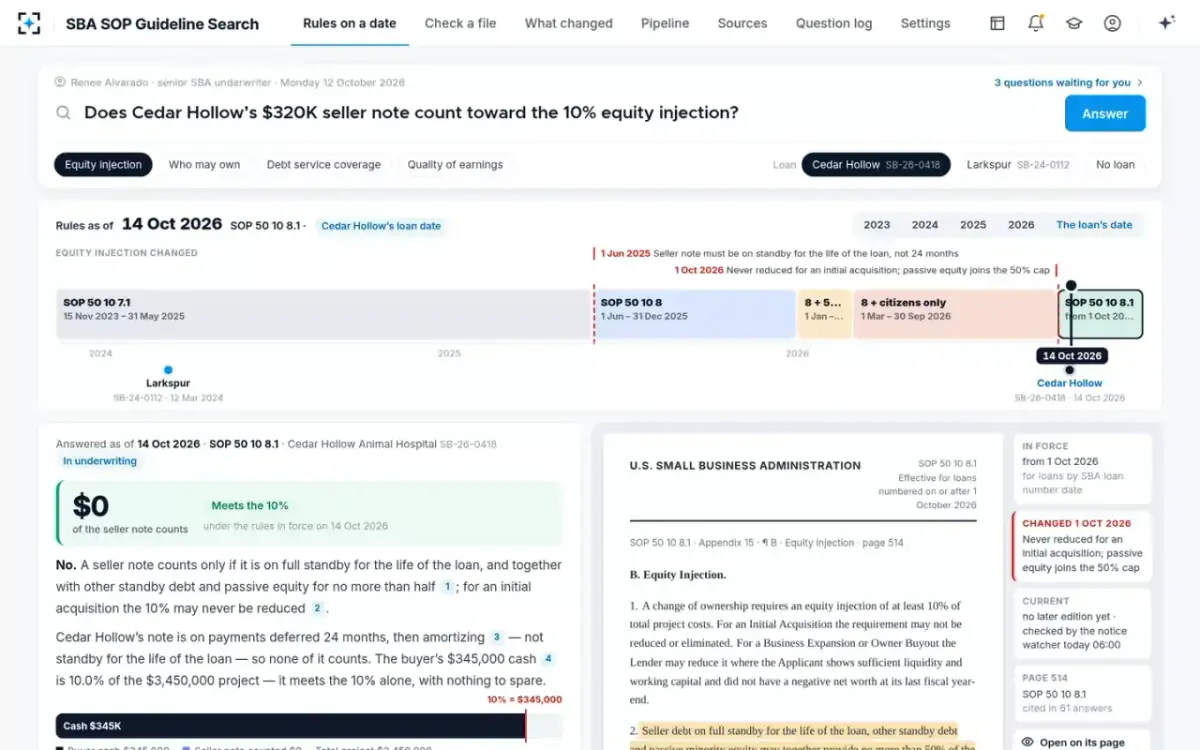
In SBA SOP Guideline Search the officer asks the question with the loan selected. The agents settle the governing date first: the file has no SBA loan number and will be submitted on Wednesday 14 October, so SOP 50 10 8.1 governs, and the answer says why. They find the paragraph in Appendix 15, read the term sheet, and answer: $0 of the note counts, because deferred payments followed by amortization are not full standby for the life of the loan. The buyer's $345,000 is 10.0% of the project, so the injection meets the floor alone.
The test question through SBA SOP Guideline Search, on the sample file
9.1 s
to a dated, cited answer
$0
of the $320,000 seller note counts under SOP 50 10 8.1
10.0%
buyer cash against the project: meets the floor with nothing to spare
4
clauses cited in the answer, each opening on its page
The answer, the loan's figures and the paragraph, with the date that chose it
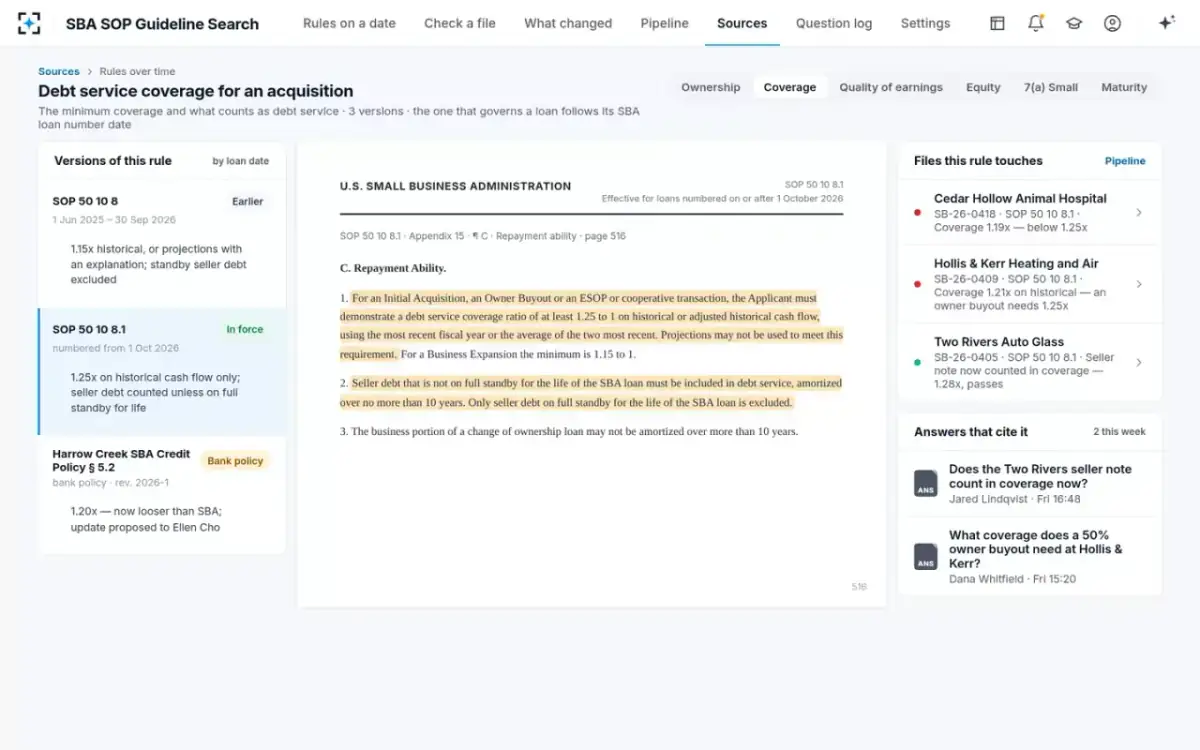
The same view answers the question the lending manager asks next: what did this rule say before, and which other files does it touch? Each rule can be opened across its versions, with the bank's own SBA credit policy beside SBA's text. In the sample, the bank's policy still said 1.20x coverage for acquisitions after SOP 50 10 8.1 raised SBA's minimum to 1.25x, so the policy is flagged for update and the stricter SBA figure governs.
One rule across its versions, the bank's own policy beside it, and the files it touches
What should SBA lending software check?
Beyond forms and arithmetic, it should check the rules SBA reviewers test at purchase, against the version in force, and show its working. For an acquisition under SOP 50 10 8.1 that means at least: every owner, direct and indirect, to 100%, against the citizenship rule; the equity injection and what may count toward it; coverage of 1.25x on historical cash flow, with seller debt that is not on full standby included in debt service; a quality of earnings report at a business purchase price of $3 million or more; and a maturity no longer than the business portion allows.
Five checks against the term sheet, each with the rule in force and the arithmetic
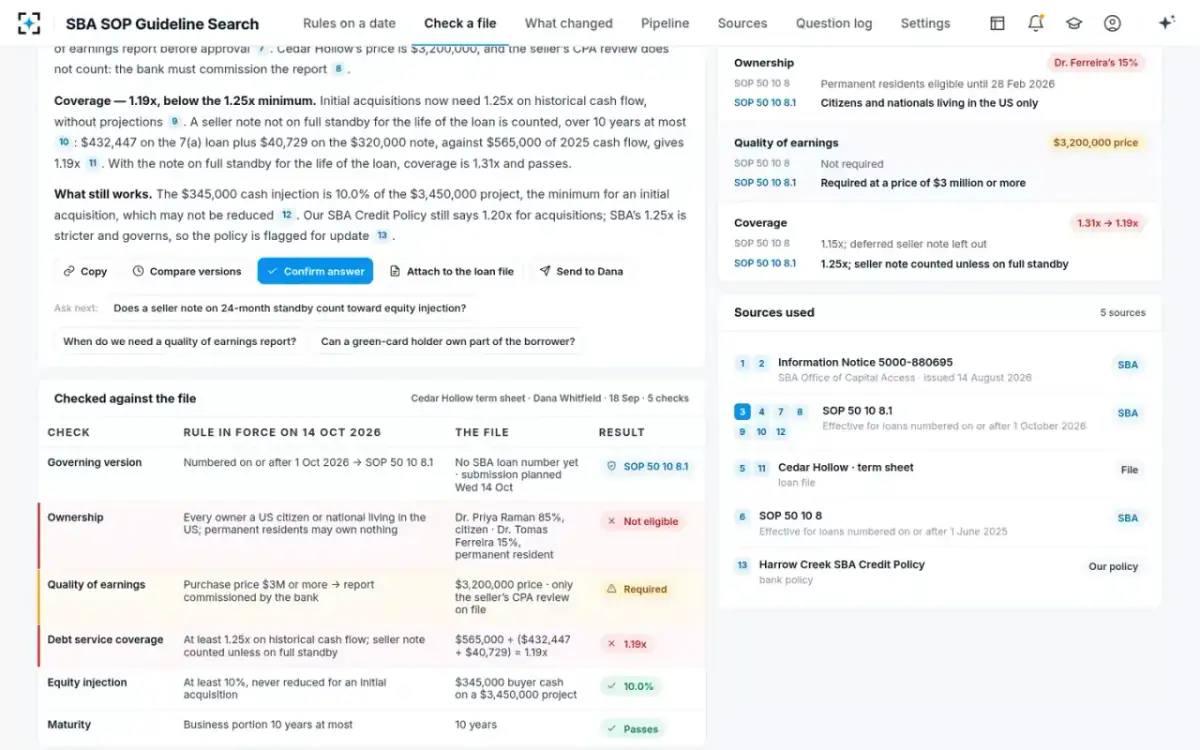
Note what the coverage line does. Because SOP 50 10 8.1 counts seller debt that is not on full standby, the $40,729 a year of seller note payments enters debt service: $565,000 of cash flow divided by $473,176 of debt service is 1.19x, below 1.25x. Put the note on full standby and coverage is $565,000 over $432,447, or 1.31x. A rule library that excluded deferred seller debt, as SOP 50 10 8 did, would have passed the deal.
How do I test SBA rule software before buying it?
Test it on your own closed and in-flight files, on rules that changed, and grade the citations as well as the answers. A vendor's sample deal is built to pass. Your files carry the edge cases: an owner who divested before the loan number, a seller note with an unusual standby clause, a file submitted on the last day of September.
Eight tests to run on SBA lending software, on files of your own
- Ask one question about two loans on either side of a rule change
A seller-note question on a 2024 loan and a 2026 one must return different answers, each naming its version.
- Ask about a file submitted in late September 2026
The tool should surface SBA’s two trigger wordings for SOP 50 10 8.1, not pick one silently.
- Open every citation
The clause must say what the sentence says, in the version claimed.
- Change a term-sheet figure and re-run
The arithmetic should move with it, and the answer should say what changed.
- Load your SBA credit policy
Where it is stricter or looser than SBA, the tool should show both and apply your setting.
- Ask what the SOP does not answer
The right result is a hand-off to a person, not a guess.
- Add a new SBA notice
See who approves it, from which date it answers, and which files it flags.
- Pull the trail for one loan
Question, answer, version, clauses, time and confirmer: what you would hand a purchase reviewer.
How to switch from PDF lookups to a search tool
Start where the risk is, run the tool beside the current process, and let underwriters confirm before anyone relies on it. A sensible sequence for a small SBA desk takes a few weeks, and the order matters more than the speed.
First, load the sources and settle the settings: the SOP versions the bank's live loans fall under, the SBA notices, the bank's SBA credit policy, and the choices the bank owns, such as which date decides when there is no loan number and who must confirm. Second, replay questions the desk has already answered, on closed files, and compare. Third, run it on the live pipeline with every answer confirmed by an underwriter before it reaches a borrower. Only then relax the confirmation rule, if ever, to answers that change a term sheet or have no loan number date.
Keep the PDF. SBA's text is the authority, and a cited search is a faster way to the right page of it, not a replacement. And keep the purchase-review lens: SBA will judge each loan under "SOP 50 10 in effect when the Loan was approved" (SOP 50 57 4), so the version each answer used must stay with the loan for its life. What moved between SOP 50 10 8 and 8.1, rule by rule, is in SBA SOP 50 10 8.1 changes.
Questions people ask
What is the best SBA lending software?
The best fit depends on the job. For workflow, forms and submission, a loan origination system with SBA support; for rule questions, a tool that answers from the SOP and notices in force for the loan and cites them. Test both on your own files, on rules that changed between SOP 50 10 8 and 8.1.
How do I search the SBA SOP quickly?
Start from the right version: SOP 50 10 8.1 for applications SBA receives from October 1, 2026, SOP 50 10 8 for those submitted through September 30, 2026. Appendix 15 now holds most change-of-ownership rules; check the notices issued since the SOP's effective date as well, because they amend it.
Does LOS software include SBA rules?
Many loan systems include SBA forms, guaranty and fee arithmetic, and some encode eligibility and structuring checks. Ask how quickly each rule is updated after an SBA notice, whether older loans keep the older rule, and whether each check shows the SOP paragraph behind it.
Can a chatbot replace the SOP?
No. SBA's SOPs and notices are binding Loan Program Requirements under 13 CFR 120.10, and the lender remains responsible for applying them. A tool can find and apply the right paragraph faster; it cannot become the authority, and its answer should always point back to SBA's text.
What does a seller note need to count as equity injection under SOP 50 10 8.1?
It must be subordinated to the lender and on full standby, with no payments of principal or interest for the term of the 7(a) loan, and together with other limited sources it may provide no more than half of the required injection. A note with payments deferred for two years does not qualify.