The types of protocol deviations in clinical trials fall on two axes, not one. The first is cause — consent, eligibility, visit schedule, dosing, prohibited medicines, endpoint assessments, clinical checks, randomisation — which is what a study acts on when it wants fewer of them next month. The second is impact, which is what the regulator and the clinical study report care about, and which collapses to two values: important, and everything else. A log that holds one list is doing one of the two jobs. Botminds' Protocol Deviation Management keeps both: each deviation is filed under a cause and a sub-cause for the fix, and answered for importance against the study's own classification specification for the report.
The counts on this page come from a fictional sample study inside the solution — Northwind Bio's VLT-302, Veltrimab in plaque psoriasis, Phase 3, 64 sites and 612 participants, with the contract research organisation Ashgrove Research running 40 sites. The published research is linked where it appears; the sample study's eight causes are its own specification, not a standard anyone else uses.
What are the types of protocol deviations in clinical trials?
Ask the question of a regulator and you get three different answers, because three different things are being named. ICH E3 names reporting categories, the groupings a clinical study report uses in Section 10.2. FDA's December 2024 draft guidance names levels — participant, site, study — and an impact split between important deviations and all others. A sponsor's own deviation plan names causes, which neither regulator prescribes, because causes are local: they depend on what this protocol asks sites to do.
The confusion is worth naming, because teams argue about taxonomy when they are not arguing about the same axis at all. A missed pre-dose pregnancy test has a cause (a visit-day process failure in clinical checks), a level (participant), an impact (important, on the participant limb) and a reporting category (patient management). All four are true at once, and each one goes to a different reader.
Cause and impact are two different axes
The two axes do not correlate, and in the sample study they run almost opposite. Visit scheduling produces a third of all deviations and not one important deviation. Eligibility produces one deviation in twenty and a quarter of all the important ones. A study that tries to reduce its deviation count will work on visit scheduling; a study that tries to protect its primary analysis will work on screening and on assessor training. Those are different projects with different owners, and the taxonomy is what keeps them from being confused.
The same study, counted twice: all deviations, then the important ones
All 418 deviations, by cause
- Visit schedule · 34%
- Endpoint assessments · 21%
- Study treatment · 15%
- Prohibited medicines · 11%
- Consent, eligibility, clinical checks, randomisation · 19%
The 57 important ones, by cause
- Eligibility · 25%
- Endpoint assessments · 21%
- Study treatment · 16%
- Clinical checks · 12%
- Consent, prohibited medicines, randomisation · 26%
Reading one axis through the other is the mistake that produces a site action plan aimed at the wrong thing. The honest summary of this study is that it has a scheduling problem, which is irritating and cheap, and a screening problem, which is small and expensive. Only the second one threatens the analysis.
The eight causes a study can actually act on
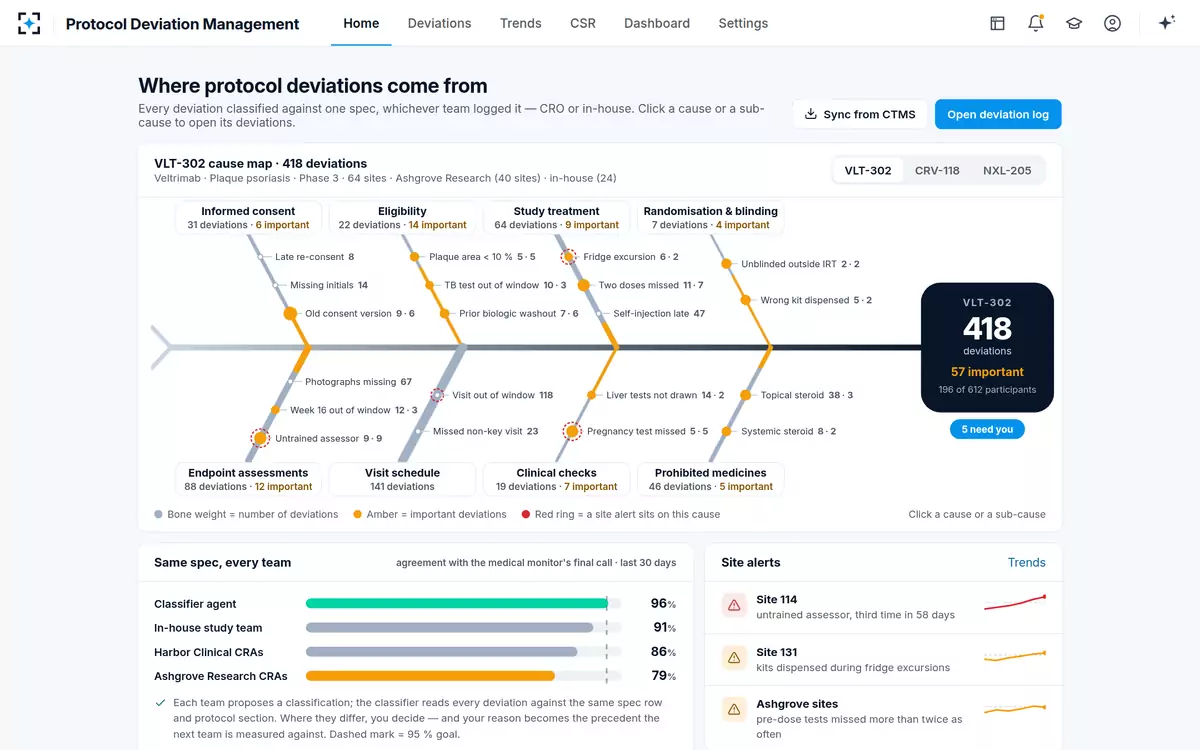
A cause list is usable when every entry names something a person could change. "Site error" is not a cause; "the assessment was done by staff not on the training log" is, because it has an owner and a fix. The sample study's specification carries eight, each with sub-causes, and the sub-cause is where the action lives.
Eight causes on one Phase 3 study, with the important share of each
| Cause | Deviations | Important | The sub-causes behind them | What a fix would have to change |
|---|---|---|---|---|
| Visit schedule | 141 | 0 | Visit out of window 118 · missed non-key visit 23 | Site staffing and scheduling |
| Endpoint assessments | 88 | 12 | Photographs missing 67 · Week 16 out of window 12 · untrained assessor 9 | Assessor training and site workload |
| Study treatment | 64 | 9 | Self-injection late 47 · two doses missed 11 · fridge excursion 6 | Participant adherence and product handling |
| Prohibited medicines | 46 | 5 | Topical steroid 38 · systemic steroid 8 | Participant and treating-physician awareness |
| Informed consent | 31 | 6 | Missing initials 14 · superseded consent version 9 · late re-consent 8 | Document control at the site |
| Eligibility | 22 | 14 | TB test out of window 10 · prior biologic washout 7 · plaque area under 10% 5 | Screening rigour |
| Clinical checks | 19 | 7 | Liver tests not drawn 14 · pre-dose pregnancy test missed 5 | Visit-day process |
| Randomisation and blinding | 7 | 4 | Wrong kit dispensed 5 · unblinded outside the system 2 | Dispensing and emergency procedures |
Three rows repay a second look. Endpoint assessments is the largest important group after eligibility, and most of it sits in one sub-cause — nine assessments by staff not on the site's assessor training log, every one of them important, because a primary efficacy score made by an untrained assessor is exactly the data limb of the importance test. Prohibited medicines is 46 deviations and 5 important ones: the topical steroid sub-cause is mostly participants treating themselves between visits, and only the systemic cases reached the threshold. Randomisation and blinding is seven deviations and four important ones — the smallest cause, and after eligibility the highest important share on the study, which is what you would expect of a cause where every event touches the allocation.
Eight causes, their sub-causes and the important ones — the cause map in Protocol Deviation Management
Participant level, site level, study level: where a deviation happened
FDA adds a third axis that most deviation logs do not carry, and it is the one that decides how many participants a single event touches. "Deviations may occur at the participant level (e.g., missed scheduled visit, inclusion of a participant not meeting eligibility criteria, failure to conduct a protocol-specified procedure during a visit), at the site level (e.g., storage of investigational products outside of protocol-required temperature range), or at the study level (e.g., premature unblinding of treatment assignments)" (FDA draft guidance, section III.A).
The three levels, and what each one costs to put right
FDA's own example: A missed scheduled visit; a participant enrolled without meeting eligibility criteria; a protocol-specified procedure not conducted at a visit.
What it means for the study: One participant's data is in question. The consequence is individual: an analysis-set flag, a safety follow-up, a conversation with one investigator.
FDA's own example: Storage of investigational products outside the temperature range the protocol requires.
What it means for the study: Every participant dispensed from that stock is in question at once. One event, many records — and a corrective action that belongs to the site, not to a participant.
FDA's own example: Premature unblinding of treatment assignments.
What it means for the study: The analysis itself is in question. These are rare, they are important almost by definition, and they are the ones a sponsor hears about last if nothing routes them upward on the day.
Level is also the cheapest early-warning signal a deviation log can carry, because a site-level event hiding inside a participant-level record is the usual shape of a problem found too late. In the sample study a fridge excursion at one site was logged as a treatment deviation on a single participant; what made it worth a decision was that kits dispensed after the excursion and before release had gone to others.
What are examples of major protocol deviations?
Major is the older word for important, and the examples that earn it are the ones that reach a planned analysis or a participant protection. Rather than repeat the guidance's list, here is the same question answered on real-shaped events — the important deviations open in the sample study, each with the reason it crossed the line.
Eight important deviations from one study, and why each one is important
| The deviation | Cause | Which test it failed |
|---|---|---|
| Week 16 PASI and sPGA performed by a coordinator not on the site's assessor training log | Endpoint assessments | Data: the primary efficacy assessment, made outside the protocol's assessor requirement. |
| Site dispensed kit 4417 instead of the assigned kit 4471 | Randomisation and blinding | Data: the allocation the randomisation scheme specified was not the one given. |
| Week 8 dose given without the protocol-required pre-dose pregnancy test | Clinical checks | Participant: a protective procedure the protocol placed before the dose was not performed. |
| Participant screened with plaque area at 8% where the protocol requires at least 10% | Eligibility | Data: a key criterion that defines the population the trial is answering a question about. |
| Prior biologic washout of 9 weeks where the protocol requires 12 | Eligibility | Both: residual drug effect bears on the endpoint, and on what the participant was exposed to. |
| Consent signed on a superseded version of the form | Informed consent | Participant: consent is the protection, and it was given to the wrong document. |
| Dose increased without the pre-dose ECG check the protocol requires | Study treatment | Participant: a safety check the protocol made a condition of the increase. |
| Participant unblinded outside the randomisation and supply system | Randomisation and blinding | Data: blinding is a study-level protection, and the unblinding left no controlled record. |
What all the other deviations look like
The guidance is as explicit about the rest as it is about the important ones: "All other protocol deviations that do not meet the definition of an important protocol deviation may encompass the commonly used terms minor, noncritical, and non-significant deviations." Its examples are small visit-window departures, a signed consent with a page missing a participant's initial, and a study procedure not performed that is neither relevant to safety monitoring nor related to an important efficacy endpoint.
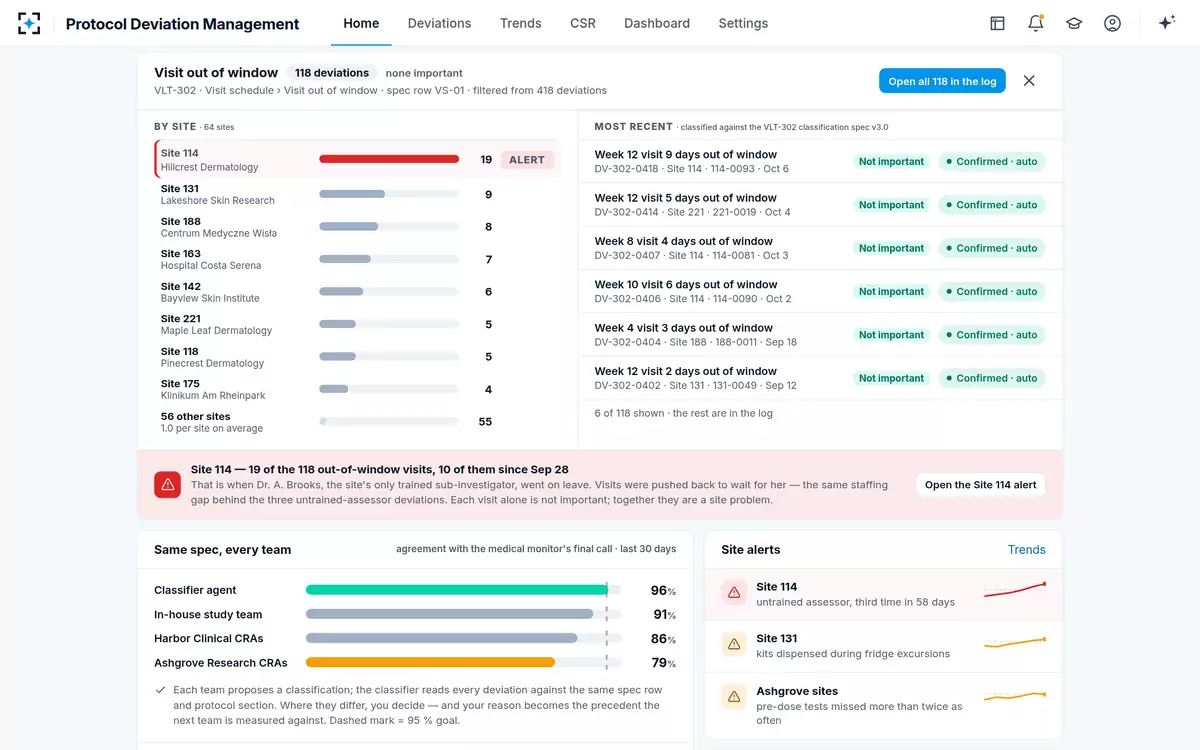
In the sample study these are the bulk: 118 visits outside their window, 67 missing photographs, 47 late self-injections, 23 missed non-key visits, 14 consent forms with an initial missing. None is important on its own, and the log says so — every one of them classified under its specification row, most of them confirmed without a person touching them because the site's proposal and the classification agreed. What makes them worth keeping is the second reading: 19 of the 118 out-of-window visits belong to one site, and ten of those nineteen arrived after the site's only trained sub-investigator went on leave. That is a site problem written in events that are individually trivial.
One cause opened in place: 118 out-of-window visits, and the site holding 19 of them
Five grades, and why most deviations sit in the bottom two
Two values — important and all other — are enough for reporting and too coarse for managing. A published alternative worth knowing is the five-grade scale proposed in Perspectives in Clinical Research in 2016, which grades by impact rather than by label: "A new method has been proposed by which deviations are classified in five grades from 1 to 5. A deviation of Grade 1 has no impact on the subjects' well-being or on the quality of data. At the maximum, a deviation Grade 5 leads to the death of the subject" (Perspectives in Clinical Research 2016;7(3):132–136). Between them sit Grade 2, minor impact on data quality; Grade 3, minor impact on participant safety; and Grade 4, major impact on either.
The authors applied the scale to every deviation recorded at one Indian research centre between January 2013 and September 2015, and the distribution is the finding.
Grade-wise distribution of 368 deviations at one research centre
The authors put the pattern plainly: "the relation between impact and incidence of deviations was inverse (deviations with minimum impact had high incidence, whereas those with maximum impact were very few)". Nine deviations in three years carried major impact; none was fatal. The same paper records something else worth sitting with — under the centre's previous two-value scale, deviations called major fell from 32 in 2013 to 6 in 2015 while the total did not fall at all — 120, then 121, then 127 in the first nine months of 2015. A scale whose top band is being used less each year is either describing a study that is improving, or describing a team that has recalibrated. Only criteria written down in advance let you tell those apart.
Visit windows, consent pages and temperature logs: the three arguments
Three categories produce most of the classification disputes on most studies, and each argument has a resolution that is already in the guidance.
Visit windows. FDA names "small deviations from protocol-specified visit windows" as an example of all other deviations, and the sample study classifies 118 of them not important. The argument starts when the visit in question carries the primary endpoint. The answer is that the window is a separate question from the assessment: a Week 16 visit on Day 113 is inside a three-day window and compliant, and if the assessment at that visit was made by an untrained assessor, the deviation is important for a reason that has nothing to do with timing.
Consent pages. A missing initial on a signed consent form is an all-other deviation in the guidance's own example. A consent taken on a superseded version of the form is not the same event: the participant agreed to a document the study had replaced, which touches the protection rather than the paperwork. Both appear in the sample study, classified differently, under different specification rows.
Temperature logs. Storage outside the protocol's range is FDA's example of a site-level deviation, and the argument is whether an excursion is a deviation at all when the product was later released by the sponsor's own assessment. Two things decide it: whether the protocol or its plans specified the storage condition, and whether any kit was dispensed between the excursion and the release. In the sample study a kit dispensed after a fridge excursion and before release was proposed not important by the site's team and classified important — the kind of disagreement that exists to be signed by a person rather than settled by a rule.
Mapping free text onto a category without losing the sentence
Every deviation arrives as prose: a sentence or a paragraph written by a coordinator or a monitoring associate, in the site's own words, often after the fact. Categorising it is a translation, and the usual failure is that the translation replaces the original. Six months later the log holds "Endpoint assessments / untrained assessor" and nobody can tell whether the assessor was untrained, unlisted, or trained on a prior version of the scale.
What a deviation record needs before anyone can categorise it at all
- What happened, in the words of whoever saw it
The original sentence, kept whole and attributed to its source system or visit report. The category points at it; it does not replace it.
- The participant and the visit
Participant identifier and the scheduled visit, so the deviation can be joined to the data it may have affected.
- Two dates, not one
When it occurred and when it was discovered. The gap between them is the only honest measure of how well a study is finding its own deviations.
- Who reported it and from where
The site, the monitoring team or the central review — and the system it came from. Studies with several teams need this to see whether the teams are classifying alike.
- The protocol provision in play
Section and version of the protocol the record is being read against. Without it, the category is an opinion.
- What was done about it
The remedy, if remedy was possible, and whether a corrective action was raised. Recurrence is what turns a category into a root-cause analysis.
In the solution the first step on every deviation is to write that clean record — participant, visit, dates and what happened, in the site's own words, marked with the system it was read from — before any classification is attempted. The category then has something to point at, and the eventual decision quotes it.
The categories that have to survive as far as the submission
ICH E3 asks the clinical study report to summarise deviations by centre and to group them, and it offers four example groupings: participants who entered without meeting the entry criteria, participants who met a withdrawal criterion and stayed in, participants given the wrong treatment or an incorrect dose, and participants who took an excluded concomitant treatment (ICH E3, Section 10.2).
Those four groupings are more than thirty years old and they still decide the shape of the deviation text in a clinical study report. They are also, notably, not a cause taxonomy: they are four ways a deviation can bear on the interpretation of a result, and a study's own eight or twelve causes have to roll up into them cleanly or the medical writer does the mapping by hand at database lock. The same text asks that the individual participants behind those groupings be listed in Appendix 16.2.2, broken down by centre for multicentre studies — which is why "by centre" belongs in the taxonomy from the first deviation, not at the end.
A submission's deviation dataset adds its own vocabulary, with a category and a subcategory variable on every record, so a study that invents its categories late ends up mapping twice. Choosing a cause list that already rolls up to the report's groupings, and recording the site on every record, costs nothing at the start of a study and saves a reconciliation at the end of it. The deviation plan is where that list is written down, and the systems a study already runs on decide how much of it is captured without anyone retyping. To see the eight causes, the grades and the listing on your own deviation log, start from Protocol Deviation Management.
Questions people ask
What categories are used for protocol deviations?
There is no mandated list. Most studies carry a cause taxonomy of their own — consent, eligibility, visit schedule, study treatment, prohibited medicines, endpoint assessments, clinical checks, randomisation is a common eight — and then classify each deviation as important or not against pre-specified criteria. The clinical study report groups them again for reporting, and ICH E3 suggests four groupings for that text: entry criteria not satisfied, withdrawal criteria developed but not withdrawn, wrong treatment or incorrect dose, and excluded concomitant treatment.
What is the difference between a participant-level and a site-level deviation?
A participant-level deviation touches one person's data or care — a missed visit, a procedure not performed, an ineligible enrolment. A site-level deviation is a single event that touches everyone the site handled, FDA's example being storage of investigational product outside the protocol's temperature range. The practical difference is scope of remedy: one is a follow-up, the other is a corrective action and a list of affected participants.
Is a missed visit a protocol deviation?
Yes. FDA names a missed scheduled visit as an example of a participant-level deviation. Whether it is important depends on what the visit carried: a missed non-key visit usually is not, while a missed visit that was to collect a primary or secondary endpoint assessment, or a safety assessment, generally is — failure to collect data to evaluate important study endpoints is on FDA's list of important deviations.
Is a temperature excursion a protocol deviation?
If the protocol or its related plans specified the storage condition, yes — FDA uses it as the example of a site-level deviation. Importance turns on exposure: whether product that fell outside the range was dispensed before the sponsor assessed and released it. An excursion caught, quarantined and released on a documented assessment is a quality event with no participant consequence; the same excursion with doses already given is a different classification.
How many grades of protocol deviation are there?
For reporting, two: important, and all other. For managing, studies use more. The five-grade scale published in Perspectives in Clinical Research runs from Grade 1, no impact on data quality or participant safety, to Grade 5, leading to a participant's death, and in the authors' own data 289 of 368 deviations fell in the bottom two grades while nine reached Grade 4 and none reached Grade 5.
Should a deviation be categorised by cause or by severity?
By both, in separate fields. Cause answers "what do we change"; severity answers "what do we report". Merging them produces a log that can do neither job: either the severe deviations are scattered across a dozen causes with no way to count them, or the causes are flattened into major and minor and the site action plan has nothing to aim at.