A protocol deviation management plan is the document that says, in advance, how this study will decide what a deviation is, how important it is, who is told, how fast, and what happens when the same thing keeps happening. Most templates circulating as a protocol deviation management plan template get the shape right and the weight wrong: they give a page each to scope, roles and definitions, and a paragraph to the classification specification — the one section everything else depends on. Botminds' Protocol Deviation Management treats that specification as the live object it is: one versioned specification per study, a row per deviation type, and every classification citing the row it was decided under.
The worked plan on this page is a fictional sample study inside the solution — Northwind Bio's VLT-302, Veltrimab in plaque psoriasis, Phase 3, 64 sites and 612 participants, run with the contract research organisation Ashgrove Research. Its routes and thresholds are one sponsor's configuration, not a requirement. The regulators' words are quoted and linked where they appear.
What is a protocol deviation management plan?
It is a study-level operating document, usually written by clinical quality or the study manager before first participant in and approved alongside the monitoring plan and the statistical analysis plan. Nothing in FDA's regulations or in ICH E6(R3) names a document called a protocol deviation management plan. What they name are the things such a document has to contain: trial-specific criteria for classifying deviations as important, a protocol that pre-specifies which types will be considered important, a time frame and a manner in which the sponsor expects to receive deviation information from investigators, and records and reports of noncompliance including protocol deviations and corrective and preventive actions.
So the plan is not itself required; its contents are. That distinction matters when a sponsor is deciding how much to write. A plan that restates the regulations and defers every judgment to "case-by-case assessment by the medical monitor" has satisfied nothing, because the criteria are the deliverable. A plan of ten tight sections, one of which is a table that grows, satisfies all of it.
What a protocol deviation management plan must contain
Ten sections, their owner, and the week each is first used
- 1. Scope and definitions · clinical quality · at approval
Which studies and sites the plan covers, which documents count as the protocol (the protocol and its related plans and procedures), and the two-value importance scale with nothing above it.
- 2. The classification specification · medical monitor and clinical quality · before first participant in
One row per deviation type: cause, sub-cause, importance, the protocol section it breaches, and where it goes. This is the section the other nine serve.
- 3. Roles, and the people in them · study manager · at site initiation
Who proposes, who signs, who may not decide, and a named back-up for every role that can block a clock.
- 4. Reporting timing · sponsor · at site initiation
How fast a site reports an important deviation, and when everything else arrives. FDA asks sponsors to set this explicitly rather than leaving it to the monitoring visit.
- 5. Routes and decision rights · study manager · at the first disagreement
Which kinds of deviation go to the medical monitor, to clinical quality, to the statistician — and which may confirm without a person at all.
- 6. The recording standard · data management · at the first deviation
The fields every deviation record carries, including the two dates, the site, and the original sentence from whoever saw it.
- 7. Trending rules and thresholds · clinical quality · in the first month of enrolment
The rate, its denominator, the threshold, the window, and the action each rule proposes. Written before there is data, so the threshold is not chosen to fit it.
- 8. Corrective actions and root cause · clinical quality · at the first recurrence
What triggers a root-cause analysis, who runs it, and what is documented whether or not further action follows.
- 9. Review and reclassification · medical monitor · at the first periodic review
How often the criteria are revisited, who approves a new version, and how the unimportant pile is re-read for reclassification.
- 10. Reporting out · medical writer and statistician · at database lock
The clinical study report text, the participant listing by site, the submission dataset, and the interface to serious breach notification. Its field requirements belong in section 6, three years earlier.
When each section of the plan is first exercised, on a four-year Phase 3
- Set-upsections 1–4
- Enrolmentsections 5–8
- Treatment and follow-upsection 9
- Lock and reportingsection 10
Read the timings in that list as the real test of a plan. Eight of the ten sections are first exercised during set-up and enrolment, most of them in the study’s opening weeks, which is why a plan finished after first participant in is a plan written against events that have already happened. Section 10 is first used at lock, three or four years later — but the fields it needs were fixed in section 6 on day one, and no amount of effort at lock can add a field nobody collected.
The classification specification: one row per deviation type
The protocol should pre-specify which types of protocol deviations will be considered important, although with accumulating data and review, the list of important protocol deviations can be updated over time.
FDA, Protocol Deviations for Clinical Investigations, draft guidance, December 2024, section III.B.2
ICH E6(R3) puts the same duty on the sponsor in its own terms, asking it to set trial-specific criteria for classifying deviations as important (section 3.9.3). That is the load-bearing requirement, and a table is the only honest way to meet it. Prose criteria — "deviations affecting primary endpoints are generally important" — cannot be applied consistently by four teams across sixty-four sites, because every word in them is arguable. A row can be applied, because it names the event, the answer and the protocol provision behind it.
Four rows from one study's classification specification, as Protocol Deviation Management holds them
| Row | The deviation it covers | Importance | Protocol section | Where it goes, and what the site sees |
|---|---|---|---|---|
| EA-03 | PASI or sPGA performed by an assessor not on the site's assessor training log | Important | VLT-302 v5.0 §8.1.2 — efficacy assessments | Medical monitor signs. Per-protocol review by the statistician when it is a primary-endpoint visit. The site sees the signed reason and retrains. |
| VS-01 | Scheduled visit performed outside its protocol window | Not important | VLT-302 v5.0 §6.2 — visit schedule and windows | Confirms without a person when the team and the classification agree at or above the confidence floor. The site sees it only if a trending rule fires. |
| CK-01 | Dose given without the protocol-required pre-dose pregnancy test | Important | VLT-302 v5.0 §7.4 — pre-dose safety checks | Medical monitor signs; at an EU or UK site it also goes to clinical quality the same day with a seven-day due date on it. |
| Proposed | Kit dispensed after a temperature excursion and before the sponsor released the affected stock | Important | VLT-302 v5.0 §5.4 — product storage and release | Drafted after a disagreement the specification had no row for. Until it is approved, deviations of this shape go to the medical monitor unclassified. |
Three design decisions make rows like these work. Each names an observable event rather than a judgment, so a coordinator can match it. Each carries the protocol section, so the classification cites a document rather than an opinion. And each carries the route, so importance and consequence are decided in the same place — which is what stops a study from classifying a deviation important in March and remembering in September that the statistician was never told. The cause taxonomy that the rows sort under is the other half of the same table.
Pre-specified, then updated: what the guidelines actually ask for
FDA's wording, quoted above, is unusually precise about the sequence, and it is a sequence rather than a single act: the protocol names the important deviation types first, and the list is updated as data and review accumulate (FDA draft guidance, section III.B.2).
Two obligations are hiding in that sentence. Pre-specification means the criteria exist before the deviations do — which is the only arrangement under which a classification cannot be accused of having been fitted to a result. Updating means the criteria are expected to move, and a plan that has never been revised after three years of enrolment is not evidence of stability; it is evidence that nobody re-read the unimportant pile. ICH's own E3 Questions and Answers makes the same allowance from the other direction, letting sponsors amend or add to the examples it gives in consideration of a trial's requirements, and asking only that substantial changes be described clearly for the reviewer.
One more thing the sequence implies: deviations should get rarer as the plan does its other job. FDA's guidance gives a passage to protocol design as deviation prevention — flexible enrolment criteria where they can be flexible, a streamlined design, flexible time frames for collecting essential data, remote assessments where possible, nonessential activities eliminated, and prohibited-medicine lists reviewed so they exclude only what has to be excluded. A deviation plan that never feeds back into the next amendment is treating deviations as weather.
Timing: the clock the sponsor sets for its sites
Sites do not know how fast to report unless the sponsor says so, and the guidance expects the sponsor to say so in terms: sponsors "should inform investigators of the time frame and the manner in which they expect to receive information about protocol deviations (e.g., important protocol deviations should be reported to sponsor expeditiously within x days of occurrence; all other deviations reported when the site monitor visits the trial site)".
The x in that sentence is the sponsor's to fill in, and filling it in badly costs in two directions. Too long, and a deviation that may turn out to be a serious breach with its own seven-day clock spends half the clock in transit. Too short for everything, and sites report late or in bulk, which is worse than reporting slowly. The usable shape is two timings, not one: a short expedited clock for the deviation types the specification already marks important, and the monitoring visit for the rest. Because importance is a row in the table, the site does not have to make the judgment to know which clock applies — a quiet benefit of writing the specification first.
The plan should also say what "aware" means. A deviation that occurred on 1 October and was discovered on 5 October has two dates, and the clocks in this area do not agree on which one they use. FDA's own example counts the site's reporting clock from occurrence, while the serious breach notification at EU and UK sites runs from the moment the sponsor becomes aware. A plan that names the date each clock starts from removes the argument before it happens. Studies that record one date collapse the distinction and lose the ability to measure their own detection lag.
Routes: who decides which kind of deviation
A route answers a question the importance flag does not: now that we know, who is owed this, and by when. Four routes cover most of a study, and each exists because a different person holds a decision nobody else can make.
One deviation through the plan: from the site's sentence to the signed classification
Agent
Read into one recordPull the deviation from the trial systems and the monitoring visit report into a single record: participant, visit, both dates, and what happened in the site's own words.
Never: edits the source system, or carries a participant's name or contact details
Agent
Classify against the specificationMatch the row, cite the protocol section breached, and answer both importance questions — data, and participant rights, safety and well-being — with a confidence.
Never: classifies without naming a specification row and a protocol section
Agent
Check it against what has been signed beforeFind the closest signed decisions on the same rule, from any team on the study or the programme, and say how many agree.
Never: counts an unsigned proposal as a precedent
Agent
Route itSend a disagreement or an important deviation to the medical monitor; a possible serious breach at an EU or UK site to clinical quality with its due date; a per-protocol consequence to the statistician.
Never: decides a serious breach, or removes a participant from an analysis set
A person decides
Decide and signThe medical monitor reads both opinions with the protocol passage and the precedents beside them, chooses, and writes the reason in words. The signature states what it means.
Never: signs without a reason, or reopens a signed decision without one
A person decides
Act on itThe study manager takes the proposed action — retraining, a site conversation, a question to the contract research organisation — and the statistician takes the analysis-set consequence.
Never: lets an alert close itself
Agent
Report it outCarry the confirmed decision into the clinical study report listing by site, the summary text and the submission dataset, each sentence citing the decision it came from.
Never: uses a decision that has not been signed
In the sample study the four routes are settings rather than prose: a disagreement between a contract research organisation and the classification goes to the medical monitor; eligibility and dosing questions go to the medical monitor with a named back-up monitor; a possible serious breach at an EU or UK site goes to clinical quality with a seven-day due date; and per-protocol impact goes to the statistician. A deviation confirms without a person only when the team and the classification both say not important at or above the confidence floor, which is adjustable and currently sits at 0.90 — and one automatic confirmation in ten is re-read by a person each week, which is the part of the arrangement that makes the other nine defensible.
The specification, the routes and the confidence floor as settings — in Protocol Deviation Management
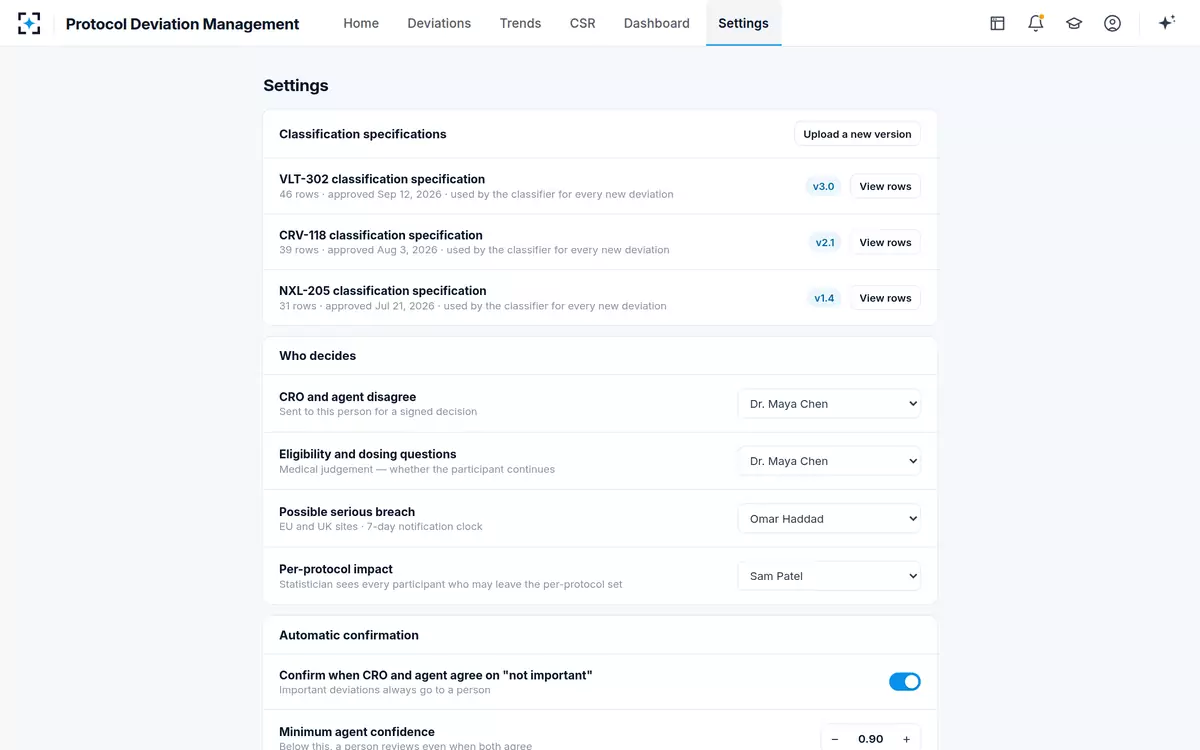
Trending rules, written before there is anything to trend
A trending rule has four parts, and plans that write only the first one are the reason site reports arrive with a chart and no conclusion. The parts are the measure, its denominator, the threshold and the window — and then a fifth, which is the action the rule proposes when it fires.
Denominators are where most of the honesty lives. Deviations per site flatters large sites and condemns small ones; deviations per participant ignores how far through the schedule each participant is. The sample study uses important deviations per 100 participant-visits, by site, by cause and by team, recalculated nightly, with a threshold of 2.0 — a measure that survives a site enrolling late and a site enrolling fast. Alongside it sit two rules of a different shape: the same cause at one site three times in sixty days, and a team's missed pre-dose checks running at more than twice the study rate. The first is a rate, the second a run, the third a comparison, and a plan needs all three because site problems arrive in all three shapes.
Writing the thresholds before enrolment is not a formality. A threshold chosen after the data arrives is a threshold chosen to produce a number of alerts somebody is comfortable with, and everyone in the room knows it. Writing it first also forces the question nobody enjoys: what will we actually do when this fires? In the sample study each rule carries its proposed action — retraining for a site above the rate, a storage check for a site with repeat excursions, a question to the contract research organisation whose sites miss pre-dose tests more than twice as often — and the person it goes to. An alert with no proposed action gets read; an alert with one gets closed.
Where should the deviation plan live: the protocol, or its own document?
Both, and the split is not arbitrary. FDA's language puts the pre-specification of important deviation types in the protocol itself, because the protocol is the document sites, ethics committees and reviewers all read. What belongs in a separate plan is everything operational: the routes, the timings, the trending thresholds, the recording standard, the review cadence. Those change during a study, and changing them should not require a protocol amendment.
Criteria written down in advance against judgment called at the review
Criteria pre-specified in a table: Which clock applies, from the row, before the deviation is reported.
Case-by-case assessment at the monthly review: Report it and wait. The site learns the classification weeks later, if at all.
Criteria pre-specified in a table: Measurable: every team's proposal sits against the same row, so drift is a number.
Case-by-case assessment at the monthly review: Unmeasurable. Each team's rate of agreement with the sponsor is an impression.
Criteria pre-specified in a table: A new version, dated and approved, with earlier decisions still readable against the version in force then.
Case-by-case assessment at the monthly review: A silent drift in judgment that leaves no trace anyone can audit.
Criteria pre-specified in a table: A scheduled re-read against the rows, which is how a run of small deviations becomes one important finding.
Case-by-case assessment at the monthly review: Rarely happens; the pile is large and nobody owns it.
Criteria pre-specified in a table: The listing is a filter over signed decisions, grouped by site.
Case-by-case assessment at the monthly review: The medical writer rebuilds the listing and the summary text by hand from the log.
Criteria pre-specified in a table: The criteria, the decision and the reason are one chain, and each decision names the version it was made under.
Case-by-case assessment at the monthly review: The decision exists; the criterion behind it has to be reconstructed from memory.
The sections that pay for themselves at database lock
Device studies have the bluntest version of the requirement in regulation: an investigator must keep "the protocol, with documents showing the dates of and reasons for each deviation from the protocol" (21 CFR 812.140(a)(4)). Dates and reasons, per deviation, kept with the protocol. ICH E6(R3) asks for the same shape of evidence in its list of essential records: "Records and reports of noncompliance including protocol deviations and corrective and preventative actions."
Read those two together and you have the test for sections 6 and 10 of the plan. Every deviation needs a date — two, in practice — and a reason, and the corrective action attached to it, in a form that can be produced years later. The sections that pay at lock are the ones that made those fields mandatory on day one: the recording standard, the signed reason, the site on every record, and the version of the specification each decision was made under. None of them can be retrofitted.
The guidance adds the other lock-time obligation, which is about patterns rather than records: where deviations of a similar nature keep recurring, the sponsor or investigator is expected to run a root-cause analysis, decide what action the noncompliance calls for, and act to stop the same or similar deviations happening again (FDA draft guidance, section III.B.2). A plan whose section 8 names what counts as recurrent — three of a kind at a site in sixty days, say — has turned that sentence into something a study can actually be held to.
Changing a specification mid-study without rewriting history
The hard part of updating criteria is not the update; it is the decisions already signed. A study that revises its specification in month eighteen now holds two populations of classifications, and a reviewer reading the deviation listing needs to know which rule each one was decided under. Three things make that readable.
First, version the specification as a document rather than editing rows in place, so version 3.0 is a thing that existed between two dates. Second, stamp the version on the decision, not just the date — the solution records the specification version alongside the protocol version on every classification, and the two are deliberately different documents; the study's protocol is at version 5.0 while its classification specification is at version 3.0, and conflating them is a common way to make a listing unreadable. Third, when a change makes a previously unimportant deviation type important, decide explicitly whether it applies backwards, and record the answer. FDA's reclassification sentence expects the sponsor to make that call and to notify the investigator of it; what it does not expect is for the earlier decisions to quietly change meaning.
Every team's proposal, the classification and the stage, in one deviation log
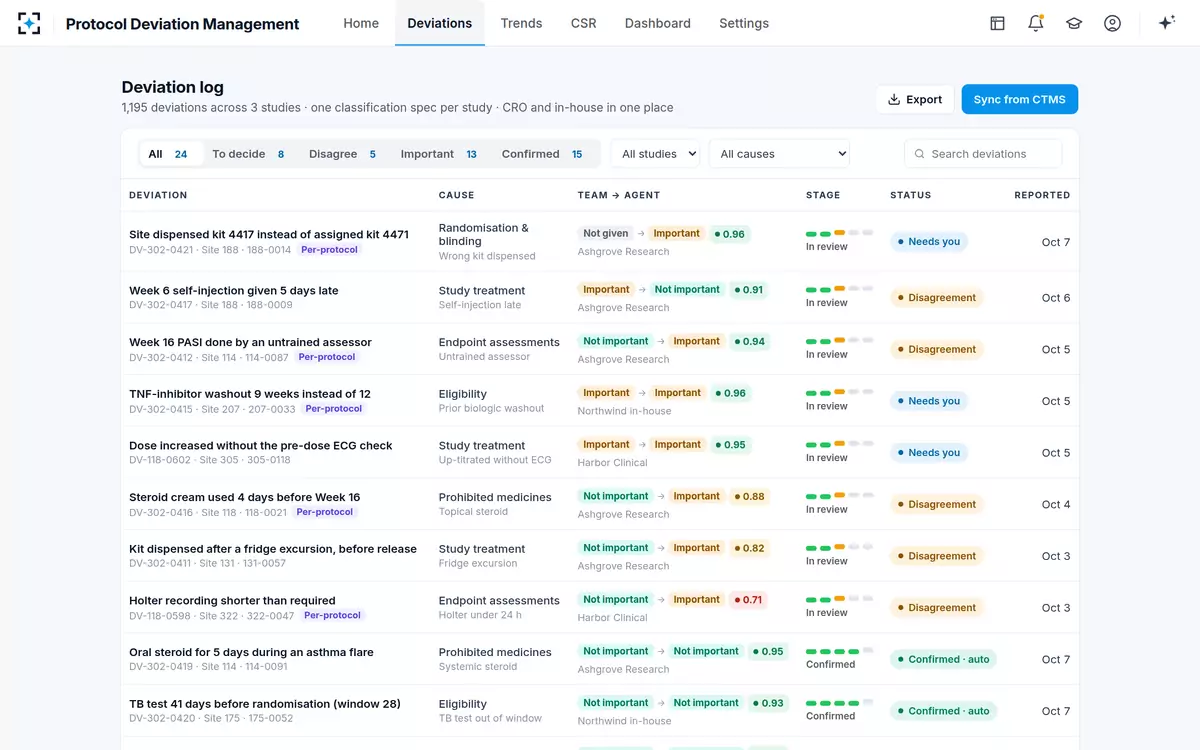
A plan that is held this way stops being a document that is approved and filed. It becomes the thing the study is actually run by — which is the only version of a deviation plan that is worth the week it takes to write. To see a classification specification, its routes and its trending rules on your own study, start from Protocol Deviation Management, or read what the importance test the rows encode actually asks.
Questions people ask
Is a protocol deviation management plan required by GCP?
Not as a named document. ICH E6(R3) requires the sponsor to determine trial-specific criteria for classifying deviations as important and lists records and reports of noncompliance including protocol deviations among the essential records; FDA asks that the protocol pre-specify which types are important and that sponsors tell investigators the time frame for reporting. A standalone plan is the common way to satisfy those, not the only way.
What is a deviation classification specification?
A table with one row per deviation type, each row naming the event, the cause it sits under, whether it is important, the protocol section it breaches, and where it goes once classified. It is the operational form of the trial-specific criteria ICH E6(R3) asks the sponsor to determine, and it is what lets several teams classify the same event the same way.
Who approves the protocol deviation management plan?
In most sponsors, clinical quality writes it, the medical monitor approves the classification criteria inside it, and the study manager owns the operational sections. Because the criteria that matter most are also pre-specified in the protocol, their approval follows the protocol's route — which is a reason to keep the operational sections, which change more often, out of the protocol itself.
How often should a deviation plan be updated?
The criteria should be re-read whenever accumulating data suggests a type of deviation is being classified wrongly, and at minimum at each scheduled review of the study's risk assessment. FDA's expectation is explicit that the list of important deviations can be updated over time, and that deviations not classified as important should be evaluated to see whether their types and numbers warrant reclassification.
Should the deviation plan sit in the protocol or a separate document?
Split it. The pre-specified list of which deviation types count as important belongs in the protocol, where sites, ethics committees and reviewers read it. Routes, reporting timings, trending thresholds and the recording standard belong in a separate plan, because they change during a study and should not need a protocol amendment to do so.
What should the plan say about recurring deviations?
What counts as recurrence, who runs the root-cause analysis and what is documented. FDA asks that recurrent deviations similar in nature trigger a root-cause analysis to determine appropriate action and prevent recurrence, and that the sponsor document the determination and whether further action was taken. A plan that defines recurrence numerically — three of a kind at one site within sixty days, for instance — makes that obligation testable.