A clinical trial management system handles protocol deviations the way it handles most things: it holds the record. A CTMS deviation module gives you a row per deviation with the participant, the site, the dates, a free-text description, a category someone picked from a list, and a field for importance that a human has to fill in. What almost none of them do is read the protocol, match the deviation to the sponsor's classification criteria, work out what it means for the per-protocol set, or notice that this is the third time at this site in sixty days. Those are the decisions, and in most studies they wait for a monthly meeting. Botminds' Protocol Deviation Management is built for that gap: it reads from the trial systems you already run and never writes back to them, classifies each deviation against the study's own specification with the protocol section cited, and routes what needs a person to the person who owns it.
The counts and timings on this page come from a fictional sample study inside the solution — Northwind Bio's VLT-302, Veltrimab in plaque psoriasis, Phase 3, 64 sites and 612 participants, run with the contract research organisation Ashgrove Research. The regulators' words are quoted and linked where they appear.
What does a CTMS do with protocol deviations?
Four things, reliably. It gives the deviation an identifier and a home, so it can be found later. It attaches it to a participant, a visit and a site, so counts by site are possible. It holds the free text, the dates and whatever classification a person entered. And it keeps an audit trail of changes to all of that, which matters more than it sounds: EMA defines an audit trail as "a secure, computer generated, time-stamped electronic record that allows reconstruction of the events relating to the creation, modification, or deletion of an electronic record" (EMA, computerised systems in clinical trials, 2023). A deviation log without one is not a record anybody can rely on three years later.
What a CTMS deviation module generally does not do is supply the judgment that fills its own importance field. The field is there; what goes in it comes from a person reading the protocol. That is not a criticism of the category — a trial management system is an operational system of record, and record-keeping is what it is for. It is a criticism of the assumption that buying one has solved deviation classification.
One deviation, four systems and nine days — before Protocol Deviation Management
4systems
hold part of one deviation: the trial management system, the electronic data capture system, the randomisation and supply system, and the monitoring visit report
9days
from a deviation being reported to a signed classification, at a monthly review
5of 9
of those days are the wait for the meeting itself
The systems one deviation already lives in
The reason deviation work is slow is rarely that anyone is slow. It is that the evidence needed to classify one deviation is split across systems that were each bought for a different job, and nobody owns the join.
What each system already holds about the same deviation
What it holds: The deviation record itself: identifier, participant, site, visit, both dates, free text, a category, a proposed importance, and the audit trail over all of it.
What it cannot tell you: Whether the proposed importance is right, which protocol section was breached, or how the same deviation was classified last time.
What it holds: The data behind the event: the visit page, the dosing and medication pages, the assessment values, and the queries raised on them.
What it cannot tell you: That a deviation happened at all, unless someone also logged it. Data and deviations are separate populations that have to be reconciled.
What it holds: Kit assignment and dispensing events, unblinding events, and the timing of each.
What it cannot tell you: Whether a kit dispensed against the wrong assignment was caught, classified, or counted anywhere else.
What it holds: The monitoring associate's findings and action items, section by section — often the only place the full story is written.
What it cannot tell you: Anything structured. The decisive sentence is prose inside a document nobody queries.
What it holds: The provision that was breached and the row that classifies it.
What it cannot tell you: Nothing on its own: these are documents, and no operational system reads them for you.
What it holds: Assessor training logs, temperature logs, consent versions — the evidence that decides several of the hardest classifications.
What it cannot tell you: Anything at all, until someone goes and looks. They usually live at the site.
FDA's expectation runs across all of it rather than through any one system. Sponsors are told to take in everything, from every direction.
Sponsors should receive information on all protocol deviations, most likely from site and central monitoring efforts.
FDA, Protocol Deviations for Clinical Investigations, draft guidance, December 2024
Central monitoring is the part sponsors most often under-build. The agency's risk-based monitoring questions and answers makes the case for it in plain terms: "By reviewing study data and metadata in real time across clinical sites, sponsors may be able to identify quality issues, such as delays in entering data or incomplete entries, earlier than when relying on on-site monitoring alone" (FDA, A Risk-Based Approach to Monitoring, Q4, April 2023). A deviation that is only ever seen at the next monitoring visit is a deviation the central view never had a chance to catch.
Storing a deviation and classifying one are different problems
Storage is a schema problem: decide the fields, enforce them, keep an audit trail, make it searchable. It is solved, and the solved version is what a trial management system sells.
Classification is a reading problem. It needs the protocol version in force on the date of the deviation, the study's classification criteria, the deviation's own prose, the data behind it, and the decisions the sponsor has already signed on similar deviations. Then it needs two separate answers — could this have affected the data, and could this have affected the participant — and a route that follows from them. No amount of schema gets you there, which is why the field sits empty in the log until a person fills it, and why the person waits for the meeting where they will have the protocol open anyway.
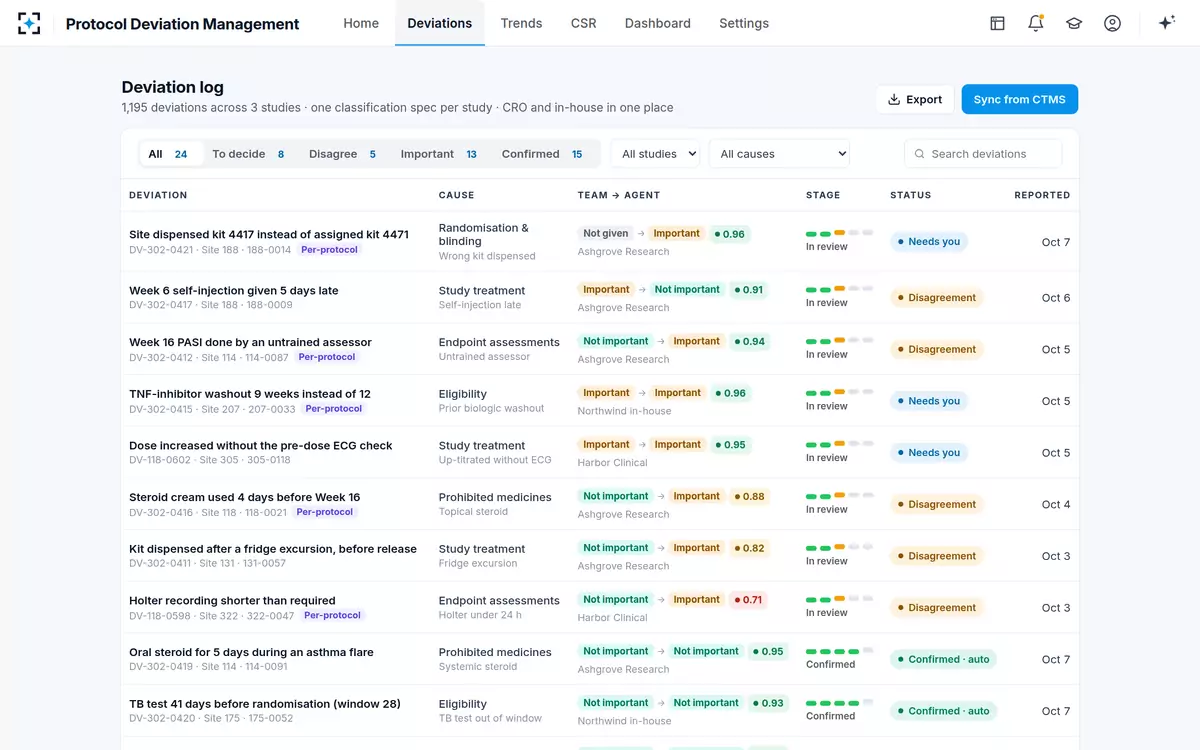
The distinction shows up most clearly where two teams disagree. In the sample study a contract research organisation proposed not important on a Week 16 assessment made by a coordinator who was not on the site's assessor training log, on the reasonable ground that the visit fell inside its window; the classification said important, citing the protocol's requirement for a trained assessor and three earlier signed decisions on the same rule. A log can hold both opinions. Only a decision resolves them, and the test it has to be resolved against is in the guidance, not in the software.
What the queue costs, counted on one study
The cost of the gap is not the classification work; it is the waiting. On the sample study, the nine days between a deviation being reported and a signed classification break down into five days of queue and four days of work — and the queue is the part that no amount of staffing fixes, because it is the interval between meetings.
Where one deviation's days go, before and after
- Gathering the evidence from four systems1 d
- Waiting for the monthly meeting5 d
- Matching the specification row and the protocol section1 d
- Settling where the teams differ1.5 d
- Per-protocol and serious breach checks
- Gathering and matching, as the deviation arrives
- Settling where the teams differ1 d
- Per-protocol and serious breach checks
Two things are worth noticing in that second lane. The human decision is still a day, because it is still a human decision — the medical monitor reads both opinions and signs. And the per-protocol and serious breach checks shrink but do not vanish, because they are consequences a person has to accept rather than steps a system completes. What disappeared was the wait, and the five days of wait are where the risk lives: a possible serious breach at an EU or UK site has a seven-day notification clock that started when the sponsor became aware, and a queue that routinely eats five days of it is a queue with a regulatory consequence.
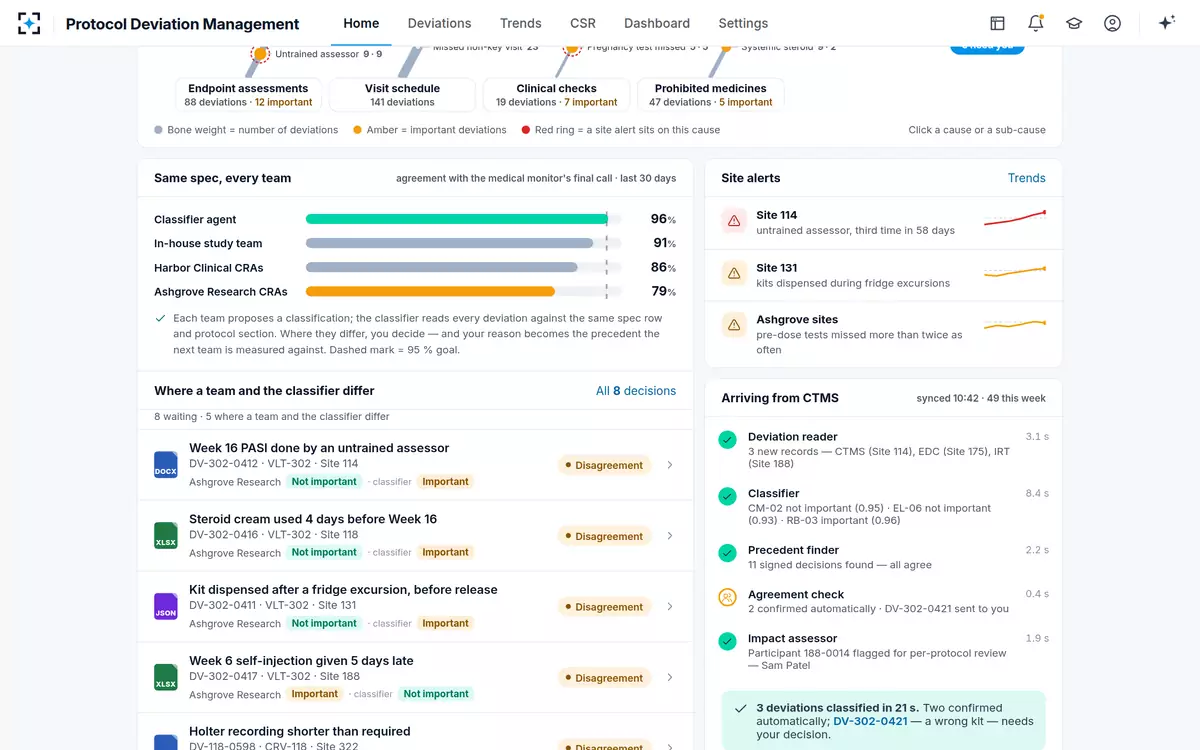
Three new deviations read from the trial systems and classified in 21 seconds
Can a CTMS classify deviations as important?
Some can hold a configurable list that maps a chosen category to a default importance, which is genuinely useful and is not the same thing as classification. The difference is what happens to the cases the list does not settle. A category-to-importance map answers "a visit outside its window is not important"; it does not answer "this visit was inside its window but the assessment was made by someone the protocol required to be trained", because that fact is in a monitoring report and an assessor training log, not in a dropdown.
The honest question to ask of any system, including this one, is therefore not whether it has a deviation module but what it does in the interval between the report arriving and the classification being signed. For most systems in the installed base, the answer is that it queues it — which is a legitimate answer, and one you should be told plainly rather than discover in month four.
Seven questions to put to a vendor about deviations
Seven questions, and the answer that should worry you
- 1. Show me a deviation arriving, and the signed classification, with nothing cut
Worrying answer: a demonstration that starts with the classification already entered. Ask to see the interval, not the endpoints.
- 2. Where does the system read the protocol, and what does it cite?
Worrying answer: "the user attaches the protocol". A classification that cannot name a section and a page is an opinion with a timestamp.
- 3. What happens when the site and the sponsor disagree?
Worrying answer: "the sponsor's value overwrites the site's". Both opinions have to survive, because the disagreement rate is the quality measure.
- 4. How do the criteria get in, and what happens when they change?
Worrying answer: a configuration screen with no versioning. Decisions signed under version 2 must still be readable as version 2 decisions.
- 5. Which decisions does the system make without a person, and how do I narrow that?
Worrying answer: "it is fully automated" — or "never, everything goes to a human", which is the queue again. Ask for the rule, the threshold and the sampling rate on what confirms itself.
- 6. Show me the listing for the clinical study report, built from this log
Worrying answer: an export to a spreadsheet. The question is whether the report's grouping by site and participant falls out of the data or is rebuilt by hand.
- 7. What does the system write back into my trial systems?
Worrying answer: anything you did not ask for. A read-only posture is a smaller validation burden and a much smaller argument with your data managers.
Where a second system earns its keep, and where it does not
It does not earn its keep on volume. A study with forty deviations a year and one contract research organisation does not have a classification problem; it has a meeting, and the meeting is fine. The gap opens on four specific shapes.
Several teams classifying against one specification. This is the commonest and the most expensive, because the drift is invisible until lock. In the sample study each team's agreement with the medical monitor's final call differs by double digits over a thirty-day window, which is the kind of thing a sponsor can only act on once it is counted.
A clock that someone else started. Serious breach notification at EU and UK sites runs from sponsor awareness, not from the review meeting.
Consequences that belong to a third party. A per-protocol exclusion is the statistician's call, and the statistician needs to hear about the participant when the deviation is classified, not at lock.
Patterns across sites. Nineteen out-of-window visits at one site, none of them important, are invisible to a process that classifies deviations one at a time — and are the earliest signal of a site in trouble. Cause and impact as two separate axes is what makes that pattern countable.
Where none of those four applies, the honest advice is to spend the money on the deviation plan instead, and keep the trial management system you have.
The validation you take on, whichever way you go
Any route — configure what you own, build something, or buy something — brings a validation obligation, and ICH E6(R3) frames it as a question of consequence rather than of category. The validation approach is to rest on a risk assessment of three things: what the system is for, how much the data it holds matter, and how far it could affect participants' rights, safety and well-being or the reliability of the trial's results (ICH E6(R3), section 4.3.4).
Three routes, and what each one owes
| Route | What it costs to stand up | What you validate | What you still own |
|---|---|---|---|
| Configure the trial management system you already have | Weeks of configuration and a specification expressed as a picklist. | The configuration, against your existing system validation. The smallest paperwork of the three. | The judgment. The importance field is still filled in by a person at a meeting. |
| Build it yourself, usually on the data warehouse | Months, and a standing team. The protocol reading is the part that never finishes. | Everything, including the parts that change each time a study's criteria change. | The maintenance, which arrives every time a protocol is amended at any study. |
| Add a system that reads the others and decides nothing on its own | Days to connect, once the classification specification exists in a usable form. | Its intended use, its effect on participant safety and on the reliability of results, and its audit trail — the E6(R3) three. | The decisions. Every important deviation and every disagreement is still signed by a named person. |
One obligation does not move whichever route you take. Under 21 CFR 312.56(b), a sponsor who discovers that an investigator is not complying must promptly do one of two things: secure compliance, or stop shipping the investigational drug to that investigator and end their participation (21 CFR 312.56(b)). The verb is discovers, and the duty is prompt. A system that shortens the distance between a deviation happening and a sponsor discovering it is making that duty easier to meet; a system that lengthens it is not neutral.
The handover to the clinical study report and the DV domain
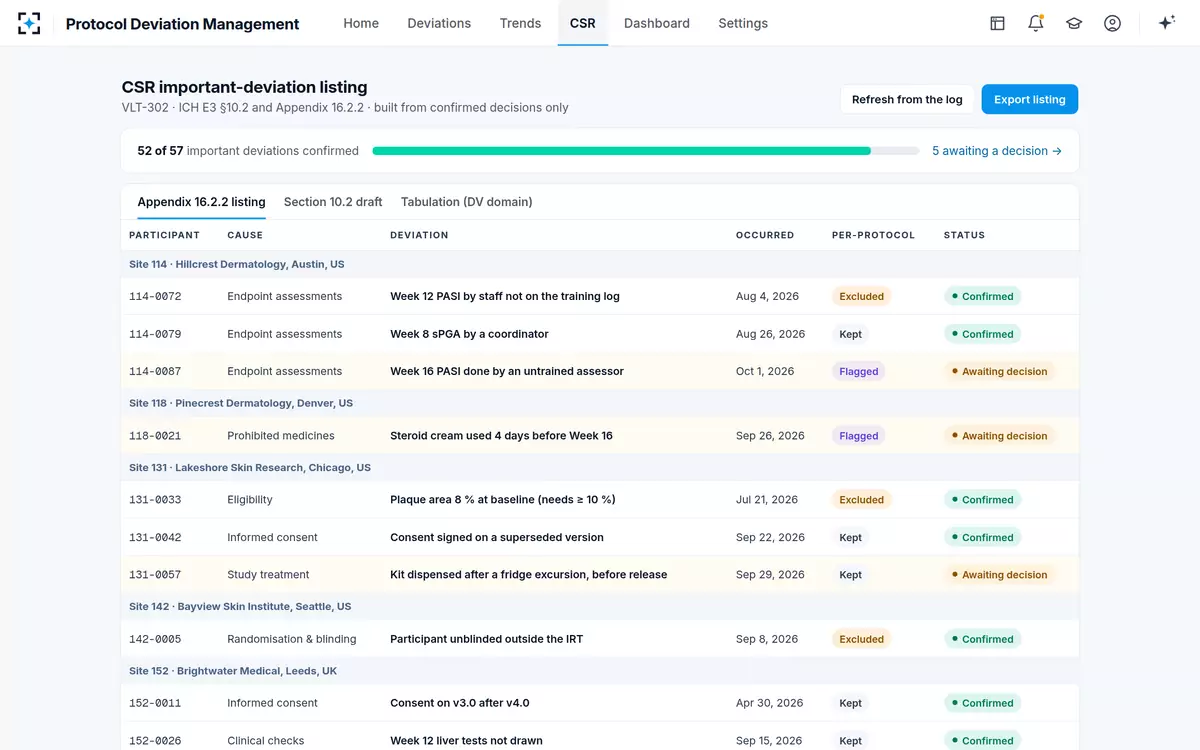
The last thing a deviation does is get reported, twice. FDA asks sponsors to discuss important deviations in the report body, to list by site the participants who had them in the appendix, and then to report every deviation, important or not, in the protocol deviation (DV) domain of the submitted tabulation data, so the agency can judge whether deviations affected data quality — with a variable on each record giving the sponsor's own determination of whether it was important (FDA draft guidance, section III.B.2).
The technical conformance guide spells out what that dataset needs: "The following variables besides CDISC required variables should be included in the DV domain when submitting DV data: DVSPID, DVTERM, DVDECOD, DVCAT, DVSCAT, DVSTDTC, DVENDTC and EPOCH" (Study Data Technical Conformance Guide, version 6.3, October 2026). Read that list against your deviation log and it becomes a shopping list of fields: a sponsor identifier, the verbatim term, a decoded term, a category and a subcategory, start and end dates, and the epoch. Studies that carried only a free-text description and a tick box spend the weeks before submission reconstructing the rest — and the decoded term and the subcategory, in particular, cannot be reconstructed, only re-judged.
The listing, the summary draft and the submission tabulation, built from signed decisions
Building on what you already own: the three integrations that matter
If you keep the trial management system — and most sponsors should — the question becomes which connections are worth making. Three carry nearly all the value.
The first is the deviation log itself, read from every team at once, so the sponsor's view is not the union of four spreadsheets. The second is the data behind the deviation: the dosing, medication and visit pages in the electronic data capture system, and the kit assignment and dispensing events in the randomisation and supply system, because many of the hard classifications turn on something only those systems know. The third is the monitoring visit report, which is where the decisive sentence usually is and which nobody can query.
Two constraints are worth writing into the requirement before anyone connects anything. Read, never write: a system that edits the trial management system has made itself part of your system of record and multiplied the validation. And participant identifiers only, with no names and no contact details, which is both the right default and much the easier conversation with a data protection officer.
Every team's deviations in one log, with each proposal against the classification
Whatever you buy, the thing that decides whether it works is upstream of all of it: a classification specification written as rows rather than prose. Without one, every system in this comparison is a filing cabinet. To see the three connections and the signed decisions on your own study, start from Protocol Deviation Management.
Questions people ask
Should protocol deviations be recorded in CTMS or EDC?
In practice, in the trial management system, because that is where the site, the monitoring visit and the corrective action already live. The data capture system holds the evidence behind the deviation rather than the deviation itself. What matters more than the choice is reconciliation: a deviation visible in one system and not the other is the usual source of a count that does not match at lock.
Do I need a separate deviation management system?
Not for volume alone. The case opens when several teams classify against one specification, when a clock runs from sponsor awareness, when a third party such as the statistician owns a consequence, or when patterns across sites matter more than individual events. If none of those applies, invest in the deviation plan and keep what you have.
How do deviations get from CTMS into the clinical study report?
Usually by export and hand assembly. FDA asks for a discussion of important deviations in the report body, a listing of participants with important deviations organised by clinical trial site in the appendix, and all deviations in the submission's DV dataset with a variable giving the sponsor's determination of importance. A log that carries the site, the decoded term, the category and subcategory and both dates can produce all three; one that carries free text and a tick box cannot.
Does a CTMS trend deviations by site?
Most will count deviations by site, which is not the same as trending them. Useful trending needs a denominator that survives sites enrolling at different speeds — important deviations per 100 participant-visits, for example — a threshold set in advance, a window, and an action attached to the rule. Counts by site tell you which sites are busy.
What should I ask a CTMS vendor about deviations?
Ask to see the interval, not the endpoints: a deviation arriving and a signed classification, with nothing skipped. Then ask where the system reads the protocol and what it cites, what happens when the site and sponsor disagree, how classification criteria are versioned, which decisions are made without a person, how the report listing is produced, and what the system writes back into your systems of record.
Can one system classify deviations the same way across several CROs?
Only if the criteria are one object rather than one per team. The mechanism is unglamorous: a single versioned classification specification per study, every team's proposal recorded next to the classification made against that specification, and a signed decision with a written reason wherever they differ — which gives you a measurable agreement rate per team instead of an impression.