The per-protocol set is the subset of randomised participants who followed the protocol closely enough for their data to answer the question the protocol asked, and its definition comes from a single paragraph of ICH E9: a participant belongs to it when a pre-specified minimum exposure to treatment was completed, the primary variable was actually measured, and no major protocol violation occurred. That definition is easy to write and hard to apply, because the facts that decide membership arrive one protocol deviation at a time across several years of conduct, and the set has to be fixed before anyone knows which arm a participant was in. Botminds' Protocol Deviation Management is built for exactly that gap: it classifies each deviation against the study's own specification within minutes of its arrival and sends the statistician every participant whose membership is now in question — and it never decides membership itself.
The worked study on this page is sample data: Northwind Bio's VLT-302, Veltrimab in plaque psoriasis, Phase 3, 64 sites and 612 participants, with the contract research organisation Ashgrove Research running 40 of them. The sponsor, the drug, the sites, the organisation and the people named here are fictional characters in the solution's own sample study. The regulatory text is quoted and linked where it is used.
What is the per-protocol set?
ICH E9, the 1998 guideline on statistical principles for clinical trials that regulators still point to, defines it in one sentence. The per-protocol set, it says, is "sometimes described as the 'valid cases', the 'efficacy' sample or the 'evaluable subjects' sample", and it "defines a subset of the subjects in the full analysis set who are more compliant with the protocol" (ICH E9 §5.2.2). Two things in that sentence do most of the work. It is a subset of the full analysis set, not of everyone randomised — so a participant already out of the full analysis set cannot be in it. And "more compliant" is not a judgement anyone makes in the abstract: E9 immediately replaces it with three testable criteria.
The practical consequence is that the per-protocol set is not a population you discover at the end of a study. It is a definition written down early and then applied to facts collected throughout, and almost all of those facts are protocol deviations.
The per-protocol set, written as ICH E9 writes it
Full analysis set
all randomised participants, less E9’s limited justified exclusions
The intention-to-treat ideal: "as complete as possible and as close as possible to the intention-to-treat ideal of including all randomised subjects". A participant outside it cannot be inside the per-protocol set.
Statistician, from the analysis plan
Minimum exposure not met
less participants below the pre-specified exposure floor
E9 criterion (i): "the completion of a certain pre-specified minimal exposure to the treatment regimen". The floor is a number in the analysis plan, not a view taken at lock.
Statistician, from dosing data
Primary variable not measured
less participants with no usable primary measurement
E9 criterion (ii): "the availability of measurements of the primary variable(s)". A missed primary assessment is the cleanest exclusion there is, because nothing is there to analyse.
Statistician, from the database
A major protocol violation
less participants with a violation the plan calls major
E9 criterion (iii): "the absence of any major protocol violations including the violation of entry criteria". This is the criterion that depends on classification, and the only one a monitor can influence.
Statistician, on a classification from the medical monitor
The three criteria, in ICH E9's own words
E9's list is worth reading as it stands, because its wording is narrower than the way teams often summarise it. The per-protocol set "is characterised by criteria such as the following: (i) the completion of a certain pre-specified minimal exposure to the treatment regimen; (ii) the availability of measurements of the primary variable(s); (iii) the absence of any major protocol violations including the violation of entry criteria" (ICH E9 §5.2.2).
"Criteria such as" means the list is illustrative, so a study may add its own. "Pre-specified" in criterion (i) means the exposure floor is a number written before the data arrive — 80% of planned doses, or twelve weeks of treatment — not a line drawn once the distribution of compliance is visible. Criterion (ii) is about availability, not quality: a primary measurement that exists but was taken badly fails criterion (iii), if it fails anything, not (ii). And criterion (iii) carries the word that causes most of the argument on a live study, "major", which E9 nowhere defines. Each study defines it, which is the whole reason a study needs a classification specification and a plan for applying it; what a protocol deviation management plan must hold sets out where that definition is written down.
Per-protocol set or full analysis set: what each one answers
The two sets answer different questions, and E9 is explicit that which one leads depends on what the trial is trying to show. In a superiority trial the full analysis set is used for the primary analysis "apart from exceptional circumstances", because keeping the non-compliers in generally pulls the estimated treatment effect down, and so guards against the over-optimistic efficacy a per-protocol analysis can produce. In an equivalence or non-inferiority trial, the same reasoning runs the other way: "use of the full analysis set is generally not conservative and its role should be considered very carefully" (ICH E9 §5.2.3).
What each analysis set answers, and which one leads
Full analysis set: What happens when this treatment is prescribed, including the participants who do not take it properly.
Per-protocol set: What happens when this treatment is taken as the protocol intends — "most closely reflects the scientific model underlying the protocol".
Full analysis set: Every randomised participant, less the limited exclusions E9 justifies: a major entry criterion failed, not one dose taken, no data after randomisation.
Per-protocol set: Those of the full analysis set who met the exposure floor, have a primary measurement, and had no major violation.
Full analysis set: Leads the primary analysis "apart from exceptional circumstances"; non-compliers drag the estimate toward no effect, which is the conservative direction.
Per-protocol set: Supporting. It may "maximise the opportunity for a new treatment to show additional efficacy", which is exactly why it does not lead.
Full analysis set: Not automatically conservative: participants who took neither treatment properly make two arms look alike, which is the result being claimed. E9 says its role "should be considered very carefully".
Per-protocol set: Carries real weight, and the exclusions are scrutinised hardest here — because every exclusion is a chance to make the arms look more alike than they were.
Full analysis set: In the protocol and analysis plan; exclusions "should always be justified".
Per-protocol set: Reasons for exclusion "fully defined and documented before breaking the blind".
Full analysis set: Eligibility violations detected objectively, and participants with no post-randomisation data.
Per-protocol set: Every classified deviation that touches exposure, the primary measurement or the plan’s definition of major.
Teams reach for a per-protocol analysis when the full analysis set result disappoints, and that instinct is the reason regulators read the exclusion list closely. A per-protocol analysis planned in advance, with its exclusions defined and its reasons documented before anyone knows the arms, is a supporting analysis. The same analysis assembled after the headline result is a different object entirely, however carefully it is computed.
Which protocol deviations exclude a participant?
No deviation excludes anyone by itself. The analysis plan's criteria exclude participants; a deviation supplies the fact the criteria are applied to. That distinction sounds pedantic until a monitoring visit, when a site asks whether the deviation it has just reported "takes the participant out" and the only correct answer is that it depends on three things: what the deviation was, how the study's specification classifies it, and what the analysis plan says about exclusion.
The table below works through six deviations that come up on almost every study. The middle column is the usual consequence under a conventionally written analysis plan, not a rule — on a particular study, any row can go the other way because of one sentence in that plan.
Six deviations, their usual per-protocol consequence, and who decides
| The deviation | Usual consequence for the per-protocol set | Who decides it |
|---|---|---|
| Enrolled without meeting a key eligibility criterion | Excluded. This is the one deviation E9 names inside criterion (iii) — "including the violation of entry criteria" — and FDA names the same thing as an important deviation: "Enrollment of a trial participant in violation of key eligibility criteria designed to ensure a specific participant population". | The statistician, against the analysis plan; the medical monitor supplies the classification and the criterion breached. |
| Doses missed, or treatment stopped before the exposure floor | Excluded where exposure falls below the pre-specified minimum. Nothing is judged: the dosing data are compared with a number already written down. | The statistician, from exposure data. The deviation explains why, and belongs in the listing. |
| The primary endpoint assessment was never done at the analysis visit | Excluded, under criterion (ii). Of the three criteria this is the one that needs no classification at all. | The statistician, from the database. |
| The primary assessment was done, by someone the protocol does not allow to do it | Contested. The measurement exists, so criterion (ii) holds; whether it is a major violation under criterion (iii) is a classification question, and the two can diverge. | The medical monitor classifies; the statistician applies the plan. This row is where a flag, rather than a decision, earns its keep. |
| A visit taken outside the protocol window | Depends entirely on the plan. E9(R1) singles this case out: a deviation "might exclude subjects from the PPS, for example by having a visit outside a time window, without an intercurrent event necessarily having occurred". | The statistician. A monitor who promises a site either answer is guessing. |
| A prohibited concomitant medicine taken during treatment | Excluded where the plan calls it a major violation, which usually turns on whether the medicine could move the primary variable; otherwise kept, and handled as an intercurrent event in the estimand. | The statistician, on the classification and the medicine’s timing and dose. |
Read down the "who decides" column and one pattern stands out: the statistician decides every row. The medical monitor's work changes what the statistician is deciding about — which specification row applies, which protocol section was breached, whether the primary endpoint was touched — and the two jobs are easy to confuse when the same meeting does both.
The deadline nobody can move: before the blind breaks
E9 sets one hard date, and it is the sentence most often forgotten. "The precise reasons for excluding subjects from the per protocol set should be fully defined and documented before breaking the blind in a manner appropriate to the circumstances of the specific trial" (ICH E9 §5.2.2). Not the exclusions — the reasons for them, fully defined and written down, before unblinding.
That requirement is the reason deviation classification is a conduct activity rather than a reporting one. If a study carries 57 important deviations into the blind review with five of them still unclassified, the reasons for exclusion cannot be fully defined, because nobody yet knows whether five participants met criterion (iii). The choice then is to unblind with the question open or to hold the blind review while a monitor works through a queue — and the second choice is made under the worst possible time pressure.
E9 asks for something more as well, in its section on pre-specifying the analysis: "It is desirable to identify any important protocol violation with respect to the time when it occurred, its cause and influence on the trial result" (ICH E9 §5.1). Time, cause and influence — three attributes that are cheap to capture when the deviation is reported and expensive to reconstruct eighteen months later from a one-line entry in a log.
Where the reasons for exclusion get written, on two ways of working
- Conduct: each deviation classified within days of its report34 months
- Blind review4 weeks
- Conduct: a backlog that is never quite empty34 months
- Blind review4 weeks
The bias that may be severe, and why it points one way
E9 is unusually blunt about what a per-protocol analysis can do to a result, and the sentence is worth having to hand in any meeting where someone proposes one.
The per-protocol set, E9 says, gives a new treatment its best chance to show extra efficacy and sits closest to the scientific model behind the protocol. But the test and the estimate it produces may or may not be conservative, depending on the trial, and the bias — which E9 warns "may be severe" — comes from the fact that sticking to the protocol can itself be related to both the treatment and the outcome (ICH E9 §5.2.2).
The mechanism in that last clause is the part to hold on to. Adherence is not random. A participant whose disease responds keeps turning up; a participant with a rash from the injection misses doses and then misses visits. Drop the non-adherent and you have not removed noise, you have removed a group whose membership depends on both the treatment and the outcome — which is the textbook recipe for bias, and why it can run in either direction while usually flattering the new treatment.
E9 adds a quieter warning in the same region: when the full analysis set and the per-protocol set agree, confidence rises, "bearing in mind, however, that the need to exclude a substantial proportion of subjects from the per protocol analysis throws some doubt on the overall validity of the trial". A per-protocol set that drops a fifth of the participants is not a cleaner analysis. It is evidence that the protocol was hard to follow.
What ICH E9(R1) changed about the per-protocol analysis
The 2019 addendum on estimands did not retire the per-protocol set, but it did change what a statistician is expected to do before reaching for one. Its argument is that the question a per-protocol analysis is usually trying to answer — what the treatment does when taken as intended — can now be posed directly, as an estimand with an explicit strategy for the events that get in the way, and estimated by a method aligned to it.
"Estimands might be constructed, with aligned method of analysis, that better address the objective usually associated with the analysis of the PPS. If so, analysis of the PPS might not add additional insights."
ICH E9(R1), Addendum on Estimands and Sensitivity Analysis in Clinical Trials, §A.5.3 (Step 4, 20 November 2019)
The addendum also separates two ideas that studies routinely conflate. "Protocol violations and deviations might exclude subjects from the PPS, for example by having a visit outside a time window, without an intercurrent event necessarily having occurred. Likewise, subjects could experience an intercurrent event, such as death, without having deviated from the protocol" (ICH E9(R1) §A.5.3). A deviation is a departure from the protocol; an intercurrent event is something that happens after treatment starts and changes what a measurement means. The two overlap and neither contains the other.
For a monitoring and quality team the practical effect of E9(R1) is liberating. The per-protocol set is no longer the default channel through which a deviation reaches the result, so the right response to a newly classified deviation is not to work out who leaves the analysis. It is to get the classified fact, with its date and its cause, to the statistician quickly enough that the estimand and the analysis plan can account for it — and to leave the analysis decision where it belongs.
Who decides, and what the statistician needs from the monitor
On the sample study, the per-protocol route is a setting with a name on it: per-protocol impact goes to the statistician, Sam Patel. The six agents in Protocol Deviation Management read, classify, compare and flag; the impact assessor's stated limit is that it never removes a participant from an analysis set and proposes to the statistician instead. That is not a modesty clause. It is the only arrangement consistent with E9, where membership follows from criteria in the analysis plan that the statistician owns.
What the statistician actually needs is narrow and specific, and a one-line "participant may be affected" note supplies almost none of it.
One deviation, and the per-protocol flag Protocol Deviation Management sends with it
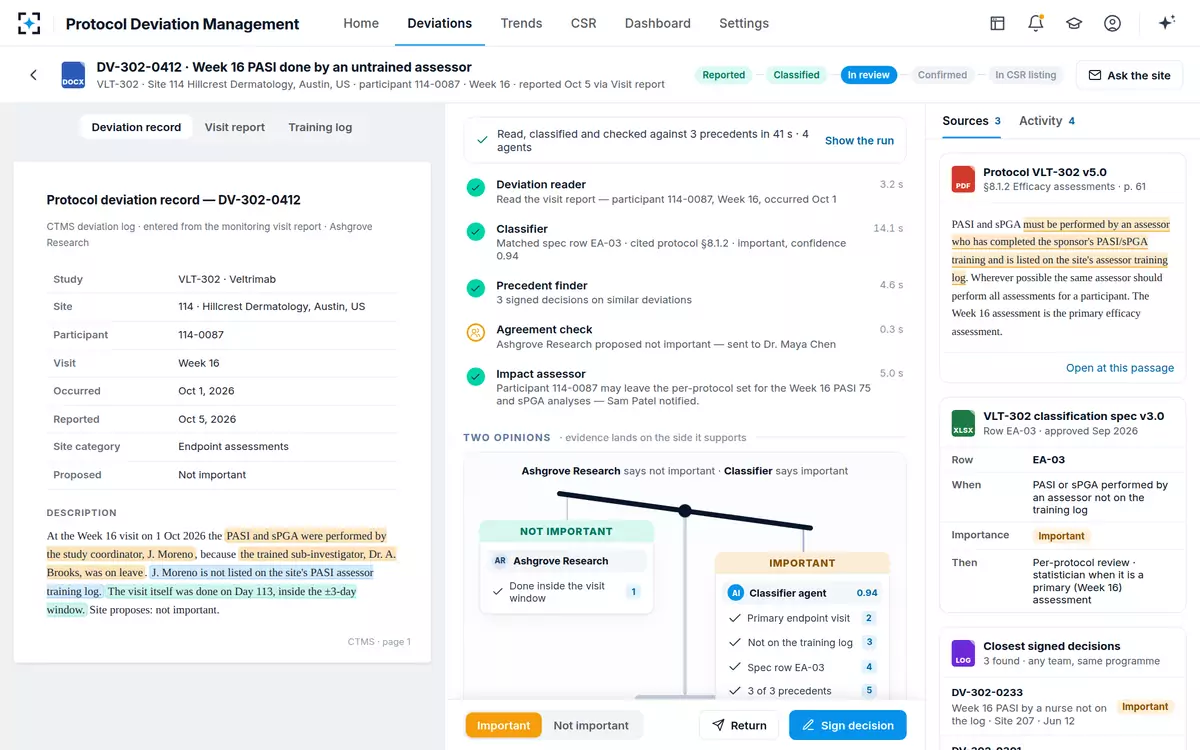
The impact assessor proposes; it never removes a participant from an analysis set.
What a per-protocol flag has to carry before a statistician can act on it
- The participant and the visit, not just the study
Participant 114-0087, Week 16. The analysis sets are built per participant per analysis; a site-level note cannot be applied to one.
- Which analyses it bears on
On the sample study the flag names the Week 16 PASI 75 and sPGA analyses. A flag that says "efficacy" makes the statistician reconstruct the endpoint map.
- The classification, with the specification row and the protocol section
Row EA-03, protocol section 8.1.2. The analysis plan’s definition of a major violation is written in these terms, so the flag should be too.
- Which of the three criteria it could touch
Exposure, the primary measurement, or a major violation. Most contested flags touch only the third, and saying so narrows the question to one sentence of the plan.
- The date it happened, the cause, and the effect on the result
E9 §5.1 asks for exactly these three: "the time when it occurred, its cause and influence on the trial result".
- Whether the classification is signed or still proposed
A statistician can hold a provisional flag open; what cannot be done is discover at the blind review that a confirmed exclusion rested on an unsigned opinion.
- A route back to the evidence
The deviation entry, the monitoring visit report, the training log — whatever the classification cited, openable without asking anyone.
Reconciling the deviation listing with the analysis sets
At lock, two sections of the clinical study report describe the same participants from different directions: the protocol deviation section, and the section that defines which participants were analysed. They are written by different people from different sources, and when they disagree the disagreement is visible to any reviewer who reads both.
The usual failure is not a wrong number but an unexplained one. The deviation listing shows a participant with an eligibility violation; the analysis-set table counts that participant in the per-protocol set; nothing in either section says why. Sometimes the answer is good — the criterion breached was not one the plan calls major — and nobody wrote it down. On the sample study the listing carries each participant's per-protocol status with the deviation, in three states rather than two: excluded, kept, or flagged and still open. The third state is the honest one, and it is the state that reconciliation exists to empty.
Per-protocol status beside each participant in Protocol Deviation Management's listing
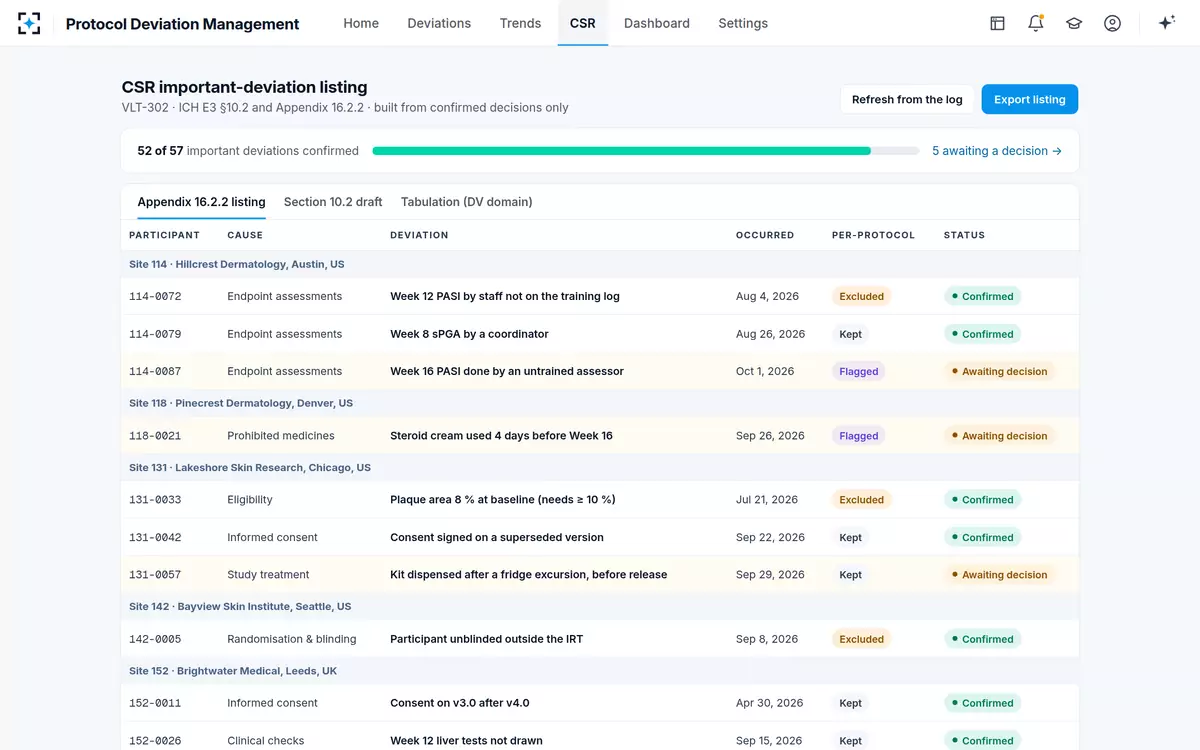
Reconciliation is quick when every deviation already carries a signed classification and a named per-protocol state, and slow when it starts with a spreadsheet of free text. What ICH E3 asks for in Section 10.2 and Appendix 16.2.2 follows the listing itself through to the submission.
A flag, not a decision: how the handover should work
The arrangement that holds up at inspection and at the blind review is the same one, and it has three properties. The classification happens during conduct, against a written specification, with the specification row and the protocol section cited. The per-protocol consequence is proposed to the statistician, with the participant, the analyses and the criterion it could touch, as soon as the classification is signed rather than at the next monthly meeting. And the analysis-set decision is taken by the statistician against criteria that were written before the data arrived, and recorded with its reason.
Where that breaks down, it usually breaks down in the middle step. The classification is fine, the statistician is competent, and the fact takes six weeks to travel between them because the only channel is a meeting. On the sample study the two per-protocol flags that arrive in the worked example — participant 188-0014 when the wrong-kit deviation DV-302-0421 is classified, and participant 114-0087 when the untrained-assessor deviation is classified — go out the moment each classification is settled, because the flag is a consequence of the classification rather than an item on an agenda.
None of that makes the per-protocol set easier to define. It makes the definition applicable on time, which is the whole of what E9 asks for. If you want to see where the classifications themselves come from, the definition of an important protocol deviation and its two tests is the place to start, and Protocol Deviation Management shows the flags, the signatures and the listing on one study.
Questions people ask
Does a visit outside the time window exclude a participant from the per-protocol set?
Only if the study's analysis plan says so. ICH E9(R1) uses this exact case as its example of a deviation that "might exclude subjects from the PPS … without an intercurrent event necessarily having occurred", which tells you the exclusion is a choice the plan makes rather than a consequence of the deviation. Most plans exclude a window breach only when it moves the primary assessment outside a stated tolerance; a visit three days late on a 112-day schedule usually does not.
Is the per-protocol set the same as the evaluable population?
In practice the terms are used interchangeably, and ICH E9 lists "the 'valid cases', the 'efficacy' sample or the 'evaluable subjects' sample" as descriptions of the same set. What matters is that the study says which criteria it means, because "evaluable" on its own can be read as criterion (ii) alone — a measurement exists — while the per-protocol set also requires the exposure floor and the absence of a major violation.
Can a participant be excluded from the per-protocol set after the blind is broken?
The reasons for exclusion must be "fully defined and documented before breaking the blind", so applying an already-defined reason to a fact that was in the database before unblinding is ordinary work. Inventing a new reason afterwards is not, and a reviewer will read it as a post hoc exclusion. This is why the five still-undecided important deviations in the sample study matter more than the 52 settled ones.
Does an important protocol deviation always affect the per-protocol set?
No, and the two classifications answer different questions. Importance asks whether a deviation could significantly affect the reliability of key data or a participant's rights, safety and well-being. Per-protocol membership asks whether a specific participant met three criteria in the analysis plan. A consent re-signature collected late can be important and have no effect on any analysis set; a quietly missed primary assessment excludes a participant whatever it is called.
Who writes the per-protocol exclusion criteria — the protocol or the statistical analysis plan?
The protocol states the analysis sets in principle; the statistical analysis plan carries the operational criteria, including the exposure floor and the list of deviations treated as major violations. The useful test is whether a programmer could build the set from the document without asking a question. If the answer is no, the criteria are not yet pre-specified, whichever document they sit in.
How many exclusions from the per-protocol set are too many?
There is no threshold, but ICH E9 gives the direction of travel: "the need to exclude a substantial proportion of subjects from the per protocol analysis throws some doubt on the overall validity of the trial". A set that loses a fifth of its participants is reporting on protocol feasibility as much as on the treatment, and the right response is usually to look at where the exclusions cluster by site and by cause rather than to defend the number.