Serious breach reporting in clinical trials starts from one definition: a breach of the regulation or of the protocol that is likely to affect, to a significant degree, either the safety and rights of a participant or the reliability of the trial's data — and under EU Regulation 536/2014 the sponsor has seven days from becoming aware of it to notify the Member States concerned. The UK's regulation 29A says the same thing in different words and on the same seven-day clock. What makes serious breaches hard is not the deadline. It is that somebody at a site has to recognise a candidate, somebody at the sponsor has to assess it, and the clock is already running while both of those happen. Botminds' Protocol Deviation Management is built for that first hour: a possible serious breach at an EU or UK site goes to the named clinical quality lead on the day it is reported, with its due date attached — and the assessment itself stays with that person.
The worked example is a fictional sample study inside the solution — Northwind Bio's VLT-302, Veltrimab in plaque psoriasis, Phase 3, 64 sites and 612 participants, run with the contract research organisation Ashgrove Research. Nothing on this page is legal advice; the regulators' own words are quoted and linked where they appear.
What is a serious breach in a clinical trial?
The EU definition is in Article 52(2) of Regulation (EU) No 536/2014, quoted in the EMA and Heads of Medicines Agencies guideline: a serious breach is one likely to affect, to a significant degree, either the safety and rights of a subject or the reliability and robustness of the trial's data (EMA/698382/2021). The notification obligation sits in Article 52(1): the sponsor "shall notify the Member States concerned about a serious breach of this Regulation or of the version of the protocol applicable at the time of the breach through the EU portal without undue delay but not later than seven days of becoming aware of that breach".
Two phrases in that sentence are worth holding on to. "Of the version of the protocol applicable at the time of the breach" means the test is applied against the protocol as it then stood, not as amended since — the same discipline a deviation classification needs. And "becoming aware" is where the clock starts, which is not when the breach happened and not when the site noticed.
The three parts of the test, in Protocol Deviation Management and in the regulation
Limb one — the participant
the safety and rights of a subject
In the UK, "the safety or physical or mental integrity of the participants of the trial". Consent, protective procedures, dosing, blinding where unblinding bears on care.
EU Regulation 536/2014 Art. 52(2)(a) · UK reg. 29A(2)(a)
Limb two — the trial
the reliability and robustness of the data generated
In the UK, "the scientific value of the trial". Judged on the design, the type and extent of the data affected, their contribution to key analysis parameters, and the effect of excluding them.
EU Art. 52(2)(b) · UK reg. 29A(2)(b)
The qualifier on both
likely to affect to a significant degree
Likely, not proven. Significant, not any. A breach can be serious without a participant having come to harm, and a breach that harmed one participant is not automatically serious.
Applies to each limb independently; one limb is enough
Where the 7-day clock starts, and what starts it
Both regulators start the clock at sponsor awareness, and both have had to say what that means in practice, because it is the question every study gets wrong at least once.
The MHRA states the mechanism plainly: notification is due "within 7 days of the Sponsor becoming aware of the breach", and if the notification function has been delegated to another party, "the 7-day timeline applies to the other party". Where the sponsor keeps the function, the agency recommends that agreements with sites and service providers oblige them to notify the sponsor promptly — "In this case, the clock starts when the Sponsor becomes aware of the serious breach" (MHRA, Notification of Serious Breaches of GCP or the trial protocol). The EMA guideline works the same way, and adds a sentence that closes the obvious loophole: any assessment the sponsor undertakes to confirm the breach "should not extend the reporting period of 7 calendar days".
So the clock is not suspended by investigating. It is also not started by a site's suspicion arriving in an inbox nobody reads — but a sponsor that arranges for suspicions to arrive slowly is building a finding, not a defence. The MHRA says inspectors will review the notification process at inspection and that "delays in notification may be classified as non-compliance", and tells sponsors to apply "a pragmatic approach to clock start".
Seven days, two routes: notify first, or assess first
- Sponsor becomes awareday 0
- Notify, without waiting for every detaildays 1–2
- Investigate, act, and follow up in writingdays 3–7
- Sponsor becomes awareday 0
- Expedited sponsor assessmentdays 1–4
- Notify if the assessment confirms itdays 5–7
Suspected, assessed, notified: three different states
The EU guideline gives "suspected serious breach" a formal definition, and it is the most useful single sentence in the document for anyone designing a process: it "means an incident which at the time of communication from investigators or from service providers to the sponsor has not yet been assessed by the sponsor to be a serious breach".
That definition does three things at once. It names the state an incident is in while it travels from a site to the sponsor. It puts the assessment on the sponsor rather than on the site. And, read with the next sentence of the guideline — "only serious breaches must be notified, not suspected serious breaches" — it establishes that the state in between is real work with its own record, not a waiting room. The same guideline immediately balances it: "On the other hand, however, the sponsor should notify a serious breach without undue delay."
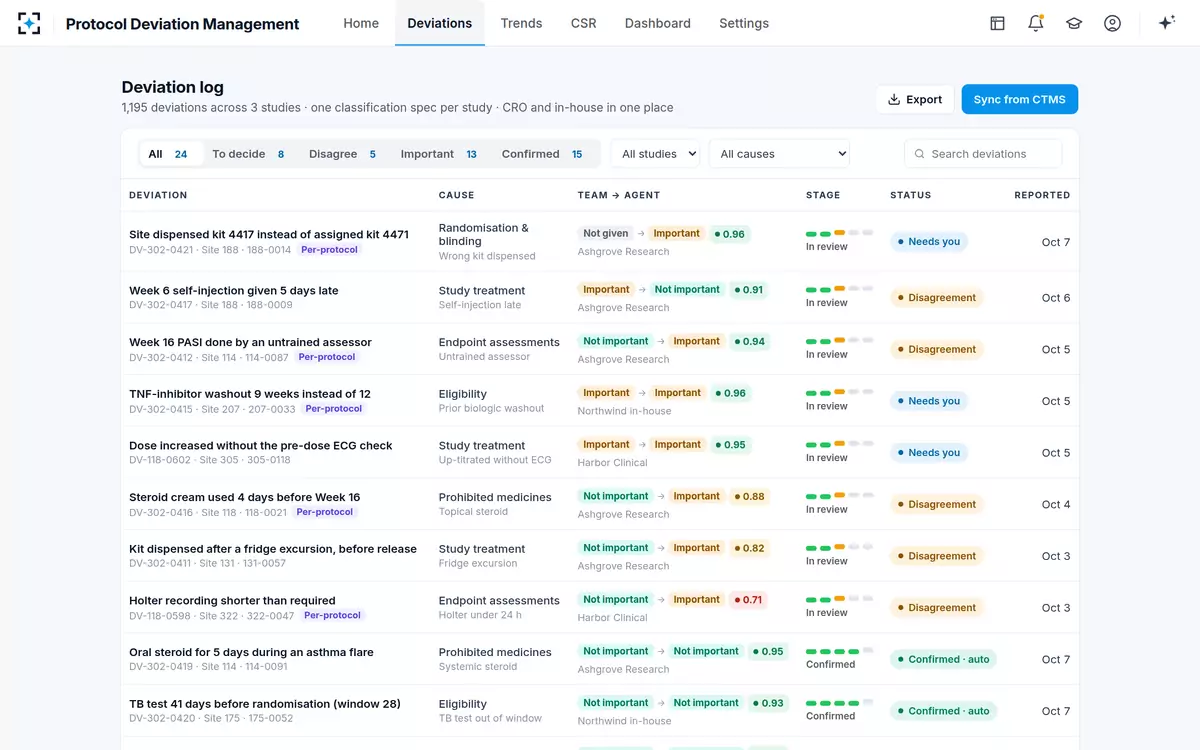
A study therefore needs three stages where most deviation logs have one. A candidate exists from the moment a site or a service provider raises it. An assessment happens, by a named person, inside the seven days. And a notification either goes or does not, with the reasoning recorded either way. In the sample study the first stage is a route rather than a meeting: the impact assessor flags a possible serious breach at an EU or UK site to the clinical quality lead on the day the deviation is reported, with the due date attached, and the agents go no further — the assessment and the decision belong to that person.
A possible serious breach, routed to clinical quality with its due date — in Protocol Deviation Management
What is the difference between a protocol deviation and a serious breach?
Scale, consequence and audience. A protocol deviation is any departure from the protocol; the sponsor classifies it as important or not and reports it in the clinical study report at the end of the study. A serious breach is a departure of either the protocol or the regulation that is likely to significantly affect participants or the data — and it is notified to a regulator within seven days, while the study is still running.
The MHRA makes the ordinary case explicit: "Deviations from clinical trial protocols and GCP occur commonly in clinical trials. The majority of these instances are technical deviations that do not result in harm to the trial participants or significantly affect the scientific value of the reported results of the trial." Those are documented in the case report form or the trial master file, fed into corrective actions, and considered in the clinical study report — and "not every deviation from the protocol needs to be reported to the MHRA as a serious breach."
The relationship between the two classifications is one-way and not symmetrical. Every serious breach of the protocol is at least an important deviation. Most important deviations are not serious breaches. And a few serious breaches are not protocol deviations at all, because they are breaches of the regulation rather than of the protocol — a failure in safety reporting, or an early destruction of investigator site files, has no protocol section to cite. A study that treats breach assessment as a subset of deviation classification will miss that last category entirely. The importance test and the seriousness test are two different questions asked of the same event.
The EU test and the UK test, word for word
Regulation 536/2014 Article 52 against UK regulation 29A
European Union: "the safety and rights of a subject"
United Kingdom: "the safety or physical or mental integrity of the participants of the trial"
European Union: "the reliability and robustness of the data generated in the clinical trial"
United Kingdom: "the scientific value of the trial"
European Union: "likely to affect to a significant degree" — identical wording in both.
United Kingdom: "likely to effect to a significant degree" — identical in substance.
European Union: Without undue delay and at the latest within 7 calendar days of the sponsor becoming aware.
United Kingdom: Within 7 days of becoming aware; where notification is delegated, the 7 days apply to the delegated party.
European Union: The Regulation, or the version of the protocol applicable at the time of the breach.
United Kingdom: The conditions and principles of good clinical practice, or the protocol as modified.
European Union: The Member States concerned, through the EU portal.
United Kingdom: The licensing authority, in writing, to the MHRA GCP team.
European Union: Notifiable where they are likely to affect participants or data in a trial authorised or being conducted in the EU or EEA.
United Kingdom: Notifiable where the breach is likely to significantly affect the overall scientific value of the trial and will impact UK participants or the UK public, or where a breach affecting participants at the non-UK site is found to affect UK participants too.
The practical difference between "the reliability and robustness of the data" and "the scientific value of the trial" is smaller than it looks, because both regulators assess it the same way: on the design of the trial, the type and extent of the data affected, the contribution of those data to key analysis parameters, and what excluding them would do. A multinational study can run one assessment and answer both, as long as it records which participants and which analyses were in scope.
Published examples, and the limb of the test each one met
The MHRA publishes a non-exhaustive list of real notifications with its own verdict on each, which is the closest thing in this area to case law. It is worth reading in full; a selection makes the pattern visible.
Notified to the MHRA, and whether it was a serious breach
| What was reported | Serious breach? | The reason given |
|---|---|---|
| A participant was dosed with the incorrect investigational product, administered by the incorrect route — the product came from a completely different trial. | Yes | "There was significant potential to impact the safety or physical or mental integrity of trial participants." |
| Participants in an entire cohort were dosed three times daily when the protocol said once daily. | Yes | Impact on safety or integrity and on scientific value — and "systematic and persistent leading to a constant breach". |
| A participant took investigational product that had expired two days earlier; no adverse events, no effect on scientific integrity. | No | A single episode with a detailed corrective and preventive action, and no impact on either limb. |
| Temperature excursions affecting investigational product. | It depends | Yes if participants were dosed with product assessed as unstable; no if the product was quarantined and a qualified assessment showed no impact on safety or data integrity. |
| An updated participant information sheet was emailed to the 11 participants at one site with all of them copied in, exposing each other's names and email addresses. | Yes | A rights failure rather than a safety or data failure — the participant limb is wider than harm. |
| Over 100 reports of suspected unexpected serious adverse reactions carried incomplete case narratives, over three years. | Yes | Inaccurate reporting prevents the regulator from having accurate oversight of safety, "a systemic issue not identified for over three years". |
| A visit date deviation — "a common deviation in clinical trials". | No | "A minor protocol deviation, which does not meet the criteria for notification." |
Three lessons run through the list. Scope decides more than severity: one participant given an expired dose with no consequence was not a breach, while one cohort dosed wrongly was. Rights count as much as safety: an email that exposed eleven participants to each other harmed nobody and was a serious breach. And a reporting failure can be the breach, with no clinical event behind it at all.
Can a run of small deviations become a serious breach?
Yes, and this is the case most studies are least equipped to see, because every event in the run is individually unremarkable. The MHRA addresses it directly, in answer to whether persistent or systematic non-compliance should be reported: "If this non-compliance has a significant impact on the integrity of trial participants in the UK or on the scientific value of the trial, this will constitute a serious breach. For example, widespread and uncontrolled use of protocol waivers affecting eligibility criteria, which leads to harm to trial participants in the UK or which has a significant impact on the scientific value of the trial."
The word doing the work is widespread. A deviation process that classifies events one at a time cannot produce that judgment, because the unit of assessment is wrong. What produces it is trending: a rate with a denominator, a threshold set in advance, and a comparison across teams and sites. In the sample study one contract research organisation's sites miss the protocol's pre-dose pregnancy test 2.4 times as often per site as the in-house sites do — which is not a serious breach, and is exactly the shape of thing that becomes one if nobody acts on it. Separating cause from impact is what makes a run countable before it is a notification.
Why remediation does not undo the notification
The most common misunderstanding in this area is that a breach fixed quickly is a breach that need not be reported. Both regulators have closed it in writing. The EMA guideline: "It should be noted that mitigation actions undertaken to remediate the occurrence of the serious breach do not negate the fact that a breach occurred and should be treated according to the legal requirements." The same section adds that systematic or significant mis-dosing meets the criteria "regardless of whether or not the trial participant(s) suffered adverse reactions as a result".
Remediation still matters, and it belongs in the notification: both regulators accept follow-up reports, and both say the initial report may set out an investigation or corrective action plan with projected timelines rather than waiting for it to finish. The thing remediation cannot do is make the seven days go away.
Serious breach notifications must not be used as a punitive measure against investigator sites or service providers and should not be used by sponsors to manage site/service provider performance.
MHRA, Notification of Serious Breaches of GCP or the trial protocol, Appendix I
That sentence is there because the opposite happens. A sponsor that treats notification as an escalation tool teaches its sites to under-report, and the first cost of under-reporting is paid on the clock: incidents arrive late, assessments start late, and a breach that should have been notified on day three is notified on day nine. Keeping performance management in the trending conversation and out of the notification is a reporting-rate decision as much as a fairness one.
Who has to be able to reach the sponsor, and how fast
The EMA guideline is specific about the plumbing, and it is the part sponsors most often leave to chance: documented training of the principal investigator and site staff on serious breaches should be kept in the trial master file, and "the sponsor should provide the PI with a dedicated, unique, e-mail address and telephone number for such communications that can be reached at all times."
Three arrangements follow from that, and all three belong in the study's own plan rather than in a procedure nobody reads. A named route that reaches a person at all times. Written agreements obliging sites and service providers to notify the sponsor promptly, so the sponsor's awareness is not an accident of who checked which mailbox. And named back-ups, because a seven-day clock that depends on one individual being at their desk is a seven-day clock that will be missed during a holiday.
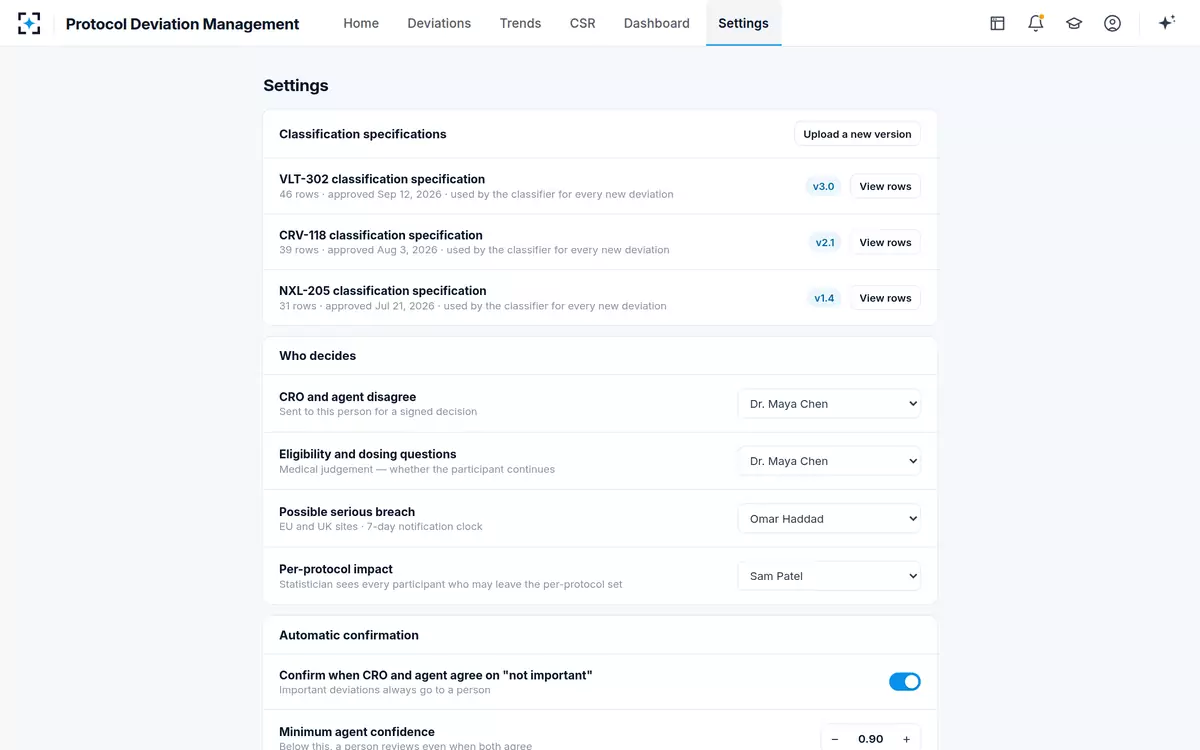
In the sample study the route is a setting rather than a sentence in a procedure: a possible serious breach at an EU or UK site goes to the named clinical quality lead, and the due date travels with it. The worked case is deviation DV-302-0410 at Site 163 in Valencia — the Week 8 dose given without the protocol-required pre-dose pregnancy test. It was flagged on 2 October with a clock ending 9 October, and its importance was never in question: both the site's team and the classification called it important under the study's clinical checks row. Importance was agreed; seriousness was a separate assessment, by a named person, inside the week.
The breach route and its owner, set per study
What the assessment record should contain either way
The record of a candidate that was not notified is as important as the record of one that was, and it is the one most studies cannot produce. The MHRA is explicit about the minimum: "as a minimum, the decision on whether an issue constitutes a serious breach should be retained in the relevant Trial Master File(s)", and the EMA guideline notes that the appropriateness of the sponsor's decisions may be examined at inspection.
What a serious breach assessment should record, notified or not
- When the sponsor became aware, and from whom
The date and the route — a site, a service provider, central monitoring, an audit. This is the fact the clock is measured from, and the one an inspector will ask for first.
- What is alleged to have happened, in the original words
The incident as it was communicated, before anyone characterised it. A candidate is assessed on the facts reported, not on the summary.
- The limb or limbs assessed, each answered separately
Participant safety, rights and integrity; and the reliability or scientific value of the data. A single yes or no loses which question was answered.
- The reasoning on significance and on extent
Why the effect was or was not likely to be significant: the design, the data affected, their contribution to key analyses, how many participants and how many sites.
- Whether it was isolated or systematic
The run, if there is one — how often, over what period, at how many sites — because persistence can turn a set of technical deviations into a breach.
- The decision, the decider and the date
Named person, date and outcome, held in the trial master file whether or not a notification went. A decision not to notify is a decision.
- The corrective and preventive action, and the follow-up
What was done, with projected timelines where the work is still running, and what follow-up report is expected and when.
The deviation record is where most of that already lives. Both dates, the original description, the protocol provision, the classification and the run across sites are all fields a well-kept deviation log carries anyway; what the breach assessment adds is the two limbs answered against a different threshold, and a named person's reasoning. That is why keeping the two questions on one record pays — the deviation plan is where the route and the record are specified, and the systems a study already runs on decide how fast a candidate gets in front of the person who has to assess it. To see the route, the clock and the record on your own study, start from Protocol Deviation Management.
Questions people ask
How long do you have to report a serious breach?
Seven days from the sponsor becoming aware, in both the EU and the UK, and without undue delay within that. If notification has been delegated to another party, the UK guidance applies the seven days to that party. An assessment undertaken to confirm the breach may not extend the period — the EMA guideline says so in terms.
Do you have to report a suspected serious breach?
No. The EMA guideline states that under Regulation 536/2014 only serious breaches must be notified, not suspected serious breaches — a suspected serious breach being an incident that the sponsor has not yet assessed. But the same passage asks sponsors with reasonable grounds based on evidence to notify first, within seven days, and investigate alongside or after, rather than holding the report while they build a complete picture.
Who reports a serious breach, the sponsor or the site?
The sponsor, or a party the sponsor has legally authorised to do it. The sponsor retains legal responsibility even when the function is delegated. The MHRA adds that where the sponsor does not report and the investigator or institution believes a serious breach occurred, the investigator or institution should perform due diligence and consider reporting directly.
What are examples of serious breaches in clinical trials?
From the MHRA's own published list: a participant dosed with product from a different trial by the wrong route; a whole cohort dosed three times daily instead of once; investigational product dispensed after a temperature excursion where participants were dosed with product assessed as unstable; an updated information sheet emailed to eleven participants with all of them copied in; and more than a hundred safety reports with incomplete narratives over three years. A visit date deviation is on the same list as not a serious breach.
Can repeated minor deviations become a serious breach?
Yes, where the non-compliance is persistent or systematic and significantly affects participants or the scientific value of the trial. The MHRA's example is widespread and uncontrolled use of protocol waivers affecting eligibility criteria. Spotting it needs trending with a denominator and a threshold rather than case-by-case classification, because no single event in the run looks like a candidate.
Does fixing the breach remove the need to notify?
No. The EMA guideline states that mitigation actions taken to remediate a serious breach do not negate the fact that a breach occurred, and that it should still be treated according to the legal requirements. The remediation belongs in the notification, which can carry projected timelines and be followed up as the work completes.