The important protocol deviation definition in force today has two limbs: a deviation is important if it might significantly affect the completeness, accuracy or reliability of the study data, or if it might significantly affect a participant's rights, safety or well-being. FDA adopted that wording from ICH E3(R1) in its December 2024 draft guidance, and ICH E6(R3) carries the same two limbs into good clinical practice. What the definition is not is a list you can look a deviation up in. It is a test the study has to apply, which is why two experienced people can read the same deviation and disagree in good faith. Botminds' Protocol Deviation Management makes the test explicit: every deviation is answered on both limbs against the study's own classification specification, with the protocol section it breaches and the earlier signed decisions beside it, and the medical monitor signs.
The worked examples below come from a fictional sample study inside the solution — Northwind Bio's VLT-302, Veltrimab in plaque psoriasis, Phase 3, 64 sites and 612 participants, with the contract research organisation Ashgrove Research running 40 of them. The study, the people and the deviation numbers are invented; the regulators' words are quoted and linked where they appear.
What is an important protocol deviation?
An important protocol deviation is a subset of protocol deviations — and a protocol deviation, in the same guidance, is "any change, divergence, or departure from the study design or procedures defined in the protocol". The definition itself comes from ICH's own questions and answers on the clinical study report guideline: an important protocol deviation is one that could significantly affect how complete, accurate or reliable the study data are, or could significantly affect a subject's rights, safety or well-being (ICH E3 Q&As (R1), Q7). FDA's draft guidance restates that definition, with might in place of may, and then adopts it outright (FDA, Protocol Deviations for Clinical Investigations, December 2024).
ICH E6(R3), the good clinical practice guideline that reached Step 4 on 6 January 2025, carries the same two limbs into good clinical practice, speaking of trial data rather than study data and of a participant rather than a subject (ICH E6(R3), section 3.9.3). The difference between might and may is not a difference of meaning. Both are conditional on purpose: the question is whether the deviation could have mattered, not whether anyone can prove afterwards that it did. A missing pregnancy test before a dose is important even when the participant was not pregnant.
The word doing the real work in both sentences is significantly. Neither guideline defines it, and neither intends to. Significance is a property of the trial — of its endpoints, its population and its safety assumptions — so the same event is important in one study and routine in the next.
The two questions the definition actually asks
Read as an instruction rather than a sentence, the definition is two independent questions with an or between them. A deviation that fails either test is important. It does not have to fail both, and a classification that only ever considers one of them is only half a classification — which is the commonest way a deviation is called not important by mistake.
Two questions, either one sufficient: how Protocol Deviation Management asks them
Could it have affected the data?
completeness, accuracy and/or reliability of the study data
Endpoint assessments, eligibility, randomisation integrity, dosing, and anything that feeds a planned analysis. Ask it of the key data, not of every field on the form.
Answered against the study's endpoints and analysis plan
Could it have affected the participant?
a participant's rights, safety or well-being
Consent, safety monitoring, withdrawal criteria, prohibited medicines, protective procedures before a dose. Harm does not have to have happened.
Answered against the protocol's participant protections
Recording which limb the answer turned on is worth more than the answer itself. A deviation that is important on the data limb produces an analysis-set question for the statistician and a line in the clinical study report. A deviation that is important on the participant limb produces a safety conversation, a site action and, at an EU or UK site, a question about whether it is also a serious breach with a seven-day clock. The two answers go to different people. A single important/not important flag loses that routing, and the team rebuilds it by hand at every review.
Why FDA's own regulations contain no definition at all
Sponsors looking for a regulatory definition in the Code of Federal Regulations will not find one, and the agency says so in the first paragraph of its guidance: "FDA regulations do not include a definition of the term protocol deviation or provide a system for classifying the various types of deviations that may occur during the conduct of a clinical investigation" (FDA, section I). The regulations impose duties — investigators must keep records of deviations, sponsors must monitor and must secure compliance — without ever saying what counts.
That gap is why the definition reached FDA through ICH, and why the December 2024 draft guidance matters more than its status suggests. A draft guidance is not binding; FDA says plainly that guidances "describe the Agency's current thinking on a topic and should be viewed only as recommendations". But for a term the regulations leave undefined, current thinking is the only published answer a reviewer and a sponsor share. Studies that classify to it are speaking the reviewer's language.
Important, major, critical, significant: one word now covers them
Most deviation logs in flight today were built on vocabulary that predates the guidance, and the words do not line up. FDA's recommendation is to stop sorting them out: the agency acknowledges that major, critical and significant have all been used for these deviations, and recommends a single word, important, to cover every one of them (FDA draft guidance, section III.A.1).
The words teams use against the one word FDA now recommends
| The word on your form | What it usually meant | Where it lands now |
|---|---|---|
| Major | A deviation serious enough to report upward, often judged by a site or a monitoring team rather than by criteria. | Important — FDA names major as one of the terms important is meant to cover. |
| Critical | Borrowed from audit grading; a finding that threatens the study rather than one participant. | Important. Severity above important is not a separate class in the guidance. |
| Significant | Used interchangeably with major, and confusing because significant is also the threshold word inside the definition. | Important. Keep significant for the test, not for the label. |
| Minor, noncritical, non-significant | Everything that did not feel reportable. | All other protocol deviations — the guidance's own phrase for the rest. |
| Violation | A departure thought wilful, or one that forced a withdrawal. | Avoid. ICH E3 Q&A notes the word "may also have other meanings in a regulatory context" and encourages sponsors to replace it with deviation in the participant-disposition flowchart. |
| Waiver, exception, approved deviation | A departure agreed in advance. | Still a deviation. Prior agreement changes who knew, not whether the protocol was followed. |
The practical consequence is that a study running three vocabularies — the sponsor's, each contract research organisation's and the site's — is not running three scales but one scale described three ways, and the translation is being done in people's heads at the monthly review. Collapsing the words onto important and all other costs nothing and removes an argument that was never about the deviation.
Who decides whether a protocol deviation is important?
The sponsor decides. ICH E6(R3) puts the criteria on the sponsor, which is to determine the trial-specific criteria for classifying a deviation as important (section 3.9.3) — and FDA's guidance puts the pre-specification in the protocol. Investigators are asked to flag, not to settle: "When reporting protocol deviations to the sponsor, investigators should identify important deviations." A contract research organisation classifying on the sponsor's behalf is exercising a delegated judgment, and delegation does not move the responsibility.
In practice that means three roles with different jobs. The site or the monitoring associate reports what happened and proposes a classification. The sponsor's criteria decide what that description means. A named person — usually the medical monitor — signs where the proposal and the criteria disagree, and where the deviation is important. In the sample study the routes are set once: a disagreement between a contract research organisation and the classification goes to the medical monitor, eligibility and dosing questions go to the medical monitor with a named back-up, and a deviation can confirm itself only when both the team and the classification say not important at or above the configured confidence floor.
One sample Phase 3 study, as Protocol Deviation Management maps it
418deviations
reported across 64 sites, from both the contract research organisation and the in-house team
57
classified important — just under one in seven
196of 612
participants touched by at least one deviation
The deviations FDA names as important, and the ones it does not
The guidance does give examples, in two non-exhaustive lists — one for deviations that threaten participants and the assessment of safety, one for deviations that reduce the reliability of conclusions on effectiveness — and a third list of what usually sits on the other side. The lists are worth reading as evidence of how the agency applies the two questions, rather than as a classification specification.
FDA's own examples, on each side of the line
Named important: Failure to conduct study procedures designed to assess participant safety, or to adequately monitor participants — for example failing to collect laboratory assessments that monitor a safety issue.
Named as all other deviations: Failure to perform a study procedure "not relevant for safety monitoring or not related to an important study efficacy endpoint".
Named important: Failure to administer the study product according to the specifications in the protocol.
Named as all other deviations: "Small deviations from protocol-specified visit windows."
Named important: Failure to obtain informed consent, or to meet other participant-protection requirements under 21 CFR part 50.
Named as all other deviations: "A signed consent with a page missing a participant's initial."
Named important: Enrolment of a participant who does not meet a key eligibility criterion — one of those the protocol relies on to produce the participant population the trial was designed to study.
Named as all other deviations: Criteria that are not key to the population the trial is answering a question about.
Named important: The wrong treatment or an incorrect dose; a prohibited concomitant treatment that may increase risk; failure to follow the randomisation scheme; premature unblinding outside the protocol's reasons.
Named as all other deviations: Nothing on this row: the guidance names every one of these as important.
Named important: Failure to collect data to evaluate important study endpoints, primary or secondary.
Named as all other deviations: Data that feeds neither safety monitoring nor an important endpoint.
Two patterns run through the important list. Every entry on the effectiveness side touches something a planned analysis depends on — eligibility that defines the population, the endpoint data itself, the integrity of the allocation. Every entry on the safety side touches a protection the protocol put there on purpose. That is the two questions again, and it is the most useful way to extend the list to a deviation nobody has written down: ask which analysis or which protection the protocol intended, and whether this departure reached it.
A GCP finding is not automatically a protocol deviation
Studies that treat every compliance finding as a deviation drown their own signal, and FDA says so with an example worth quoting in full: "if a monitor discovers that the site delegation log is missing a signature of one of the site study staff, this missing signature should be addressed, but it is not considered a protocol deviation because the protocol likely does not specify this level of detail at the site level. Classifying potential GCP compliance issues as protocol deviations can inflate the number of events submitted to sponsors, FDA, and IRBs."
The test is whether the protocol — including its related plans and procedures, which the guidance treats as part of the protocol — actually specified the thing that was not done. A missing signature on a delegation log is a quality system problem with its own corrective action. An assessment performed by someone the protocol required to be trained is a protocol deviation, because the protocol said so. The dividing line is the document, not the seriousness.
The study writes its own criteria — and may change them
The definition of important protocol deviations for a particular trial is determined in part by study design, the critical procedures, study data, subject protections described in the protocol, and the planned analyses of study data.
ICH E3 Structure and Content of Clinical Study Reports: Questions and Answers (R1), Q7
That sentence is the whole answer to "is this deviation important?" being unanswerable in the abstract. The same Q&A adds the permission that follows from it: "In keeping with the flexibility of the Guideline, sponsors may amend or add to the examples of important deviations provided in E3 in consideration of a trial's requirements. Substantial additions or changes should be clearly described for the reviewer."
Criteria also move during a study, and the guidance expects them to. FDA asks sponsors to document and evaluate the deviations they did not call important "to determine if the types and numbers of these protocol deviations warrant reclassification; if the sponsor determines that reclassification is warranted, they should then notify the investigator of the reclassification". Reclassification by volume is a real mechanism: thirty out-of-window visits at one site stop being thirty small events and start being a question about whether that site's data can carry an endpoint. What the sentence demands in return is that the change be visible — the earlier calls were made under the old criteria, and a reviewer reading the study later needs to see which version each decision was made under. The solution keeps the criteria versioned for exactly this reason, so a classification signed in June can still be read against the version in force in June. What belongs in the deviation plan that holds those criteria is set out separately.
One deviation, decided twice: a worked classification
Deviation DV-302-0412 in the sample study is the ordinary hard case. At the Week 16 visit on 1 October the PASI and sPGA assessments — the study's primary efficacy assessments — were performed by the site's study coordinator, who is not on the site's assessor training log; the site's only trained sub-investigator was on leave. It was reported on 5 October. Ashgrove Research, which runs the site, proposed not important, on a reasonable ground: the visit fell on Day 113, inside the protocol's three-day window.
Both parties are right about different questions. The timing was fine. The timing was not the deviation. Protocol VLT-302 version 5.0, section 8.1.2, requires PASI and sPGA to be performed by an assessor who has completed the sponsor's training and is listed on the site's assessor training log, and the primary efficacy assessment was made by someone outside that requirement. On the data limb the answer is yes: an untrained assessor can bias the score that the study's primary endpoint is built from. On the participant limb the answer is no: no safety procedure was missed and the participant was not put at risk. One yes is enough.
Both opinions, both questions, and the evidence behind each — in Protocol Deviation Management
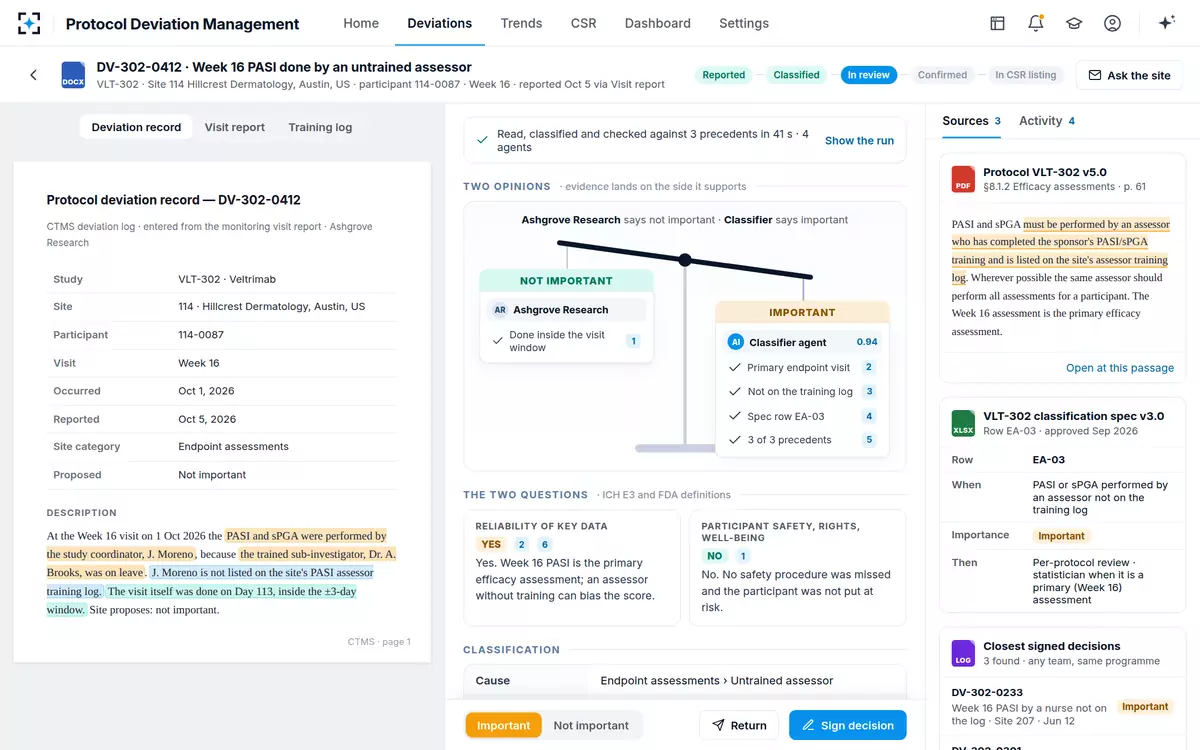
The medical monitor signed important, and the reason she signed became the text the next similar deviation is measured against: the primary efficacy assessment was performed by a coordinator not on the training log, and the visit timing does not change that. The confidence figure beside the classification, 0.94, is not a probability of being right; it is the threshold mechanism. Below the configured floor, currently 0.90, a person decides regardless of what either side proposed.
What a classification has to show to survive a review
A classification is reviewed twice: once by the next person who disagrees with it, and once, years later, by someone reading the clinical study report or standing in an inspection. Both readers want the same five things, and none of them is the answer on its own.
What a defensible important-deviation classification records
- The criterion it was decided under
The row of the study's classification specification that covers this deviation type, and the version of the specification in force on the decision date.
- The protocol section breached
Section and page of the protocol version applicable at the time — not the current version, if the protocol has been amended since.
- Which of the two questions it turned on
Data, participant, or both, answered separately. This is what routes the deviation to the statistician, to clinical quality, or to neither.
- The earlier signed decisions it is consistent with
The closest previously signed classifications on the same rule, from any team on the study, and whether they agree.
- Who signed, and what the signature meant
A named person, the date, and the stated meaning of the signature — plus a reason in words, because the reason is what the next team is trained on.
Consistency is the part teams underestimate. A study whose criteria are sound but applied differently by four teams produces a deviation listing in which the same event appears on both sides of the line, and that is visible to a reviewer without any inside knowledge. In the sample study the log shows every team's proposal next to the classification, so the drift is a number rather than an impression — the in-house team, the two contract research organisations and the classification each agreeing with the medical monitor's final call at a different rate over the last thirty days.
Every team's proposal beside the classification, in one deviation log
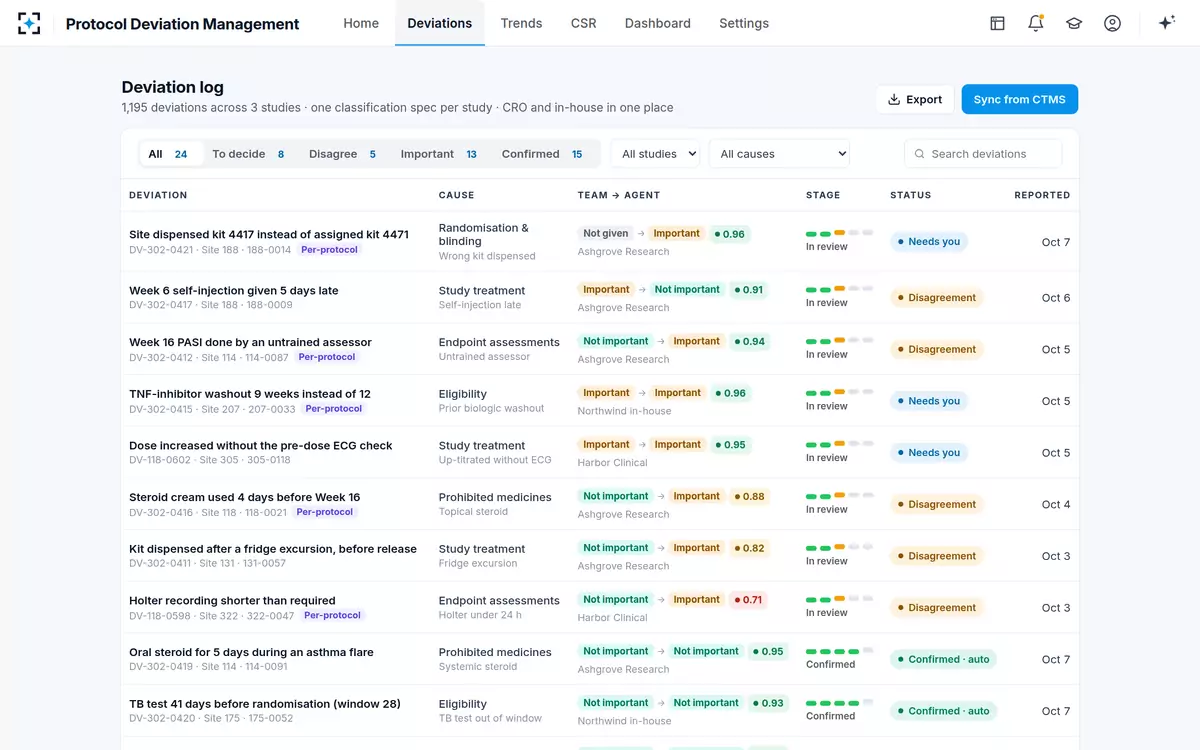
Once the criteria and the evidence are in one place, the harder questions become answerable in the same motion: which categories a study should be sorting deviations into, and what the trial systems you already own will and will not decide. To see the two questions answered on your own deviations, start from Protocol Deviation Management.
Questions people ask
Is a major protocol deviation the same as an important one?
In effect, yes. FDA's December 2024 draft guidance says that while terms such as major, critical and significant have been used for these deviations, it recommends using important to encompass all of them. If your forms still say major, the safest reading is that major deviations are important deviations under a previous name — but check the definition behind the word, because some sponsors used major for a severity above important rather than for the same class.
Does FDA define protocol deviation in its regulations?
No. The guidance opens by saying FDA regulations include no definition of protocol deviation and no system for classifying deviations. The definition FDA uses comes from ICH E3(R1), and the December 2024 draft guidance adopts it. The regulations still impose duties around deviations — investigator records, sponsor monitoring, securing compliance — without defining the term.
What action is required when an important protocol deviation occurs?
Report it to the sponsor in the time frame the sponsor set, and remedy it where remedy is possible: FDA asks that identified important deviations "be promptly remedied or addressed during the conduct of the clinical investigation". The sponsor evaluates it, considers whether a root-cause analysis is needed if similar deviations are recurring, and includes it in the clinical study report discussion and in the listing of participants with important deviations by site.
Is every GCP finding a protocol deviation?
No, and treating them as one inflates the numbers reported to sponsors, FDA and institutional review boards. FDA's own example is a site delegation log missing a staff signature: it must be addressed, but the protocol does not specify that level of site detail, so it is not a protocol deviation. The test is whether the protocol or its related plans specified the thing that was not done.
Can a deviation be reclassified as important later?
Yes, and the guidance expects sponsors to look for the case. Deviations not classified as important should be documented and evaluated to see whether their types and numbers warrant reclassification, and where the sponsor decides they do, the investigator should be notified of the reclassification. A run of individually unimportant deviations at one site is the usual trigger.
Who has the final say when a CRO and the sponsor disagree?
The sponsor. ICH E6(R3) places the trial-specific classification criteria on the sponsor, and delegating a task does not move the responsibility for it. In practice a named person — most often the medical monitor — signs the classification where a team's proposal and the study's criteria differ, and the reason given becomes the precedent the next proposal is measured against.