ICH E3, the 1995 guideline on the structure and content of clinical study reports, deals with important protocol deviations in two short paragraphs, and between them they create three separate obligations: Section 10.2 of the report body summarises the deviations by centre and by category, Appendix 16.2.2 lists the individual participants who had them, and — because FDA asks for it on top of E3 — every deviation goes into the Protocol Deviation (DV) tabulation with the sponsor's own judgement of whether it was important. Writing all three is a day's work if every deviation already carries a signed classification, and a month of reconstruction if it does not. Botminds' Protocol Deviation Management is built on the second observation: it classifies each deviation against the study's specification during conduct, and builds the Appendix 16.2.2 listing, the Section 10.2 draft and the deviation tabulation from confirmed decisions only, with every drafted sentence citing the entry it came from.
The study used as an example here is sample data: Northwind Bio's VLT-302, Veltrimab in plaque psoriasis, Phase 3, 64 sites and 612 participants, with the medical writer Priya Raman assembling the report. The sponsor, the drug, the sites and the people are fictional characters in the solution's own sample study; the guideline text is quoted and linked where it is used.
What does ICH E3 say about important protocol deviations?
It says one sentence about what must be described, and one about where the participants are listed. The first is the sentence that governs the body of the report.
"All important deviations related to study inclusion or exclusion criteria, conduct of the trial, patient management or patient assessment should be described."
ICH E3, Structure and Content of Clinical Study Reports, §10.2 Protocol Deviations (Step 4, 30 November 1995)
Four classes of deviation, and the word "all". E3 does not define important — which is the single most consequential gap in the guideline, and the reason every study needs its own written criteria. The E3 questions and answers close the gap only partly: "The E3 Guideline provides examples of the types of deviations that are generally considered important protocol deviations and that should be described in Section 10.2 and included in the listing in Appendix 16.2.2" (ICH E3 Q&As (R1), Q7, last updated 6 July 2012). Examples, not a definition, and the same Q&A then says the definition for a particular trial is determined in part by its own design and planned analyses.
The practical reading is that E3 tells you the shape of the output and leaves the input to you. A study that has not written down what it means by important cannot satisfy Section 10.2, because it has no way of deciding which deviations the word "all" refers to. The definition of an important protocol deviation and its two tests sets out what FDA now recommends in that space.
Section 10.2: a summary by centre, in four categories
E3's instruction for the body text is specific about three things: summarise, break it down by centre, and group it. "In the body of the text, protocol deviations should be appropriately summarised by centre and grouped into different categories", it says, and gives four examples of such categories: participants who entered the study even though they did not satisfy the entry criteria; those who developed withdrawal criteria during the study but were not withdrawn; those who received the wrong treatment or incorrect dose; and those who received an excluded concomitant treatment (ICH E3 §10.2).
Those four are not a closed list — "such as" does the same work here that "criteria such as" does elsewhere in the ICH guidelines — and most studies carry deviations that fit none of them, from consent documentation to sample handling. The useful discipline is to keep E3's four as the spine of the section, because a reviewer looking for them will find them where they expect to, and to add the study's own categories after rather than instead.
"By centre" is the instruction most often honoured in the breach. A section that reports 57 important deviations across a 64-site study, with no site breakdown, has summarised away the only pattern a reviewer is looking for. The same number split by site shows whether the study had a diffuse problem or three sites with a concentrated one, which is a different conclusion about the reliability of the data.
What goes in Appendix 16.2.2, and what does not?
Appendix 16.2.2 is one of the patient data listings, and E3 is brief about it: "In appendix 16.2.2, individual patients with these protocol deviations should be listed, broken down by centre for multicentre studies" (ICH E3 §10.2). Three words carry the design. Individual patients — the unit is the participant, not the deviation, so a participant with four deviations appears once with four rows beneath, not scattered through a chronological log. These — the listing covers the deviations described in Section 10.2, which is to say the important ones, not every entry in the study's deviation log. Broken down by centre — the same grouping as the body text, so the two can be read against each other.
FDA asks for the same listing in its own words, and adds the participant identifier: in "the Patient Data Listing section of the appendix to the clinical study report, sponsors should provide a listing of all trial participants (by unique subject identifier) with important protocol deviations organized by clinical trial site (if the study is a multicenter study)" (FDA, Protocol Deviations for Clinical Investigations, draft guidance, December 2024).
What does not go in: minor deviations, which belong in the tabulation and not in the appendix; narrative explanation, which belongs in Section 10.2; and — a common and avoidable error — any deviation whose classification is still an open question. A listing containing a row that may be reclassified after the report is signed is a listing that will have to be reissued.
Three artefacts out of one set of facts
| Section 10.2, in the report body | Appendix 16.2.2, in the patient data listings | The DV tabulation | |
|---|---|---|---|
| What it contains | A narrative summary of all important deviations related to entry criteria, conduct of the trial, participant management or participant assessment. | Each individual participant who had one of those deviations, with the deviation itself. | Every protocol deviation on the study, important or not, as structured data. |
| How it is grouped | By centre, and into categories — E3 offers four, and a study may add its own. | By centre, then by participant identifier. | By participant and deviation, with a category and a start date on each. |
| Which deviations qualify | Important only. | Important only — "individual patients with these protocol deviations". | All of them, with a variable carrying the sponsor’s determination of importance. |
| Who owns it | The medical writer, with the medical monitor answering for the classifications. | The medical writer, from the study’s deviation entries. | A statistical programmer, who validates the dataset before it is submitted. |
| Where the requirement comes from | ICH E3 §10.2, and FDA’s December 2024 draft guidance for an NDA or BLA. | ICH E3 §10.2 and its Appendix 16.2.2; FDA asks for the unique subject identifier. | FDA’s Study Data Technical Conformance Guide and the December 2024 draft guidance; not an ICH E3 requirement. |
| What a reviewer does with it | Reads it, and compares the count with the analysis sets section. | Looks up the participants named in the narrative, and scans for clustering by site. | Runs it. It feeds site-level trend analysis for inspection planning. |
The DV domain, and the one variable FDA asks you to add
The DV domain is the standard structured dataset for protocol deviations in a submission, and FDA is unusually explicit about why it wants it: "The DV domain should be included in your submission. It will be used by reviewers to examine protocol deviation trends of various study sites in order to facilitate the Bioresearch Monitoring Program (BIMO) clinical investigator site selection process, and once FDA tools are developed to extract and format needed data from SDTM, to populate line listings used by the Office of Regulatory Affairs (ORA) investigators during inspections" (FDA, Study Data Technical Conformance Guide, v6.3, October 2026).
Read that twice. The deviation dataset a sponsor submits is one of the inputs to deciding which of its investigator sites get inspected. A site whose deviations cluster in the tabulation is a site a reviewer can see, which makes the quality of the categories and dates in that dataset a matter of more than conformance.
The same guide names the variables expected beyond the standard required set, and FDA's protocol deviations guidance adds one more that the standard does not contain at all: "Sponsors should include a variable in the DV domain that provides the sponsor's determination of whether the protocol deviation was important." That single flag is the bridge between the tabulation, which holds everything, and the two E3 artefacts, which hold only the important ones — and it can only be populated from decisions somebody actually made.
What the deviation tabulation asks for beyond the required set, and where each value has to come from
- DVSPID — the sponsor’s own identifier for the deviation
The identifier used in the deviation log, so a reviewer, a monitor and the listing are all talking about the same event.
- DVTERM — what happened, in text
The site’s description of the event, not a category. This is the field an inspector reads, so a one-word entry costs more than it saves.
- DVDECOD — the standardised term
From the study’s own controlled list of deviation types, which should be the same list the classification specification is written against.
- DVCAT and DVSCAT — category and sub-category
The cause map. If these are assigned by hand at lock rather than at classification, they will not agree with the deviation log.
- DVSTDTC and DVENDTC — when it started and ended
Dates, not the date it was reported. A deviation discovered at a monitoring visit six weeks later still happened on the day it happened.
- EPOCH — which part of the trial it fell in
Screening, treatment, follow-up. Derived, but derived wrongly if the deviation’s own dates are wrong.
- An importance flag, which the standard does not require
FDA asks for a variable carrying the sponsor’s determination of whether the deviation was important. It has one honest source: a signed classification.
Three artefacts, one set of facts: how they reconcile
The three outputs reconcile on two numbers and one flag. The count of important deviations in Section 10.2 must equal the number of deviations in Appendix 16.2.2; the participants named in Section 10.2's narrative must all appear in that appendix; and the subset of DV rows carrying the importance flag must be the same set again. Any study can check those three equalities in an afternoon, and the check is worth running early rather than at the point where fixing a mismatch means re-issuing a dataset.
They diverge for predictable reasons. A deviation reclassified after the listing was cut, and the body text never updated. A participant whose deviation was logged under one site number and moved to another when a site was re-coded. A category applied in the tabulation by one convention and in the appendix by another. Each of those is a reconciliation failure rather than a writing failure, and each disappears when all three outputs are generated from the same set of decisions rather than assembled separately by three people from the same spreadsheet.
All deviations, important deviations, and which output takes which
All protocol deviations: The DV tabulation, in full. FDA asks sponsors to report all protocol deviations there.
Important protocol deviations: Section 10.2 of the report body and the Appendix 16.2.2 listing, plus a flagged subset of the tabulation.
All protocol deviations: 418 deviations on the cause map across eight causes, touching 196 of 612 participants.
Important protocol deviations: 57 of the 418.
All protocol deviations: Anything that departed from the protocol and was reported. No judgement needed.
Important protocol deviations: The study’s own classification criteria, applied to each deviation and signed.
All protocol deviations: Site-level trend analysis, which feeds inspection site selection.
Important protocol deviations: Judging whether the conduct of the trial supports the conclusions drawn from it.
All protocol deviations: Under-reporting: deviations that were never logged cannot be tabulated, and a suspiciously clean site is itself a signal.
Important protocol deviations: Inconsistent classification: the same event called important at one site and not at another, which makes the by-centre breakdown meaningless.
All protocol deviations: As they are reported, into the trial systems.
Important protocol deviations: As they are reported, against a written specification — not at lock.
Why the listing cannot be built at database lock
The listing is a conduct artefact wearing a writing problem's clothes. Everything in it — the importance of each deviation, the protocol section it breached, the site it belongs to, the participant it touched — is a fact that existed during conduct and can only be established cheaply then. At lock, the medical writer is not writing. They are asking a medical monitor to re-read a deviation from eighteen months ago, with the person who reported it gone from the site and the monitoring visit report in an archive.
ICH E6(R3) places that work firmly in data finalisation, alongside the other things that must be settled before a database can be locked: its list of finalisation activities runs from reconciling data sets and databases, correcting errors and filling omissions where possible, and medical coding, to "compilation of and addressing the impact of" noncompliance, protocol deviations included (ICH E6(R3) §4.2.6, 6 January 2025). Compiling and addressing the impact of — the second half is the expensive one, because it means per-protocol consequences and serious breach questions, each of which has its own owner and its own clock.
Where the deviation section's work actually sits
- Conduct: classify, sign, flag impact as each deviation arrives34 months
- Lock and finalise4 weeks
- Draft, reconcile, submit10 weeks
- Conduct: deviations logged, importance deferred34 months
- Lock, plus a classification backlog10 weeks
- Draft, reconcile, re-reconcile, submit14 weeks
Confirmed decisions only, and what to do with the open ones
The rule that makes the listing trustworthy is also the rule that makes it uncomfortable: build it from confirmed decisions only. On the sample study at this point, 52 of 57 important deviations are confirmed and five are still waiting for a decision — and the listing says so rather than quietly including or excluding them. That visible five is the whole argument of this guide in one number. Those five participants cannot be placed in the appendix, cannot be counted in Section 10.2, and cannot have their per-protocol consequence settled, and nobody can know which way they will go until somebody decides.
The wrong responses are familiar. Including them with their proposed classification produces a listing that may change after the report is approved. Excluding them silently produces a count that is wrong in a direction a reviewer cannot detect. The workable response is to treat the open set as a tracked list with names against it and a date, and to hold the section — not the whole report — until it is empty.
From a signed decision to three outputs in Protocol Deviation Management
A person decides
Medical monitorSigns the classification with a reason, and the signature states its meaning. Only signed decisions count.
Never: Never signs a classification without the specification row and the protocol section in front of them
Agent
The listing writerBuilds the Appendix 16.2.2 listing by site and then by participant, from confirmed decisions only, carrying each participant’s per-protocol status: excluded, kept or flagged.
Never: Never includes a deviation whose classification is still a proposal
Agent
The listing writerDrafts the Section 10.2 summary by centre and category, with every sentence citing the entry behind it.
Never: Never writes a sentence that cannot be traced to a signed decision
Agent
The listing writerPrepares the deviation tabulation, with the importance flag taken from the signed classifications rather than re-derived.
Never: Never submits anything: the dataset goes to a programmer
A person decides
Statistical programmerValidates the tabulation against the standard and the study’s controlled terms, and fixes what conformance checks find.
Never: Never changes an importance flag — a disagreement goes back to the medical monitor
A person decides
Medical writerEdits the draft into the report’s voice, reconciles it against the analysis sets section, and owns the document.
Never: Never ships a section whose counts disagree with the appendix
Protocol Deviation Management's Appendix 16.2.2 listing, grouped by site
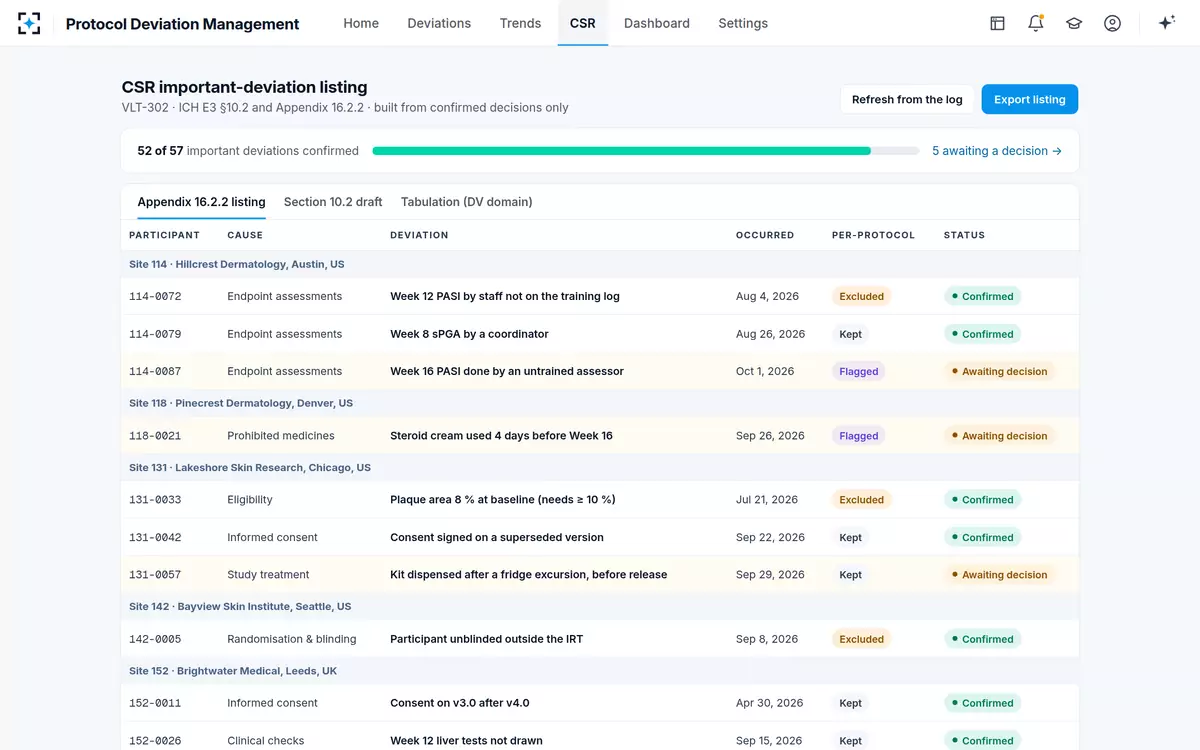
Confirmed decisions only, and every drafted sentence cites the entry it came from.
The deviation section against the analysis sets section
Section 10.2 is read next to the section that defines who was analysed, and the two have to tell one story. A participant who appears in Appendix 16.2.2 with an eligibility violation and then appears inside the per-protocol set needs a sentence explaining why — and the explanation is usually legitimate, because the analysis plan's definition of a major violation is narrower than the study's definition of important. What is not legitimate is leaving the reader to guess.
The cleanest way to make the two agree is to carry the per-protocol consequence on the deviation itself, in three states rather than two: excluded, kept, or flagged and still open. The sample study's listing does exactly that, so the medical writer reconciling the two sections is comparing two columns rather than two documents. The per-protocol set, and which deviations exclude a participant works through where those three states come from.
What the reviewer does with the listing, which is not what the writer does
A medical writer reads the listing as a count to be reconciled. A reviewer reads it as a map of where a study might have gone wrong, and the first thing they do with it is look for concentration — by site, by category, by time. That is why the by-centre breakdown is not a formatting preference, and why the structured tabulation exists at all: FDA says in plain terms that it feeds the selection of clinical investigator sites for inspection.
What inspectors then find at those sites is published each year. For fiscal year 2023, FDA's list of the most common clinical investigator inspection observations from issued Form 483s includes "Failure to comply with Form FDA 1572 requirements, failure to follow the investigational plan", alongside inadequate or inaccurate case history records, inadequate participant protection and informed consent issues, inadequate accountability for the investigational product, and safety reporting failures (FDA, Bioresearch Monitoring Fiscal Year 2023 Metrics). Failure to follow the investigational plan is a protocol deviation by another name, which makes the deviation listing a preview of what an inspector is likely to test first.
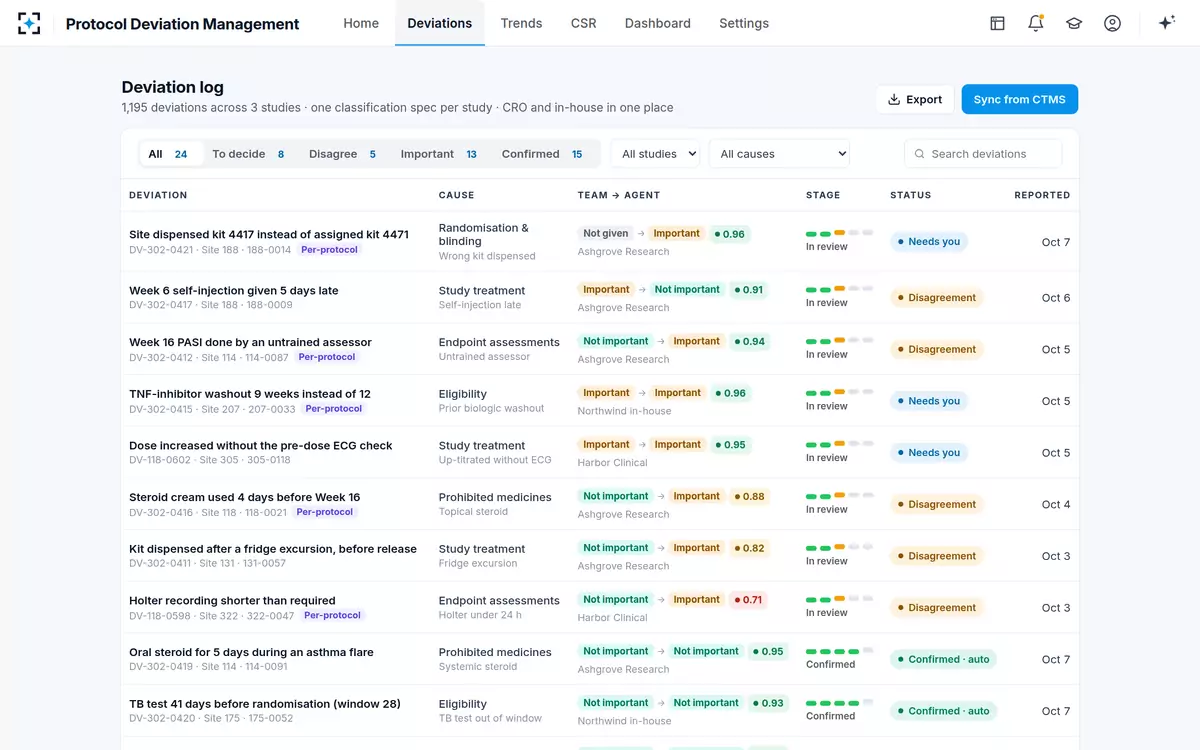
Every classification behind the listing, in one place
What a good deviation section reads like
Three properties separate a section a reviewer trusts from one they interrogate. It quantifies before it narrates: the count of important deviations, the proportion of participants touched, and the breakdown by centre and category come before any discussion of individual cases. It is specific about the ones that matter: a deviation that could have affected the primary endpoint gets its own paragraph naming the participants, what happened and what was done, rather than being folded into a category total. And it states its own judgement: it says why the study's authors believe the deviations, taken together, did not undermine the conclusions, and it says so in terms a reader can check against the appendix.
A section that does all three is also much shorter than one that does none, because most of the length in a weak deviation section comes from hedging that a count would settle. On the sample study the section is drafted from 57 signed decisions carrying 418 deviations behind them, which means every sentence in it has a number and a citation available; how deviations are categorised by cause and by impact covers the grouping that the by-centre summary rests on, and Protocol Deviation Management shows the listing, the draft and the tabulation on one study.
Questions people ask
Do you list all protocol deviations in a clinical study report, or only the important ones?
Only the important ones go in Section 10.2 and Appendix 16.2.2: E3 asks for "individual patients with these protocol deviations", meaning the deviations described in the body text. All of them, important or not, go in the structured deviation tabulation FDA asks for, with a variable carrying the sponsor's determination of importance. So the report narrates a subset and the dataset carries everything.
Does the Appendix 16.2.2 listing have to be broken down by site?
For a multicentre study, yes. E3 says individual patients should be listed "broken down by centre for multicentre studies", and FDA asks for the same listing "organized by clinical trial site". The reason is practical rather than formal: a reviewer is looking for clustering, and a listing sorted by participant identifier across 64 sites hides exactly what the requirement exists to reveal.
Does ICH E3 define an important protocol deviation?
No. It names four classes of deviation that must be described — entry criteria, conduct of the trial, participant management and participant assessment — and gives examples, and its Q&A says the definition for a particular trial is determined in part by study design, critical procedures, the participant protections in the protocol and the planned analyses. The definition has to be written by the study, which is what a classification specification is for.
Can a study use its own categories in Section 10.2?
Yes. E3's four categories are introduced as examples — "grouped into different categories, such as" — so a study may add its own, and most need to, because categories like consent documentation and sample handling appear in every trial and in none of E3's four. Keeping E3's categories as the spine and adding to them is easier for a reviewer than replacing them.
What is the DV domain used for once it is submitted?
FDA states the use directly: reviewers examine protocol deviation trends across study sites to support clinical investigator site selection for inspection, and the data are intended to populate line listings used by investigators during those inspections. That makes the categories, dates and importance flag in the dataset consequential beyond conformance checking.
Who signs off the deviation section of a clinical study report?
The medical writer owns the document, but the classifications underneath belong to whoever decided them — usually the medical monitor, by signature, with the reason recorded. The division matters when a classification is questioned during review: the answer should be a dated decision with a stated reason, not a drafting choice made while the section was being written.