Claims software programs for fraud detection, on a bank's P2P desk, are the systems that take a customer's claim that a person-to-person payment was fraud or a scam and help the bank decide it: gathering the evidence, detecting which payments were unauthorized and which were induced, flagging recipients and false claims, and producing the outcome, the letter and the file. They are not the fraud-detection systems that score payments before they leave; they work after the customer has already lost the money. The right one makes every decision faster and easier to defend under Regulation E. The wrong one automates the failures examiners cite, from generic "no error" letters to denials no one can explain. P2P Fraud Claims, Botminds' software for dispute teams that resolve P2P fraud and scam claims, is one such program; the questions below are written to test it as hard as any other.
This guide is for the buyer: the head of disputes, the operations lead and the compliance and model risk colleagues who will sign off. It lists the questions, explains what a good answer looks like and why the rule asks for it, and shows how to test each in a demonstration on the bank's own past claims.
Ten questions to put to any claims software for P2P fraud and scam claims
- Does it decide each payment separately?
One bank-impersonation call can produce unauthorized payments Regulation E covers and induced ones it does not.
- Can every statement open the record it came from?
The bank bears the burden of proving a disputed transfer was authorized; the evidence must be in the file.
- Does each decision cite its rule and the rule's version?
Regulation E, the CFPB's FAQs, the network's imposter rule and the bank's policy all change, on different calendars.
- Is there a threshold below which it decides nothing?
Uncertain payments should reach a person with the evidence, not a default.
- Can it deny a claim without a person?
The answer should be no, and enforced, not configured.
- Does it count Regulation E's clocks the rule's way?
Business days, the 20- and 90-day extensions, and escalation before the deadline, never after.
- Does it check consistency against decided claims?
The same facts should get the same answer; the software can measure it on every draft.
- Will its letters pass an examiner's reading?
A reason per payment, the right to documents, no blame, no police-report demand.
- Does it hand recipients to the fraud team the same day?
The claims desk sees mule accounts first; a recovery request and a referral should leave on approval.
- Can an auditor rebuild any decision two years later?
Who did what, when, on which evidence and under which version, exportable for a named examiner.
What software do banks use for fraud claims?
Banks use three kinds of software on fraud claims: case-management or dispute-tracking systems that log the claim and its deadlines, fraud-detection and investigation tools that score transactions and link accounts, and the core and digital-banking systems that hold the evidence. On most P2P desks the specialist is the integration layer, copying device logs and payment data into case notes by hand. Botminds estimates, modestly and without a measured customer figure, that this gathering takes 20 to 40 minutes of a specialist's time per claim.
Claims software for P2P fraud sits across those systems. Its job is to read the evidence where it lives, decide or propose a decision on each payment, and produce the outcome and the file. A dispute-tracking system that only tracks will not do that, and a detection system built to score payments before they leave answers a different question. Card disputes are a separate market with network chargeback rules; the card dispute software guide covers it.
Detection before the payment, and detection inside the claim
Fraud detection inside a claim means finding, from the evidence after the fact, which payments a fraudster made, which the customer made under deception, which recipients recur across claims, and which claims are not what they say. The Federal Reserve's FraudClassifier gives the vocabulary: it first asks who initiated the payment, then separates an authorized party who was manipulated from an unauthorized party who took over the account, and it also names a false claim by the authorized party. Each of those classifications points to a different rule and a different outcome.
The last one deserves care. A first-party false claim is a real category, but no government, academic or non-profit source publishes a reliable measure of how common it is among P2P claims, and a vendor that quotes a prevalence figure should be asked where it comes from. The legal ground for denying on that basis is narrow: Regulation E excludes transfers made with fraudulent intent by the consumer, and the bank must be able to show it. Software that flags a possible false claim should send it to a person with the evidence, never decide it.
Two kinds of fraud detection a P2P bank needs, and what each is judged on
Detection before the payment: Should this payment be stopped, delayed or warned about?
Claims software, after the loss: For each payment in this claim, who started it, and what does the bank owe?
Detection before the payment: Real-time signals: device, behaviour, recipient risk.
Claims software, after the loss: The full record after the fact: logs, payments, the customer's account, decided twins.
Detection before the payment: The bank's risk appetite and network standards.
Claims software, after the loss: Regulation E, the network's imposter rule and the bank's claims policy, with deadlines.
Detection before the payment: Losses prevented against customers inconvenienced.
Claims software, after the loss: Correct, consistent, explained decisions inside the clock.
Detection before the payment: A scam payment that went through.
Claims software, after the loss: A wrongful denial, a missed deadline, a letter that says only "no error".
What should claims software do for Reg E?
Claims software should make each of Regulation E's error-resolution requirements visible and hard to miss: the notice date, the 10-business-day decision or provisional credit, the 45- or 90-day finish, the three-business-day report, the written explanation and the right to documents. The requirement software most often weakens is the last two. The Federal Reserve's review of 2024 examination data found banks sending explanations that were not explanations: letters that said little more than "no error", produced by thin templates in the banks' own dispute tracking systems, a failure the Reg E dispute tracking software guide takes apart.
The same review traced those violations to vendors: "Examiners determined that violations of §1005.11(d) were largely attributable to weaknesses in third-party risk management practices, including oversight of the functions provided by the third parties, the use of third-party templates as well as weaknesses or gaps in Regulation E staff training, policy and procedure documents, and internal controls." A buyer should therefore read a vendor's letters as an examiner would, and ask what stops a generic one from leaving.
How to test each question in a demonstration on your own past claims
| Question | Ask the vendor to show | A good answer | A warning sign |
|---|---|---|---|
| Per-payment decisions | A past claim with both a takeover payment and a payment the customer sent | Two placements, two rules, two outcomes | One verdict for the claim |
| Evidence behind each statement | The record behind "started on a new device" | The log line opens, highlighted, read-only | A score with a list of features |
| Rule and version | A claim decided before and after a policy change | Each shows the version in force on its date | Only the current rule exists |
| Threshold | Today's payments below the threshold | A count, and each waiting for a person | No threshold, or a default outcome |
| No automated denial | Where denial is blocked without a person | Enforced in the product, not a setting | "Configurable by the client" |
| Clock | A notice on a Friday before a federal holiday | Business days counted the rule's way; 20 and 90 for new accounts | Calendar days, or no holiday table |
| Letters | A denial draft with a blaming sentence inserted | Blocked until reworded; documents right included | Sent as written |
Can claims software handle scams and fraud separately?
It should, and it should do so within a single claim, because customers do not separate them. A caller posing as the bank who obtains a one-time passcode and adds his own device has committed fraud in Regulation E's sense; the same caller telling the customer to move money "to safety" has induced a scam payment. Software that classifies the claim once, from the customer's description at intake, will get one of the two wrong. The Senate staff who examined the three largest Zelle owner banks could not tell how much of the fall in fraud repayments came from claims being classified at intake as one thing when they were another.
In the solution, each claim is drawn as a dividing line with a dot for each payment, and each payment is placed separately with its own confidence; the specialist can move any one across the line with a reason code. The detail of that boundary, and what each agent may never do, is in claims fraud using AI.
Does it count the clocks the rule's way?
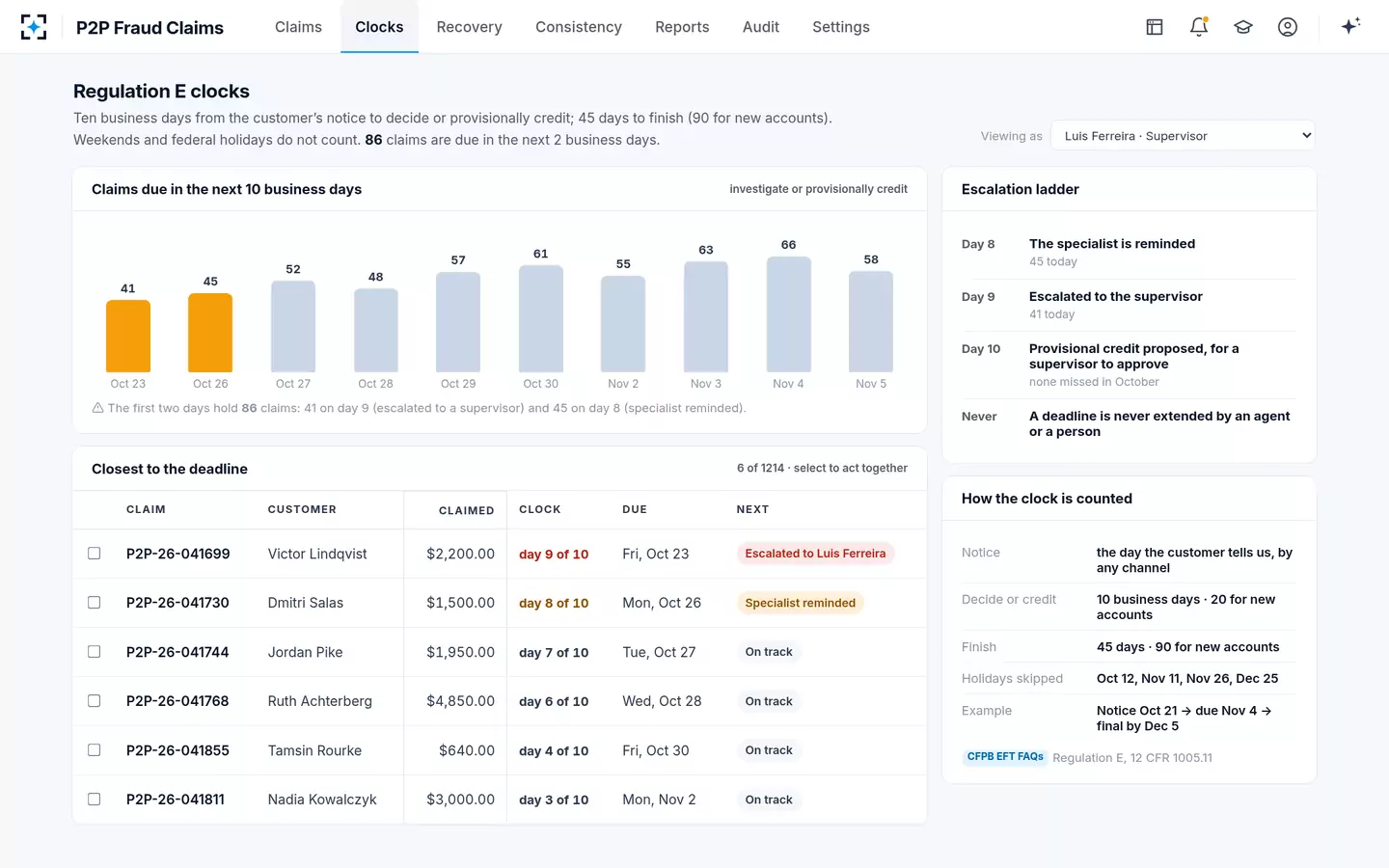
Regulation E counts most of its deadlines in business days, extends them for new accounts, and does not let anyone extend them for convenience. Software that counts calendar days, or that lets a deadline be edited, will produce violations at scale. The test is simple: give the vendor a notice received the business day before a federal holiday and ask for the due date, then a notice on a transfer made within 30 days after the account's first deposit, which moves the decision to 20 business days and the finish to 90 days.
Regulation E clocks, counted in business days, with escalation before the deadline
Can it produce the documents a denied customer may request?
It must, in a form the customer can read. A bank that finds no error must tell the customer she can request the documents it relied on, under 12 CFR 1005.11(d), and the Official Interpretations add a requirement software has to meet: the copies must be in a form the customer can understand. A raw device log full of codes does not meet it; the commentary's own example is converting data to readable form and explaining any codes.
For P2P claims, that means the evidence the software cites should be presentable to the customer as well as the examiner: the time a code was sent and what it was for, the device it added, the payment that followed. Ask the vendor to produce, for a denied sample claim, the document set it would send, and read it as the customer would.
Does claims software need model validation?
If it uses models, the bank must govern them, but the April 2026 interagency model risk guidance does not cover the generative and agentic AI many new claims products rely on: the OCC's bulletin states that such models are not within its scope, and the agencies said they would seek information on banks' use of AI. Outside that guidance, a bank can draw on the NIST AI Risk Management Framework, released in January 2023 for voluntary use, and on its own third-party risk program, which is where the Federal Reserve's examiners located the template failures above.
The practical answer is to ask the vendor for its control design rather than a validation report alone: what the system may never do, how that is enforced, the threshold below which it does nothing, how overrides are recorded and reviewed, and how each version of a model, prompt and rule is tied to the decisions it made. A product whose every decision is confirmed by a specialist and approved by a supervisor, with the evidence attached, is easier to govern than one whose accuracy must be taken on trust.
What a defensible P2P claim file carries
1placement
per payment, with its evidence, rule, version and confidence
2people
a specialist who confirms and a supervisor who approves, never the same person
2years
minimum retention of evidence of compliance under Regulation E
0
denials an agent can issue on its own in P2P Fraud Claims, by design
What audit trail should claims software keep?
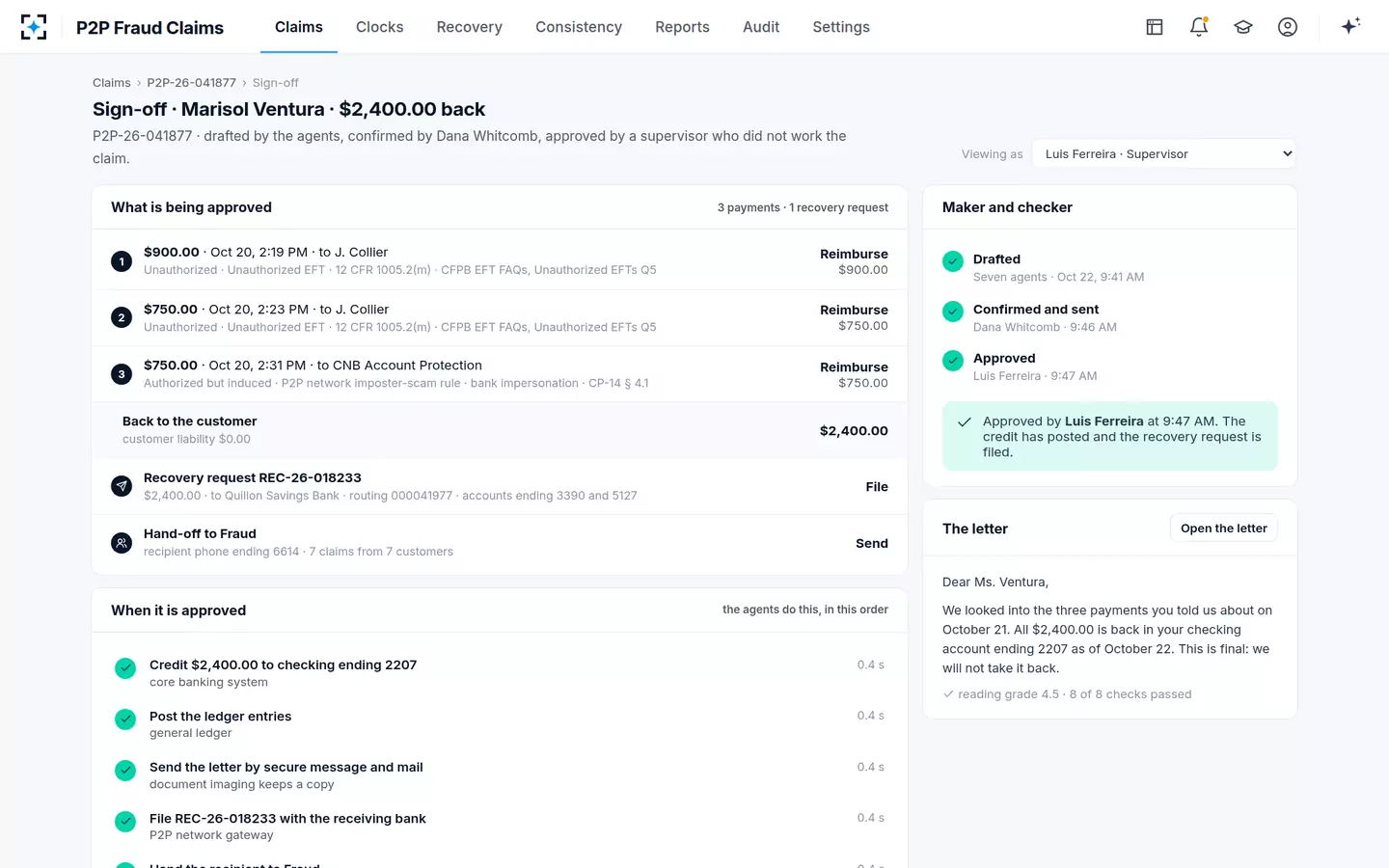
Enough to rebuild any decision: who or what did each step, when, on which evidence, under which version of which rule, and who approved it. Regulation E requires a bank to keep evidence of compliance for at least two years, and to keep records longer while it is under investigation or sued over them. Evidence of compliance on a P2P claim is not only the letter; it is the notice date, the records reviewed, each placement and its reason, the approval and the dates.
The trail should also be selective about who sees what. A claim that leads to a suspicious activity report carries information that must not reach the customer or a general export. In the solution, every agent step and human action is on one trail, account and phone numbers are masked to the last four digits, and an export pack is built for a named examiner, with restricted referrals included only in a pack for the BSA officer.
Approved: the credit, the accounting entries, the letter and the recovery request, each step recorded
Where P2P Fraud Claims fits, and where it does not
Botminds' P2P Fraud Claims fits the claim after the customer reports it, on P2P payments, under Regulation E, the network's imposter rule and the bank's own policy. Seven agents read the call or form, rebuild each payment from the bank's records, place it with the record and rule that put it there, check it against decided claims, draft the letter and the recovery request and keep the clock; a specialist confirms and a supervisor approves. It goes live on the bank's own systems and policy, and the first run is on a sample of the bank's past claims.
It does not score payments before they leave, and it is not a fraud case-management system; it hands recipients to one. It does not handle card chargebacks. And it does not decide anything on its own: if a buyer wants software that denies claims without a person, this is the wrong product, and the questions above explain why that is a feature. For the records a desk needs connected first, see fraud and claims management for P2P. The sample claims on this page start from P2P Fraud Claims.
Questions people ask
What are claims fraud detection tools?
On a bank's P2P desk they are tools that examine a customer's claim after the loss to detect which payments were made by a fraudster, which were induced by a scam, which recipients recur across claims and which claims may be false. They differ from transaction-monitoring tools, which score payments before they leave.
How do you evaluate fraud claims software?
Run it on a sample of your own decided claims with known answers, and test the cases that go wrong in practice: mixed claims, below-threshold claims, deadlines around holidays and denial letters. Judge it on whether each decision shows its evidence, rule and version, not on a headline accuracy figure.
Can claims software deny a Reg E claim automatically?
No rule names a tool, but a denial must rest on a reasonable investigation, a written explanation and documents the bank can produce in understandable form, and the bank carries the burden of proof. Software that denies without a person makes those hard to show; the safer design keeps every denial with a specialist and a supervisor.
What integrations does P2P claims software need?
Read access to the digital banking platform's sign-in and device logs, the network gateway's payment and recipient data, the core banking system and contact-center transcripts, plus a route to post credits and file recovery requests. Without the device logs, it cannot tell a takeover from a payment the customer made.
Does claims software replace the claims team?
It should not. It replaces the gathering and drafting, so specialists spend their time on the placements and decisions the rule requires a person to defend, and supervisors approve with the evidence in front of them.