A Zelle qualifying imposter scam is a payment a customer authorized herself because a scammer posed as a government agency, a bank or an existing service provider, the three kinds of impersonation the network's reimbursement policy has covered since June 30, 2023. Because the customer sent the money, Regulation E does not require her bank to repay it; the network's rules do, for qualifying cases, by contract among the banks that offer the service. Purchases are excluded, as are impersonations of anyone else: a relative, a romantic partner, an employer. In the policy's first six months, member banks reported about 54,000 imposter disputes and about 44% qualified. P2P Fraud Claims, Botminds' software for dispute teams that resolve P2P fraud and scam claims, places such payments on the authorized side of Regulation E's line and then applies the imposter rule and the bank's own policy, citing the version of each.
The network's rulebook is not public, so this guide describes the rule as the U.S. Senate Permanent Subcommittee on Investigations' staff report describes it, quoting the rule text the report itself reproduces. It is written for claims specialists and the people who own a bank's claims policy.
The 44% that qualified: imposter disputes in the policy's first six months
by member banks to the network, June 30 to December 31, 2023
about 44% of those reported
not a government agency, financial institution or existing service provider
other requirements of the policy not met, or claims found invalid
What is a qualifying imposter scam?
A qualifying imposter scam is one in which the customer sent the money herself after a scammer posed as one of three trusted parties. The Senate staff describe the change this way: "On June 30, 2023, EWS expanded the network’s reimbursement policies to cover claims made by consumers who were victims of “scammers claiming to be from a government agency, bank, or existing service provider.”" EWS is Early Warning Services, which operates the network for its seven owner banks.
The rule also says what it does not cover. The report reproduces the clause that excludes purchases: "For the avoidance of doubt, the [disputed] Payment must not be for the purchase of goods or new services; or for Payments where the Customer asserts that the service was not as described." So a payment to a fake ticket seller fails the rule even if the seller claimed to be a well-known company, while a payment to someone posing as the customer's electricity provider, about a bill she really has, can qualify.
Who the scammer pretended to be, and whether the payment can qualify
| Who was impersonated | Can it qualify? | Why |
|---|---|---|
| The customer's own bank, for example its fraud department | Yes | A bank is one of the three covered parties |
| A government agency, such as a tax or benefits office | Yes | A government agency is covered |
| A company the customer already pays, such as a utility | Yes, if it is an existing service provider | Covers an existing service provider; the relationship must be real |
| A seller of goods or a new service | No | Purchases of goods or new services are excluded |
| A relative, friend or romantic partner | No | Not a covered party; most ineligible disputes fell here |
| An employer or recruiter | No | Not a covered party |
When did the Zelle imposter scam reimbursement start?
June 30, 2023. The Senate staff noted the timing: "EWS implemented the new reimbursement policy on June 30, 2023, two weeks after the Subcommittee sent its initial June 16, 2023 request letter to EWS and the Three Banks." The policy was publicised that November. The report traces it to the rise of bank-impersonation scams in 2021 and 2022 that the owner banks had been handling case by case, each bank its own way.
A claims desk needs the date for a practical reason. A payment made before June 30, 2023, was decided under the earlier rules, and a payment made after any later revision is decided under that revision. Recording the version of the rule that decided each claim is the only way to show, a year later, that a denial was right when it was made.
Why most imposter disputes did not qualify
The largest group of ineligible disputes failed because of who was impersonated, not because the customer did anything wrong. The report records the network's breakdown: about 30,000 of the 54,000 reported disputes were ineligible, of which about 10,000 failed the policy's other requirements or were found invalid, and the remaining approximately 20,000 "consist of instances in which the consumer alleged that the criminal impersonated someone other than a government agency, financial institution, or existing servicing provider".
In money, the policy's first year was small against the scale of scam disputes. The staff report found it "resulted in $18.3 million in claims eligible for reimbursement across all Zelle Member Banks in 2023." Customers of the three largest owner banks alone disputed about $207 million as scams that year. How the rest of that money fared is set out in Zelle scam reimbursement.
Imposter scams are the most reported fraud, and the rule reached a slice of them
1M+
imposter scam reports to the FTC in 2025, the most frequently reported fraud since 2020
$3.5B+
reported lost to imposter scams in 2025
$18.3M
eligible for reimbursement under the network's policy across all member banks in 2023
15–20%
of all scam disputes on the network, July to December 2023, qualified as eligible imposter scams
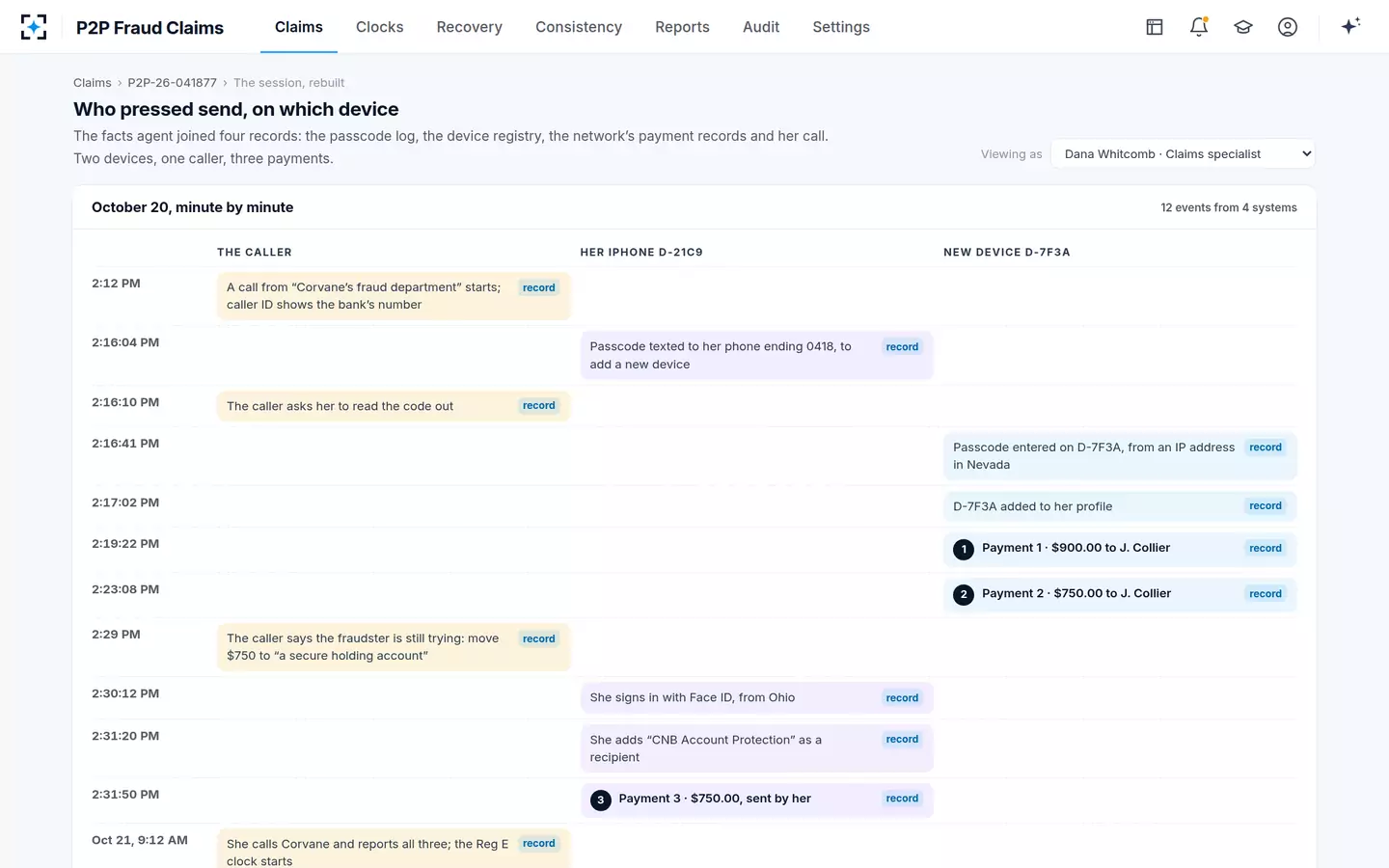
The call that produces both kinds of payment
The bank-impersonation call is the scam the imposter rule was written for, and it is also the one most likely to produce payments the rule does not need to cover at all. The Senate staff describe the pattern banks call "me-to-me": "A common form of imposter scam in recent years are so-called “Me-to-Me” scams in which bad actors impersonate an employee at a consumer’s bank, often cloning the bank’s phone number or using an email address that includes the bank’s name." The Federal Reserve's ScamClassifier defines a bank impostor scam in the same terms, including a caller who asks for funds to be moved to a secure account or for a one-time passcode.
That last detail matters. If the impostor obtains a one-time passcode and uses it to send money himself, those payments are unauthorized transfers under Regulation E, which the CFPB's Electronic Fund Transfers FAQs treat as covered; the imposter rule never comes into it. Only the payments the customer sends herself, to the "secure account", fall to the imposter rule. A desk that applies the imposter rule to the whole call will under-repay, because the rule has conditions Regulation E does not.
One impersonation call, rebuilt: the caller's payments and the customer's own, in separate lanes
What evidence decides whether a payment qualifies?
Four pieces of evidence decide most imposter-rule placements, and each sits in a different place. Who the scammer claimed to be comes from the customer's own account of the call, usually a contact-center transcript or claim form, and it should be recorded in her words, because "someone from the bank" and "someone from a website I bought from" lead to opposite answers. Whether the payment was a purchase comes from the same account and from the recipient: a payment to a marketplace seller is excluded however the seller presented itself.
Whether an impersonated company was an existing service provider comes from the bank's own records of the customer's payments: a customer who has paid a utility every month for years has an existing relationship; one who has never paid it does not. And the recipient's display name, taken from the network's payment record, often shows the impersonation directly, as with an account named after the bank itself. A specialist who has those four in front of her can place an induced payment against the rule in minutes; one who has to chase them across systems will be tempted to decide on the customer's label instead.
In the solution, the customer's statement in her own words, the recipient and the recipient's history sit beside each induced payment, and the placement names the rule and the policy section that applies, bank impersonation or purchase scam, so the two cannot be confused. The specialist still confirms each placement, and a payment the agents cannot place with enough confidence is left for her.
Is the imposter rule part of Reg E?
No. Regulation E is a federal regulation that covers unauthorized transfers; the imposter rule is a private network rule that covers certain authorized ones. The Senate staff explain where its force comes from: "These Network Rules and related documents give EWS the authority to require its Member Banks to reimburse certain types of disputed transactions, even above and beyond the regulatory requirements of Regulation E, as it did in June 2023." A customer cannot sue under the Electronic Fund Transfer Act to enforce it, and a regulator does not examine against it as law.
Regulation E and the imposter rule, side by side
Regulation E: Unauthorized transfers, including those sent with a code or login obtained by fraud.
The network's imposter rule: Authorized payments induced by impersonation of a government agency, bank or existing service provider.
Regulation E: Payments the consumer started herself, however deceived.
The network's imposter rule: Purchases of goods or new services; impersonations of anyone else.
Regulation E: Federal regulation under the Electronic Fund Transfer Act.
The network's imposter rule: Contract among the banks that offer the service.
Regulation E: Examiners, regulators and consumers' private suits.
The network's imposter rule: The network, under its participation rules.
Regulation E: Rulemaking, with public notice.
The network's imposter rule: Network rule versions, not published.
Does every bank follow the imposter rule?
Every member bank is bound by it, because participation in the network is conditional on its rules; how consistently each applies it is another matter. The Senate staff found the network's enforcement of its own fraud standards uneven: six of the seven owner banks were out of compliance with its scam and fraud standards for at least two consecutive months between April 2021 and May 2023, and the fees assessed were small, $25,000 for one bank in 2022 and $30,000 for another in 2023. The report also found that member banks rejected more imposter disputes than they reimbursed in the policy's first months.
For a bank, the safe assumption is that an examiner or a court will hold it to its own written policy and to the network rule it agreed to, and that inconsistency between similar claims is the first thing anyone will look for. The consistency test in Reg E fraud claims: do two specialists reach the same answer? applies to imposter-rule decisions as much as to Regulation E ones.
Who pays an imposter scam claim?
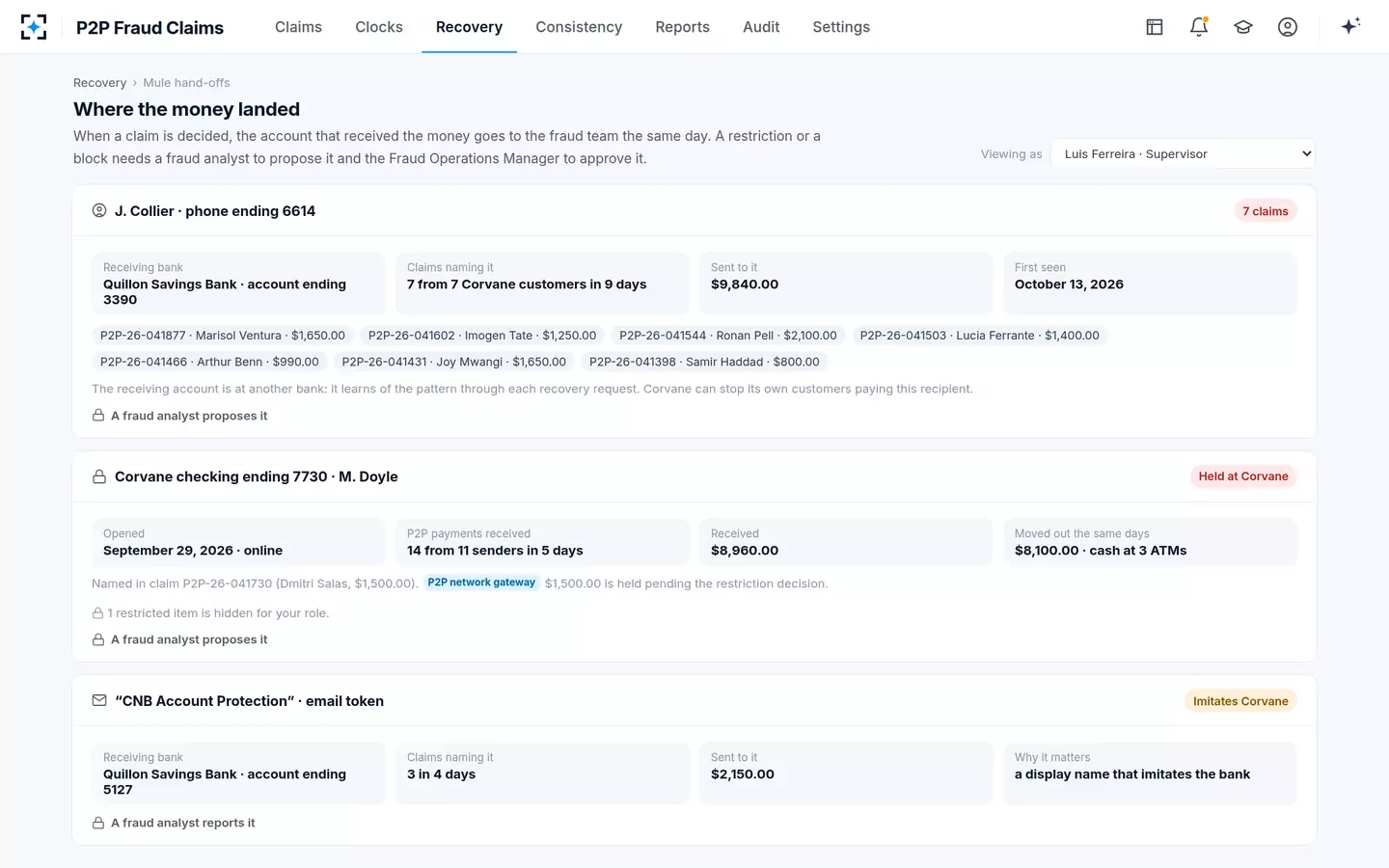
The customer's bank pays the customer. Behind that, the network's rules let a sending bank that believes another bank is ultimately liable file a dispute with the network, which mediates between the two; and the sending bank can ask the receiving bank to return any funds still in the recipient's account. The recipient's account is often worth more than the one claim: in the solution's sample book, a recipient whose display name imitated the bank appeared in three claims in four days.
Where the money landed, including a recipient whose name imitates the bank
Recording which version decided each claim
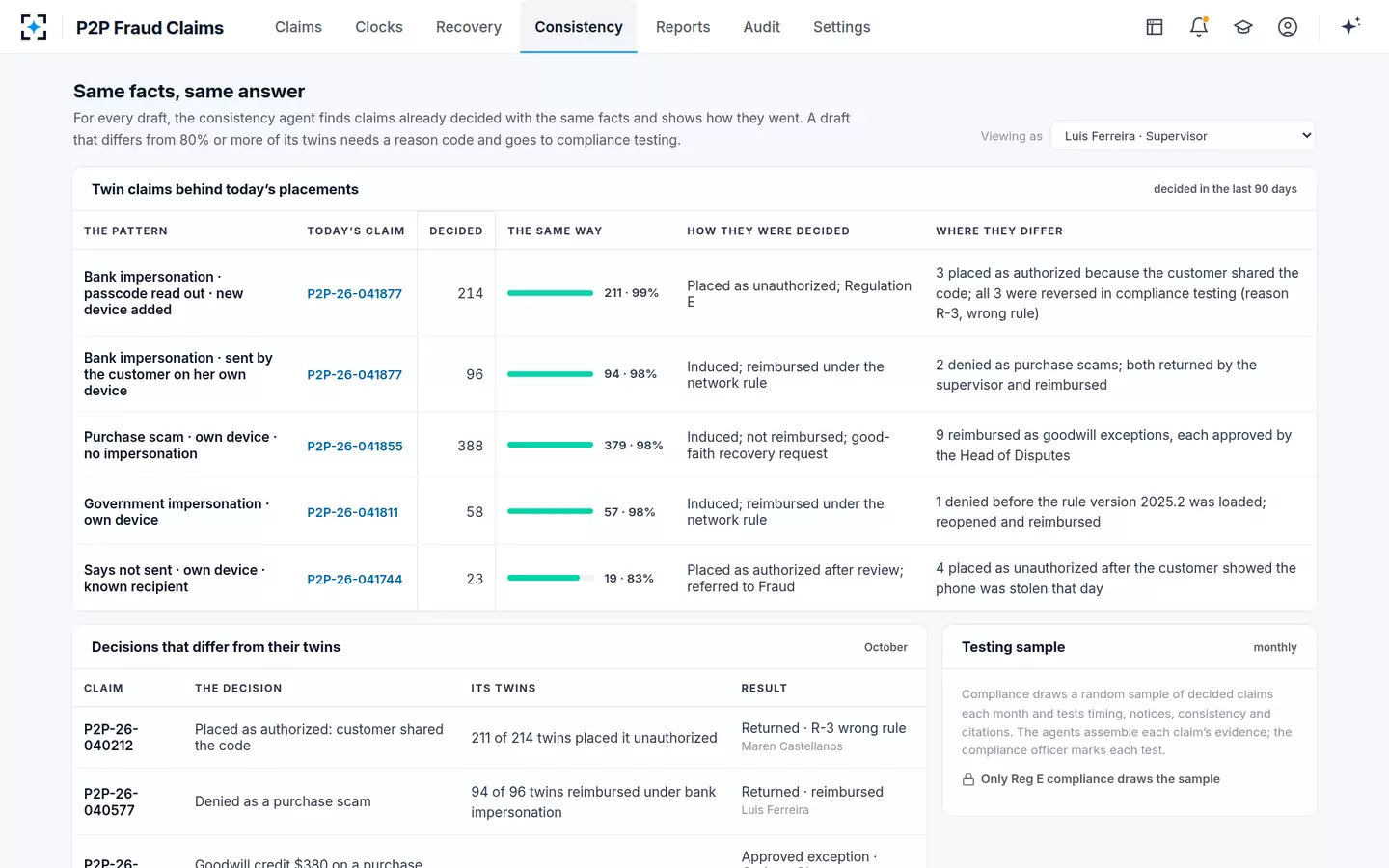
Because the rule is a contract that changes, a bank should treat its version as a setting, record it on every claim it decides, and reopen claims when a change affects them. In the solution, the network rule set is a versioned setting alongside the bank's claims policy, and each placement on the induced side names both. In the sample book, one government-impersonation claim had been denied before the current rule version was loaded; the consistency screen listed it as differing from its 57 twins, and it was reopened and reimbursed.
A denial made before the rule version changed, caught by its twins
Applying the imposter rule to a P2P scam claim
- Place each payment first
Payments the impostor sent are unauthorized under Regulation E; the imposter rule applies only to the ones the customer sent.
- Identify who was impersonated, in the customer's words
Bank, government agency or existing service provider can qualify; a relative, partner, employer or seller cannot.
- Check for a purchase
Payments for goods or new services are excluded, whoever the seller claimed to be.
- Confirm the provider relationship is real
An existing service provider means one the customer already uses.
- Record the rule version in force on the payment date
And the bank's own policy section, if it goes further.
- File the recovery request and hand off the recipient
The same day, whatever the outcome for the customer.
P2P Fraud Claims carries the imposter rule and the bank's policy as versioned settings that an administrator proposes and the Head of Disputes approves, and it places each payment with the rule and version that decided it. To follow the sample claims on this page, start from P2P Fraud Claims.
Questions people ask
How many imposter claims were repaid under the Zelle rule?
In the first six months, member banks reported about 54,000 imposter disputes, of which about 24,000, or 44%, were deemed eligible. The policy resulted in $18.3 million in claims eligible for reimbursement across all member banks in 2023, according to the Senate staff report.
What are the Zelle imposter scam rules?
As the Senate staff describe them, member banks must reimburse payments a customer was induced to send by someone claiming to be from a government agency, a bank or an existing service provider. Payments for goods or new services, and claims that a service was not as described, are excluded.
Is a romance scam a qualifying imposter scam?
No. A romantic partner is not one of the three covered parties, and the largest group of ineligible imposter disputes in the policy's first months involved impersonation of someone other than a government agency, bank or existing service provider.
Does the imposter rule apply to payments the scammer sent?
It does not need to. Payments a scammer sent from the customer's account, for example with a one-time passcode she was tricked into sharing, are unauthorized transfers under Regulation E, which requires the bank to repay them on its own terms.
What is the Zelle imposter scam liability shift?
It is not a term the public record defines. In effect, the 2023 change moved the loss on qualifying imposter scams from the customer to her bank. Between banks, the network's rules let a sending bank that believes another bank is ultimately liable file a dispute for the network to mediate.