Zelle dispute training should teach one skill above all: deciding, payment by payment, who started each transfer, because that single fact decides whether Regulation E makes the bank repay it. A P2P claims specialist works a queue where one claim can hold a payment a fraudster sent and a payment the customer sent after being lied to, under a 10-business-day clock that starts the moment the customer says something is wrong. Most training covers the clock and the forms. Fewer programs drill the line itself, and that is where the Senate's 2024 inquiry into the network found the money going missing. P2P Fraud Claims, Botminds' software for dispute teams that resolve P2P fraud and scam claims, rebuilds each payment from the bank's own logs so the specialist starts from the evidence and spends the shift on the decisions.
This guide follows a single shift through a sample queue in the solution, on a fictional bank and fictional customers, and stops at each claim type to name the rule that governs it, the evidence that settles it and the mistake a new specialist is most likely to make. It is written for claims managers and trainers building or refreshing a P2P curriculum.
Five people touch every P2P fraud claim, and training has to reach all of them
Today
Opens four systems per claim, copies device, passcode and payment details into notes, then decides the whole claim at once.
With agents
Opens each claim with every payment rebuilt and placed, checks the evidence, and confirms or moves each placement with a reason code.
Still theirs: The placement of every payment, and every case below the confidence threshold.
Today
Signs credits and denials from case notes; the recovery request leaves days later.
With agents
Sees exactly what will happen before approving; credit, letter and recovery request go out on approval.
Still theirs: Approval of every reimbursement, denial, provisional credit and recovery request on claims they did not work.
Today
Tests a monthly sample for timing and notices, rarely for consistency.
With agents
Sees each kind of claim beside its decided twins and draws the testing sample in one step.
Still theirs: Monthly testing and the reason a decision is sent back.
Today
Hears about the receiving account after the money has moved on.
With agents
Receives the recipients and receiving accounts the claims point to on the day of the decision.
Still theirs: Any proposal to restrict an account, approved by the fraud operations manager.
Today
Rebuilds who decided what, and on which evidence, from several systems before each exam.
With agents
Filters one trail of every agent step and human action, and builds a masked export for an examiner.
Still theirs: Read-only access; changes nothing.
What should Zelle dispute training cover?
Zelle dispute training should cover five things in this order: recognising a notice of error in any channel, sorting each payment by who started it, reading the device and authentication evidence, applying the network's imposter rule to payments the customer sent, and writing an outcome a customer can understand. Each maps to a rule a specialist can be examined on. The order matters, because a mistake in the first two cannot be repaired by good work in the last three.
The Federal Reserve's own examiners say where the gaps sit. In their review of 2024 supervisory data, Regulation E error resolution failures most often traced to training: staff without the expertise, without adequate Regulation E training, or working from unclear policies. The same article names the most persistent misunderstanding, the belief that only a written notice obliges the bank to investigate; Reg E training works through the frontline call that disproves it.
That misconception costs P2P claims more than most. A customer who has just realised she was robbed by a caller tends to phone, chat or walk into a branch, not write. Under the official interpretation of Regulation E, a phone call obliges the bank to start investigating promptly, without waiting for written confirmation. A training module on intake that drills the phrases customers use ("I didn't send that", "someone got into my account", "the bank called me") pays for itself in clocks started on the right day.
The Senate's numbers a P2P trainer should know by heart
62%
of consumers who disputed a Zelle payment as fraud were repaid by the three largest owner banks in 2019
38%
in 2023, by the same measure, after a dip to 42% in 2021 and a rise to 50% in 2022
$388
average fraud dispute at those banks in 2023; the average scam dispute was $496
2,100+
banks and credit unions take part in the network besides its seven owner banks
Who pressed send? The question that sorts every payment
Every P2P payment in a claim is sorted by one question before anything else: did the customer start it, or did someone else? The Federal Reserve's FraudClassifier, built so that payment fraud can be classified the same way across institutions, opens with exactly that question, "Who initiated the payment?", and branches into an authorized party who was manipulated and an unauthorized party who took over the account. Regulation E draws its line in the same place. A transfer started by someone without actual authority, from which the customer receives no benefit, is unauthorized and covered. A transfer the customer started herself, however cruelly she was deceived, is not.
Training has to make that question automatic, because customers rarely describe their claim in those terms. They describe a phone call. The Senate staff who examined the three largest owner banks could not tell how much of the drop in fraud repayments came from the law being misapplied and how much from claims being mislabelled at the door: "it is unclear to what extent the Three Banks’ low reimbursement rate for fraud results from failure to follow the requirements of Regulation E, or whether customer disputes about situations that actually constitute scams, billing disputes, or other categories that banks rarely reimburse, are being classified as fraud upon intake." Either way, the fix is the same: classify each payment on the evidence, not the claim on the story.
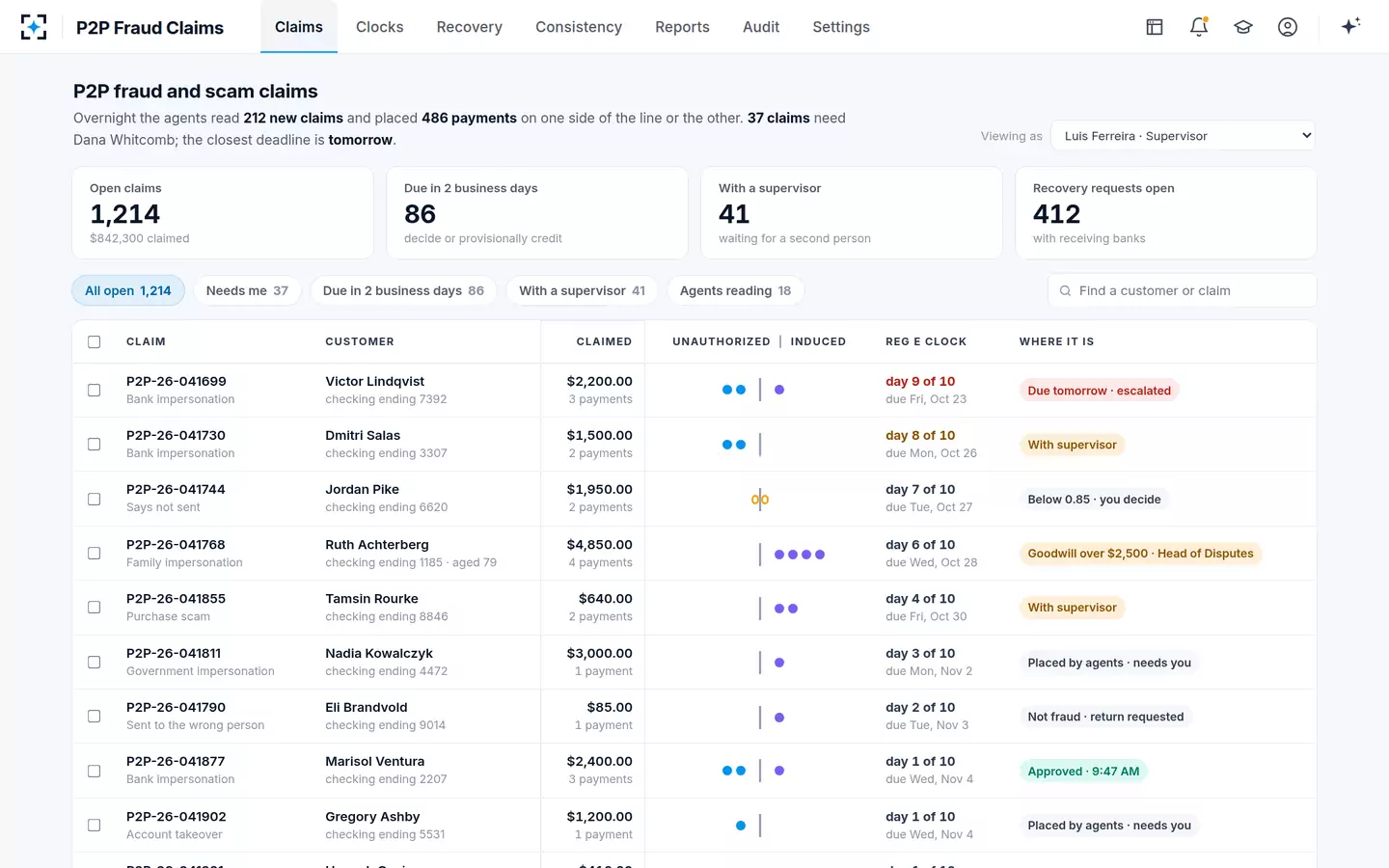
In the solution, the specialist's queue shows every claim as a small dividing line with a dot for each payment, filled where the agents have placed it and hollow where the specialist still has to. A trainer can use that picture directly: a new specialist should be able to say, before opening any claim, how many payments it has and what the first question about each one will be.
The queue a specialist starts the shift with: every claim drawn as a dividing line
Is a scam claim handled differently from a fraud claim?
Yes: a fraud claim is a Regulation E error the bank must investigate and, if it finds the transfer unauthorized, correct; a scam claim is a payment the customer authorized, which Regulation E does not make the bank repay, though the network's imposter rule or the bank's own policy may. Both start the same way, with a notice and a clock. They part when the specialist decides who started each payment, and a single claim often contains both, as the next section shows.
One shift, five claim types: the rule and the trap in each
| Claim type | What decides it | The rule | The trap for a new specialist |
|---|---|---|---|
| Bank impersonation, code read out | Whether the code added a new device that then sent the money | 12 CFR 1005.2(m); comment 2(m)-3; CFPB EFT FAQs | Treating "she shared the code" as consent |
| Bank impersonation, customer sent it | Who the caller pretended to be | The network's imposter rule and the bank's own policy | Denying it as a scam without checking the imposter rule |
| Purchase scam | Whether anyone impersonated a bank, agency or existing provider | Outside Regulation E; outside the imposter rule | A denial letter that blames the customer |
| "I did not send it", known device | Whether the device and sign-in can really be tied to the customer | 1005.2(m) and the bank's burden of proof | Denying because the device is familiar |
| Sent to the wrong person | Whether the network directory routed it wrongly | 1005.11(a)(1)(ii): an incorrect EFT | Checking only that the payment followed the instructions |
Claim one: the passcode read to a caller
The most common teaching case is also the one most often decided wrongly. A caller posing as the bank's fraud department asks the customer to read back a code "to lock the account". The code was in fact sent to add a new device. Minutes later that device sends money. The customer handed over a code, but she did not authorize the payment, and Regulation E's Official Interpretations say a transfer by a person who obtained the access device "through fraud or robbery" is unauthorized. The CFPB's FAQs apply the same reasoning to a texted confirmation code, and the full rule is set out in is Zelle covered by Reg E.
In the solution's sample claim, the evidence for that decision is a few lines of a log, and the agents rebuild the afternoon in three lanes so the specialist can see it at a glance: what the caller said, what happened on the customer's own phone and what happened on the device the code added.
Who pressed send, on which device: the afternoon rebuilt minute by minute
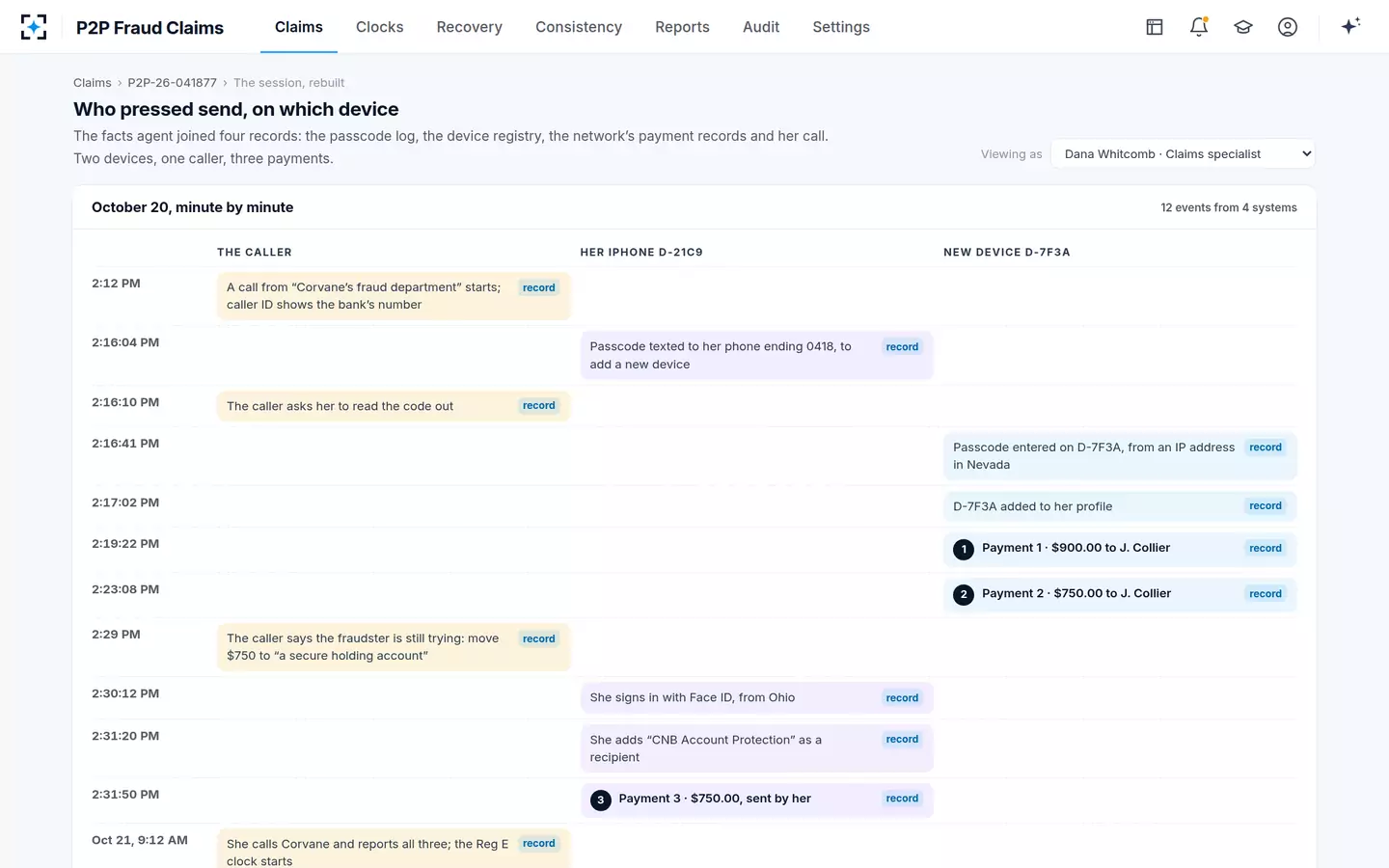
A trainer can ask a class one question about this screen: which payments did the customer authorize? The answer, the third only, is the whole skill. A specialist who decides the claim as one unit will either deny $1,650 the law protects or approve $750 on the wrong rule, and both mistakes surface later in compliance testing.
Claim two: the payment she sent herself
The third payment in that claim went from the customer's own phone, after her own Face ID sign-in, to a recipient she added herself. It is authorized, so Regulation E does not require the bank to repay it. It is not automatically a denial, though. Since June 30, 2023, the network has required its member banks to reimburse certain imposter scams, those involving someone posing as a government agency, a bank or an existing service provider, and this caller posed as the customer's bank. Which scams qualify, and how few did in the first six months, is the subject of what is a Zelle qualifying imposter scam.
Training should teach this as a second, separate decision with its own source. The specialist first places the payment on the authorized side, then asks which impersonation the customer describes, then checks the version of the network rule and the bank's own claims policy in force on the payment date. A bank's policy may go further than the network, for example for older customers, and that policy is the bank's to write.
Claim three: "I did not send it", on a phone the bank knows
Some claims arrive with the opposite problem: the customer says she did not send the payment, but the logs show her own phone, her own biometric sign-in and a recipient she has paid before. The temptation is to deny on the device alone. The CFPB found exactly that practice at Block, which ran Cash App, and listed it among the Regulation E failures in its January 2025 consent order: the company sometimes refused refunds only because the disputed activity came from a known device, one that regularly used the account, and wrongly treated that alone as proof of authorization. Why a device match is evidence but not a verdict is set out in Reg E denial reasons.
A familiar device is evidence, not a verdict. Phones are stolen, shared and taken over remotely, and the burden of proving a disputed transfer was authorized sits with the bank. Training should teach specialists to say what else they checked: the time against the customer's pattern, whether the phone was reported lost, whether the sign-in followed a password reset.
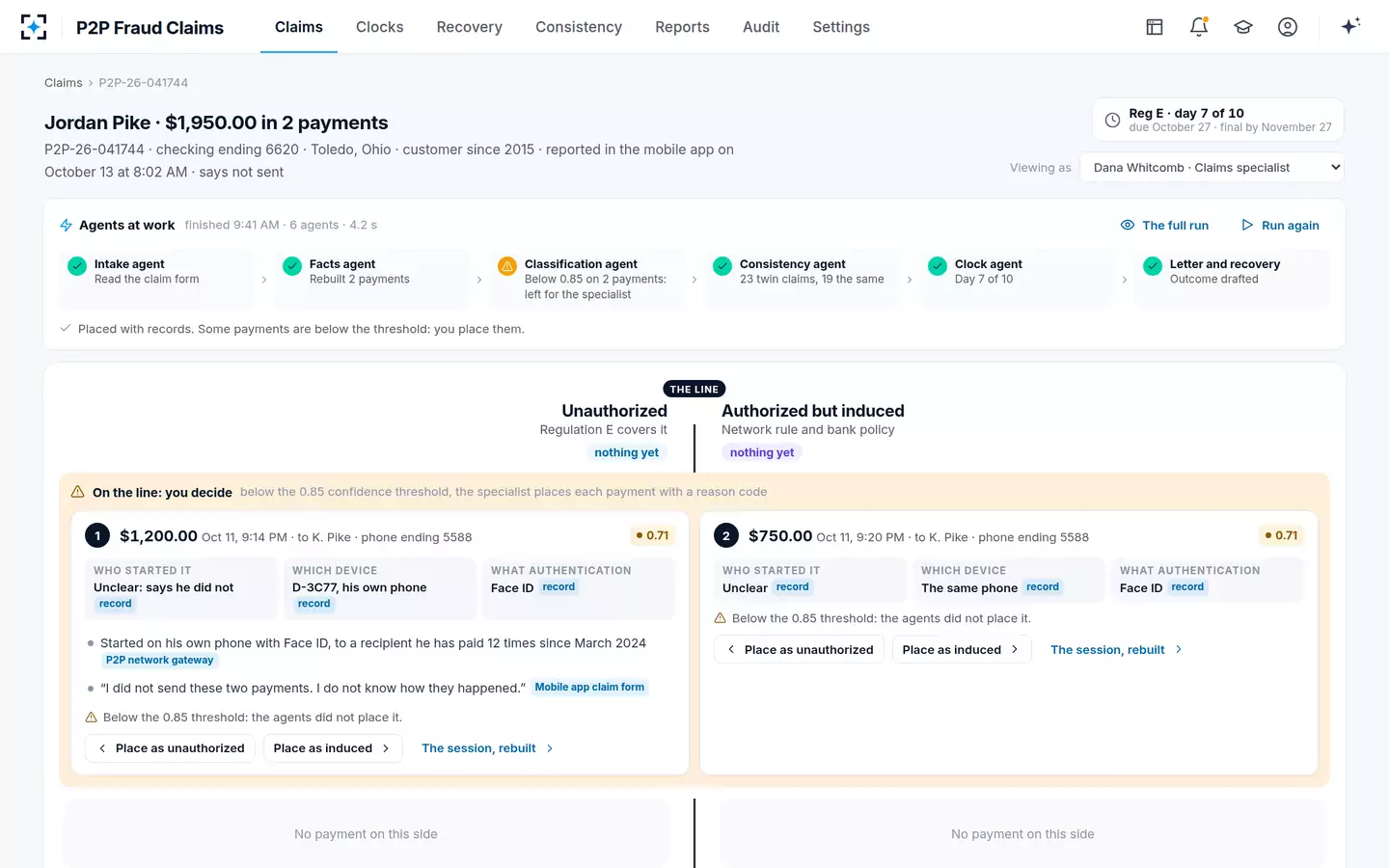
Below the confidence threshold, the agents place nothing and the specialist decides
How is a misdirected Zelle payment handled?
A payment that reached the wrong person is not fraud, but it can still be a Regulation E error, and training that files every such claim under "customer mistake" will miss the ones the bank must correct. The CFPB's examiners found institutions whose network directory sent payments to an outdated recipient even though the customer typed the right phone number or email: "Token errors are incorrect EFTs because the funds are not transferred to the correct account." The institutions had checked only that each payment matched the sender's instructions, which is not an investigation of whether the money reached the right person.
The training point is a habit: when a customer says the intended recipient never got the money, check what the directory held for that phone number or email on the payment date before deciding whose mistake it was. A customer who mistyped is in a different position from one whose correct entry was routed to a stranger.
What records does a specialist check on a Zelle claim?
A specialist checks four sets of records on every P2P claim: the digital banking platform's sign-in, passcode and device logs; the network gateway's payment and recipient data; the core banking system's account history; and the call or chat in which the customer described what happened. Regulation E's Official Interpretations say a bank may not limit its investigation to the payment instructions when other information in its own records could help, and they list the account's recent transaction history and the location of the transaction relative to the customer among the things a review might include.
By hand, those four systems are the slowest part of a claim. Botminds' own estimate, deliberately modest, is 20 to 40 minutes of a specialist's time per claim just to gather and copy the evidence into case notes. In the solution, the agents do that gathering, and every statement on the claim screen opens the record it came from, so a trainer can teach a new specialist to read evidence rather than to find it. The full list of what a desk needs connected on day one is in fraud and claims management for P2P.
How many Zelle claims does a specialist handle a day?
There is no public benchmark for P2P claims handled per specialist per day, and a trainer should be wary of any figure offered without a source. What is public is the scale behind the queues. The Senate staff counted 41,390 Zelle payments disputed as scams at one of the three banks in 2020 alone, and 25,061 at another. Capacity depends on how much of each claim is gathering rather than deciding, which is why measuring minutes per task on a desk's own claims tells a manager more than any headcount ratio.
The more useful training metric is the deadline. Regulation E gives a bank 10 business days to decide or provisionally credit, and the specialist's queue should be worked in that order. In the solution, the specialist is reminded on day 8, the supervisor takes the claim on day 9, and on day 10 provisional credit is proposed for a supervisor to approve; no agent and no person can extend the date.
Who approves a P2P reimbursement?
A disputes supervisor who did not work the claim should approve every reimbursement, denial, provisional credit and recovery request; the specialist confirms the placements and drafts the outcome but does not sign it. Regulation E itself does not prescribe who inside a bank approves, but separating the person who gathered the evidence from the person who signs is the control examiners expect to see when they test whether denials met the bank's burden. In the solution, a specialist who confirmed a claim is shown, in plain words, that she cannot approve it, and the screen names who will.
Training should include the approver's job explicitly. A supervisor reviewing a P2P claim is checking three things: that each payment's placement cites its evidence and its rule, that the letter explains the outcome payment by payment and offers the documents relied on, which 12 CFR 1005.11(d) requires for any finding of no error, and that the recovery request to the receiving bank goes out the moment the claim is decided.
A specialist who decides the claim as one unit will either deny money the law protects or approve money on the wrong rule.
What to test before a new specialist works claims alone
The best test of Zelle dispute training is a set of past claims with known answers, worked blind. A bank can pull a sample of decided claims, remove the outcomes, and ask each trainee to place every payment and name the rule. The answers that differ from the original decision are either a training gap or an error in the original, and both are worth finding. The method for measuring how often two specialists agree is set out in Reg E fraud claims: do two specialists reach the same answer?
Eight things a P2P claims specialist should do without prompting
- Start the clock on any notice, oral or written
Phone, chat and branch notices count. Written confirmation may be requested, but the investigation does not wait for it.
- Count the payments before reading the story
Each payment gets its own placement, its own rule and its own outcome.
- Ask who pressed send, on which device
A code read to a caller who then adds a device makes that device's payments unauthorized.
- Never ask for a police report or affidavit as a condition
The CFPB's FAQs say an investigation may not wait on information from the consumer.
- Check the imposter rule before denying an induced payment
A bank, government or existing-provider impersonation can qualify even when the customer sent the money.
- Never deny on a known device alone
Say what else was checked, and remember the burden of proof sits with the bank.
- Check the directory on a misdirected payment
A token error is an incorrect EFT the bank must correct.
- Write the outcome payment by payment
With the right to the documents relied on, and no blame.
P2P Fraud Claims is built around that list. Its agents read the call or the claim form, rebuild each payment from the logs, place it with the record and rule that put it there, and check the draft against similar decided claims; the specialist confirms or moves each placement, and a supervisor approves. It does not replace the training. It removes the gathering, so the hours a bank spends training specialists go into the judgement the law actually asks of them. To see the sample claims on this page screen by screen, start from P2P Fraud Claims.
Questions people ask
What does a P2P claims specialist do?
A P2P claims specialist investigates customers' notices that a person-to-person payment was unauthorized, misdirected or induced by a scam, decides each payment against Regulation E and the network's rules, and drafts the outcome for approval. The work runs on Regulation E's clock: a decision or provisional credit within 10 business days of the notice, and a final answer within 45 days.
What is the Zelle dispute process at a bank?
The customer gives notice by any channel, and the bank's 10-business-day clock starts. The bank investigates using its own records, decides whether an error occurred, reports the result within three business days and corrects an error within one business day of finding it. If it cannot finish in 10 business days it may take up to 45 days, provided it provisionally credits the account first.
Can a bank require a police report before investigating a Zelle claim?
No. The CFPB's Electronic Fund Transfers FAQs say a bank must begin its investigation promptly and may not delay it pending information from the consumer, including a police report. A bank may ask for a written statement, but the investigation proceeds without it.
How long does a bank have to resolve a Zelle fraud claim?
Ten business days to decide, or 45 calendar days if the bank provisionally credits the disputed amount within the first 10 business days. The periods become 20 business days and 90 days when the disputed transfer was made within 30 days after the account's first deposit.
Does sharing a one-time code make a Zelle payment authorized?
Not when the code was obtained by fraud. Regulation E's Official Interpretations treat a transfer by someone who obtained the access device through fraud or robbery as unauthorized, and the CFPB's FAQs give a caller posing as the bank and asking for a texted code as an example.