Zelle lawsuit status, as of October 2026: the Consumer Financial Protection Bureau's federal suit against the network's operator, Early Warning Services, and three of its owner banks ended when the CFPB voluntarily dismissed it on March 4, 2025, before any defendant had answered, so none of its allegations was ever decided. New York's Attorney General sued Early Warning Services under state law in August 2025; the case was moved to federal court and sent back to New York state court in February 2026, and its allegations have not been decided either. Separately, Block, the owner of Cash App, is under a 2025 CFPB order and settled with 46 attorneys general in July 2026. For a bank's P2P claims desk, the cases matter less for who wins than for what they allege banks did wrong when customers called, and those are the practices P2P Fraud Claims, Botminds' software for dispute teams that resolve P2P fraud and scam claims, is designed to prevent.
This guide is for compliance, legal and executive readers who need the current position, case by case, with the documents behind it. Allegations are labelled as allegations throughout; a complaint is a party's account, not a finding.
Three P2P cases on one calendar: what is over, what is pending
- Before the suitJul–Dec 2024
- In court74 days
- Voluntarily dismissed; nothing decidedSince Mar 4, 2025
- Before removalJul 2024 – Sep 2025
- Removed to federal courtSep 12, 2025 – Feb 2026
- Back in New York state courtSince Feb 2026
- Before the orderJul 2024 – Jan 2025
- CFPB order in forceJan 16, 2025 →
- States settleJul 2026
Is the Zelle lawsuit still going?
The CFPB's lawsuit is not; New York's is. The federal case, filed in the District of Arizona on December 20, 2024, was ended by the CFPB itself. The docket records a "NOTICE of Voluntary Dismissal by Consumer Financial Protection Bureau." on March 4, 2025, and the court's order the next day dismissed the case with prejudice. No court ruled on whether the network or the banks broke the law, and none of the allegations was tested.
New York's case is a separate action under a state statute. The Attorney General filed it in New York State Supreme Court on August 13, 2025. Early Warning Services removed it to the federal court in Manhattan on September 12, 2025; on February 19, 2026, the federal judge granted New York's motion and ordered "that this matter be remanded to New York state court", reissuing the opinion in amended form a week later. The case is pending there, and its allegations have not been decided.
Where each P2P case stands, October 2026
| Case | Brought by, and under what | What it alleged or found | Status |
|---|---|---|---|
| CFPB v. Early Warning Services, JPMorgan Chase, Bank of America, Wells Fargo (D. Ariz.) | CFPB; Consumer Financial Protection Act, EFTA and Regulation E | Alleged: weak safeguards on the network, and banks failing to investigate and reimburse fraud as required | Voluntarily dismissed March 4, 2025; dismissed with prejudice March 5; allegations never decided |
| People of the State of New York v. Early Warning Services (N.Y. Sup. Ct., Index No. 654753/2025) | New York Attorney General; Executive Law § 63(12) | Alleged: a network designed without basic anti-fraud safeguards; over $1 billion stolen from users, 2017 to 2023 | Removed to S.D.N.Y. September 2025; remanded February 2026; pending, allegations undecided |
| In re Block, Inc. (CFPB administrative order) | CFPB; CFPA, EFTA and Regulation E | Found: failures in fraud handling and Regulation E error resolution on Cash App | Consent order January 16, 2025; listed by the CFPB as post order |
| Multistate settlement with Block, Inc. | New York and 45 other attorneys general | Alleged: misleading users and failing to provide fraud protection and resolution required by law | Settled July 8, 2026: $45 million and practice changes |
What the CFPB alleged, and why none of it was decided
The CFPB's complaint accused Early Warning Services of building a network with weak identity checks and slow fraud controls, and the three banks of failing their Regulation E duties. In its announcement, the CFPB said that "Customers of the three banks named in today’s lawsuit have lost more than $870 million over the network’s seven-year existence due to these failures." It alleged that the banks "failed to properly investigate Zelle customer complaints and take appropriate action for certain types of fraud and errors."
Those were allegations in a complaint, and they remain only that. The defendants never answered; the case ended on the plaintiff's own notice ten weeks after filing. A bank reading the case today should treat it as a list of what one regulator believed, in December 2024, a P2P desk was doing wrong, not as a finding that anyone did.
Why did the CFPB drop the Zelle lawsuit?
The CFPB did not say. New York's complaint describes the filing: "On March 4, 2025, before EWS or any other defendant answered the CFPB’s complaint, the CFPB filed a one-page notice dismissing the case as against all defendants with prejudice. The notice did not provide any explanation for the dismissal." New York's Attorney General, announcing her own suit, said it followed after the CFPB "abandoned a similar lawsuit, filed in December 2024, following the change in the federal administration."
The Zelle case was one of many. In its own 2025 enforcement lookback, the CFPB reported that it had dismissed or withdrawn as plaintiff in 19 public enforcement actions and terminated or modified a pending order, or issued a no-action letter, in 22. The CFPB's review of its priorities explains the volume; it does not explain any one case.
The federal and state picture in four numbers
19
CFPB public enforcement actions dismissed or withdrawn as plaintiff in 2025
74days
from the CFPB's Zelle complaint to its notice of dismissal
46
attorneys general in the July 2026 Cash App settlement
$45M
paid by Block to the states, on top of the 2025 CFPB order
What is New York suing Zelle for?
New York is suing the network's operator, not the banks, for fraud under Executive Law § 63(12), which lets the Attorney General act against repeated and persistent fraud in business. Its press release states the core allegation: "EWS designed Zelle without critical safety features, allowing scammers to easily target users and steal over $1 billion between 2017 and 2023." The complaint seeks an order requiring anti-fraud safeguards, an accounting of New York consumers who reported losses, and restitution.
One example in the release will be familiar to any claims specialist: a customer called by someone posing as a utility, who sent $1,476.89 to an account named "Coned Billing" and was told by his bank it could not get the money back. On the facts given, that payment was authorized, and Regulation E would not require repayment. The complaint's argument is about the network's design, not the bank's Regulation E duties, which is why it was brought under state fraud law.
What did Block pay for Cash App fraud?
Block, the company behind Cash App, agreed in January 2025 to a CFPB order requiring it to pay at least $75 million and up to $120 million in redress to consumers, plus a $55 million civil money penalty, and in July 2026 paid $45 million to 46 states. The CFPB's order recorded Regulation E failures a P2P desk should study line by line, among them that the company "used the card network chargeback process as a substitute for fulfilling its obligations under the Electronic Fund Transfer Act (EFTA) and Regulation E". The order also prohibits requiring a consumer to contact the recipient of a P2P transfer, or to file a police report, before an investigation starts.
The states' settlement adds practice changes: live support by phone and chat, an end to misleading safety claims, and "Fulfilling its legal obligations to investigate fraud claims and reimburse users for unauthorized transactions." The CFPB lists the order's status as post order.
Can states enforce Reg E?
The P2P cases states have brought rest on state law, not on Regulation E itself. New York's suit against the network's operator is under its Executive Law; the Cash App settlement resolved the states' allegations of misleading users and failing to provide required protection. The federal Act separately lets consumers sue: a bank that fails to comply is liable for actual damages and, "in the case of an individual action, an amount not less than $100 nor greater than $1,000", with class recoveries capped, plus costs and fees.
For a bank, the shift matters in practice. Fewer federal actions do not mean fewer challenges to P2P claim decisions; they mean the challenges arrive through state attorneys general, private suits and examiners, each with its own documents and standards. A claim file that shows the evidence, the rule and the reason for every payment is the same defence in all of them.
What did the Senate find about Zelle?
The Senate's Permanent Subcommittee on Investigations did not sue anyone; its majority staff published a report on July 23, 2024, after reviewing data from Early Warning Services and the three largest owner banks. It found the share of Zelle fraud disputes those banks repaid fell from 62% in 2019 to 38% in 2023, that almost nine in ten consumers who disputed a payment as a scam in 2023 were not repaid, and that the banks' investigation procedures gave employees broad discretion with little review. Its recommendations included amending the Electronic Fund Transfer Act to cover fraudulently induced transfers; none has been enacted into Regulation E's text. The numbers are examined in Reg E fraud claims: do two specialists reach the same answer?
Allegations that were never decided are still a list of what regulators believed a P2P desk was getting wrong.
What the cases mean for a bank's P2P claims desk
Read together, the cases and the Senate report name the same practices again and again: investigations that do not look at the bank's own evidence, conditions placed on starting an investigation, refusals based on a single fact such as a familiar device, and reimbursements denied for payments that were in law unauthorized. None of those depends on how any lawsuit ends. Each is a Regulation E question an examiner can ask tomorrow.
A familiar phone is not a verdict: below the threshold, the specialist decides
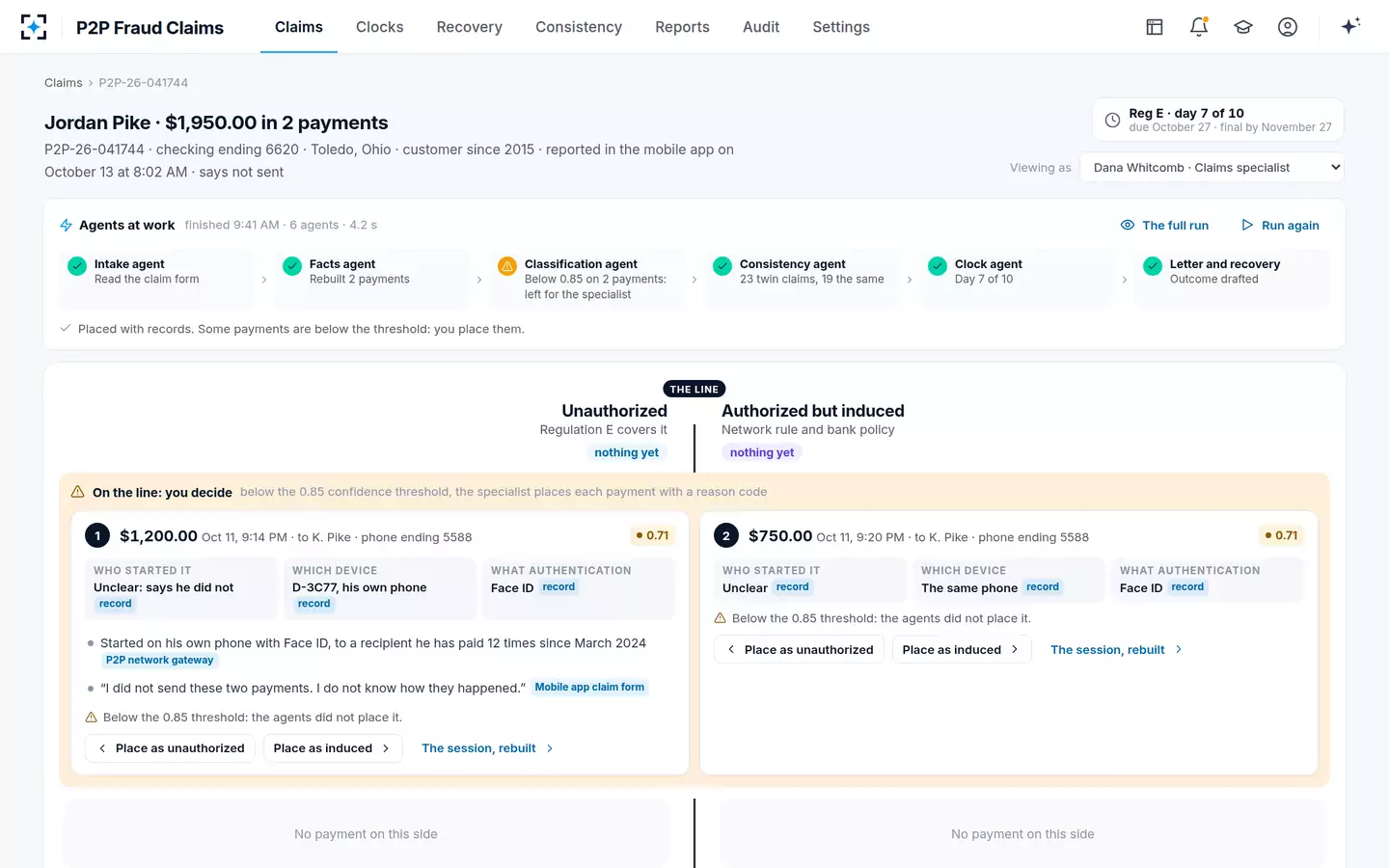
Six practices the P2P cases put in question, and the control for each
- Investigating only the payment instructions
Review device, sign-in and routing records for every disputed payment.
- Making the customer contact the recipient, a merchant or the police first
Start the investigation on notice; never make it conditional.
- Denying on a single fact, such as a known device
Record what else was checked; send low-confidence cases to a person.
- Treating a whole claim as a scam
Decide each payment; a code taken by deception does not make the scammer's payments authorized.
- Using a network process as a substitute for Regulation E
Chargebacks and interbank disputes run alongside, never instead of, the bank's own investigation.
- Leaving the customer without a reason
A written explanation, payment by payment, and the right to the documents relied on.
P2P Fraud Claims builds those controls into the claim: the intake agent never asks for a police report or contact with the recipient, every placement cites its records, low-confidence payments go to the specialist, and a supervisor who did not work the claim approves every outcome. The letter checks block a draft that blames the customer or omits the right to documents. To follow the sample claims on this page, start from P2P Fraud Claims.
Questions people ask
Was the CFPB Zelle lawsuit dismissed?
Yes. The CFPB filed a notice of voluntary dismissal on March 4, 2025, and the court dismissed the case with prejudice the next day. The defendants had not answered, and none of the CFPB's allegations was decided.
Can I join the Zelle lawsuit?
New York's case is brought by the Attorney General on behalf of the state's residents, not as a class action, and it seeks restitution for affected New Yorkers. The Attorney General's release invites consumers who lost money to scammers through Zelle to report it to the office's Consumer Frauds Bureau.
Did Zelle pay a settlement?
Not in the cases on this page. The CFPB's case ended by dismissal, not settlement, and New York's remains pending in state court. The $45 million multistate settlement and the 2025 CFPB order concern Block and Cash App, a different P2P service.
Does the dismissal change banks' Regulation E duties on Zelle?
No. Regulation E and the CFPB's Electronic Fund Transfers FAQs, which treat P2P payments as EFTs and payments made with credentials obtained by fraud as unauthorized, are unchanged; the CFPB's May 2025 withdrawal of guidance did not include them.
What is the Senate report on Zelle?
A July 2024 majority staff report of the Senate Permanent Subcommittee on Investigations, titled "A Fast and Easy Way to Lose Money", based on data from the network's operator and its three largest owner banks for 2019 to 2023. It is an investigation, not a lawsuit, and made recommendations to Congress, the CFPB and the network.