Zelle scam reimbursement is not guaranteed: if the customer sent the money herself after being deceived, federal law does not require her bank to repay it, and only a narrow set of imposter scams is covered by the network's own rule. If a scammer sent the money from her account, using a code or login she was tricked into giving, the payment is unauthorized and Regulation E does make the bank repay it. Most scam claims mix the two, and the Senate's 2024 inquiry found almost nine in ten consumers who disputed a Zelle payment as a scam at the three largest owner banks were not repaid in 2023. P2P Fraud Claims, Botminds' software for dispute teams that resolve P2P fraud and scam claims, places each payment in a claim on its own side of that line, so the payments the law protects are not lost inside a scam story.
This guide is for the people who own a bank's P2P claims policy, and it is written from the customer's side of the outcome: what each rule repays, what it does not, and what getting each payment right is worth to the person who lost the money.
Even payments the law protects were not all repaid: Zelle fraud disputes at the three largest owner banks, by dollar value
2021 · $189.4 million disputed as fraud
- Reimbursed · $86.9 million · 46%
- Not reimbursed · $102.5 million · 54%
2023 · $165.8 million disputed as fraud
- Reimbursed · $63.5 million · 38%
- Not reimbursed · $102.3 million · 62%
Does Zelle refund scams?
Zelle itself refunds nothing; the customer's own bank decides, and for scams the bank is required to repay only those that qualify under the network's imposter rule, in force since June 30, 2023. That rule covers payments induced by someone posing as a government agency, a bank or an existing service provider, and excludes purchases. Every other scam payment the customer sent herself is repaid only if the bank chooses to. The Senate staff were blunt about how rarely the largest banks chose to: "Almost Nine Out of Ten Consumers Who Disputed a Transaction as a Scam at the Three Banks in 2023 Were Not Reimbursed".
The earlier years were starker. In 2020, the staff found, "JPMorgan reimbursed three transactions out of 41,390 scam disputes that year, Wells Fargo did not reimburse any of the 25,061 scam disputes". Across 2021 to 2023 the three banks rejected scam disputes worth about $560 million. In 2023 alone, customers of those three banks disputed about $207 million as scams.
What is the difference between fraud and scam reimbursement?
Fraud reimbursement is a legal duty and scam reimbursement mostly is not. The Senate report puts the line in one sentence: "Federal law requires platforms such as Zelle to reimburse consumers who lose money in unauthorized transactions, what Zelle calls “fraud,” but not authorized transactions, what Zelle calls “scams.”" The duty for fraud comes from the Electronic Fund Transfer Act and Regulation E, with a 10-business-day investigation clock and the customer's own liability limited by how quickly she reports.
The trouble is that customers, and sometimes banks, use "scam" for anything that started with a lie. A caller who talks the customer into reading out a one-time code, then uses it to add his own device and send money, has committed fraud in Regulation E's sense, even though the customer experienced it as a scam. That payment is unauthorized and the bank must repay it. The whole-claim label "scam" is the most expensive word on a P2P desk, for the customer who is wrongly refused and for the bank that later has to remediate.
Three sources of Zelle scam reimbursement, and what each repays
| Source | What it repays | Binding on | Where the decision sits |
|---|---|---|---|
| Regulation E | Unauthorized transfers, including those started with a code or login obtained by fraud | Every financial institution holding the account | The customer's bank, within 10 business days or with provisional credit |
| The network's imposter rule | Payments the customer sent after an impersonation of a government agency, bank or existing service provider; not purchases | Member banks, by contract with the network | The customer's bank, under the rule version in force |
| The bank's own claims policy | Whatever the bank chooses, for example older customers or particular scam types | Only the bank that wrote it | The bank, usually as a goodwill exception approved above the specialist |
How much do banks repay on Zelle scam claims?
Little, on the only public data. The Senate staff obtained the three largest owner banks' dispute data and found scam repayment close to zero in 2019 and 2020, rising later but leaving almost nine in ten scam disputers unpaid in 2023. Across every reason for a dispute, the same banks repaid 26% of the dollar value of disputed Zelle payments from 2019 through 2022, against an average of 47% for credit card disputes and 36% for debit card disputes.
What the Senate staff counted at the three largest owner banks
$560M
of scam disputes rejected, 2021 to 2023
$207M
disputed as scams by their customers in 2023 alone
26%
of disputed Zelle dollars repaid, any reason, 2019–2022
47%
of disputed credit card dollars repaid over the same years
The comparison with cards is not a like-for-like legal comparison, since card disputes carry network chargeback rights and credit cards a separate law, a difference the card dispute series covers. It does show what customers experience: the same bank, the same money, a very different chance of getting it back depending on how it left. Nationally, the pressure is rising. The Federal Trade Commission reported that in 2024 consumers lost more to scams paid by bank transfer or cryptocurrency than by every other payment method put together.
Can Zelle refund money if scammed? The network's imposter rule
Yes, for qualifying imposter scams, through the customer's bank. Since June 30, 2023, the network has required member banks to reimburse consumers for certain claims involving scammers posing as a government agency, a bank or an existing service provider. The Senate staff found the policy reimbursed $18.3 million in the six months after it began, roughly 15 to 20% of all scam disputes on the network in that time. Which disputes qualified, and why most did not, is set out in what is a Zelle qualifying imposter scam.
For a bank, the rule turns a slice of scam claims into obligations, with versions that change. A claims desk that decides scam payments as one undifferentiated pile will miss the ones the rule now requires, just as a desk that decides fraud and scam together will miss the ones Regulation E requires.
Will my bank refund a Zelle scam?
Your bank will refund it if the payment was unauthorized, if it qualifies under the network's imposter rule, or if the bank's own policy covers it; otherwise it may not. What decides it is the evidence about each payment, not the label on the claim. A bank should tell you in writing what it decided for each payment and why, and you can ask for the documents it relied on.
Banks' own policies vary and are rarely published in detail. In the solution's sample setup, the bank's claims policy has separate sections for zero liability on unauthorized transfers, bank impersonation, purchase scams and customers aged 75 or older, and every goodwill exception needs the Head of Disputes' approval. That is a fictional policy, but it shows the shape a written policy needs: each clause a setting with a version, so a claim decided in March can show the clause in force in March.
What a correct placement is worth to the customer
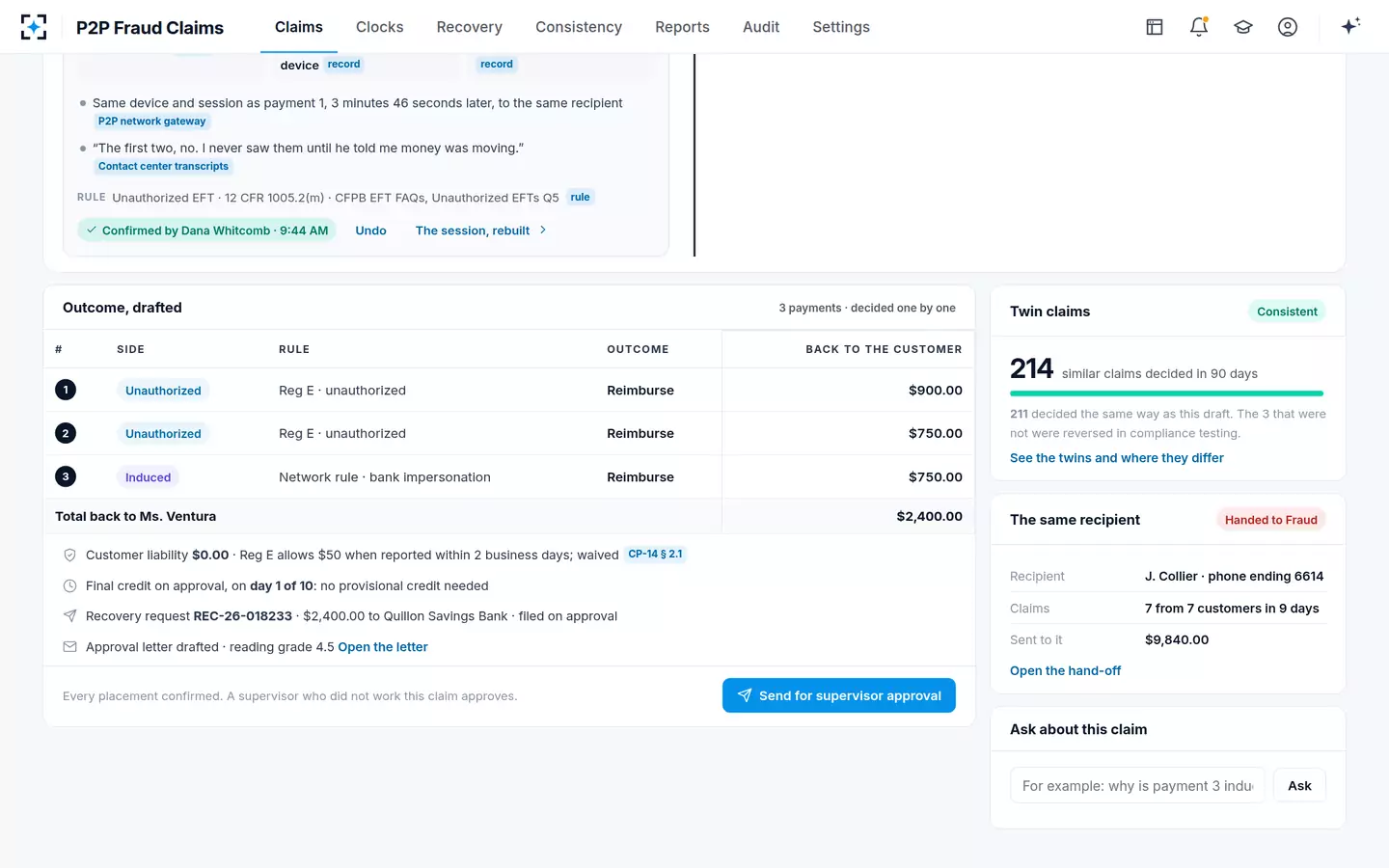
On a mixed claim, deciding payment by payment can be the difference between all of the money and none of it. Take the solution's sample claim on a fictional bank: a customer read a passcode to a caller posing as her bank's fraud department. The caller used it to add his own device and sent two payments, $900.00 and $750.00, from it. Then he told her to move $750.00 to "a secure holding account", and she sent that one herself. Decided as one scam, the answer is a denial of $2,400.00. Decided payment by payment, the first two are unauthorized and repaid under Regulation E, and the third is induced by a bank impersonation and repaid under the network's rule and the bank's policy.
One $2,400 claim, decided two ways
Decided as one scam: Denied: "she shared the code."
Decided payment by payment: Repaid: started on a device added with a code obtained by fraud; unauthorized under Regulation E.
Decided as one scam: Denied with the rest.
Decided payment by payment: Repaid: sent by her, induced by a bank impersonation; the network rule and the bank's policy apply.
Decided as one scam: $0, and a letter she cannot follow.
Decided payment by payment: $2,400, customer liability $0, a final credit on day 1 of 10.
Decided as one scam: A wrongful denial waiting for testing, a complaint or a lawsuit.
Decided payment by payment: A recovery request to the receiving bank the minute it is approved.
The wrong answer also carries a legal price. The Electronic Fund Transfer Act gives consumers a private right of action with actual and statutory damages (15 U.S.C. 1693m), and trebles the damages where a bank failed to provisionally recredit without a good-faith investigation, or knowingly and wilfully concluded there was no error when the evidence could not support it (15 U.S.C. 1693f(e)). For the customer, the value is simpler: the money back within the 10-business-day window instead of after a complaint.
The outcome drafted payment by payment: $2,400 back, each payment on its own rule
Does the UK refund scams?
Yes, by rule. Since October 7, 2024, the UK's Payment Systems Regulator has required payment firms to reimburse most victims of authorised push payment scams on its Faster Payments scheme (which claims the UK rules cover), up to £85,000 a claim, a limit the regulator says "will cover over 99% of claims." In its first 18 months, to March 31, 2026, the regulator reports that "88% (£316m) of the money lost to APP scams has been reimbursed to victims."
A scam payment the customer sent herself: United States and United Kingdom
United States, P2P: None under Regulation E; the network's imposter rule for some impersonations; otherwise bank policy.
United Kingdom, Faster Payments: Mandatory reimbursement for in-scope claims, with a consumer standard of caution exception.
United States, P2P: The customer's bank, which may pursue the receiving bank through the network.
United Kingdom, Faster Payments: Shared between the sending and receiving firms.
United States, P2P: Regulation E's 10 business days apply to errors, not to authorized scams.
United Kingdom, Faster Payments: Five business days, extendable to 35 in set circumstances.
United States, P2P: No public national figure; Senate staff data for three banks.
United Kingdom, Faster Payments: 88% of money lost reimbursed in the first 18 months.
The Senate staff pointed to the UK rule when it recommended that Congress amend the Electronic Fund Transfer Act to cover "fraudulently induced" authorized transfers. Regulation E's definition of an unauthorized transfer, in the text current in October 2026, still does not reach a payment the consumer authorized herself. Until that changes, US scam reimbursement remains a mix of contract and choice, which makes the bank's written policy, and the consistency with which it is applied, the customer's real protection.
Who pays when a Zelle scam is reimbursed?
The customer's bank pays the customer first. Under the network's rules as the Senate staff describe them, a bank must first try to resolve a dispute itself, "but if the bank determines that another bank is ultimately liable to the consumer, it may file a dispute with EWS, which serves as a mediator between the two institutions." Separately, the bank can ask the receiving bank to return what is left in the recipient's account, and the speed of that request decides how much is left.
That is the part of reimbursement a desk controls most directly. In the solution, the recovery request to the receiving bank is drafted with the outcome and filed the moment a supervisor approves, and the receiving account and recipient go to the bank's fraud team the same day. In the sample book, one recipient appeared in seven claims from seven customers in nine days, $9,840 in all, a pattern no single claim would show.
The whole-claim label "scam" is the most expensive word on a P2P desk.
How a claims desk repays what it owes, and only what it owes
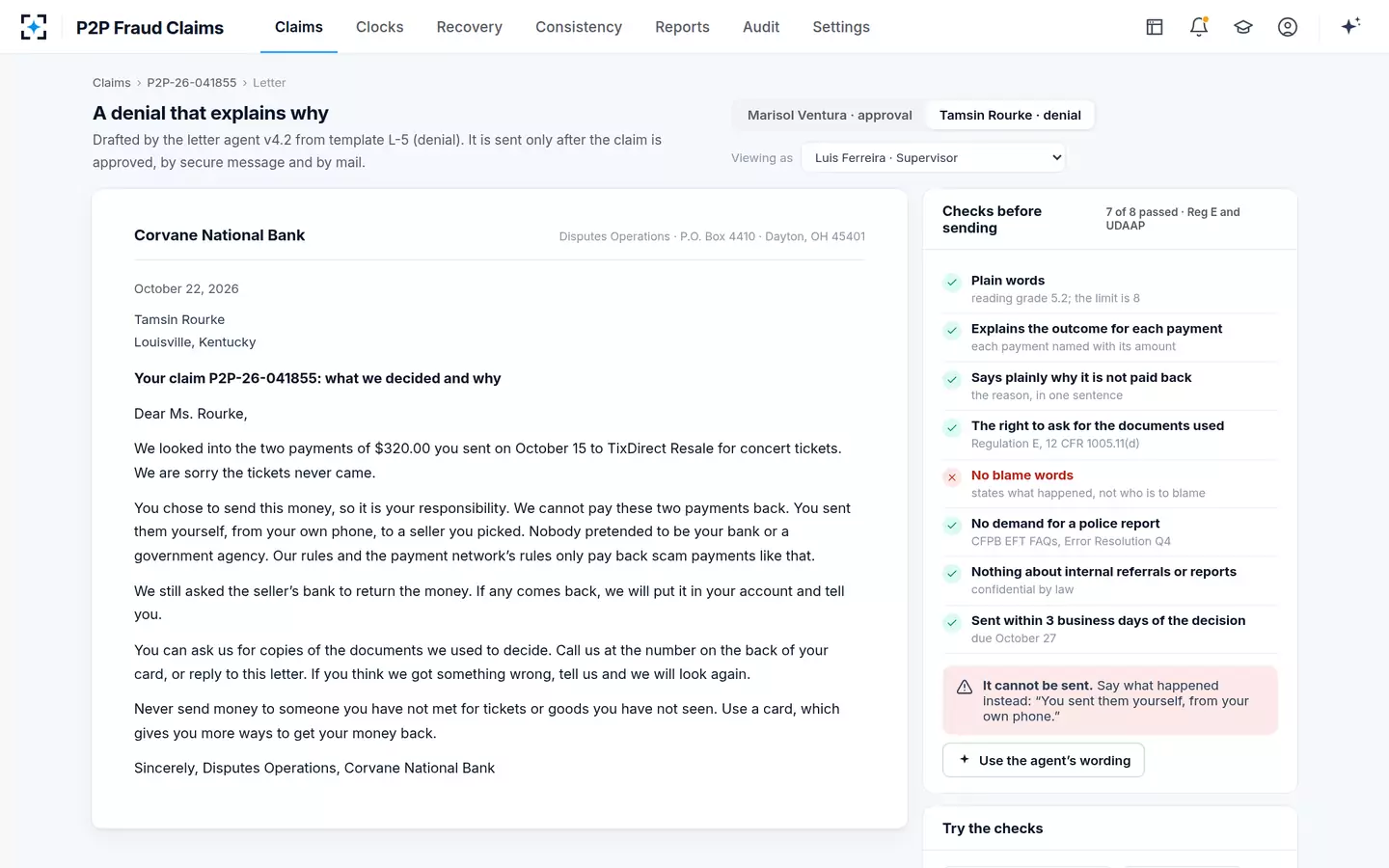
A desk repays the right amount when it decides each payment on its evidence, applies each rule in its own lane and writes down why. That protects the customer who was wrongly refused and the bank that would otherwise pay goodwill on a payment no rule covers. A denial still has to be explained in plain words, and in the solution the letter checks block a draft that blames the customer or demands a police report.
A purchase scam the rules do not cover: the denial explains why, and is checked before it can go
P2P Fraud Claims does not change what the law, the network or a bank's policy repays. It makes sure each payment meets the right one: placed with the record that puts it there, checked against similar decided claims, approved by a supervisor who did not work it. To follow the sample claims on this page, start from P2P Fraud Claims.
Questions people ask
Will Zelle refund me if I was scammed into sending money?
Only through your bank, and only if the payment qualifies. Your bank must repay payments a scammer sent from your account without your authority, and the network's imposter rule requires repayment of some payments you sent to someone posing as a bank, government agency or existing service provider. Purchase scams are excluded from that rule.
Is a Zelle payment sent to an impostor of my bank covered?
If you sent it yourself, it is outside Regulation E but may qualify under the network's imposter rule for bank impersonation. If the impostor used a code or login you gave them to send it, it is an unauthorized transfer and Regulation E requires your bank to repay it, subject to the liability limits.
How long does a Zelle scam claim take?
For payments claimed as unauthorized, Regulation E gives the bank 10 business days to decide or provisionally credit, and up to 45 days to finish. There is no federal deadline for a decision on an authorized scam payment; the bank's policy and the network's rule set the timing.
What happens to the scammer's account after a claim?
The customer's bank can ask the receiving bank to return funds still in the account, and refer the recipient to its own fraud team. Whether money comes back depends on how quickly the request arrives and what is left.
Did Congress change the law on Zelle scams?
The Senate staff report of July 2024 recommended amending the Electronic Fund Transfer Act to require reimbursement of fraudulently induced transfers. Regulation E's definition of an unauthorized transfer, as published in October 2026, is unchanged and still excludes a payment the consumer authorized, however she was deceived.