Yes, you can dispute a Zelle payment if you were scammed: tell your bank as soon as you can, by phone, chat or in writing, and it must investigate. Whether it must give the money back depends on who pressed send. If the scammer sent the payment from your account, even using a code or password you were tricked into sharing, the payment is unauthorized and federal rules require your bank to repay it, with limits on what you can be asked to bear. If you sent the payment yourself because someone lied to you, the federal rule does not cover it, though the network's imposter rule or your bank's own policy may. Many scam calls produce both kinds of payment in a single afternoon. P2P Fraud Claims, Botminds' software for dispute teams that resolve P2P fraud and scam claims, is built to separate them, so one call gets the two answers it deserves rather than one.
This guide is for customers trying to understand what happens to their claim, and for the contact-center staff who take the call. It walks through one invented call, then answers the questions customers ask most.
One scam call, two payments, two different rules
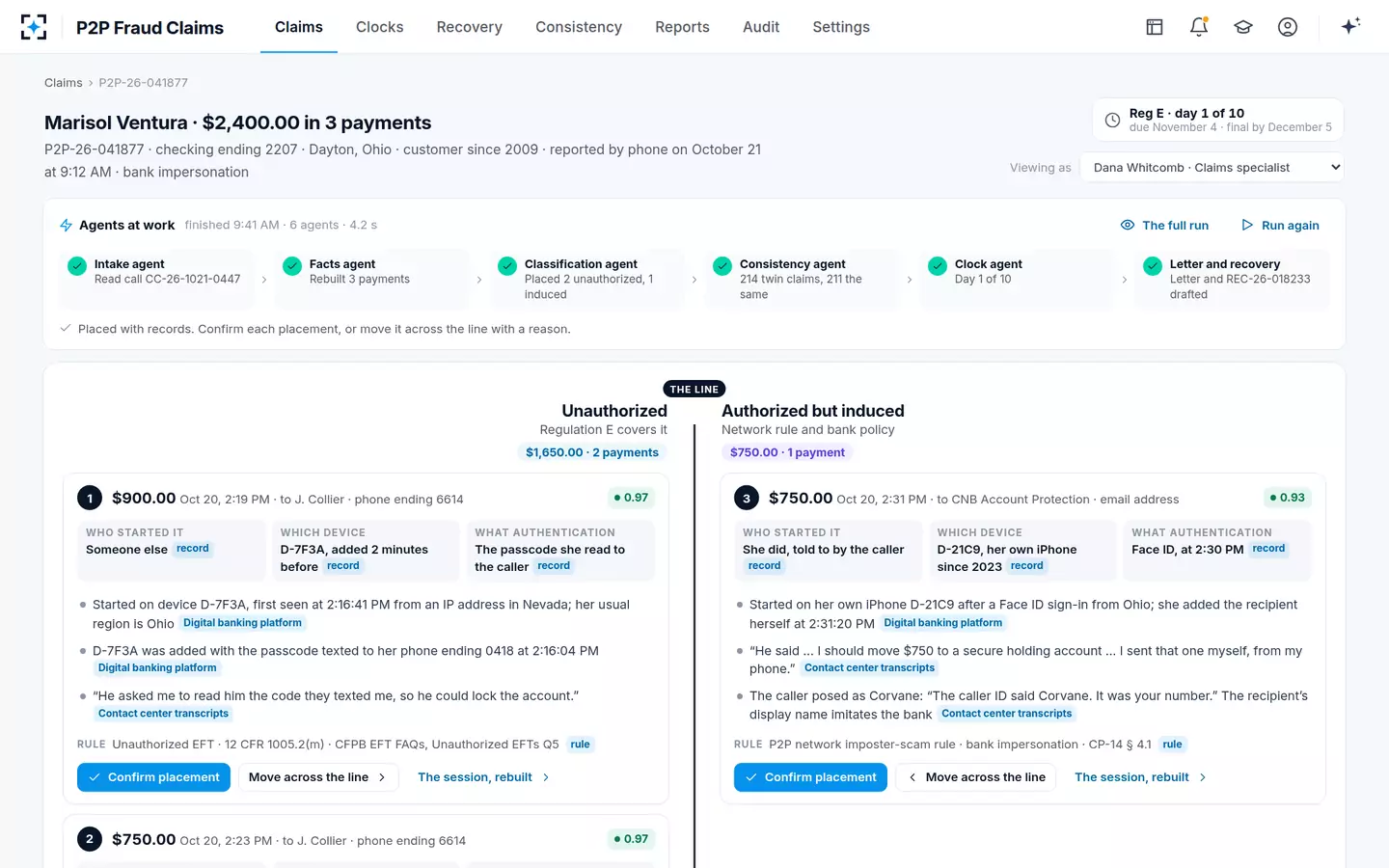
Payment A: the scammer pressed send: You read a code to a caller posing as your bank. He used it to add his own phone to your account and sent $1,200 from it.
Payment B: you pressed send: The same caller told you your money was unsafe and had you send $600 to "a protected account". You sent it from your own phone.
Payment A: the scammer pressed send: Unauthorized: started by someone else, without your authority. Covered.
Payment B: you pressed send: Authorized: you started it, though you were deceived. Not covered.
Payment A: the scammer pressed send: Not needed; the bank must investigate and repay an unauthorized transfer.
Payment B: you pressed send: The network's imposter rule may apply, because the caller posed as your bank. Your bank's policy may go further.
Payment A: the scammer pressed send: Limited by how fast you report: at most $50 if you report within two business days of learning of it.
Payment B: you pressed send: Up to the full $600, if neither the imposter rule nor the bank's policy covers it.
Can I dispute a Zelle payment if I was scammed?
You can always dispute it, and your bank must take the dispute seriously from the moment you speak. Regulation E, the federal rule for electronic transfers, requires a bank to investigate any notice of error, oral or written, received within 60 days after it sends the statement on which the transfer first appears (12 CFR 1005.11). The bank has 10 business days to decide, or it can credit your account provisionally and take up to 45 days.
What the dispute can achieve depends on the payment. An unauthorized transfer is an error under Regulation E, and the bank must correct it. A payment you authorized is not an error in that sense, even if you authorized it because you were lied to. That is why the first thing a well-run claims desk asks is not "was it a scam?" but, for each payment, "who sent it, from which device?"
One call, two kinds of payment: an example
Take an invented customer, Delia Marsh, who banks at a fictional Fenwood Community Bank. One Tuesday afternoon her phone shows Fenwood's number. The caller says he is from the fraud team, that someone is trying to take money from her account, and that a code is about to arrive by text, which she should read back so he can lock the account. She does. The code was really sent to approve a new device. Within a minute, a phone she has never seen is on her account and has sent $1,200 to a stranger.
The caller stays on the line. The attackers are still trying, he says; she should move $600 to a protected account while the fraud team works. She opens her own banking app, adds the recipient he gives her and sends the money. When the call ends she realises, rings the real Fenwood number and reports both payments.
Decided as one claim, Delia's case looks like a scam in which she cooperated twice: she shared the code and she sent the money. Decided payment by payment, it is two different cases. The $1,200 was sent by someone else, from a device he added with a code he obtained by deception, so it is unauthorized. The $600 she sent herself, so it is authorized, though induced by a man posing as her bank. The Senate staff who examined the largest banks' Zelle disputes noted that those banks "typically either deny or reimburse a transaction in full", which is exactly why the line has to be drawn per payment rather than per call.
What if I gave the scammer my code?
Sharing a code because someone deceived you does not make the scammer's payments yours. The CFPB, which writes the rules under the Electronic Fund Transfer Act, says so directly: a person tricked into giving up account information has not handed over an access device in the rule's sense. Payments the scammer then makes with that code or password are unauthorized transfers, and the bank must treat them that way.
Nor can a bank use your carelessness to raise what you owe. The same FAQs point to the commentary to Regulation E, which says a consumer's negligence can never push liability above the limits the rule sets. A bank agreement that says you lose protection if you share account information cannot override that, because the Act forbids waivers of consumers' rights. What the rule does not cover is a payment you sent yourself; that is where the second answer comes from.
The same split, drawn for a specialist: who started each payment, on which device
Is a scam the same as fraud?
Not in the rules, though people use the words interchangeably. In banking, "fraud" on a P2P payment usually means a transfer someone else made from your account; "scam" means one you made because you were deceived. The Federal Reserve's ScamClassifier, a model built so banks classify scams consistently, recognises that a scam can produce either kind: it counts both the payments victims were tricked into sending and the payments criminals sent after getting into an account; the Fed fraud classifier model guide shows how banks use the two together.
For your claim, the distinction matters more than the label. A call that you would describe as a scam can contain payments that are, legally, fraud. The bank's investigation should identify which is which from its own records: device logs, sign-in times, where each payment was started. You do not have to know the answer when you call; you only have to say what happened.
How long do I have to dispute a Zelle payment?
Report it as soon as you can. Regulation E requires the bank to investigate a notice received within 60 days after it sent the statement showing the transfer, and your share of an unauthorized loss depends on speed. Under 12 CFR 1005.6, if a code or other access device was lost or stolen and you report within two business days of learning of it, your liability is at most $50; after that it can rise to $500, and transfers after the 60-day statement window can be unlimited.
The clocks that run once you tell your bank
60days
after the statement showing the transfer, to give notice of an error
2
business days after learning a code or device was compromised, to keep your liability at $50 or less
10
business days for the bank to decide, or to credit you provisionally and take up to 45 days
3
business days for the bank to tell you the result once it has decided
A payment you authorized has no federal clock of its own, but the network's imposter rule and your bank's policy may set limits, and the sooner the bank knows, the sooner it can ask the receiving bank to hold whatever is left in the scammer's account.
What will my bank ask me when I dispute a Zelle payment?
Your bank will ask what happened, payment by payment: the amounts, dates and recipients, whether anyone contacted you first, and whether you shared any code or password. It may ask you to confirm in writing within 10 business days, but only if it tells you so when you call and gives you the address. What it may not do is make the investigation wait. Asked whether a bank can require a police report before investigating, the CFPB answers no: the investigation starts promptly when you call or write, and the bank cannot hold it up, or hold up the result, while it waits for anything more from you.
The same goes for being told to contact the person you paid first. You can choose to file a police report or a report with the Federal Trade Commission, and both can help, but neither is a condition of your bank's investigation.
What your bank may and may not ask of you on a Zelle dispute
| Request | Allowed? | Why |
|---|---|---|
| Describe each payment and what happened | Yes | The notice should identify the account and why you believe there is an error, with the type, date and amount where possible. |
| Confirm in writing within 10 business days | Yes, if told when you call | The bank must tell you of the requirement and the address at the time of your oral notice. |
| A police report before it investigates | No | The investigation may not wait on information from you. |
| Contact the recipient or merchant first | No | Notice to the bank starts its duty to investigate. |
| Accept liability because you shared a code | No | A code taken by deception is not furnished, and negligence cannot raise your liability. |
Can a bank deny my claim because I sent the money?
For a payment you genuinely sent yourself, yes: Regulation E does not require the bank to repay it, and courts have agreed. In one decision the Senate staff cite, a federal court dismissed a Zelle customer's claim because, in the court's words, "she, in every sense of the word, authorized the transaction. Unfortunately for Plaintiff, the person on the other side of the Zelle transactions was not who they claimed to be."
Two things can still bring the money back. If the scammer posed as your bank, a government agency or a company you already do business with, the network has required its member banks since June 30, 2023 to reimburse qualifying imposter scams; the details are in what is a Zelle qualifying imposter scam. And your bank may repay under its own policy. What the bank may not do is deny the payments the scammer sent on the ground that you sent others, which is the error a whole-claim decision invites. How often scam claims are repaid in practice is set out in Zelle scam reimbursement.
"Was it a scam?" is the wrong first question. "Who pressed send, on which device?" is the right one, asked once for every payment.
What the bank must send you when it decides
If the bank finds an error, it must correct it within one business day and tell you within three. If it finds no error, or a different one, it owes you a written explanation of what it found, and the letter must tell you that you can ask for the documents it relied on; what that letter has to contain is set out in Reg E documentation. If it had credited you provisionally, it must also tell you when it will take the credit back and honor your checks and preauthorized payments for five business days.
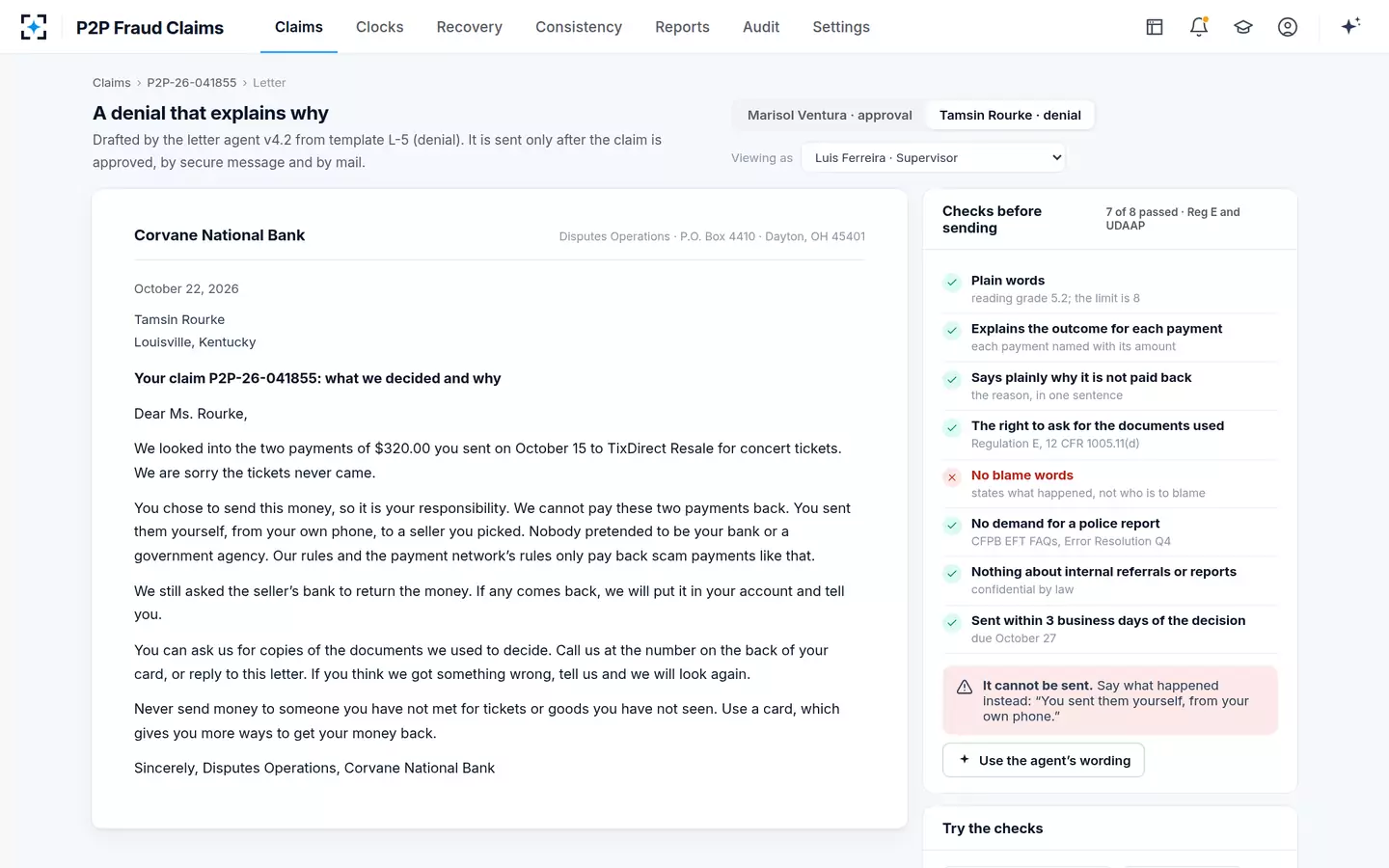
On a mixed claim, a good letter explains each payment separately, in plain words, without blaming you. In the solution, the letter for a denied purchase scam says why the rules do not repay it, that the bank still asked the receiving bank to return the money, and that the customer can ask for the documents; a check blocks the letter if a blaming phrase creeps in.
A denial that explains why, checked before it can be sent
For contact-center staff: hearing two stories in one call
The person who answers the phone decides, without meaning to, how the claim will be read. A note that says "customer was scammed, shared code, sent money" will be denied by a tired investigator. A note that lists each payment with what the customer says about who sent it gives the investigator the split from the start. The checklist below is what an intake script should capture on any P2P scam call. In the solution, the intake agent reads the transcript for the same things and lists each payment with the customer's own words.
What to capture on a Zelle scam call, before the customer hangs up
- Every payment, one line each
Amount, time and recipient as the customer describes them; ask "were there any others?" before closing.
- For each payment: who pressed send?
The customer, or "it just happened"? Note her words, not a conclusion.
- Any code, password or approval shared, and when
A code read to a caller often precedes a new device on the account.
- Who the caller claimed to be
The bank, a government agency, an existing provider, a seller, a romance. It decides whether the imposter rule applies.
- The date and channel of first notice
The 10-business-day clock starts here, whether the notice was a call, a chat or a branch visit.
- No conditions
Do not tell the customer the claim depends on a police report or on contacting the recipient.
- Protect the account now
Remove unknown devices, reset credentials, and flag the recipient for the fraud team.
P2P Fraud Claims starts where that call ends: the agents rebuild each payment from the bank's logs, place it on its side of the line with the record that puts it there, and draft the outcome; a specialist confirms each placement and a supervisor approves. The sample claims on this page can be followed from P2P Fraud Claims.
Questions people ask
How do I dispute a Zelle payment?
Contact your bank or credit union, not the network, by phone, chat or in writing, and describe each payment you dispute. The bank must start investigating on your notice, decide within 10 business days or credit you provisionally, and give you the result in writing if it finds no error.
Can a Zelle payment be reversed if I was scammed?
The payment itself usually cannot be cancelled once sent, but your bank can repay you if the transfer was unauthorized or qualifies under the imposter rule or its own policy, and it can ask the receiving bank to return any funds still in the scammer's account.
What is the difference between fraud and a scam on Zelle?
Fraud, in banking terms, is a payment someone else made from your account without your authority; a scam is a payment you made because you were deceived. Regulation E requires banks to repay the first, subject to liability limits; the second depends on the network's imposter rule and your bank's policy.
Do I need a police report to dispute a Zelle payment?
No. You may file one, and it can help, but the CFPB says a bank may not require a police report or other documents before starting or completing its investigation.
What if my bank denies my Zelle claim?
Ask for the documents the bank relied on, which Regulation E entitles you to, and check whether it decided each payment separately. If a payment was sent from a device you never used, say so in writing and ask the bank to review it. You can also submit a complaint to the Consumer Financial Protection Bureau or your state's regulator.