A promotional review committee is the body a pharmaceutical company convenes to decide whether a promotional piece may be used: medical, regulatory and legal reviewers, usually with an operations chair, who between them confirm that every claim is supported, that the piece stays inside the current labelling, and that risk is presented as prominently as benefit. Signing is the committee's real output, and it is the part most firms have never written down precisely. MLR Review Automation is Botminds' agentic software for the work that arrives at that committee: every claim pinned on the piece and checked at its cited page before anyone sits down, so the meeting spends its hour on judgement rather than on footnotes.
The people, brands and pieces in the worked examples here are fictional sample data from the solution. The rules come from the Code of Federal Regulations, FDA guidance and the UK medicines regulator's own guidance, each linked where it appears.
What does a promotional review committee do?
It does three things, and only the first two are usually described. It decides findings — the specific objections raised against specific claims. It grants approval, by signature, with named people accepting responsibility. And, almost always unacknowledged, it acts as the firm's standard-setting body: the place where precedent is made about what wording is acceptable, which no written procedure ever quite captures.
The third job is why committees resist being shrunk. A reviewer who sits through forty pieces a quarter builds a sense of where the line is that no checklist transfers. The mistake is to conclude that the committee must therefore read everything. It needs to decide the contested things; precedent accumulates from decisions, not from attendance.
What the committee is not is a regulator's requirement. Nothing in the United States rulebook establishes it, sets its membership, or fixes its cadence. The nearest thing is FDA's recommendation that firms have qualified medical, scientific, legal and regulatory people carefully review a communication before it goes out — four disciplines, no structure. What the law fixes and what a firm invents sets out the whole boundary; this page is about the part of it that carries a name and a date.
Who sits on a promotional review committee?
Five seats commonly recur, and the useful description of each is not its title but the decision only it can make.
Five seats around one piece in MLR Review Automation, and what each one keeps
Today
Opens every cited reference by hand to check the number, the population, the endpoint and the timepoint — fourteen times for one detail aid.
With agents
Opens a piece already pinned, each claim beside its source page, and spends the hour on the medical findings that need a decision.
Still theirs: Whether the evidence supports the claim.
Today
Compares safety text against the label by eye, then assembles and files the submission package.
With agents
Reads a word-for-word label comparison and a fair balance reading, and files a package built only after the signatures exist.
Still theirs: Whether the piece sits inside the current labelling.
Today
Asks for the data behind every superiority and comparative line, then waits for it.
With agents
Sees the underlying data opened at its page, with the population, comparator and period that do not match, and qualified wording ready.
Still theirs: Comparative and superiority wording, and trademark use.
Today
Chairs a weekly meeting that reads every piece from the top, and answers for how long approval takes.
With agents
Sets routing and signers once, and chairs an agenda of open judgement calls only.
Still theirs: The lanes, the thresholds and who signs.
Today
Uploads a version, then waits for three reviewers’ comments to arrive separately and disagree.
With agents
Receives each change request with its finding, the page it rests on and suggested wording, and gets the revision re-checked on arrival.
Still theirs: What the next version actually says.
Two of the five are routinely misdescribed. The operations lead is often treated as an administrator, when in practice they own the system's design — which pieces go to which lane, how many signatures a lane needs, when the meeting sits. Those choices determine the committee's workload more than any reviewer's reading speed. And the agency account lead, who usually works for a different company, is left off the diagram entirely, despite owning the revision that closes every finding.
The seat nobody names: who signs in the United States
Search the Code of Federal Regulations for the person who must approve a promotional piece and you will not find one. There is no required signatory, no required qualification, no required number of signatures, and no required independence. The regulations fix what the piece must be — truthful, fairly balanced, consistent with the labelling — and are silent on who assures it.
Firms fill the silence with convention, and the conventions vary. Some require three signatures on everything. Some allow a single regulatory signature on low-risk material. Some let a reviewer delegate to a named alternate; some do not. None of these is right or wrong as a matter of law. What matters is whether the firm can say, afterwards, who decided and what they were asserting when they did.
The one United States rule that bears directly on the signature is not about promotion at all. 21 CFR Part 11 governs electronic records and signatures, and it is unusually specific about what a signature has to carry.
What a signature has to record to be worth anything (21 CFR 11.50)
- The printed name of the signer
Not a user identifier, not initials in a workflow tool: the name a person would be identified by if the file were read years later.
- The date and time the signature was executed
Which makes the order of signatures legible — and makes visible the case where a package was assembled before the last reviewer signed.
- The meaning associated with the signature
The regulation gives its own examples: review, approval, responsibility, or authorship. A signature whose meaning is not stated says only that somebody clicked.
- All three under the same controls as the record itself
And included in any human-readable form of it, so an exported or printed copy still shows who signed and what they meant.
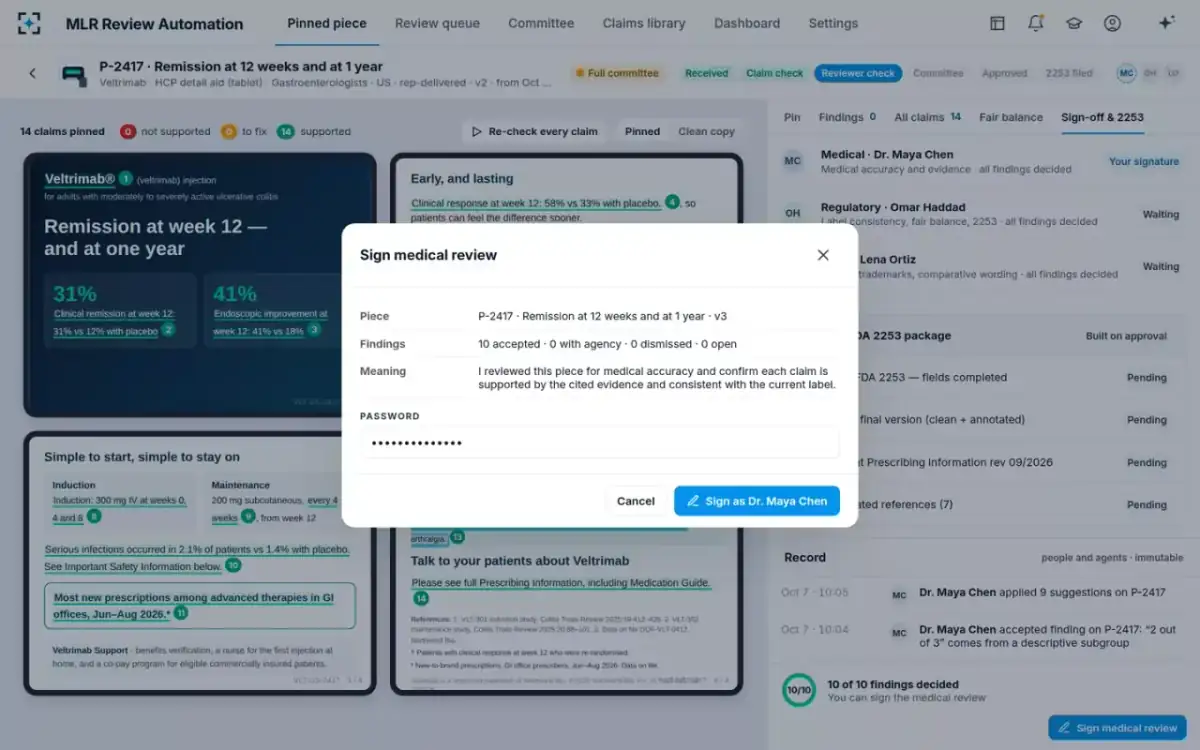
That third item is the one most review systems fail. A reviewer who clicks "approve" in a workflow tool has recorded a state change, not an assertion. A reviewer whose signature carries a sentence — I reviewed this piece for medical accuracy and confirm each claim is supported by the cited evidence and consistent with the current label — has recorded something a person can be held to. In the solution, the signing screen shows the meaning and asks for the reviewer's password before the signature is written, which is the difference between a decision and a button.
The seat the United Kingdom names: the qualified signatory
Where the American rulebook is silent, the British arrangement names a person, and it is worth borrowing from even if you never sell a medicine in the United Kingdom. The Medicines and Healthcare products Regulatory Agency, in its guidance on advertising, puts responsibility on the licence holder and describes how firms discharge it.
A company will normally delegate final approval of all promotional material to qualified signatories. Although it is not a legal requirement, the appointment of qualified signatories to certify advertising material is a requirement of both the ABPI Code of Practice and of the PAGB Medicines Advertising Codes.
MHRA, The Blue Guide: Advertising and Promotion of Medicines in the UK, section 4.4 (third edition, third revision, November 2020)
Three things in that arrangement are worth taking seriously anywhere. Approval is final approval — of the piece as it will be used, not of a draft on the understanding that small changes follow. It rests with named, qualified people rather than with a committee as a body, which concentrates responsibility rather than diffusing it. And the regulator asks companies to tell it who those people are and when they change, which makes the seat auditable from outside. A fourth rule is not in the regulator's text but follows from the same logic, and most firms' procedures omit it: the person who signs should not be the person who wrote the piece.
Who signs a promotional piece: the United States and the United Kingdom side by side
United States (21 CFR; FDA guidance): No named signatory anywhere in the regulations. FDA recommends that qualified medical, scientific, legal and regulatory personnel carefully review a communication before it is disseminated.
United Kingdom (MHRA Blue Guide): Final approval is normally delegated to qualified signatories who certify the material. MHRA notes this is not a legal requirement but is required by the industry's self-regulatory codes.
United States (21 CFR; FDA guidance): No. Nothing asks a firm to tell FDA who approves its promotion.
United Kingdom (MHRA Blue Guide): Companies are asked to inform the MHRA of signatory appointments and of any later changes.
United States (21 CFR; FDA guidance): Whatever the firm says it asserts. 21 CFR 11.50 requires an electronic signature to record its meaning, but does not say what the meaning should be.
United Kingdom (MHRA Blue Guide): The guidance does not script the wording. The law it describes requires all advertising to be consistent with the current summary of product characteristics, so that is the least a signature asserts.
United States (21 CFR; FDA guidance): Nothing fixes an interval. In practice a label change is what makes a live piece wrong.
United Kingdom (MHRA Blue Guide): All advertising should be reviewed promptly each time the summary of product characteristics changes, to decide whether it needs changing or withdrawing.
United States (21 CFR; FDA guidance): No promotional-specific retention period for the approval itself.
United Kingdom (MHRA Blue Guide): MHRA considers the minimum to be three years after the last use of the piece, or after the end of any regulatory or self-regulatory action, whichever is later.
What a reviewer's signature commits them to
A useful signature is three statements rather than one. The signatory has examined the final form of the piece and believes it meets the house standards and the advertising rules; believes it is consistent with the current label; and believes it is a fair and truthful presentation of the facts about the medicine as a whole. Write those three into the meaning a signature records and you have stated, precisely, what a reviewer is being held to.
Set those three against what a reviewer actually has in front of them and the gap is instructive. The first is a compliance assertion, and it is checkable if the house standards are written down. The second is a comparison with the label, which is mechanical and should never rest on memory. The third is a judgement about the whole piece — the one that cannot be delegated, automated or inferred from a checklist, because it is about the impression the piece leaves rather than the truth of its sentences.
A reviewer who can only produce the third is guessing at the first two. A reviewer who has been given the first two — the standards applied, the label comparison done word for word — can spend their attention on the third, which is the only one their signature uniquely qualifies them to make.
The signature itself, with the meaning it records
Independence: the signatory who did not write the piece
Keeping the author out of the signing seat looks like a formality and is not. The person who drew up a piece knows what they meant by every sentence, which is precisely why they are the worst person to judge what a reader will take from it. Net impression is a reader's experience, not an author's intention, and an author cannot un-know the intention.
In the United States nothing forbids the arrangement, so it survives in small teams and at launch, when the person who wrote the claim strategy is also the most senior medical voice available. The cheap fix is not a bigger committee but a named alternate: a second qualified reviewer who did not write the piece and signs in the author's place. It costs one person's hour and removes an objection that is otherwise unanswerable.
What happens when a reviewer disagrees with a claim
A finding needs somewhere to go, and most review systems give it only two exits: fixed, or argued about in the meeting. Four exits are better, and the fourth is the one that keeps committees honest.
One finding, four exits — and the line the agents in MLR Review Automation do not cross
Agent
A finding is raisedThe checking agent states what it compared, what it found and the page or label section the finding rests on.
Never: Never decides the finding, never edits the piece, never signs.
A person decides
Accept the approved wordingThe reviewer applies the pre-approved claim or the label wording offered with the finding; the change is applied to the draft and recorded against their name.
A person decides
Send the change to the agencyThe finding leaves as a change request carrying its page and the suggested wording, and the revised version is re-checked when it comes back.
A person decides
Dismiss, with a written reasonThe reviewer disagrees and says why in writing. A serious finding cannot be dismissed silently.
A person decides
Escalate to the committeeThe finding stays open and goes on the agenda as a judgement call, with the evidence already attached.
The dismissal exit is the one worth designing carefully. Reviewers are right to dismiss findings — a checking agent that never produces a false positive is a checking agent set too loosely — but a dismissal with no reason leaves the file indistinguishable from one where the finding was never read. Requiring a written reason on serious findings costs a sentence and buys a defensible record. It also produces, over a year, a list of the checks your reviewers keep overruling, which is the best available evidence that a house standard needs changing.
The escalation exit is what makes the meeting shorter rather than longer. If a finding can be escalated with its evidence already attached — the claim, the page it was checked against, what did not match — the committee opens the agenda on the substance instead of spending its first twenty minutes reconstructing the problem.
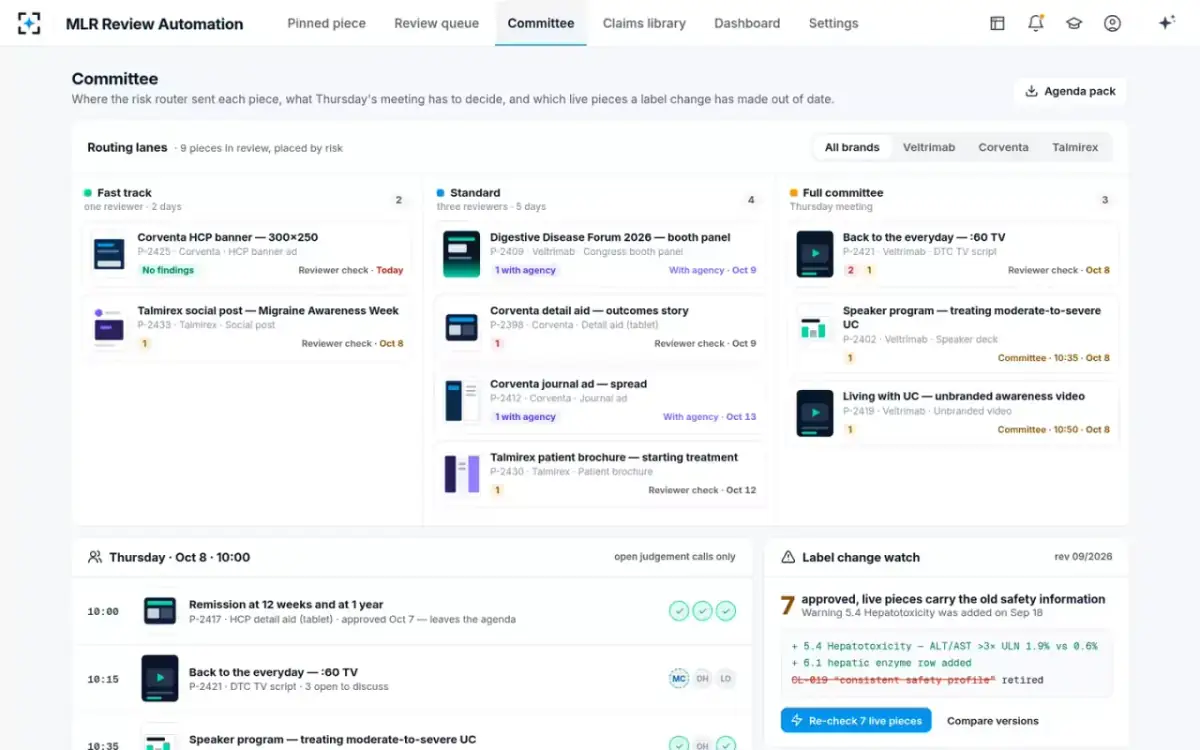
The committee screen in MLR Review Automation: lanes, Thursday's agenda, and the pieces a label change has overtaken
An approved piece does not stay approved
Approval is usually treated as an end state, and it is not. Two things can make a signed piece wrong without anybody touching it, and only one of them is widely watched.
The first is a label change. When a new label version adds a warning, every live piece carrying the old safety text is inconsistent with the current labelling from that date. On the fictional sample brand, one revision — a hepatotoxicity warning added in September — left seven approved, live pieces carrying superseded safety information, five of which could be fixed by swapping the safety module and two of which had to come out of the field. What a label change does to live material works that sweep through in detail.
The United Kingdom regulator puts the first point plainly: "All advertising materials should be reviewed promptly each time the SPC changes to determine whether any changes are required and if materials need to be withdrawn from use." The summary of product characteristics is the British equivalent of the label, and the same discipline applies to a label change in the United States.
The second is time itself. No American rule imposes a re-review interval, which means a piece first approved in 2021 can still be in a representative's bag with nobody having looked at it since. A scheduled sweep, at an interval the firm writes down, is a sensible house rule precisely because it catches what event-driven watches miss: evidence that has been superseded, comparators that have changed, and claims whose supporting study has been overtaken.
What the committee has to keep, and for how long
What you keep determines what you can answer. The United Kingdom regulator sets an explicit floor: "the MHRA considers that the minimum time that materials should be kept for by licence holders and/or other parties is a period of three years after either the last use of the piece or the conclusion of any regulatory or self-regulatory action, whichever is later." Note the clock — three years after last use, not after approval, which for a long-lived piece can be a decade from signature.
What travels with the approval matters as much as the approval. Keep the piece in the form signed, who it was sent to, how it was disseminated and the date it was first used. That last item is the same fact the American filing deadline turns on, which is a useful coincidence: a firm that keeps a proper first-use date for its own records has, by construction, the date it needs for the submission to FDA.
One more habit is worth building in at approval rather than later. When a doctor, a competitor or a regulator asks what a claim rests on, the answer is the study, the page and the passage — and finding them for a claim made in a piece approved two years ago is slow and uncertain unless the evidence was captured when the claim was approved. What a claim can rest on follows that thread.
The meeting, and the work that should never reach it
Here is the test to run on your own committee. Take the last three agendas and mark each item as a comparison or a judgement. A comparison has a right answer that two careful people would reach independently: does this number appear on this page, does this safety block match the current label, is this type size comparable. A judgement does not: is this layout fair, is this comparative line defensible, does this piece leave an accurate impression.
In many firms the comparisons dominate, and they are the expensive items, because resolving one in a meeting requires somebody to open a document everybody else is waiting on. Worse, the comparisons crowd out the judgements: the piece that needed a real argument about net impression gets eight minutes at the end because the first fifty went on footnotes.
Moving the comparisons out does not make the committee less important. It makes it the only thing it was ever uniquely able to be. An agenda of four contested judgement calls, each with its evidence attached, is a meeting that finishes, and a meeting that finishes is one people prepare for. What to pilot first, and what to measure sets out how to test that claim on your own material rather than taking it on faith.
Questions people ask
What is a PRC in pharma?
PRC stands for promotional review committee, the body that reviews and approves promotional material before use. Some firms call it the MLR committee, the copy approval committee or the commercial review board; the acronym carries no fixed meaning because no regulation defines it. What varies between firms is substantial — who sits, how many signatures a piece needs, whether the committee reads everything or only contested items — so when a job description or a vendor mentions PRC review, it is worth asking which of those they mean.
Who has to sign off promotional material in the United States?
Nobody in particular, as a matter of law. The regulations fix what the piece must be rather than who must assure it, and FDA's guidance goes only as far as recommending that qualified medical, scientific, legal and regulatory personnel carefully review a communication before it is disseminated. Firms therefore set their own signature rules, and the question that matters in an audit is not how many signatures you collected but whether each one records a named person, a time and a stated meaning.
Can a promotional review committee delegate approval?
Yes, within whatever rules the firm writes for itself — nothing in United States law prevents it. The sensible constraint is independence: whoever signs should not be the person who developed the material. A delegate who satisfies that test and holds the same qualification adds resilience; a delegate chosen because the named reviewer is on holiday and the launch date is fixed is how a piece gets approved by its own author.
How often must approved promotional material be reviewed again?
In the United States no interval is set at all, so firms choose. In the United Kingdom, the regulator's guidance asks that all advertising be reviewed promptly each time the summary of product characteristics changes. Two triggers are worth building in regardless: a scheduled sweep so nothing ages quietly, and an event-driven re-check whenever the label changes, because a label revision can make a live piece inconsistent on the day it is approved and nobody will notice from the piece itself.
How long must a company keep an approved promotional piece on file?
The UK regulator sets the clearest published floor: MHRA considers the minimum to be three years after the last use of the piece, or after the end of any regulatory or self-regulatory action, whichever is later. The clock runs from last use rather than from approval, so for a piece in the field for five years the file is kept for eight. In the United States, retention is driven by the firm's own record-keeping policies and by the general requirement to be able to substantiate what it has claimed.
What should a committee agenda actually contain?
Open judgement calls, each with the evidence already attached: the claim, the page it was checked against, what did not match, and the wording proposed. Anything that can be settled by opening a document should have been settled before the meeting, and anything already agreed should appear only as a line confirming it. A useful proxy for whether your agenda is right is how long the meeting spends on its first item — if it is more than a few minutes, the room is still reconstructing a problem somebody could have stated in writing.