Data on file in pharma is evidence a company holds but has not published: an internal study report, a market research or prescription-audit report, an analysis done for a submission, a letter from an investigator. It is cited in promotional material the way a journal article is cited, usually as a document number, and it can be perfectly good evidence. What makes it different is that a reader who wants to check it has to ask the company for it, and the published audits of journal advertising found that asking often fails. Botminds' MLR Review Automation treats the claim and its source as one unit of work: it opens each cited reference at its anchored page, including a data-on-file report, and compares the claim with the passage line by line before a reviewer reads either.
That comparison is the whole job, and it is worth being precise about why. A claim is not substantiated because a reference exists under it. It is substantiated when a named person has opened the source at its page, compared what the piece says with what the source says, and could hand that page to a doctor who asks tomorrow.
What is data on file in pharma?
It is any unpublished document a company holds and cites in support of a claim. Two kinds turn up under the same label, and the distinction matters more than it looks: a bare "data on file", which points at an unspecified company document, and a citation that names a specific document by its number. A bare citation cannot usefully be requested, because it does not identify anything. A specific one can, which is why a document number is the minimum a reviewer should accept.
Typical contents are a clinical study report that has not been published, a post-hoc or pooled analysis prepared for internal use, a prescription audit or market research report bought from a data vendor, a stability or device-handling study, or a health-economic model. None of these is disqualified from supporting a claim. What is disqualified is a claim the document does not actually make, and the audits found a great many of those.
Why a reference is not substantiation
The two words are used interchangeably in review meetings and they are not the same thing. A reference is a pointer: a citation under a claim telling a reader where to look. Substantiation is the evidence itself, in a form that can be produced. A claim can carry a reference and still have nothing behind it that a reader could be shown.
United States regulation makes the same distinction from the opposite direction. Among the things that render an advertisement false or misleading, 21 CFR 202.1(e)(6)(x) lists one that uses "literature, quotations, or references that purport to support an advertising claim but in fact do not support the claim or have relevance to the claim" (21 CFR 202.1). The regulation is not interested in whether a citation is present. It is interested in whether the cited thing supports the claim — which can only be established by someone opening it.
How often does the cited reference fail to support the claim?
Often enough that it should be assumed rather than hoped against. Peer-reviewed audits, run in different countries and different years, have read advertisements against the studies they cited. The two below that counted unsupported claims put the share between a fifth and nearly half.
What four published studies found in the references
44.1%
of claims not supported by the reference cited, in advertisements published in six Spanish medical journals in 1997
21%
of claims not supported, with a further 32% based on potentially biased evidence, in Swiss journal advertisements from 2005
<67%
of claims supported by a systematic review, a meta-analysis or a randomised controlled trial, across 24 studies of advertisements from 26 countries
48.2%
of US physician-directed advertisements lacking verifiable references, in a November 2008 sample
The Spanish audit is the most useful of these, because it says why the claims failed: "In 45 claims (44.1%; 95% CI 34.3–54.3) the promotional statement was not supported by the reference, most frequently because the slogan recommended the drug in a patient group other than that assessed in the study" (Villanueva et al., The Lancet, January 2003). The commonest failure was not an invented number. It was a real number moved into a population the study never studied.
The Swiss audit classified its 16 unsupported claims and found a different mix, which its authors put down to the different drugs studied: four were false statements, four exaggerations of efficacy, three unjustified generalisations, three claims with no relation to the cited study at all, and two an unjustified transfer to humans. Both audits were counting the gap between a sentence and a source — which is exactly the gap a claim-by-claim comparison closes.
The reference a reader cannot get
The second finding is about availability, and it is the one that makes data on file a category of its own. Cooper and Schriger reviewed 438 advertisements from the 1999 issues of ten American medical journals. They did not only classify the references; they tried to obtain every one of them, through library and internet searches and direct requests to manufacturers.
How obtainable each kind of cited reference turned out to be
Twenty per cent. A systematic review of the same literature reports that only 42% of the authors' requests to manufacturers drew a response at all. Meanwhile data on file was not a rare citation: it made up nearly a fifth of all the references the advertisements carried.
What an advertisement cited, against what a research article in the same journal cited
Advertisements, 1999: Journal articles, 55% of 721 unique references.
Research articles, same journals: Journal articles, 88% of 400 sampled references.
Advertisements, 1999: 19% of the 721 unique references, 135 citations.
Research articles, same journals: Not reported as a category; books made up 8%.
Advertisements, 1999: 126 of the 438 advertisements, 29%, offered no reference for their medical claims.
Research articles, same journals: Not applicable: every claim in a research article carries a citation.
Advertisements, 1999: 84% of citations overall; 20% of data-on-file citations.
Research articles, same journals: 99% of citations overall.
Advertisements, 1999: 58% of the original research cited was sponsored by, or had an author affiliated with, the product's manufacturer.
Research articles, same journals: 8% of the sampled original research.
Two later studies suggest the habit is more American than universal, and that it persisted. Othman and colleagues, comparing journal advertising in three countries, found that "Data on file were significantly more likely to be cited in the US (17%) than in Australia (2%) and Malaysia (4%)". In a November 2008 sample of US physician-directed advertisements, Korenstein and colleagues found 43.4% referenced data on file, and counted an advertisement as lacking verifiable references where its only citations were data on file or the package insert.
Could you send it tomorrow? The test data on file has to pass
Citing data on file creates a practical duty even where no rule writes one down: a doctor who reads the citation may ask for it. FDA's advertising regulations say what a piece may not do, not what a company must send to a doctor who asks — but 21 CFR 202.1(e)(6)(x) makes a reference that does not in fact support its claim a misleading one, and a document nobody can produce is a support nobody can show.
So the useful internal test is simple and answerable at review time rather than months later: could the relevant part of this document be sent to a health professional who asked tomorrow? If the relevant part cannot be identified now — the page, the table, the passage — it will not be found later by someone who was not in the room. A review process that anchors every claim to a page has already done the work the clause asks for.
Can a market research report carry a number one claim?
It can carry exactly what it measured, and the trouble is always in the gap between that and the sentence on the piece. A prescription-audit report measures a defined set of prescribers, a defined set of competing products and a defined period. A claim to be "the number one prescribed" product usually states none of those three, and so claims something wider than the data behind it.
United States regulation treats the wider claim as a comparative one, and 21 CFR 202.1(e)(6)(ii) makes an advertisement misleading where it "contains a drug comparison that represents or suggests that a drug is safer or more effective than another drug in some particular when it has not been demonstrated to be safer or more effective in such particular by substantial evidence or substantial clinical experience." A market-share figure is not clinical evidence; it says what prescribers did, not what the drug does. Where a superiority reading is available to the reader, the qualification has to be on the piece, not in the file.
One comparative claim against its data on file, field by field
| Field | What the piece says | What the source says | Verdict |
|---|---|---|---|
| Value | The number one prescribed biologic | Highest new-to-brand prescription share, 24.6% against 22.1% for the next therapy | Matches — the source does show the highest share |
| Population | New ulcerative colitis patients, prescribers unqualified | Gastroenterology-office prescribers only; hospital, academic and primary-care prescribers not included | Does not match — the piece implies all prescribers |
| Comparator | Biologics | Advanced therapies | Does not match — a different and wider set of products |
| Period | Not stated | June to August 2026 | Does not match — an unstated period reads as current and continuing |
| What the claim can carry | A superiority reading across a whole market | A share figure for one prescriber setting, one product class and one quarter | Qualify on the piece, or do not make the claim |
The same claim, as written and as the data on file can carry it
As written: "The #1 prescribed biologic for new UC patients."
As the source supports it: "Most new prescriptions among advanced therapies in GI offices, Jun–Aug 2026."
As written: This product is prescribed more than any other biologic, everywhere, now.
As the source supports it: In one prescriber setting, among one class of therapies, in one quarter, it took the largest share of new prescriptions.
As written: A measurement across all prescribers and all biologics, kept current.
As the source supports it: The report as it stands, cited at its page, with the period in the footnote.
As written: Nobody has yet: the claim was written before the report was opened.
As the source supports it: A named legal reviewer, on the qualified wording, with the page beside it.
A comparative claim opened at the page of its data on file
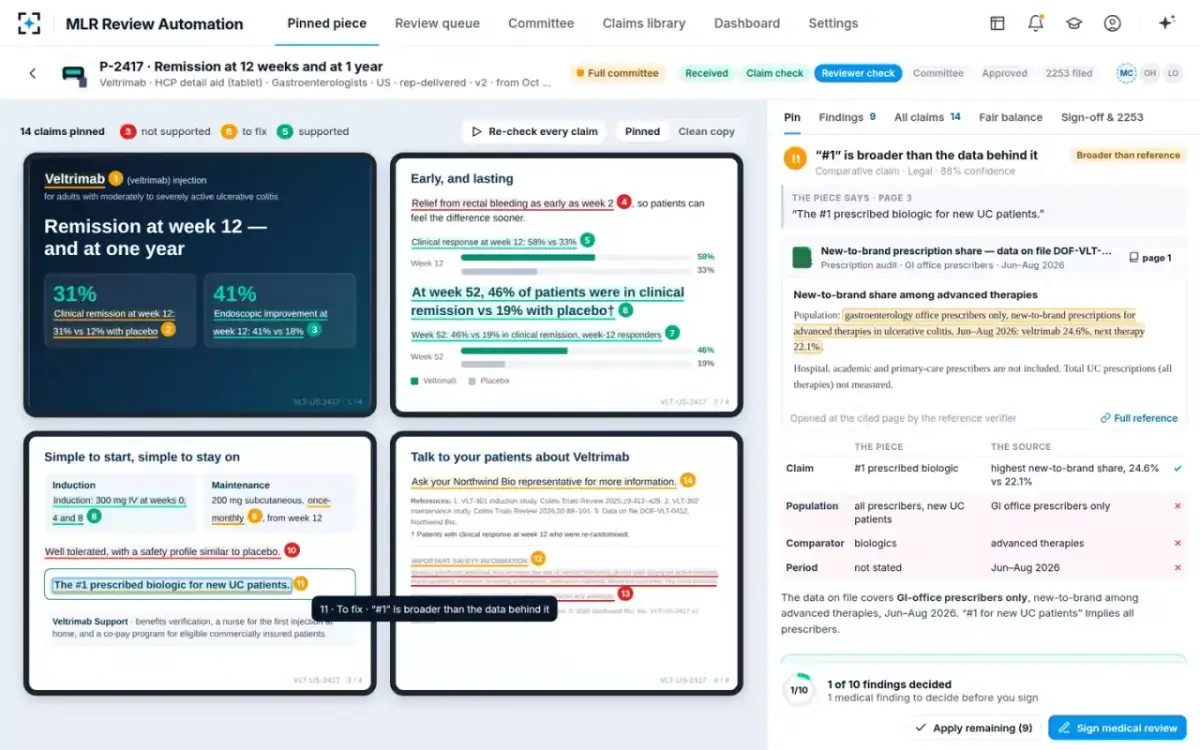
The four things to compare, claim by claim
Unsupported claims tend to fail on one of four fields, and a reviewer who checks all four in order will catch many of them. The fields are the value, the population, the comparator and the timepoint. The Spanish audit's commonest failure — a drug recommended in a patient group other than the one studied — is a population failure. The market-share example above fails on population, comparator and period at once, while its value is perfectly accurate.
A fifth question sits beside the four and decides what the claim may be called at all: was the result the study's primary endpoint, a pre-specified key secondary endpoint, an exploratory endpoint, or a descriptive subgroup? ICH E9 is the usual reference for why that matters, and FDA has said in enforcement what follows when it is ignored. An exploratory or subgroup result can be true and still be unable to carry an efficacy claim, which is why a checker that names the analysis is worth more than one that only matches numbers. In MLR Review Automation the reference verifier is explicit on this point: it cites the page and passage for every verdict, and exploratory and subgroup results are never recorded as supported efficacy claims. What consistent with labeling means, factor by factor, takes the question further into the label.
Relative risk, and the number the reader also needs
One failure is not about the source at all but about how its number is expressed. When Othman and colleagues looked at advertisements carrying quantitative results in Australia, Malaysia and the United States, they found risk results "reported exclusively as a relative risk reduction" — no absolute reduction, no number needed to treat, in any of the three countries.
FDA's final guidance on presenting quantitative efficacy and risk information in consumer-directed promotion says what is wrong with that. Research it cites suggests consumers understand relative frequencies less easily than absolute ones and may find them more favourable, and it recommends that a firm presenting a relative figure "include the corresponding absolute probability measures in presentations of relative frequency measures". The guidance is written for consumer-directed material, but the reasoning carries to a detail aid: a reader cannot judge a reduction without the rates it was calculated from.
This is a check a reviewer can run without opening anything: wherever a piece gives a percentage reduction, does it also give the two rates it was calculated from? A claim of a thirty per cent reduction built on four per cent against five point seven per cent is true and, standing alone, misleading. The cited paper will have both numbers; the piece usually has one.
How to check a claim against its reference, in order
The order matters, because each step makes the next cheaper. Anchoring first means a reviewer never reads the wrong page; comparing the four fields before judging the wording means the argument is about evidence rather than taste.
Seven steps from a claim to a decision you could defend
- Find the anchor, and confirm it points at a page
A reference without a page number is a reference nobody will check. Assume the anchor is wrong until the page proves it right.
- Open the source at that page and find the passage
Not the abstract, not the study as a whole: the sentence or table the claim rests on. If the passage cannot be found on the cited page, the finding is an anchor problem, not yet a claim problem.
- Compare the value
The number as printed, including its denominator and its units. A rate quoted as a count, or a count quoted as a rate, is a different claim.
- Compare the population
The study population, including any restriction — setting, line of therapy, prior treatment, age. This is where the Spanish audit found failures most often.
- Compare the comparator
Placebo, active comparator, another class, or none. A single-arm study has no comparator, and a claim implying one cannot rest on it.
- Compare the timepoint, and name the analysis
Week 12 is not week 52. Then say what the result was: primary endpoint, pre-specified key secondary, exploratory, or descriptive subgroup — and treat only the first two as capable of carrying an efficacy claim.
- Decide whether you could hand the page over tomorrow
If the source is data on file, could the relevant part be sent to a health professional who asked? It is a good test of whether the claim is really substantiated.
Every approved claim with the reference, page and label section behind it
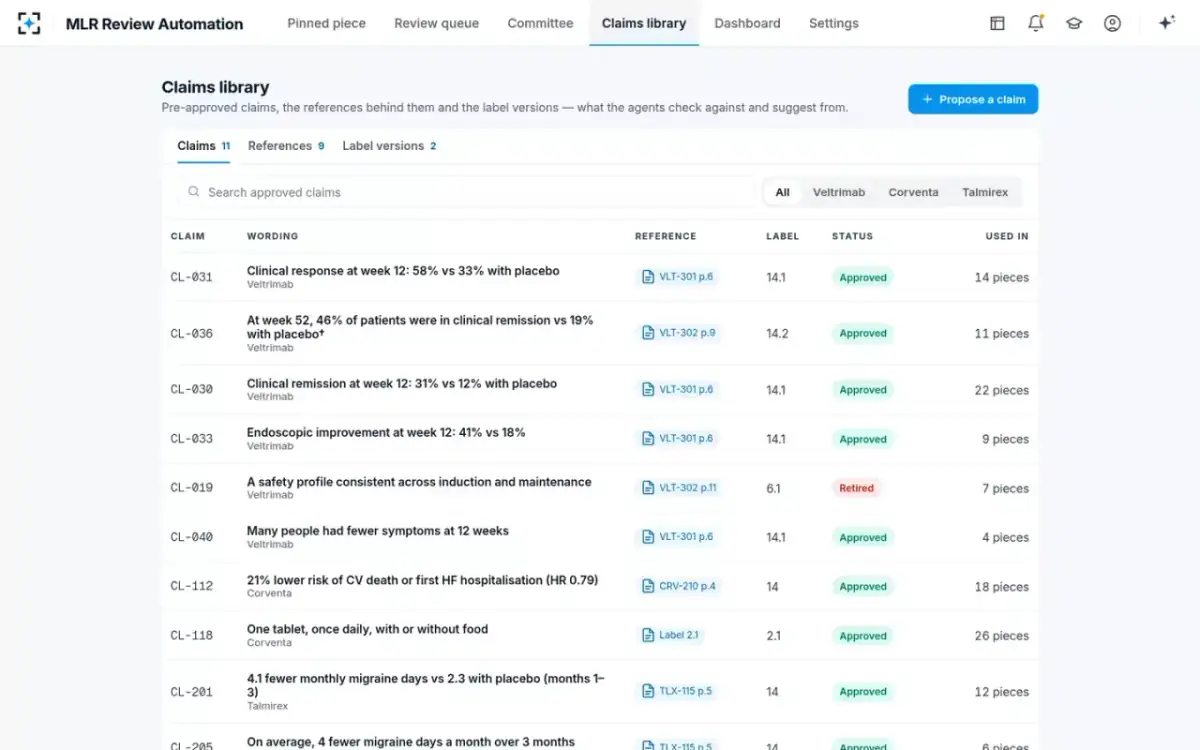
A library like this is the practical answer to the data-on-file problem, because it moves the work from the piece to the claim. Each approved claim is held once, with the reference and page it rests on, the label section it matches and the pieces that use it, so the comparison is done when the claim is approved rather than every time it appears. What FDA keeps citing in its letters shows why that record is worth having before it is asked for, and MLR Review Automation shows the checking itself.
Questions people ask
Can you cite data on file in promotional material?
Yes. No regulation forbids it, and unpublished company evidence is often the only evidence for a claim about handling, stability or prescribing patterns. Two conditions make it defensible: the citation identifies a specific document rather than an unspecified company file, and the relevant part of that document can be produced to someone who asks. In one audit of US journal advertising, only a fifth of data-on-file references could be obtained at all.
Is data on file peer reviewed?
Usually not. It is evidence the company holds and has not published, so it has had no external review and, in most cases, no external reader. That is not the same as being unreliable — a clinical study report is a far fuller document than the paper drawn from it — but it does mean the claim resting on it has been checked by nobody outside the company. Where a published source exists for the same point, cite that one.
Do you have to give data on file to a doctor who asks for it?
In the United States no federal regulation sets that duty, though a reference that does not in fact support the claim it is cited for is itself one of the things that makes an advertisement misleading under 21 CFR 202.1(e)(6)(x). The industry's own codes in some countries do set one. Either way, a claim resting on a document the company would not or could not produce is a claim a reader has no way to check, so the practical answer is to be ready to.
What is the difference between a reference and substantiation?
A reference is the citation printed under the claim; substantiation is the evidence itself, capable of being produced and of actually supporting the claim. The two come apart more often than review teams expect: one audit of 1999 US journal advertisements found 29% of advertisements carried no reference for their medical claims at all, and that only a fifth of the data-on-file references they did carry could be obtained.
What counts as substantiation for a promotional claim?
Evidence that covers the claim as a reader will read it — the same value, the same population, the same comparator and the same timepoint — and that was capable of answering the question asked. A pre-specified primary or key secondary endpoint from an adequate and well-controlled study carries an efficacy claim; an exploratory endpoint or a descriptive subgroup does not, however striking the number. Across 24 studies of advertisements from 26 countries, fewer than 67% of claims were supported by a systematic review, a meta-analysis or a randomised controlled trial.
How do you check a claim against its reference?
Open the cited reference at the anchored page, find the passage, then compare four fields in order: value, population, comparator and timepoint. Then name the analysis — primary, key secondary, exploratory or subgroup — because that decides what kind of claim the result can carry. The commonest failure the Spanish audit found was not a wrong number but a right number applied to a patient group the study never enrolled.