Form FDA 2253 is the transmittal form that accompanies a prescription drug promotional piece when a company sends it to the Food and Drug Administration, and the instructions that matter are shorter than most teams expect: send the completed current form, the promotional material and the product's current professional labelling, at the time of initial dissemination of the labelling or initial publication of the advertisement. MLR Review Automation is Botminds' agentic software for medical, legal and regulatory review, and it assembles that package — form, final piece clean and annotated, current prescribing information and annotated references — only after every required signature exists.
The piece codes, dates and counts in the worked example are sample data on a fictional brand from the solution. The requirements come from the Code of Federal Regulations and FDA guidance, linked where they appear.
What is Form FDA 2253, and what is it not?
It is a transmittal. The form identifies the applicant, the application, the product and the material being sent, and travels with the specimens so FDA knows what it has received and under which application. It creates no review obligation, starts no clock, and produces no response in the ordinary course.
What it is not is the more useful half. A 2253 submission is not an approval, and filing one does not mean FDA has looked at the piece. It is not a request for comment — that is a different, voluntary route. It is not a defence: a piece that is misleading is misleading whether or not it was properly transmitted. And it is not optional for material in scope, which is a point recent enforcement letters make.
One more thing it is not: a record of what the piece says. The form identifies the material; it does not carry the claims, the evidence or the reasoning behind any of it. Everything a firm would need to defend a piece two years later — which claim rested on which page of which study, who decided each finding, what the label said on the day — lives in the firm's own file, not in anything FDA receives. A submissions process that is complete and a review file that is thin is a common and uncomfortable combination.
The confusion is worth clearing up explicitly because it shapes behaviour. Teams who believe the 2253 is a review wait for a response that never comes, and teams who believe it is a formality treat it as paperwork that can be done later by whoever has time. Neither is right. It is a required filing, triggered by use, carrying a defined set of contents.
When do you submit Form FDA 2253?
At first use. The requirement sits in 21 CFR 314.81(b)(3)(i), which states that the applicant "shall submit specimens of mailing pieces and any other labeling or advertising devised for promotion of the drug product at the time of initial dissemination of the labeling and at the time of initial publication of the advertisement for a prescription drug product". The same paragraph adds that each submission "is required to be accompanied by a completed transmittal Form FDA-2253 … and is required to include a copy of the product's current professional labeling".
Two features of that deadline cause more trouble than the deadline itself. It is an event, not a date: a piece signed off in June and launched in October is filed in October, which means somebody has to be watching for the launch rather than the approval. And it is per piece, including revisions that are disseminated — so a piece reissued after a label change is a new initial dissemination of new material.
For biological products the obligation routes through the same place. 21 CFR 601.12(f)(4) provides that "advertisements and promotional labeling shall be submitted to the Center for Biologics Evaluation and Research or Center for Drug Evaluation and Research in accordance with the requirements set forth in § 314.81(b)(3)(i) of this chapter". One rule, two centres.
FDA's own frequently asked questions restate the timing in the regulation's words, so there is no interpretive gap to exploit: submissions must be made "at the time of initial dissemination of the labeling and at the time of initial publication of the advertisement for a prescription drug product".
What must be included in a 2253 submission
FDA's guidance on providing promotional submissions in electronic format sets out what firms are required to include, and the list is three items long.
What is required to travel with Form FDA 2253 — and what FDA encourages besides
- The completed fillable Form FDA 2253
Firms must use the most current version of the fillable form. For submissions to the Office of Prescription Drug Promotion, the form goes with final promotional materials only.
- The promotional material itself
The specimen as disseminated or published. Where a piece mentions several products, the guidance asks firms to note the lead application number on the form and attach an identification of the other referenced products.
- Current product labeling
The regulation requires a copy of the product’s current professional labelling with each submission — which is why a package assembled weeks early can be wrong on the day the piece ships.
- An annotated version of the material — encouraged, not required
For postmarketing submissions, firms may choose to submit annotated versions cross-referenced to the product labelling and, where applicable, references. FDA notes plainly that references improve the efficiency of review.
- The references the annotations point to
Submitted alongside the annotated copy, so a reviewer can follow a claim to the page that supports it without asking.
The distinction between required and encouraged is where firms often get the economics wrong. The three required items are the minimum for compliance. The annotated copy is what makes the submission useful — to FDA, and far more importantly to the firm itself.
The annotated copy, and the link to the page
One sentence in FDA's guidance, written as a formatting instruction, describes the entire discipline of promotional review.
Firms should highlight and annotate the materials with a cross-reference to the product labeling or references. When product labeling or other references are used to support a claim or presentation in proposed promotional materials, hypertext links should be provided in the annotated promotional material to the specific page that contains the supporting information.
FDA, Providing Regulatory Submissions in Electronic and Non-Electronic Format — Promotional Labeling and Advertising Materials for Human Prescription Drugs, on the annotated version of promotional materials
Read it as a test rather than an instruction. A firm that can produce, for every claim on a piece, a link to the specific page that supports it has by construction done the review — because you cannot produce that link without having opened the page. A firm that cannot has been approving claims whose sources nobody opened, and the gap will show up in the annotated copy as a cross-reference to a document rather than to a page.
This is why the annotation should be a by-product of the review rather than a task after it. If each claim's verdict already names the page and the passage it rests on, the annotated copy assembles itself. If it does not, somebody spends two days at the end reconstructing evidence that existed three weeks earlier — and reconstructing it from the same documents, with less time and less attention. Where a review's days actually go shows how much of the total that stage carries.
There is a second-order benefit worth naming. Annotation at the page level is what makes a substantiation request answerable later. A health professional or a regulator asking what sits behind a claim made eighteen months ago is asking for exactly the artefact the annotated copy already contains, and what a claim can rest on takes that further.
Where each part goes in the electronic submission
A promotional submission is not one file. It is a set of parts, each with its own place in the electronic structure, and keeping them straight is most of what a submissions specialist does.
The parts of a promotional submission, and whether each is required
| The part | What it is | Required or encouraged |
|---|---|---|
| Form FDA 2253 | The transmittal: applicant, application, product and material. Firms must use the most current version of the fillable form, and for OPDP submissions it accompanies final materials only. | Required |
| The promotional material | The specimen as disseminated or published, identified by the most specific material type the form offers. | Required |
| Product labelling accompanying the submission | A copy of the product’s current professional labelling, as 21 CFR 314.81(b)(3)(i) requires with each submission. | Required |
| The annotated material | The same piece, highlighted and annotated with cross-references to the labelling or the references — with links to the specific supporting page. | Encouraged |
| Annotated product labelling | The labelling marked up to show which sections support which claims. | Encouraged |
| The references | The studies, reports and data the annotations point to, so a claim can be followed to its page. | Encouraged — FDA notes references improve the efficiency of review |
Paper, and when it stopped being accepted
Promotional submissions in scope are electronic now. FDA's guidance sets the changeover as a period rather than a calendar date: "Accordingly, 24 months after the issuance of this guidance, firms will be required to submit electronically all promotional submissions that fall within the scope of section 745A(a) as specified in this guidance. As of that date, paper copies will no longer be accepted for such submissions." The guidance says the same thing again in its section on paper format: paper copies of all promotional submission types are accepted until 24 months following publication, and beginning 24 months after publication they are no longer accepted for postmarketing submissions made under 21 CFR 314.81(b)(3)(i) or 601.12(f)(4), or for presubmissions required for approval.
Two things follow for anyone reading an old procedure. The cut-off is expressed relative to the guidance's own publication, so a firm that wants the date has to read it off the revision in force rather than off a vendor's summary — the revision read for this page is dated April 2022, Revision 1, and the original final guidance preceded it. And the guidance notes that firms were never required to wait: they could begin submitting electronically immediately, whether or not a particular submission fell within the scope of section 745A(a).
There is a procedural detail in the same guidance worth knowing if you inherit an old submission. Where a 2253 submission was originally received in paper, FDA says it will work with firms to determine the appropriate format for subsequent submissions made after the changeover — so a long-lived piece first filed on paper does not strand its successors. Check the current revision before relying on any of this; the format requirements have been revised within the last decade, and a procedure written against an older revision will be wrong in details that matter to a specialist and nobody else.
Before launch: accelerated approval and the preapproval period
One category of product inverts the whole timing, and a launch team that does not know which category it is in will get the deadline wrong in the most expensive direction. Under 21 CFR 314.550, for products being considered for approval under the accelerated approval subpart, applicants "must submit to the agency for consideration during the preapproval review period copies of all promotional materials, including promotional labeling as well as advertisements, intended for dissemination or publication within 120 days following marketing approval". And after that window: "After 120 days following marketing approval, unless otherwise informed by the agency, the applicant must submit promotional materials at least 30 days prior to the intended time of initial dissemination of the labeling or initial publication of the advertisement."
Two filing clocks around one launch, and where MLR Review Automation builds the package
- Reviewed, signed and held until launchbefore launch
- First use · submittedday 0
- Reviewed and signedbefore
- Submittedto FDA
- At least 30 days before first use30+ days
- First useday 0
The practical difference is not the thirty days. It is that on an accelerated-approval product the submission precedes use, so the review has to finish earlier than the launch plan suggests, and material that was not submitted cannot simply be released while the paperwork catches up. FDA's own FAQs flag the same point, noting that accelerated approval products are under a presubmission requirement.
Advisory comments are a different route
Firms sometimes conflate the 2253 filing with asking FDA what it thinks of a draft. They are separate routes with separate purposes, and confusing them produces either a wasted request or a missed obligation.
Advisory comments on a draft, and a 2253 submission of a final piece
Advisory comments: An opinion from OPDP on a proposed advertisement or labelling piece, before it is used, at the applicant’s request.
A 2253 submission: A required transmittal of material that is being disseminated or published.
Advisory comments: No — voluntary, and FDA notes that it does not require promotional material to be approved in advance, outside rare cases.
A 2253 submission: Yes, for material in scope, at the time of initial dissemination or initial publication.
Advisory comments: Before use, on a draft.
A 2253 submission: At first use, on the final piece.
Advisory comments: Comments. FDA notes a generally short turnaround for draft press releases that only reference the prescribing information; other material types vary.
A 2253 submission: Nothing, in the ordinary course. Silence is not clearance.
Advisory comments: Nothing. A piece that received advisory comments still has to be filed when it is used.
A 2253 submission: Nothing about the piece. The content obligations are unaffected by the filing.
What happens when a piece is never filed
The failure to file does not stay a paperwork problem. When FDA writes to a firm about a promotional piece, an unfiled piece is cited alongside the content findings — which means the omission becomes part of the public record of the enforcement action rather than a separate, quieter matter.
In a warning letter of 9 September 2025 to Eli Lilly and Company concerning ZEPBOUND, the Office of Prescription Drug Promotion recorded exactly that: "A copy of the video was not submitted to OPDP under cover of Form FDA-2253 at the time of initial publication as required by 21 CFR 314.81(b)(3)(i)." The letter's substantive findings concerned the video's content — it omitted risk information, and failed to disclose limitations of use — and the filing failure sits beside them.
The pattern is worth internalising because of what it implies about which pieces go unfiled. Material that moves through the ordinary approval route is usually filed, because the filing is part of the route. What goes unfiled is material that bypassed the route: a video posted by a team that did not think of it as an advertisement, a piece reissued without going back through review, a channel nobody had assigned an owner. The filing gap and the review gap are the same gap.
A package built after the signatures, not before
There is a sequencing rule inside all of this that is easy to miss and expensive to get wrong: assemble the package after every required signature exists, never before.
Three things can change between a near-final piece and a signed one. The piece itself — a claim replaced, a safety block swapped, a comparative line qualified. The labelling, which has to be included at its current version. And the annotated copy, whose cross-references follow the claims that survived. A package assembled early is a package that has to be rebuilt, and the version that goes to the agency is the one most likely to be stale.
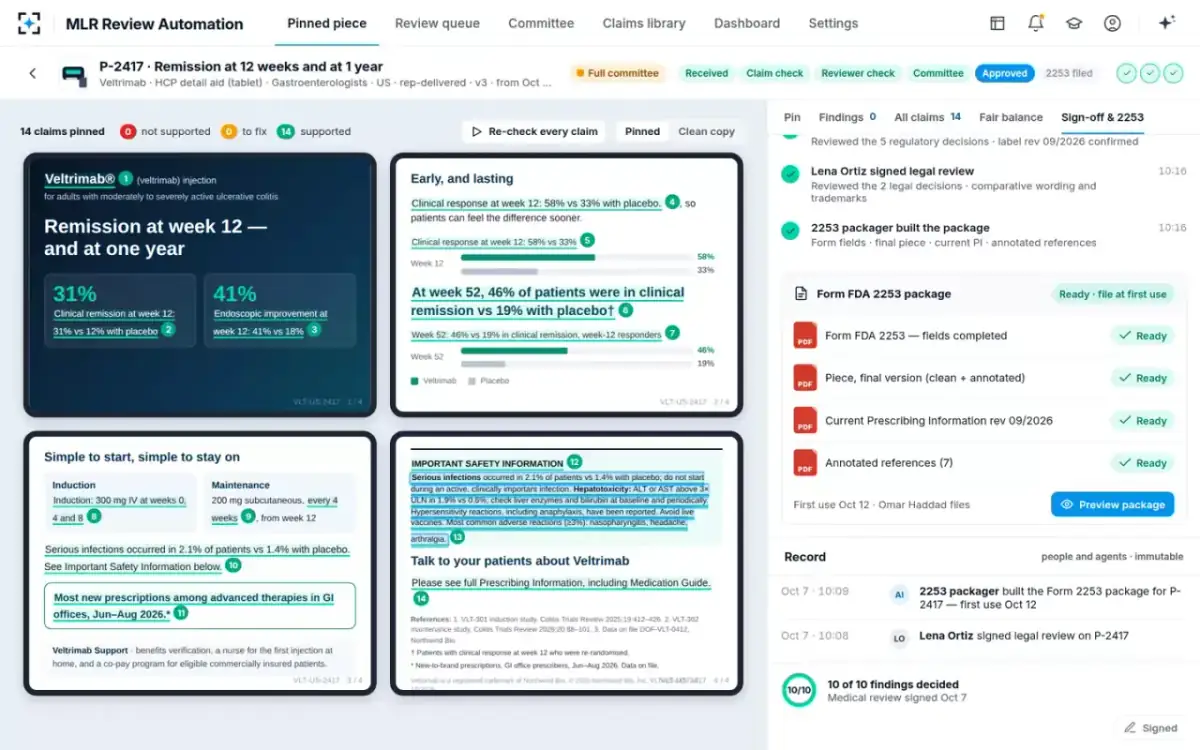
The package MLR Review Automation builds on approval, on one fictional sample piece
3signatures
medical, regulatory and legal — and the package is built only after all three
2versions
of the final piece in the package: one clean, one annotated
7
annotated references, each pointing at the page that supports its claim
5days
from approval on Oct 7 to the filing at first use on Oct 12
Sign-off and the 2253 package in MLR Review Automation
The signature that releases the package, and the meaning it records
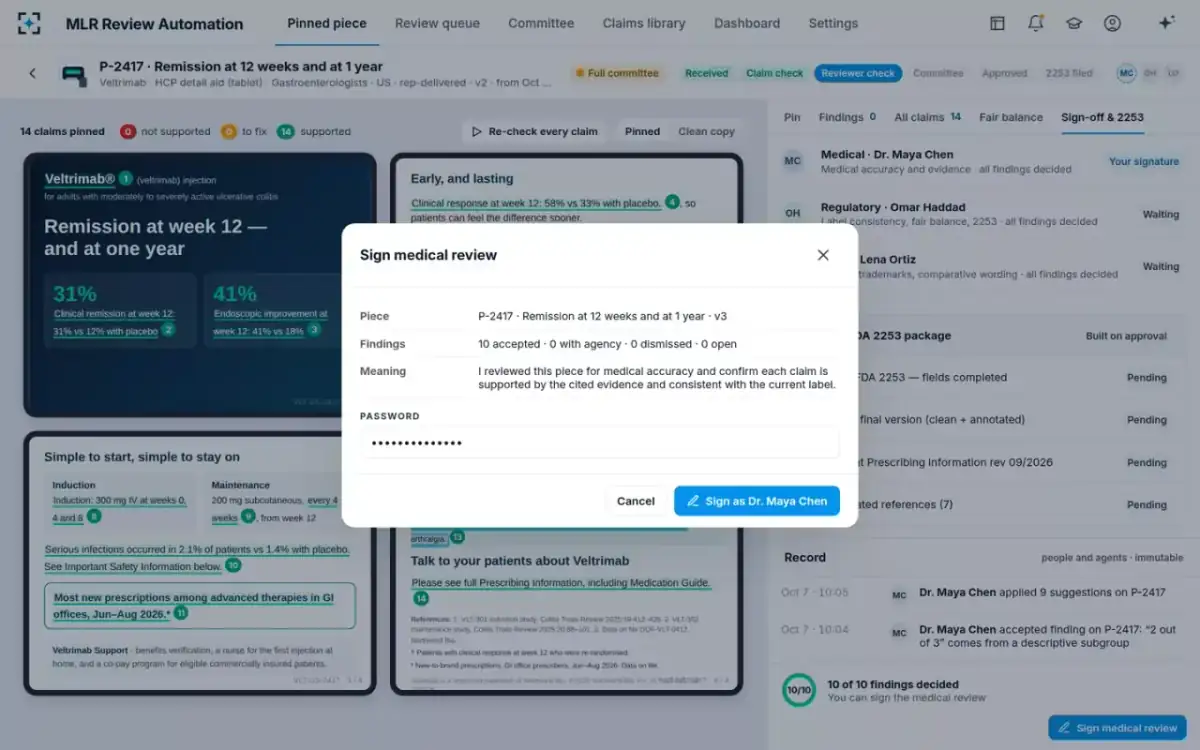
The rule has a second half that is easier to state than to live with: do not let the package's assembly become the thing that delays the filing. If the annotated copy is produced as a by-product of the checking, and the current labelling is pulled at the moment of assembly rather than remembered from the start of review, the package takes minutes rather than days — and the five days between approval and first use on the sample piece are a launch schedule, not a build time.
Who files it, and what filing sets in motion
The applicant is responsible. FDA's FAQs address the case where the manufacturer and the distributor are different companies and are direct about it: either company may submit the specimens, but the applicant is ultimately responsible for compliance with 21 CFR 314.81(b)(3). Inside a firm, the filing usually belongs to a regulatory operations or promotional submissions specialist, and in practice it is the regulatory reviewer who owns the connection between the signature and the filing.
That connection deserves to be explicit in a procedure, because it is where the handover fails. A reviewer who signs believing the filing is somebody else's problem, and a submissions specialist who waits to be told a piece has gone live, together produce exactly the unfiled video the enforcement record describes. The fix is not a tool: it is naming, for each piece, the person who will know the date of first use and act on it. What a signature commits a reviewer to is the right place to settle that.
Questions people ask
Does FDA approve a piece when you file the 2253?
No. Filing is a transmittal, not a review, and no response should be expected. FDA's own frequently asked questions say advance approval of promotional material is required only in rare cases — a compliance action, for example, or an accelerated-approval product under the presubmission requirement. Nothing about a filed piece is cleared by the act of filing it, and a firm that treats silence as agreement has misread what the form is.
Do you have to annotate promotional material for the FDA?
For postmarketing 2253 submissions, no — annotation is encouraged rather than required, and FDA notes that firms may choose to submit annotated versions cross-referenced to the labelling and references, and that references improve the efficiency of review. The reason to do it anyway is internal: the guidance asks that where labelling or references support a claim, hypertext links be provided to the specific page containing the supporting information, and a firm that can produce that link for every claim has demonstrably done the review it says it did.
Can you still submit promotional material to the FDA on paper?
Not for the submissions in scope. FDA's guidance on electronic promotional submissions sets the changeover at 24 months after the guidance's publication, after which paper copies are no longer accepted for postmarketing submissions under 21 CFR 314.81(b)(3)(i) or 601.12(f)(4), or for presubmissions required for approval. Because the cut-off is expressed relative to publication rather than as a calendar date, read it from the revision in force; the revision consulted for this page is dated April 2022, Revision 1.
Who files Form FDA 2253?
The applicant is responsible, even where another company does the sending. FDA addresses the split case directly: either the manufacturer or the distributor may submit the specimens, but the applicant is ultimately responsible for compliance with 21 CFR 314.81(b)(3). Operationally the work usually sits with regulatory operations or a promotional submissions specialist, and the useful discipline is to name one person per piece who will know when first use happens.
What happens if you do not submit a promotional piece to the FDA?
The omission is a violation of 21 CFR 314.81(b)(3)(i) in its own right, and in practice it appears in enforcement correspondence beside the content findings rather than instead of them. FDA's warning letter of 9 September 2025 concerning ZEPBOUND records that a copy of the video was not submitted under cover of Form FDA-2253 at the time of initial publication as required. The pieces that go unfiled are generally the pieces that bypassed review altogether, which is why the filing gap is usually a symptom.
Do accelerated approval products have to submit promotional material before launch?
Yes. Under 21 CFR 314.550, applicants must submit, for consideration during the preapproval review period, copies of all promotional materials intended for dissemination or publication within 120 days following marketing approval. After those 120 days, materials must be submitted at least 30 days before the intended time of initial dissemination or initial publication, unless the agency informs the applicant otherwise. A launch team working on an accelerated-approval product is therefore on a different clock from one working on a standard approval, and the review has to finish correspondingly earlier.