OPDP untitled letters are the letters the FDA's Office of Prescription Drug Promotion sends when a promotional piece is false or misleading but the violation does not reach the threshold of regulatory significance a warning letter requires. They are published, they name the piece and they quote the sentence that failed, which makes them the main public record of how the advertising rules are applied in practice rather than in theory. Read the recent warning letters, the most detailed of them, and three findings keep coming back: risk left out or set less prominently than benefit, efficacy claimed beyond what the study design can carry, and the piece never filed on Form FDA 2253. Botminds' MLR Review Automation turns those three into checks that run on a piece before a reviewer opens it — every claim opened at its cited page, every safety block compared with the current label, prominence measured rather than judged.
This page reads FDA's own findings. It does not say that any named company's piece would have been caught by any software, and no tool prevents a letter: a letter is the agency's view of a piece after it went out. What the letters do give a review team is a list of the arguments the agency actually makes, in the agency's words, with the regulation beside each one.
What is an untitled letter, and how is it different from a warning letter?
Both are advisory letters, and FDA's Regulatory Procedures Manual sets out the difference precisely. A warning letter is issued "only for violations of regulatory significance", which the manual defines as "those violations that may lead to enforcement action if not promptly and adequately corrected"; it is "the agency's principal means of achieving prompt voluntary compliance". An untitled letter, by contrast, "cites violations that do not meet the threshold for significance of regulatory significance for a Warning Letter", and the manual then lists the ways its format must make that visible.
The two letters a promotional piece can attract, and what each one actually demands
Untitled letter: The letter is not titled — there is no banner at the top naming it as anything.
Warning letter: Headed WARNING LETTER, and addressed to the highest known official in the corporation.
Untitled letter: Cites "violations that do not meet the threshold for significance of regulatory significance for a Warning Letter."
Warning letter: Issued "only for violations of regulatory significance" — those "that may lead to enforcement action if not promptly and adequately corrected."
Untitled letter: Requests rather than requires a written response "within a reasonable amount of time (e.g., ‘Please respond within 30 days’)."
Warning letter: Requires a written response within 15 working days, listing every other promotional communication making the same representations, with its 2253 submission date.
Untitled letter: Carries no warning that failure to correct may result in enforcement action, and does not evoke a mandated follow-up.
Warning letter: "Failure to adequately address any violations may result in legal action without further notice, including, without limitation, seizure and injunction."
Untitled letter: Correction of the piece itself.
Warning letter: May require "a comprehensive plan of action to disseminate truthful, non-misleading, and complete corrective communication(s)" to the same audience, in the same media, for the same duration and frequency.
Untitled letter: "Any appropriate agency compliance official may issue an Untitled Letter," with centre concurrence.
Warning letter: Cleared under the agency's procedures for clearing warning letters, including review by the Office of Chief Counsel.
For a review team the practical difference is smaller than the names suggest. Both letters say a piece was misleading, both are published under the company's name, and both ask for a list of everything else that says the same thing. That last request is the one teams are often least ready for, because it asks a question about the whole live estate rather than about one piece: which other materials carry this representation, and when was each filed?
What do recent OPDP letters cite?
Across the recent letters three findings recur, and they are worth ranking by how easily a checker can test for them. Risk left out of the piece entirely is the easiest: it is a yes-or-no question about whether risk information is present at all. Risk present but set less prominently than benefit is harder, because the regulation names the factors rather than a number. Efficacy claimed beyond the study design is the hardest and the most valuable, because it needs the cited study opened and read.
Three findings that recur, the regulation each cites, and the check each one implies
| The finding | What FDA cited | The agency's own sentence | The check it implies |
|---|---|---|---|
| Risk omitted entirely | 21 U.S.C. 352(a), (n); 321(n); 331(a). See 21 CFR 202.1(e)(3)(ii) and (iii); (e)(5) | "The video is misleading because it includes representations about the benefits of Vectibix but fails to communicate any risk information." (Amgen, 12 August 2026) | Does every piece carry risk information at all, in the same piece and the same medium as the benefit claims? A presence check, run before anything else. |
| Risk present, but less prominent than benefit | 21 CFR 202.1(e)(7)(viii) | The regulation asks for risk to be about as prominent and readable as the benefit, judged on the type, layout, contrast, headlines, paragraphing and white space. | Measure the named factors — share of words, type size, contrast, placement — and hand the measurement to a reviewer rather than a verdict. |
| Efficacy beyond what the design can carry | 21 CFR 202.1(e)(6)(v) and (e)(6)(x) | The rules name a study presented "in a way that implies that the study represents larger or more general experience with the drug than it actually does", and references that "purport to support an advertising claim but in fact do not support the claim." | Open the cited page. Compare value, population, comparator and timepoint, and record whether the endpoint was primary, key secondary or exploratory. |
Omitted risk: the finding that needs no argument
The simplest letters are about pieces that said nothing about risk. In September 2025 FDA wrote to Eli Lilly about a sponsored online video in which two company representatives discussed obesity treatment on a local television station's website. The letter's finding is one sentence: "By omitting the risks associated with Zepbound, the video fails to provide material information about the consequences that may result from the use of Zepbound and creates a misleading impression about the drug's safety" (warning letter to Eli Lilly and Company, 9 September 2025). Eleven months later the same finding appears against a product video from Amgen, in almost the same words.
Two things make this finding more common than it looks. The first is format. A piece that is an interview, a podcast, a sponsored segment or a short social video has no obvious place to put a safety block, and the people who produce it are often not the people who produce detail aids. The second is ownership: both letters concern material that lived outside the usual production line — one on a broadcaster's website, one a video the company itself submitted. A review process that only sees what the agency of record uploads will not see the piece that attracts this finding.
Prominence: the clause FDA reaches for when a piece looks balanced
When risk is present but buried, the citation changes. The ImmunityBio letter of March 2026 cites 21 CFR 202.1(e)(7)(viii) alongside (e)(5), and the same letter shows what buried means in practice: the full indication did appear at the end of the television advertisement, but "it is presented after the screen fades to black, which typically signals the close or end of a presentation; therefore, this does not mitigate the misleading impression."
That sentence is worth keeping, because it is the agency reasoning about placement rather than counting words. The regulation's own list — typography, layout, contrast, headlines, paragraphing, white space — invites exactly that kind of argument, and it is why a prominence check should produce a set of readings a reviewer can dispute rather than a pass or a fail. How fair balance is measured, factor by factor, works through the six readings the regulation's wording supports.
Can a single-arm study support an efficacy claim?
Not for a time-to-event endpoint, and FDA has now said so in terms clear enough to use as a rule. The ImmunityBio letter concerns claims that the drug could keep cancer from returning, resting on disease-free survival results from a trial with no comparator.
As QUILT-3.032 was designed as a single-arm study (i.e., with no comparator arm), and DFS is a time-to-event efficacy endpoint, the reported DFS results are uninterpretable; absent an appropriate comparator, it is not possible to determine if lack of recurrence is attributable to Anktiva or to other factor(s) …
FDA warning letter to ImmunityBio, Inc. (MARCS-CMS 725468), 13 March 2026
The letter does not stop there. It also finds that claims calling the drug a "single jab" misleadingly suggested a single-agent effect, when efficacy had been established only in combination and the single-agent arm "was stopped early for futility". Both findings are of the same shape: the claim is about something the study was not built to answer. That shape is testable. For each claim, a checker can ask what the cited analysis was — primary, key secondary, exploratory or descriptive subgroup — and what design produced it, and refuse to call anything but the first two supported as efficacy. What consistent with labeling means, factor by factor, covers the related question of whether the label supports the use at all.
The filing finding that rides along
Two of the three recent letters add a second violation that has nothing to do with the words on the piece. The ImmunityBio letter records that the podcast was never sent to FDA with a Form FDA 2253 when it was first published or disseminated, and the Lilly letter makes the same finding about its video. The regulation is unambiguous about timing: specimens go in when a piece is first used, each with a completed Form FDA 2253 and a copy of the product's current professional labeling (21 CFR 314.81(b)(3)(i)).
This is the cheapest finding to avoid and the easiest to accumulate, because it attaches to the pieces nobody treats as promotional material: an interview, a podcast appearance, a sponsored segment. It is also the finding that makes the warning letter's follow-up request painful, since the agency asks for every comparable communication "with the 2253 submission date". A team that cannot produce that list quickly is answering the letter and auditing itself at the same time. What goes into a Form FDA 2253 submission sets out the package itself.
How many promotional pieces does the FDA see, and how many letters follow?
The volume behind these letters is published, and it is the second half of the argument. A JAMA review of twenty years of medical marketing counted what companies filed and what the agency sent back.
Twenty years in which the filing grew and the letters shrank
34,182
consumer and professional drug promotional materials submitted for FDA review in 1997
97,252
submitted in 2016 — nearly three times as many pieces through the same door
103
financial settlements between drug companies and federal and state governments since 1997
$11B+
in fines from those settlements, for off-label or deceptive marketing practices
The same study recorded the other side of that count — FDA violation letters for misleading drug marketing fell from 156 in 1997 to 11 in 2016. FDA's own September 2025 announcement carries the rest: the number of warning letters sent to pharmaceutical companies "dropped to one in 2023 and zero in 2024."
The long arc: three times the pieces, a fraction of the letters, then a step change
Quiet years, then September 2025
On 9 September 2025 FDA announced that it was "sending thousands of letters warning pharmaceutical companies to remove misleading ads and issuing approximately 100 cease-and-desist letters to companies with deceptive ads." It also said it was "initiating rulemaking to close the ‘adequate provision’ loophole created in 1997, which drug companies have used to conceal critical safety risks in broadcast and digital ads" (FDA press announcement). The same announcement acknowledges the preceding period in the agency's own words: "Despite widespread violations, the FDA has been increasingly lax and reactive in its enforcement approach over the last few decades."
One line in that announcement matters more to a review team than the letter counts: "The FDA is already implementing AI and other tech-enabled tools to proactively surveil and review drug ads." Surveillance that scales changes which pieces get looked at. For twenty years a common assumption was that few of the tens of thousands of pieces filed each year would be read closely outside the company; that assumption is now a bet, and the same technology is now on both sides of the table.
What happens after a letter arrives
A warning letter sets a clock and asks three questions. Within 15 working days of receipt the company must respond in writing, addressing the concerns, "listing all other promotional communications (with the 2253 submission date)" that contain the same kind of representation, and explaining its plan for discontinuing them. Where corrective communication is requested, it must reach the audiences that saw the original, "using the same media, and generally for the same duration of time and with the same frequency".
Each of those is an estate question rather than a piece question. Which live materials make this claim? When was each filed? Who received them, through which channel, and for how long? A review process organised around approving the next piece will not answer them; one that keeps each approved claim with its reference, its label version and the list of pieces that use it can answer them the same day. That is the practical argument for a claims library: it is the answer to a letter, prepared in advance.
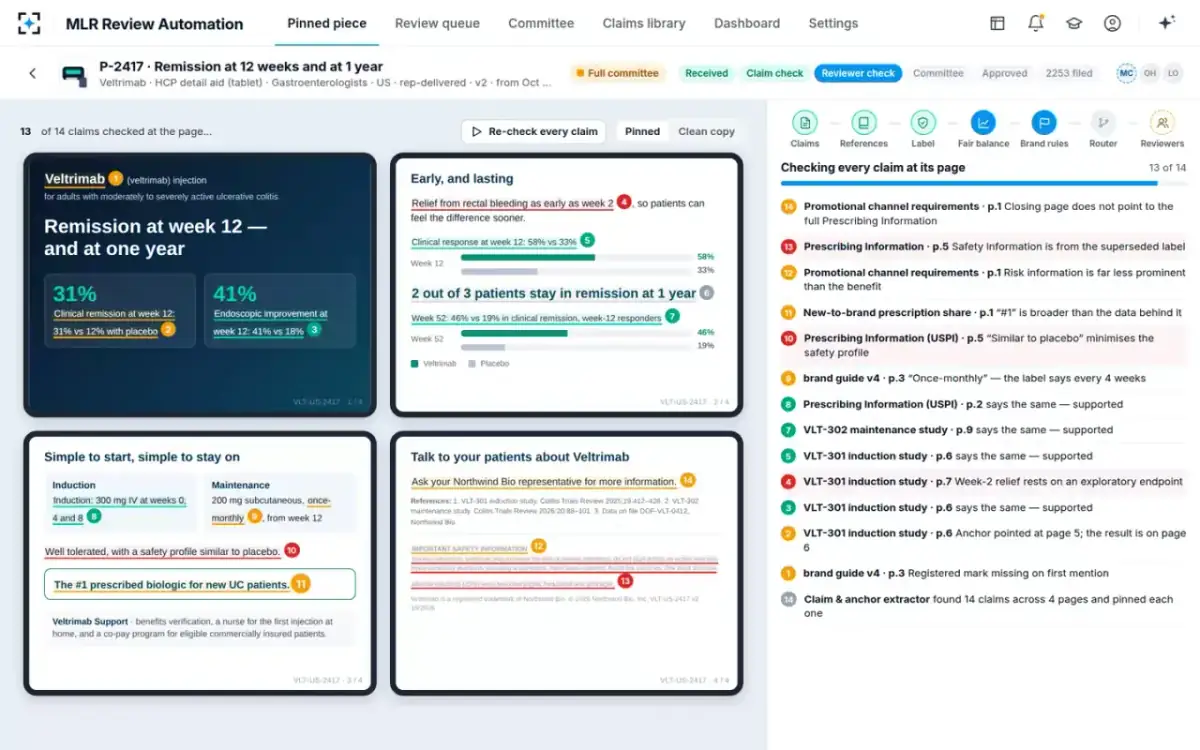
MLR Review Automation checking each claim against its cited page, before anyone reads the piece
Reading letters as your own check list
The useful way to read a run of letters is not as a warning but as a specification. Each finding is a test someone could have run before the piece went out, and most of them need no judgement at all — only the discipline of opening the source. The ten below come straight from the three letters this page cites.
Ten checks taken from three recent letters
- Risk information is present at all, in the same piece and the same medium as the benefit claims
The finding against both the Lilly video and the Amgen video was simply that risk was absent.
- Risk is as prominent as benefit, measured against the factors the regulation names
21 CFR 202.1(e)(7)(viii), cited in the ImmunityBio letter: typography, layout, contrast, headlines, paragraphing, white space.
- Required information does not appear after the piece has visually ended
The ImmunityBio letter: the full indication appeared "after the screen fades to black", which did not mitigate the impression.
- The full indication is stated, not a shortened version of it
Both the ImmunityBio and Amgen letters cite failure to disclose the full approved indication.
- Limitations of use are carried where the label has them
The Amgen letter: the video omitted that the drug is not indicated where the mutation status is unknown.
- A combination therapy is not presented as working alone
The ImmunityBio letter: efficacy was established only in combination, and the single-agent arm was stopped early for futility.
- A time-to-event efficacy claim is not drawn from a single-arm study
The ImmunityBio letter calls the reported disease-free survival results uninterpretable, absent a comparator.
- No claim of prevention, or of use in another disease, without data for it
The ImmunityBio letter addresses claims that the drug could "treat all cancers" and prevent cancer after radiation exposure.
- Every piece is filed on Form FDA 2253 at first use, and the date is kept
Cited as a separate violation in both the ImmunityBio and Lilly letters, under 21 CFR 314.81(b)(3)(i).
- Sponsored interviews, podcasts and third-party segments go through review like any other piece
The Lilly letter concerns a sponsored segment on a broadcaster's website; the ImmunityBio letter, a podcast appearance.
Nine of the ten can be tested mechanically if the right material is to hand — the piece, the current label, the cited references indexed by page, and a list of the claims the company has already approved. The tenth, whether a comparative or superiority claim is fair, stays with a named legal reviewer, and should. In MLR Review Automation the mechanical nine are what the agents do and the tenth is what a reviewer decides; the agents never approve a piece and never sign one.
What the agents found, and where, across one month of pieces
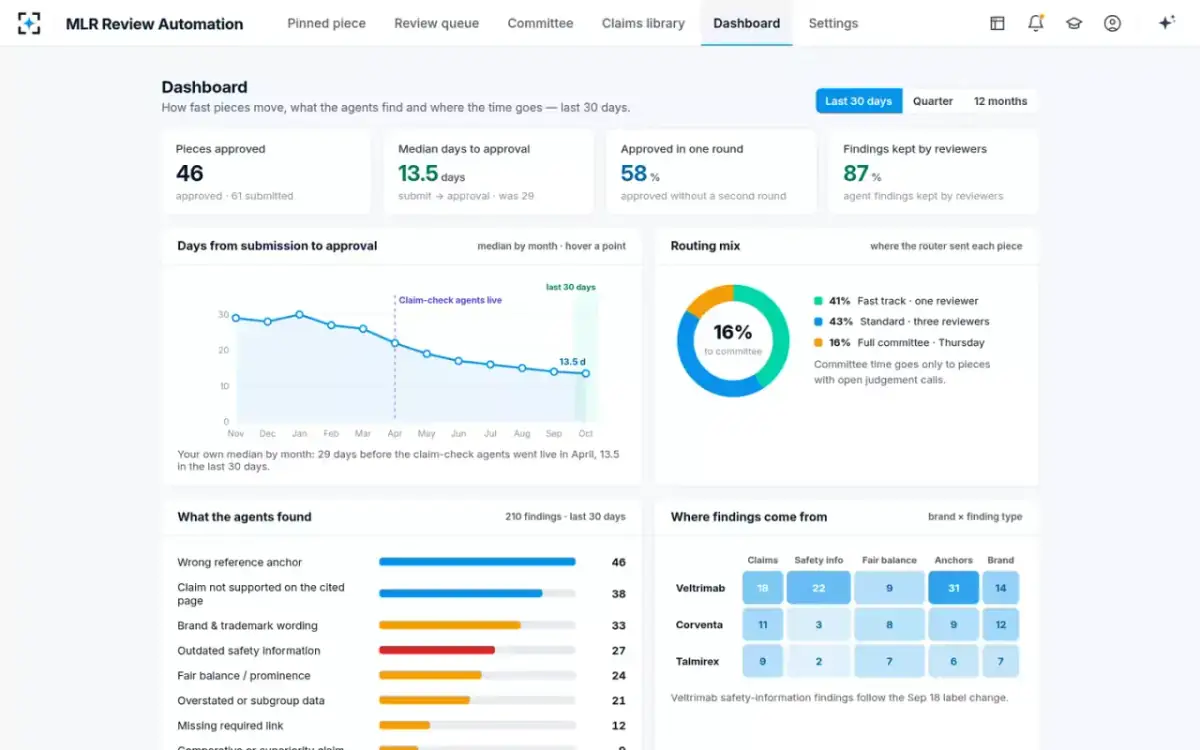
Letters are published for exactly this purpose: so that the next company does not have to learn the argument the hard way. The whole sequence they imply, from the piece arriving to the filing, is set out in the MLR review process, stage by stage, and the solution itself is at MLR Review Automation.
Questions people ask
What is an untitled letter from the FDA?
An advisory letter citing violations that, in FDA's words, "do not meet the threshold for significance of regulatory significance for a Warning Letter." Its format is required to make that clear: it carries no title, no statement that other federal agencies will be told of it, and no warning that failure to correct may lead to enforcement action, and it requests rather than requires a written response within a reasonable time. Any appropriate agency compliance official may issue one.
Does the FDA still enforce drug advertising rules?
Yes, and more actively than in the preceding decade. FDA's own figures show warning letters to pharmaceutical companies falling to one in 2023 and none in 2024; on 9 September 2025 the agency announced thousands of letters warning companies to remove misleading ads and approximately 100 cease-and-desist letters in a single action, plus rulemaking to close the 1997 "adequate provision" allowance for broadcast advertising. It also said it is deploying automated tools to surveil and review drug advertisements.
Can a single-arm study support an efficacy claim in an advertisement?
Not for a time-to-event endpoint. FDA's March 2026 warning letter to ImmunityBio states that because the study was designed as a single-arm study with no comparator arm, and disease-free survival is a time-to-event efficacy endpoint, the reported results are uninterpretable: absent an appropriate comparator, it is not possible to determine whether a lack of recurrence is due to the drug or to other factors.
How much have companies paid for deceptive drug marketing?
More than $11 billion since 1997, across 103 financial settlements between drug companies and federal and state governments for off-label or deceptive marketing practices, as counted by Schwartz and Woloshin in JAMA in 2019. That figure covers settlements to 2016 and is separate from the advisory letters this page describes, which carry no fine of their own.
What happens after you receive an OPDP letter?
For a warning letter, the company has 15 working days from receipt to respond in writing: addressing the concerns, listing every other promotional communication making the same kind of representation together with its Form FDA 2253 submission date, and setting out a plan to discontinue them. FDA may also request corrective communications to the same audiences, in the same media, for the same duration and frequency as the original.
Which regulations do OPDP letters cite?
Typically the misbranding provisions of the Federal Food, Drug, and Cosmetic Act — 21 U.S.C. 352(a), (n) and 321(n) — together with the advertising rules at 21 CFR 202.1: (e)(5) for a piece that is not a true statement, (e)(7)(viii) for risk that is less prominent than benefit, and (e)(6) for a study or reference presented as supporting more than it does. Where a piece was never filed, 21 CFR 314.81(b)(3)(i) is cited alongside.