The MLR review process is the sequence a promotional piece goes through before a company may use it: medical, legal and regulatory reviewers confirm that every claim says what its cited source says, that risk is presented as prominently as benefit, and that nothing in the piece recommends a use the labelling does not carry. Many firms run it in four or five stages — intake, claim-by-claim checking, a committee, signature — and then file the finished piece with the Food and Drug Administration at first use. Only the last of those is written in law. MLR Review Automation is Botminds' agentic software for the stages before it: it pins every claim on the piece, opens each cited reference at its page, compares the two, and hands a reviewer findings instead of a reading list.
The worked figures on this page come from a fictional sample brand and a fictional agency as they run through the solution: a four-page Veltrimab detail aid, piece P-2417, from the agency Wrenfield Health. The rules come from the Code of Federal Regulations and FDA's own guidance, linked where they appear.
What is the MLR review process?
Three different people are usually asking this question. A brand manager wants to know how long their piece will be gone. A new reviewer wants to know what they are being asked to certify. An operations lead wants to know which stage to attack. The answer that serves all three is structural: the process is a chain of checks, and each link in it is either a comparison or a judgement.
A comparison is mechanical. Does the 67% on page three appear on the page of the study the footnote cites? Is the population behind it the population the piece describes? Does the safety block match the current label, word for word? Is the risk type size comparable with the benefit headline? None of these needs a medical degree; all of them need somebody to open a PDF, find a page and read carefully. A judgement is the opposite. Is this comparative claim fair to the comparator? Does this layout leave a doctor with an accurate impression of the balance of benefit and risk? Is this wording defensible if a regulator reads it uncharitably? That needs the room, and the signature.
Many of the familiar complaints about MLR — it takes too long, the committee is a bottleneck, the comments contradict each other — is a complaint about the two being mixed. A committee that spends forty minutes establishing that a footnote points at the wrong page has spent forty minutes of its scarcest people on a task a careful intern could do, and has not yet started on the judgement it exists for.
Why no regulator publishes an MLR process
There is no MLR regulation. There is no FDA-mandated stage list, no required number of reviewers, no approved routing matrix. What exists is a set of outcomes the law fixes, and one filing obligation.
The outcomes live in 21 CFR 202.1(e). An advertisement fails the statutory requirement to present a "true statement" of information if "it is false or misleading with respect to side effects, contraindications, or effectiveness" or if it "fails to present a fair balance" between the two. Those words apply to the whole piece, not to a safety page bolted on the back: the requirement "applies to the entire advertisement", and a misleading statement in one part is not cured by a true statement somewhere else. And a piece for an approved drug may not recommend or suggest a use that the approved labelling does not carry.
The closest thing to a process rule is a recommendation, and FDA puts it in one sentence at the end of its guidance on communications consistent with the FDA-required labelling.
FDA recommends that, before disseminating a CFL promotional communication, firms should have qualified medical/scientific, legal, and regulatory personnel carefully review the communication to ensure it is not false or misleading.
FDA, Medical Product Communications That Are Consistent With the FDA-Required Labeling — Questions and Answers, Q.8/A.8 (June 2018; contains nonbinding recommendations)
That is the whole mandate for the shape of MLR: qualified medical, scientific, legal and regulatory people, carefully, before dissemination. Everything else in your standard procedure — the tiers, the score thresholds, the Thursday committee, the three signatures, the five-day service level — your company wrote. That is worth saying out loud in a room where someone is defending a stage on the grounds that "FDA requires it", because almost nothing in the middle of the process is required by anyone.
What the law fixes, and what a firm invents, in MLR Review Automation and everywhere else
| The question | What a rulebook decides | What your company decides |
|---|---|---|
| Is the piece truthful? | 21 CFR 202.1(e)(5): an advertisement that is false or misleading as to side effects, contraindications or effectiveness does not present a true statement — and the test applies to the entire advertisement. | Nothing. The outcome is fixed; only how you assure yourself of it is yours. |
| Is risk prominent enough? | 21 CFR 202.1(e)(7)(viii): risk must be about as prominent and readable as the effectiveness claims, judged on typography, layout, contrast, headlines, paragraphing and white space. | Any numeric threshold you set — share of words, type size, a score — is your house standard, not a legal line. |
| Does it stay inside the label? | 21 CFR 202.1(e)(4)(i)(a): the advertisement shall not recommend or suggest any use that is not in the labelling accepted in the approved application. | How you prove it claim by claim, and who is allowed to say a claim is close enough. |
| Who reviews it? | Nothing binding. FDA recommends qualified medical, scientific, legal and regulatory review before dissemination. | The seats, the number of signatures, who may delegate, and what a signature means. |
| When must it reach FDA? | 21 CFR 314.81(b)(3)(i): specimens go in when the labelling is first disseminated and when the advertisement is first published. | Nothing. The deadline is an event, not a date you can negotiate. |
| How fast must review be? | Nothing. No rule names a review clock. | Every tier, lane, service level and committee cadence you run. |
Stage 1: the piece, its claims and its references arrive
Intake looks administrative and decides most of what follows. The piece arrives from an agency or an in-house creative team as a near-final layout; with it come the references the claims rest on, and that pack is where the trouble usually starts. A reference pack that is a folder of thirty PDFs with no page anchors turns every later stage into a search. A pack in which each claim names its study, its page and its passage turns the same stages into a comparison.
Three intake decisions are worth making deliberately. First, what the piece is, in the channel's own terms, because the channel changes the rules: a television spot carries obligations a detail aid does not. Second, whether it is new or a revision, because a revision only needs the delta re-checked if you can prove what the delta is. Third, how far from the last approved version it sits, which is the input to any routing you do.
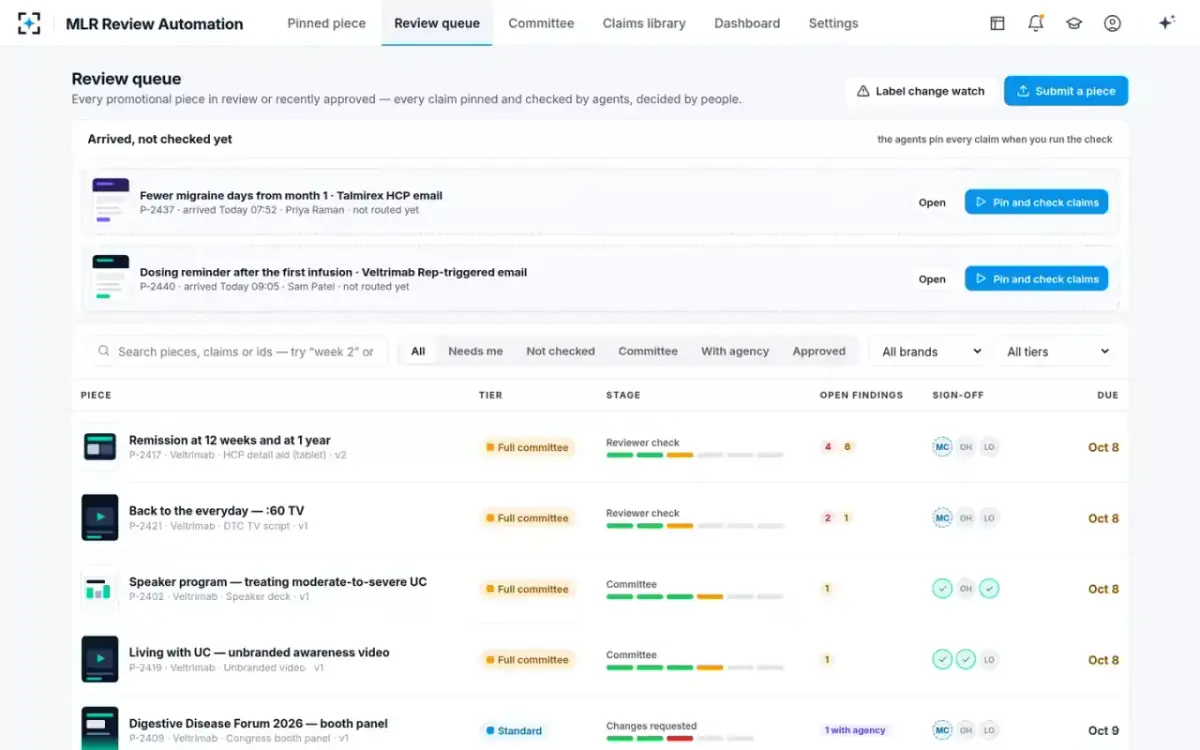
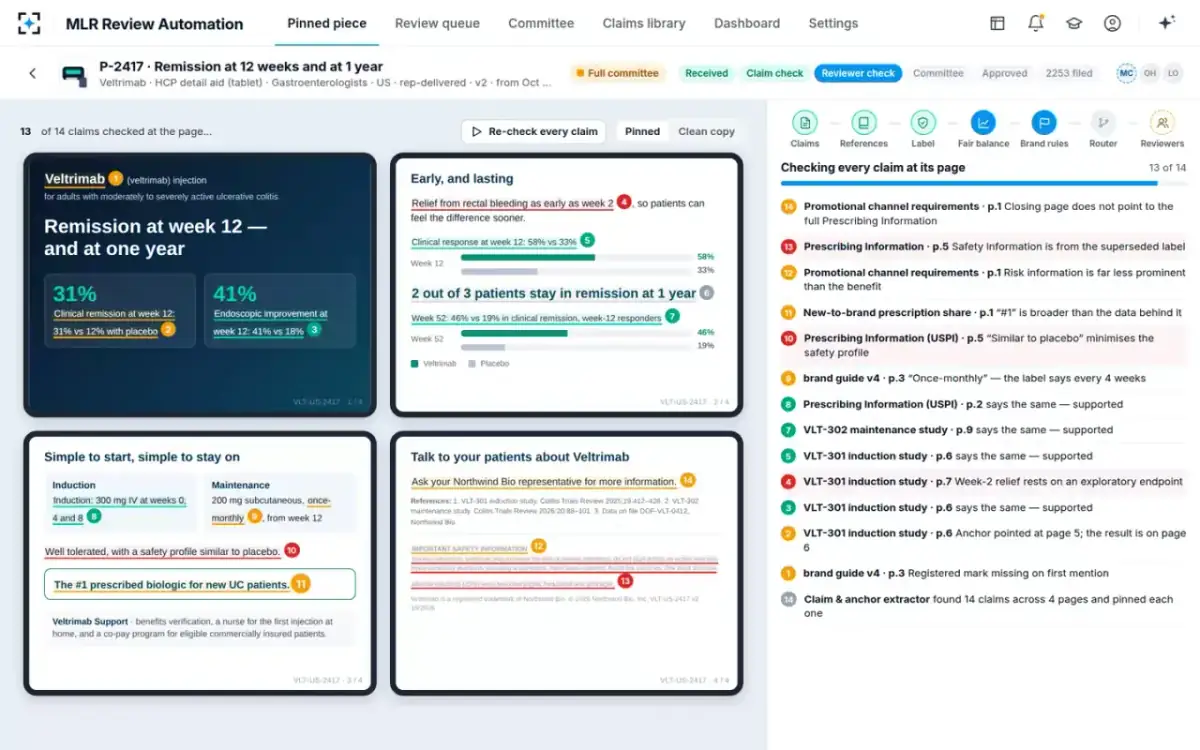
In the solution, intake is also where the claim-and-anchor extractor runs: it finds every claim, statistic and reference anchor in the piece — email, PDF, deck or broadcast script — holds each statistic as a value, a comparator, an endpoint and a timepoint, and pins it on the page it appears on. On the sample detail aid that is fourteen claims across four pages. The point of pinning is not tidiness. It is that from here on, every later stage has something to be exact about.
The review queue in MLR Review Automation: every piece, its lane, its open findings and its signatures
Stage 2: every claim checked at its cited page
This is the longest stage in most firms and the one that needs the least judgement, which is exactly why it is the one to automate first. The work is a comparison repeated: open the cited reference at the page the footnote names, find the passage, and check four things against what the piece says — the value, the population, the analysis the value came from, and the timepoint.
The fourth and third are where real pieces fail. On the sample detail aid the line claiming that two in three patients stay in remission at one year is checked against study VLT-302 at page 9. The 67% is there. It describes the 141 patients who were already in remission at week 12 — a descriptive subgroup, not the randomised population the sentence implies. The value is right and the claim is wrong, and no amount of reading the piece on its own would reveal it. Only the page does.
A second failure mode is quieter: an anchor that points at the wrong page. On the sample piece one footnote cites page 5 when the result is on page 6. By hand, that costs a reviewer ten minutes of hunting and produces no finding, because the number does check out eventually. It is still a defect, because the annotated copy that travels with the eventual filing has to point a regulator's reviewer at the right page. The same discipline that makes a Form FDA 2253 package assemblable is the discipline that makes this stage honest: if you cannot produce a link to the page that supports a claim, you have not checked the claim.
Stage 2 at work: each claim checked against its own cited page
Stage 3: the label, fair balance and the rules of the channel
Stage 2 asks whether a claim matches its source. Stage 3 asks three different questions, and they are easy to run in parallel because none of them depends on the others.
The label question is a word-for-word comparison against the version marked current, and it is the one most likely to fail for a reason nobody did wrong: labels move. A safety block that matched perfectly in March can be missing a warning in September, and the piece has not changed at all. That is why the consistent-with-labeling test is better treated as a standing check than a one-time stage.
The fair balance question is a measurement, not a verdict. Share of words, type size against the benefit headline, contrast, where risk falls in the reading order, whether anything signals it, and for audio the pace. Those readings argue a case; they do not decide it. What 21 CFR 202.1 actually asks for, and how to turn prominence into numbers a brand team will argue with, is a page of its own.
The channel question is the one teams most often discover late. Broadcast carries requirements print does not. A rep-triggered email carries required statements and links. A banner has almost no room for either, which is one reason small-format digital tends to generate findings.
Stage 4: medical, legal and regulatory sign-off
The signing stage is short and carries all the weight. Every finding has to be disposed of by a named person: accept the suggested change, send it to the agency as a change request, or dismiss it — and a dismissal of a serious finding should cost a sentence of written reasoning, because a dismissal with no reason is indistinguishable from an oversight when someone reads the file two years later.
Then the signatures. No United States regulation names who they must be, how many there must be, or what they must say — which is why it is worth borrowing a discipline from somewhere that does. What a promotional review committee signature actually commits a reviewer to, and how the United Kingdom's qualified signatories answer the question the American rules leave open, is the subject of the next guide in this series.
The five stages in MLR Review Automation, and the line each agent does not cross
A person decides
The agency delivers the pieceA four-page detail aid arrives with its claims and its reference pack. A person says what it is, which brand and channel it serves, and when it is wanted.
Agent
Claims pinned and readEvery claim, statistic and reference anchor is found and pinned on the page it sits on, each statistic held as value, comparator, endpoint and timepoint.
Never: Never paraphrases a claim, and never moves a claim it cannot read.
Agent
Each claim opened at its cited pageThe cited reference is opened at the anchored page, the passage found, and the value, population, analysis and timepoint compared with what the piece says.
Never: Never calls a subgroup or an exploratory result supported as an efficacy claim.
Agent
Label, fair balance and the channelSafety text is compared word for word with the label version marked current; risk prominence is measured against benefit; brand and channel rules are applied.
Never: Never passes or fails a piece on its own — the measurements are evidence.
A person decides
Medical, regulatory and legal sign-offNamed reviewers decide every finding — accept, send back to the agency, or dismiss with a written reason — then sign with the meaning of the signature recorded.
Never: No agent approves a piece or signs for a person.
A person decides
The filing at first useOnce every required signature exists, the Form FDA 2253 package is assembled: the completed form, the final piece clean and annotated, the current labelling and the annotated references. The regulatory reviewer files it.
Never: No package is built before the signatures, and no agent files with the agency.
Stage 5: the filing at first use, and what it must carry
The one hard deadline in the whole process is not a date. Under 21 CFR 314.81(b)(3)(i), an applicant sends FDA specimens of its promotional labelling and advertising when the labelling is first disseminated and when the advertisement is first published. Every submission travels with a completed Form FDA 2253 and a copy of the product's current professional labelling.
Two consequences follow. First, the filing is triggered by use, so a piece approved in September and launched in December is filed in December, and somebody has to be watching for the launch. Second, because the package has to carry the current labelling, a package assembled early can be wrong by the time the piece ships.
One path inverts the deadline. For products under accelerated approval, 21 CFR 314.550 requires applicants to send, while the application is still under review, copies of all the promotional material they plan to use in the first 120 days after approval — and after that window, to send each new piece at least thirty days before they intend to use it. A launch team working on an accelerated-approval product and a launch team working on a standard approval are running two genuinely different processes, and a single stage list that does not know the difference will mislead one of them.
How long does MLR review take, and where the days go
There is no published, trustworthy industry median, and a figure quoted without its method is worth nothing: "days to approval" can be measured from the agency's hand-off, from first reviewer touch, or from the version that was eventually approved, and those are different numbers on the same piece. What is worth having is your own split, stage by stage, because the split tells you what to fix and the total does not.
The two lanes below are the fictional sample brand's own: a 29-day baseline for one detail aid taken by hand, against the solution's 13.5-day design target with the checking done before anybody reads. Both are estimates on sample data, not a measured customer result, and the point is the shape rather than the totals.
One detail aid, by hand and with the checking already done — the design target in MLR Review Automation
- Opening every cited reference, and the label check9 d
- Comment rounds with the agency8 d
- Fair balance, the committee wait, signatures and the package12 d
- References and the label check2 d
- Comment rounds with the agency5 d
- Fair balance, the committee wait, signatures and the package6.5 d
Read the lanes rather than the totals and the lesson is uncomfortable. The reference and label checking falls from nine days to two, because it is comparison work with a right answer. The committee wait barely moves — about six days to about four — because a weekly meeting is a weekly meeting, and no software makes Thursday come sooner. And the comment rounds with the agency fall only from eight days to five, growing from 28% to 37% of the whole, because they are a conversation between two organisations rather than a task one of them can speed up.
Where a piece's review days go, before and after
By hand · 29 days
- Checking claims at their cited pages · 31%
- Comment rounds with the agency · 28%
- Fair balance and channel review · 10%
- Waiting for the weekly committee · 21%
- Signatures and the filing package · 10%
Checking done first · 13.5-day target
- Checking claims at their cited pages · 15%
- Comment rounds with the agency · 37%
- Fair balance and channel review · 11%
- Waiting for the weekly committee · 30%
- Signatures and the filing package · 7%
That is the redesign, stated plainly: automate the comparison stage, shrink the committee to judgement calls only, and accept that the agency conversation is the next thing to work on, not the first. A team that buys software expecting the committee wait to disappear has misread its own split. What to pilot first, and what to measure, follows from here.
Does the FDA approve promotional material before it is used?
No. FDA's Office of Prescription Drug Promotion says so in its own frequently asked questions: "No, pre-approval of promotional materials is not required except in rare instances." The rare instances it names are a compliance action, where FDA may require pre-approval, and accelerated-approval products, which are under the presubmission requirement described above. OPDP adds that it will give opinions on proposed pieces before use when an applicant asks — advisory comments, which are voluntary and are not an approval either.
This is the single most useful fact to establish in a room arguing about MLR, because it relocates the responsibility. Nobody outside the company checks the piece before it goes out. The reviewers' signatures are the only review the piece gets before a doctor reads it, and the filing is a transmittal that happens at the same moment the piece reaches its audience, not a clearance before it does.
It also explains a trend worth knowing. Over the twenty years to 2016, the volume of promotional material filed with FDA roughly tripled while the number of violation letters fell by more than ninety per cent.
Twenty years of filings against twenty years of letters
34,182
consumer and professional drug promotional materials submitted for FDA review in 1997
97,252
submitted in 2016, roughly a threefold rise
156
FDA violation letters for misleading drug marketing in 1997
11
FDA violation letters in 2016
Read those four numbers together carefully. They do not show that promotional material got better; they show that far more of it is filed and far less of it is challenged. For a reviewer, the practical consequence is that the chance of an outside correction is small, and the chance that an error reaches a prescriber uncorrected is correspondingly larger. That is an argument for doing the checking properly, not for doing less of it.
Who is involved in MLR review, and what each one decides
The names differ by company; the decisions do not. Five people often touch one piece, and the useful way to describe each is by what they alone can decide.
The medical or scientific reviewer decides whether a claim is supported by the evidence cited for it, and whether an endpoint, population or analysis is being represented honestly. This is the seat that has to be able to say no to a number that is technically present in a study. The regulatory reviewer decides whether the piece sits inside the current labelling, whether the required statements for the channel are there, and — in practice — owns the filing. The legal reviewer decides comparative and superiority wording, trademark use, and anything that would have to be defended to a competitor or a court. The operations lead decides nothing about the content and everything about the system: the lanes, the thresholds, who signs, the cadence. And the agency account lead, who is usually outside the company entirely, decides what the next version actually says.
That last seat is the one process documents tend to leave out, and in the sample split above it is where more than a quarter of the elapsed time sits. A change request that arrives as three reviewers' contradictory comments produces a version that satisfies none of them. A change request that arrives once, with the finding, the page it rests on and the suggested wording, usually produces a version that closes it. Shrinking the agency round is mostly a matter of what you send, not how fast you send it.
Why a piece goes round more than once
Multiple rounds are not a sign of a careless agency. They are a predictable output of three design choices, each of which can be unmade.
The first is sequential review. If medical reads first and legal reads after the revision, a legal finding on page two arrives only after medical's findings have already been fixed, and the piece goes round again. Parallel review on the same version costs more reviewer attention in week one and saves a whole round.
The second is unspecific findings. "This claim is not supported" sends the agency back to guess. "This claim rests on a descriptive subgroup of 141 patients at page 9 of VLT-302; the approved claim CL-036 covers the same ground from the primary analysis" sends the agency a change it can make once. The difference is whether the finding carries its page.
The third is a stale label or claims library. If the approved wording a reviewer wants is not available to the agency when it writes the piece, the first version will contain wording nobody will ever approve. A library of pre-approved claims, each with its reference page and label section, removes a whole class of round trips before review begins — and it is the same library the reviewer reaches for when a claim fails. How that evidence base is built is a subject of its own.
Questions people ask
What is the difference between MLR and PRC review?
They name the same work. MLR — medical, legal and regulatory — describes the disciplines that review the piece; PRC, promotional review committee, describes the body they sit on. Some firms use MLR for the review itself and PRC for the meeting where contested pieces are decided, so a piece can be "in MLR" without ever reaching the PRC. Neither term appears in the regulations, so neither has a fixed definition you can hold a vendor or an auditor to; what matters is which seats exist and what each signature means.
When must promotional material be submitted to the FDA?
At first use. 21 CFR 314.81(b)(3)(i) requires specimens when the labelling is first disseminated and when the advertisement is first published, each sent with a completed Form FDA 2253 and a copy of the product's current professional labelling. The deadline is an event rather than a date, so a piece approved months before launch is filed at launch. Products under accelerated approval are different: 21 CFR 314.550 requires materials intended for the first 120 days after approval to go in during the preapproval review period.
What documents does a reviewer need to check a claim?
Four, and all four at once. The piece itself in its final layout, so prominence and placement can be judged. The cited reference, opened at the page the claim's footnote names, so the value, population, analysis and timepoint can be compared. The current prescribing information, so the claim and the safety text can be checked against the label version in force. And the approved claims library, so a failing line can be replaced with wording that has already been cleared rather than re-litigated.
Can a piece be approved without a committee meeting?
Yes, and most firms do it for low-risk material — a reminder piece, a minor revision, a congress invitation. Nothing in law requires a meeting at all; the committee is a firm's own device for handling pieces whose risk justifies several people in one room. The honest question is not whether to have lanes but whether the rule that assigns a piece to a lane is written down and reviewed. In the sample settings here, a piece below a score of 30 takes one reviewer and anything from 60 upward goes to the full committee, with broadcast always in the top lane — one fictional team's thresholds, not an industry standard.
Which stage should an operations lead attack first?
The one with the most days and the least judgement, which in almost every split is reference checking. It is also the safest to change, because a comparison has a right answer that can be audited after the fact, whereas a judgement cannot. Attacking the committee first usually fails: the meeting is long because the material arriving at it is unfinished, so the queue shortens only after the checking is already done.
Does an approved piece stay approved?
No. A label change can make a live piece wrong without anyone touching it — a new warning in the current prescribing information means every approved piece carrying the old safety text is now inconsistent with the label. That is why approval should create a watch rather than close a file: when a new label version lands, every live piece needs re-checking, and some need withdrawing. On the fictional sample brand, one label revision left seven approved, live pieces carrying superseded safety information.