"Consistent with the FDA-required labeling" is the phrase FDA uses for a promotional communication that presents information about a product's approved conditions of use without conflicting with the labelling — and it is a written test rather than a judgement about tone. The guidance that defines it sets out three factors, and a communication that fails any one of them is not consistent. MLR Review Automation is Botminds' agentic software for medical, legal and regulatory review, and the comparison those factors describe is exactly what it runs: every claim on a piece checked against the label version marked current, with the label section named on every finding.
The worked examples here are sample data on a fictional brand from the solution. Every rule is quoted from FDA's guidance, the current eCFR text or ICH E9, linked where it appears.
What does consistent with labeling mean?
It means the information a firm presents about its product does not conflict with the conditions of use its approved labelling carries. The term comes from FDA's 2018 guidance, Medical Product Communications That Are Consistent With the FDA-Required Labeling — Questions and Answers, usually shortened to the CFL guidance, which addresses firms' communications about their products' approved uses that are not themselves contained in the labelling.
The phrase repays slowing down. "Consistent with" is not "contained in": a communication can present information the label does not contain and still be consistent, which is the entire point of the guidance. Nor is it "approved by FDA": the agency does not approve a company's claim wording, and nothing in the CFL framework turns a consistent communication into an endorsed one. What the framework does is mark the boundary between a communication about an approved use and one that drifts outside it.
There is an older, blunter rule underneath. Under 21 CFR 202.1(e)(4)(i)(a), an advertisement for a drug approved under section 505 "shall not recommend or suggest any use that is not in the labeling accepted in such approved new-drug application or supplement". The CFL guidance does not displace that; it explains how FDA evaluates the harder cases that sit near the line.
The three factors, and why failing one is enough
FDA states the structure of the test in one paragraph, and the second sentence is the one to quote in a review meeting.
FDA uses three factors to determine whether the representations or suggestions in a product communication are consistent with the product's FDA-required labeling. If a product communication fails to satisfy any one of these factors, it is not considered consistent with the FDA-required labeling.
FDA, Medical Product Communications That Are Consistent With the FDA-Required Labeling — Questions and Answers, Q.2/A.2 (June 2018; contains nonbinding recommendations)
That makes the test conjunctive, which has a practical consequence for how a review is sequenced. There is no weighing, no balance of factors, no compensating strength. A claim that passes Factor 1 cleanly and fails Factor 2 is not consistent. So the cheapest order to run them in is the order of effort: Factor 1 is four mechanical comparisons against the label and can be done claim by claim at scale; Factors 2 and 3 need a medical reader, and only on what survives.
The three factors, and the single exit that means not consistent
Factor 1
How does the information in the communication compare with the conditions of use in the FDA-required labelling?
Four questions — indication, patient population, limitations and directions for handling or use, and dosing or use regimen, route and strength. A yes to any of them indicates the communication is not consistent.
Factor 2
Do the representations increase the potential for harm to health, relative to the labelling?
If using the product as the communication represents would reasonably be expected to introduce new risks not in the labelling, or materially increase the rate or severity of existing ones, the communication is not consistent.
Factor 3
Do the directions for use in the labelling enable the product to be used safely and effectively as represented?
If the labelling does not furnish enough information about risks and effects for the use the communication suggests, the answer is no — and a no indicates the communication is not consistent.
Any one failure — the communication is not consistent with the FDA-required labelling. There is no weighing between the three.
Factor 1: four questions to ask of every claim
Factor 1 compares what the communication says with what the labelling says about the same conditions of use, through four questions. FDA frames them so that a yes is the bad answer: if the answer to any of them is yes, that indicates the communication is not consistent with the FDA-required labelling.
Factor 1, claim by claim — the comparison MLR Review Automation runs against the current label
| The question FDA asks | What a reviewer compares | The finding a mismatch produces |
|---|---|---|
| Indication — do the representations relate to a different indication than the one or ones reflected in the labelling? | The disease, stage or setting the claim is about, against the Indications and Usage section. | A claim about a condition the label does not carry. The most clear-cut failure, and the one a brand team is least likely to argue. |
| Patient population — is the population represented or suggested outside the approved population in the labelling? | Who the claim is about — age, line of therapy, prior treatment, severity — against the approved population. | A frequent real-world failure, and the quietest: a claim whose number came from a subset the label does not describe. |
| Limitations and directions for handling or use — do the representations conflict with the use limitations or directions for handling, preparing or using the product? | Anything the claim implies about preparation, storage, administration or circumstances of use, against the labelling’s limitations. | Often a visual rather than a sentence: an image showing a preparation or setting the directions do not support. |
| Dosing or use regimen and administration — do the representations conflict with the recommended dosage or use regimen, route of administration, or strengths? | Dose, schedule, route and strength as the claim states or implies them, against the labelling. | A convenience claim that implies a schedule the label does not recommend is a typical case. |
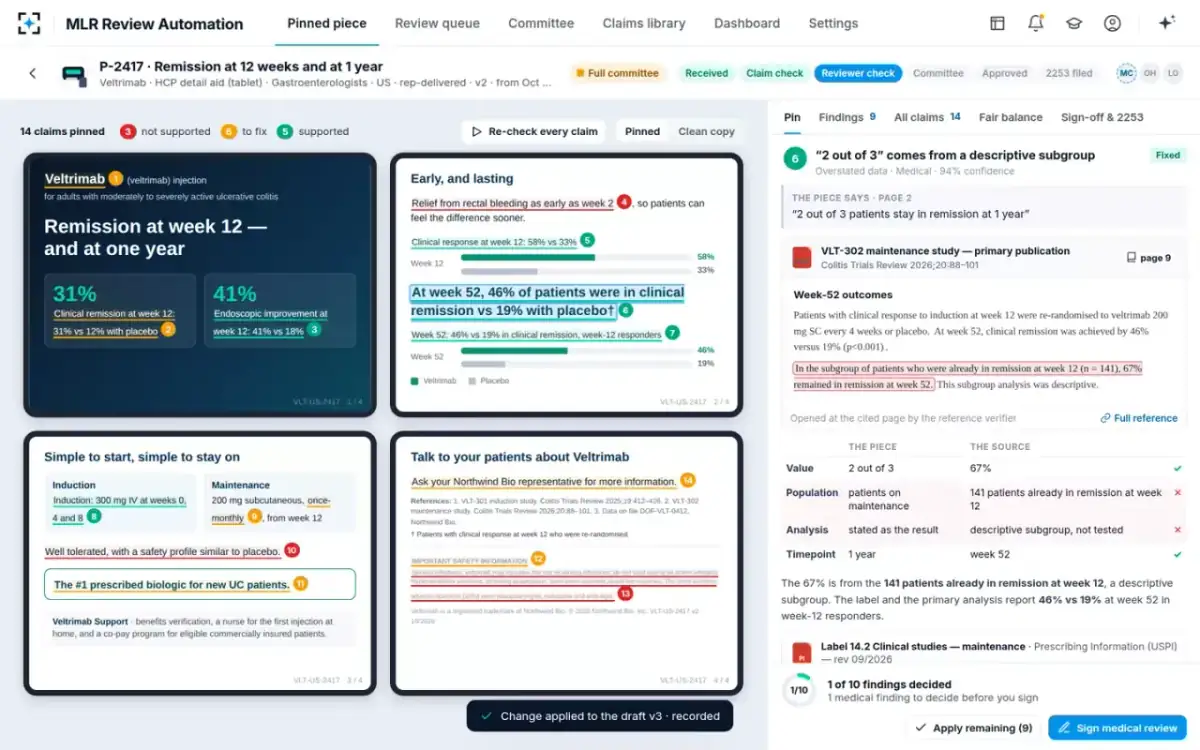
Read in a review meeting, those four look obvious. Read against a real piece, the second one does most of the work, because a population mismatch hides behind a number that is perfectly accurate. On the fictional sample detail aid, the line "2 out of 3 patients stay in remission at 1 year" is checked against study VLT-302 at page 9: the 67% is there, and it describes the 141 patients who were already in remission at week 12. The value survives the check. The population does not.
A claim and its label section side by side in MLR Review Automation
Factors 2 and 3: new harm, and whether the label supports the use
The second and third factors are less often applied and are where the genuinely hard cases live, because neither is a comparison of two texts.
Factor 2 asks whether the representations increase the potential for harm relative to the labelling. FDA's example is the test: if using the product in accordance with the communication "would reasonably be expected to introduce new risks that are not included in the FDA-required labeling or to materially increase the rate of occurrence or severity of existing risks" in the labelling, the communication is not consistent. Note that this can be triggered by a piece whose every sentence tracks the label, if what it suggests in combination leads somewhere the label's risk profile does not cover.
Factor 3 inverts the question: do the directions for use in the labelling enable the product to be used safely and effectively under the conditions the communication represents? FDA's guidance asks firms to consider whether the labelling provides sufficient information about the risks and effects of using the product as presented, and whether it furnishes appropriate context for any unique considerations the suggested use raises. If the answer is no, the communication is not consistent — even where nothing in it contradicts the label.
The reason to keep these two in a reviewer's hands rather than in a comparison is that both require imagining how a prescriber would act on the piece. That is judgement, and it belongs with the person who signs — which is what the signature is for.
Being consistent is not the same as being supported
This is the distinction that catches teams who treat the CFL guidance as a permission. Consistency is about the boundary of the approved conditions of use. Support is about whether the evidence behind the claim can carry it. A communication can be entirely inside the label and still be false or misleading, and the guidance is explicit that the evidentiary standard does not go away.
FDA puts the requirement plainly at Q.6/A.6: "Any data, studies, or analyses relied on should be scientifically appropriate and statistically sound to support the representations or suggestions made in a CFL promotional communication." And the guidance pairs that with a disclosure obligation at Q.8/A.8: aspects of study design and methodology that are material for the audience to interpret the information — type of study, objectives, dosage or use regimens, controls, the population studied — should be disclosed clearly and prominently, along with material limitations.
One more sentence from the same answer is worth having to hand, because it addresses selective presentation directly: the communication "should accurately characterize and contextualize the relevant information about the product, including by disclosing unfavorable or inconsistent findings". FDA's own example is a postmarketing study that measured two endpoints, such as overall survival and progression-free survival, where the product failed on one of them — the firm should clearly and prominently disclose that rather than presenting only the positive result.
Can you use an exploratory endpoint or a subgroup in promotional material?
Not as a demonstration of efficacy, and the clearest statement of why comes not from FDA but from the statistical guideline both regulators and sponsors work to. ICH E9, Statistical Principles for Clinical Trials, distinguishes confirmatory from exploratory work, and its description of the latter is unambiguous.
Two numbers from the same trial, and the line between them
A pre-specified primary analysis: A confirmatory trial tests pre-defined hypotheses; its analysis is set out in advance and its result can serve as formal proof of efficacy.
A descriptive subgroup or exploratory analysis: "Their analysis may entail data exploration; tests of hypothesis may be carried out, but the choice of hypothesis may be data dependent. Such trials cannot be the basis of the formal proof of efficacy, although they may contribute to the total body of relevant evidence."
A pre-specified primary analysis: An efficacy claim, stated with its population, endpoint and timepoint.
A descriptive subgroup or exploratory analysis: Context, hypothesis-generation, a line in a scientific exchange — not a claim that the drug does the thing.
A pre-specified primary analysis: Rarely fails on this axis; fails instead on population or timepoint drift when the claim is written loosely.
A descriptive subgroup or exploratory analysis: Presented as though it were the study result, with the subset silently standing in for the randomised population.
A pre-specified primary analysis: Data relied on should be scientifically appropriate and statistically sound, with material aspects of study design disclosed clearly and prominently.
A descriptive subgroup or exploratory analysis: Presenting p-values on analyses where type 1 error was not controlled implies a statistically rigorous conclusion where one does not exist — which would be false or misleading.
The practical reviewer's test is three questions on any number taken from a study: was this analysis pre-specified, was multiplicity controlled, and is the population it describes the population the claim describes? A number that fails the third can sometimes be rescued by writing the population into the claim. A number that fails the first two cannot be rescued by wording at all, which is why the useful response to a failing line is to offer a pre-approved claim covering the same ground from the primary analysis rather than to negotiate adjectives. What a claim can rest on goes further into the evidence base behind that library.
What evidence a consistent claim still needs
Put the two halves together and the working standard for a claim inside the label is four things, none of which the CFL framework removes.
It needs a source that can be opened at a page, because a claim whose evidence cannot be produced is a claim nobody has checked — and a request for substantiation is easiest to answer when the page was captured at approval. It needs the material aspects of the study design disclosed where the audience will see them, not buried in a footnote nobody reads. It needs unfavourable or inconsistent findings disclosed rather than omitted, which is the single hardest conversation to have with a brand team. And it needs the population, endpoint and timepoint stated in the claim itself, because those three are what turn an accurate number into an accurate claim.
That last one is worth a sentence of its own. "46% of patients were in clinical remission" is a number. "At week 52, 46% of patients were in clinical remission versus 19% with placebo", carried with its footnote naming the re-randomised population, is a claim. The difference is not pedantry: it is the difference between a line a reader can evaluate and a line that borrows credibility from a trial it does not describe.
What happens to promotional material when the label changes?
Here is the part review procedures often handle worst. The three-factor test is a comparison with a moving target. The labelling is required to be updated when new information makes it inaccurate, false or misleading — 21 CFR 201.56(a)(2) says the labelling "must be informative and accurate and neither promotional in tone nor false or misleading in any particular", and that it "must be updated when new information becomes available that causes the labeling to become inaccurate, false, or misleading". When that update lands, every live piece measured against the old version has been re-measured without anybody touching it.
A piece that passed on Monday can be inconsistent on Tuesday. Nothing in the piece changed; the thing it was compared with did. That makes the label version, not the piece, the right trigger for a review — and it makes "approved" a state that needs a watch rather than a file.
One label revision on the fictional sample brand, and what it reached
1
new label version approved, adding one warning and retiring one claim
7
approved, live pieces still carrying the superseded safety information
5
revisions proposed — swap in the safety text for the current label version
2
withdrawals proposed, for a person to confirm
Safety information compared word for word with the superseded and current label versions
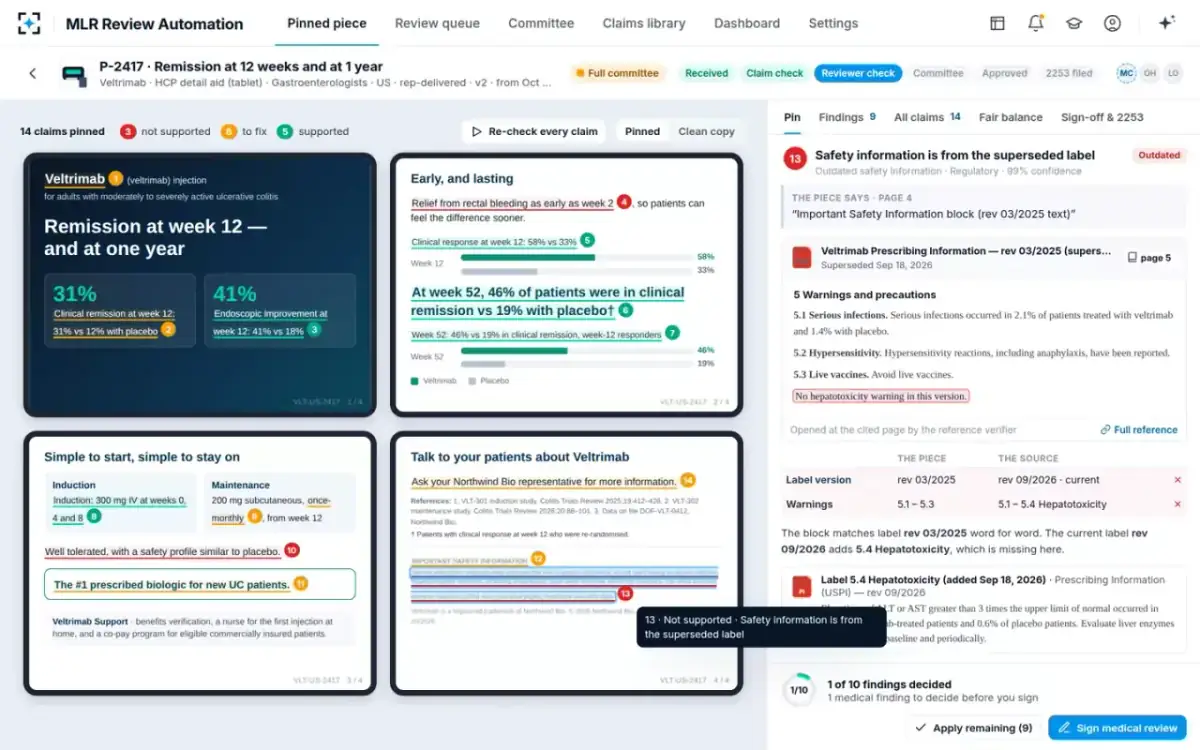
The year a change stays visible, and the sweep it should start
One labelling rule gives a review team a free signal it mostly ignores. Under 21 CFR 201.57(a)(5), substantive labelling changes are listed under Recent Major Changes in the Highlights of Prescribing Information, and the regulation fixes how long they stay there: a changed section stays listed in Highlights for at least a year from the date of the change, and comes off at the first printing after that year is up.
Two uses follow. As a monitoring aid, the Recent Major Changes block is a year-long, publicly visible list of what moved — which is a cheap way to check your own watch caught everything, and a cheap way to check a competitor's label too. And as a horizon, one year is a sensible outer bound for how long a revision-driven sweep should stay open, because a change that is still being flagged to prescribers is still a change your field material may not have absorbed.
A new label version on day 0, and the sweep MLR Review Automation starts
- Sweepday 0
- Revisions and withdrawals confirmed, piece by piecedays
- Watch stays open on new and revised piecesthe rest of the year
- Listed under Recent Major Changes in Highlights of Prescribing Informationat least 1 year
The sweep has one design rule worth stating. It proposes; it does not act. A software agent can find every live piece whose safety text matches a superseded version and can tell you which ones a revision would fix — but pulling a piece out of the field is a commercial and compliance decision with consequences, and it belongs to a named person. In the solution, five revisions and two withdrawals are proposed and each is confirmed by a reviewer before anything happens.
Is off-label promotion the same as being inconsistent with labeling?
Not quite, and the difference is worth keeping straight because the two terms get used interchangeably in review meetings. Promoting an unapproved use is the clearest way to be inconsistent with the labelling, and it is what the old regulation addresses directly. But the CFL framework describes a broader boundary: a communication can be about an approved indication and still fail — on population, on dosing, on limitations, on new harm, or because the labelling does not support safe use as represented.
The CFL guidance also says plainly that communicating information that is not consistent with the labelling is outside the scope of its recommendations; FDA addresses those communications separately. For a review team, the practical consequence is that "is this off-label?" is the wrong first question. The right one is the four-part comparison in Factor 1, applied claim by claim, because it catches the drift that nobody intended and that nobody would describe as off-label promotion. What FDA actually cites shows how the categories appear in enforcement.
Questions people ask
What is the CFL guidance?
It is FDA's June 2018 guidance for industry, Medical Product Communications That Are Consistent With the FDA-Required Labeling — Questions and Answers, which explains how the agency evaluates firms' communications about their products' approved uses where the information is not itself contained in the labelling. It is a guidance document containing nonbinding recommendations rather than a regulation, so it describes FDA's current thinking rather than creating obligations; the obligations it works against come from the Federal Food, Drug, and Cosmetic Act and the advertising and labelling regulations.
Can you promote a subgroup result?
You can present one, but not as a demonstration of efficacy, and not with the subgroup standing in for the randomised population. The failure that matters is silent substitution: a percentage drawn from a subset presented in a sentence whose subject is "patients". If the subgroup analysis was pre-specified and appropriately controlled, it may be presentable with its design disclosed; if it was descriptive, presenting it with a p-value implies a rigour the analysis does not have. The safest route is usually to replace the line with an approved claim from the primary analysis.
What evidence do you need for a claim that is consistent with labeling?
Consistency does not lower the evidentiary bar. FDA's guidance states that any data, studies or analyses relied on should be scientifically appropriate and statistically sound to support the representations made, and that material aspects of study design and methodology — type of study, objectives, dosage or use regimens, controls, population studied — should be disclosed clearly and prominently, along with material limitations. Unfavourable or inconsistent findings should be disclosed rather than omitted. In practice that means a source openable at a page, the design disclosed where the reader will see it, and the population, endpoint and timepoint written into the claim.
How long does a label change stay in Recent Major Changes?
At least one year. 21 CFR 201.57(a)(5) requires a changed section to be listed under Recent Major Changes in the Highlights of Prescribing Information for at least one year after the date of the labelling change, and removed at the first printing after that year. For a review team this is a useful external check: anything listed there within the last twelve months should have triggered a sweep of live material, and if it did not, your watch has a gap you can see from the label itself.
Does a label change mean every live piece has to be withdrawn?
No, and treating it that way is expensive and usually unnecessary. Many pieces affected by a safety-related change need the safety information block replaced with the module for the current version, which is a reissue rather than a withdrawal. Withdrawal is for pieces that cannot be repaired — one carrying a claim the revision retired, or one whose whole argument rests on something the new label contradicts. On the fictional sample brand, seven affected pieces produced five proposed revisions and two proposed withdrawals.
Who decides whether a claim is consistent with the labelling?
A named reviewer, on evidence. Factor 1 is a comparison and can be prepared for them claim by claim, with the label section named on each finding; Factors 2 and 3 require someone to think about how a prescriber would act on the piece, which is not a comparison at all. The division matters because the two kinds of work have different failure modes: a comparison fails by being skipped, and a judgement fails by being made without the comparison in front of it.