The meaning of "late-breaking abstract" is narrower than it sounds, and the narrowness is the point. A late-breaking abstract is one a congress accepts on a second, later deadline, reserved for work whose results were not yet conclusive when the ordinary deadline passed — not for work that was late, and not for work the authors wanted to polish. ESMO states the test directly: "Only abstracts for which no conclusive data are available at the time of the abstract submission deadline of 30 September 2025 will be considered for late-breaking status." Everything that makes a late-breaker difficult to cover follows from that one sentence. The data is new to everybody, it arrives in a handful of minutes, and the people who need to hear about it are in other rooms. Botminds' Medical Congress Intelligence is built around that hour: a tracked late-breaker stays locked until its own release time, is read the moment the embargo lifts, and reaches the programme team as cited lines while the session is still running.
The rules below are quoted from the societies' own current regulations. The worked hour — EIMC 2026, late-breaker LB-07, the sponsors and the people — is fictional sample data inside the solution, and is marked as such wherever it appears.
What a late-breaking abstract is
A late-breaking abstract is a congress abstract submitted after the ordinary deadline, under a separate set of rules, for a narrow class of work. ESMO defines the class: late-breaking abstracts "may be submitted for high quality, new research findings from prospective interventional clinical trials or observational series (large real world data sets) or novel technologies with major implications for clinical practice and/or understanding and targeting of disease processes".
Read that as two filters rather than one. The first is the kind of study: an interventional trial, a large real-world series, or a genuinely new technology. The second is consequence — "major implications for clinical practice" or for how a disease is understood and targeted. An incremental analysis of an existing data set does not qualify however interesting it is, and neither does a study whose results were already in hand in September.
That is why the letters "LBA" on a programme are a signal rather than a label. The society has already judged, twice, that the work is both new and consequential. A watch list that treats every abstract equally wastes the signal the society has handed it for free.
Two deadlines, and the intent to submit
The mechanism behind the second deadline is not simply a later date. ESMO requires an intent to be filed on the ordinary deadline: "A preliminary abstract indicating the data expected to be available by the late-breaking abstract deadline must be submitted online by 30 September 2025 as an 'intent to submit a late-breaking abstract'." That preliminary abstract must carry the title, the first author with full contact details and declaration of interest, the background, the methods, and — the striking part — "expected results and expected conclusions".
So an author declares in September what they expect their trial to show, and submits in November what it actually showed. The society then has both documents. The final deadline is explicitly not a grace period: "The final late-breaking abstract deadline of 4 November 2025 is under no circumstances to be considered as an extension of the general submission deadline." And a declared intent that is not followed through is dropped: "If a preliminary abstract marked for late-breaking submission is not updated by the late-breaking abstract deadline, the entire abstract will be automatically rejected."
The ordinary route and the late-breaking route, to scale
- Open for submissionto 30 September
- Reviewed and scheduledafter the deadline
- Accepted and embargoedto its release hour
- Intent, with expected resultsby 30 September
- Data matures, full abstract dueby 4 November
- Accepted and embargoedto its release hour
For anyone watching a competitor, the September filing is the useful fact. The society knows in September that a readout is coming; the public finds out when the titles are released. A watch list built from registry completion dates and the released titles can therefore have a late-breaker on it weeks before anybody is allowed a word of its content.
What makes an abstract eligible to be late-breaking?
Four conditions, each of which a scientific committee can check. They are worth reading as a competitive intelligence analyst rather than as an author, because each one tells you something about what you are going to be looking at.
Only abstracts for which no conclusive data are available at the time of the abstract submission deadline of 30 September 2025 will be considered for late-breaking status.
ESMO, abstract submission regulations and instructions, ESMO Immuno-Oncology Congress 2025
The late-breaker test, and what each condition implies for a watcher
| The condition | As the regulations put it | What it implies for a watcher |
|---|---|---|
| The kind of work | New findings from prospective interventional trials, large real-world series or novel technologies "with major implications for clinical practice and/or understanding and targeting of disease processes". | Expect a trial result rather than an analysis. The society has already judged it consequential. |
| No conclusive data at the ordinary deadline | "Only abstracts for which no conclusive data are available at the time of the abstract submission deadline" qualify. | Nobody outside the trial has seen this. There is no prior version of the number to compare against. |
| Not already published or presented | The work "must not have been previously published in any publication in a peer review setting or presented at a meeting of any other scientific organisation" before the congress. | The session is the first public account. A prior conference deck does not exist to read ahead. |
| An intent filed on the ordinary deadline | A preliminary abstract with title, author, background, methods and "expected results and expected conclusions", filed by the first deadline. | The readout was foreseeable in September. Registry dates and the released titles are where it shows up first. |
| Updated by the second deadline, or dropped | An intent not updated by the late-breaking deadline means "the entire abstract will be automatically rejected". | A late-breaker that appears in the programme has cleared two filters, not one. |
One further rule shapes what is in the room. Where work has been shown before, ESMO does not accept a repeat: "Encore abstracts will NOT be accepted. However, abstracts containing updated data with respect to a previous presentation may be submitted," provided the authors specify "clearly which new data will be presented, for example final analysis of primary endpoint(s) or intermediate statistical analysis", and identify the prior presentation. For an analyst, that sentence is a reading instruction: when an abstract is an update, the society has required the authors to say what is new, so the delta is written down somewhere.
How a scientific committee decides
Twice, and with the outcome deciding how much of the meeting's attention the work gets. In ESMO's process the scientific committee first reviews the intents to submit and "will determine if they can be identified as potential late-breaking abstracts". Authors who pass that first review must then submit the entire abstract — final author list, results, conclusions and any table — by the late-breaking deadline. The committee then "will re-consider the final abstract to determine whether it will be accepted as a late-breaking abstract".
The decision at that second review has three outcomes, and they map directly onto how a congress week should be staffed. An oral presentation is reserved for "authors presenting original data of superior quality, presented in a Proffered Paper session or Presidential Symposium". A mini oral is a short presentation for "original data of good quality". Anything that meets neither bar is rejected outright and, in ESMO's words, "will not be accepted for presentation and will not be published".
Note what this process is and is not. It is editorial selection by a committee against stated criteria, carried out quickly and without the back-and-forth of journal review. It is not peer review, and treating it as though it were is a common mistake made with a congress number — what a congress number is actually worth sets out how far the two diverge.
When the embargo on a late-breaker lifts
At the hour the society publishes for late-breaking abstracts specifically, which is usually not the hour it publishes for everything else. The AACR's schedule for its Annual Meeting 2027 separates them explicitly: late-breaking and clinical trials abstract titles only, with no text, are published on 2 March 2027 at 4:30 p.m. ET, while late-breaking and clinical trials abstract text is published on 2 April 2027 at 12 p.m. ET. A month in which the title is public and the content is not.
The same policy closes the obvious workaround: a title-only press release about a late-breaker "must not include any data or information from the abstract". And whatever goes beyond the abstract — slides, subgroups, the full data set — is a third release again, tied to the session itself. What goes public when at a medical congress works through all three in order, society by society.
Two practical consequences for a coverage plan. First, the hour that matters for a late-breaker is often closer to the session than the hour that matters for a regular abstract, which is why late-breaker coverage cannot be scheduled the same way. Second, because a late-breaker's abstract is thin by construction — written against a deadline weeks after the data closed — the session adds proportionally more than it does for an ordinary abstract. The person in the room is not redundant; the typing afterwards is.
The first hour, minute by minute
Here is the hour as it runs in the solution on its fictional sample congress, with every step timestamped. Late-breaker LB-07 is a Phase 3 induction readout for a competitor's antibody; it has been on the tracked list since 28 September, from its published title alone; its embargo lifts at 08:40 in the first hall.
One late-breaker, from locked to a rated and routed event
| Clock | What happens | What it leaves behind |
|---|---|---|
| 08:39 | The session grid shows the abstract still locked: published title, session, the analyst in the room, and the channel the summary will go to. | No abstract text has been read, stored or shared. |
| 08:40 | The embargo lifts. The cell turns to a high-impact competitor readout and the abstract is read. | A timestamped reading, tied to the hour the society published. |
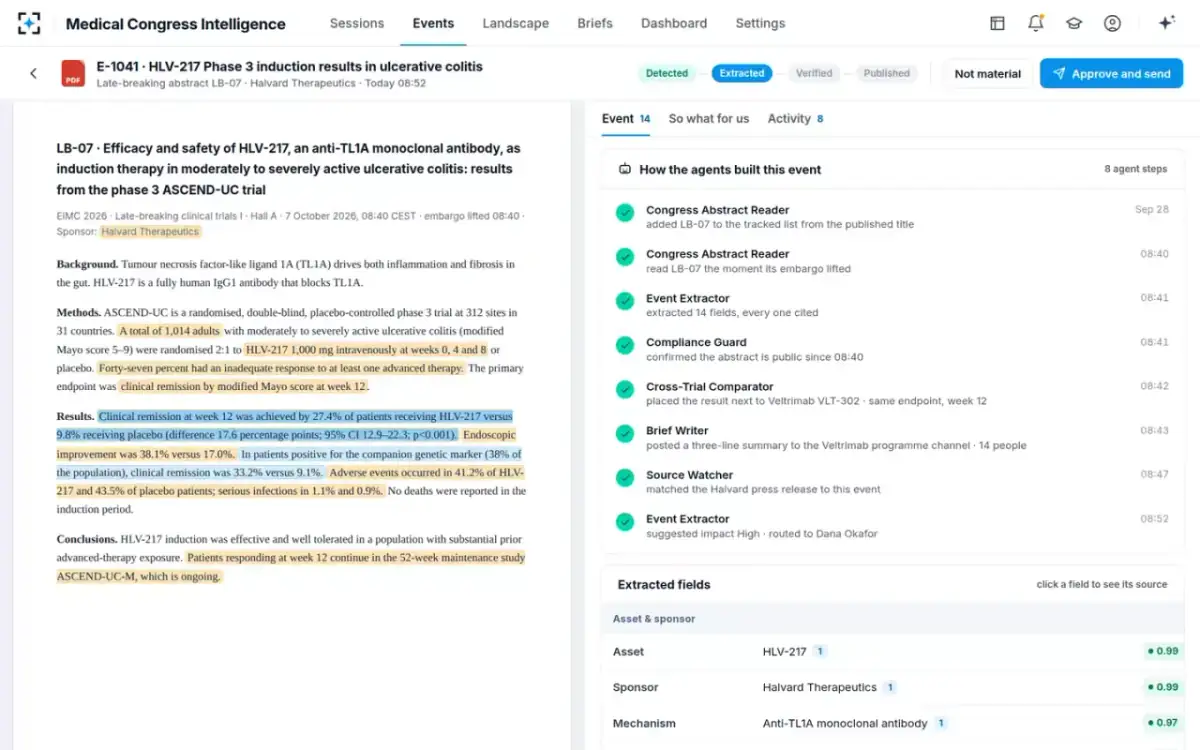
| 08:41 | Fourteen fields are extracted — asset, sponsor, mechanism, phase, endpoint, result, dates — each citing the passage it came from. The source check confirms the abstract has been public since 08:40. | Fields with a confidence each; anything below the bar waits for a person. |
| 08:42 | The result is set beside the company’s own trial on the same endpoint at the same timepoint, with both populations shown. | A comparison labelled as separate trials rather than a head-to-head. |
| 08:43 | Three cited lines are posted to the programme channel, fourteen people. | Facts only. The rating and the interpretation still wait for the lead. |
| 08:47 | The sponsor’s own press release is matched to the same event. | One event, two sources, no duplicate alert. |
| 08:52 | The event is routed to the lead with a suggested impact of High. | A decision in front of the person who makes it, hours before the sponsor’s investor call. |
The moment the cell changes colour
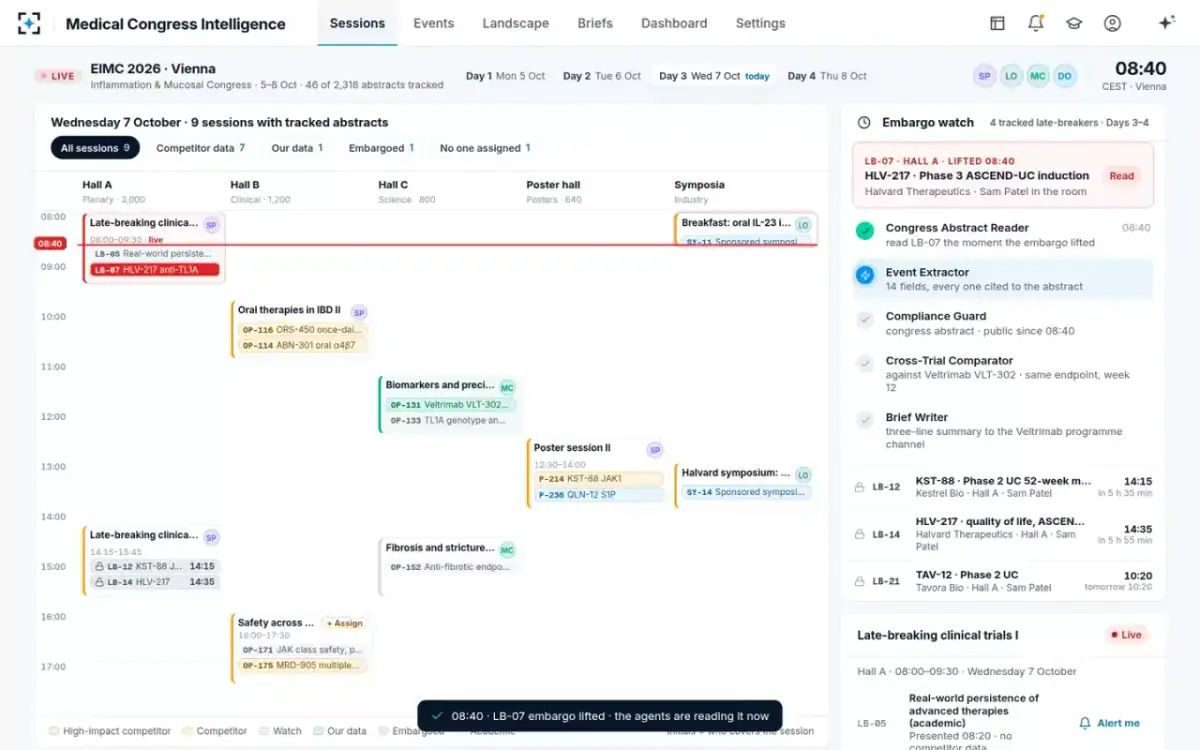
What can you know in the first sixty seconds?
More than most teams expect, and less than the meeting will eventually tell you. In the first minute after the text is published you can know what the trial was, who ran it, what the primary endpoint was, what it read, in how many patients, and whether the number is better or worse than the one your own programme carries. That is enough to decide whether anyone needs to be told immediately, which is the only decision the first minute has to support.
What you cannot know is anything the abstract does not contain, and that is a longer list than it looks. Subgroups, safety detail, discontinuation rates, the shape of the curve and every sensitivity analysis arrive with the slides, at the session. A late-breaker's abstract is written to a character limit — ESMO caps it at the standard 2,000 characters excluding spaces — against data that had only just closed. The headline is real; almost nothing around it is in the document yet.
What the first thirteen minutes produced, on the sample congress
3min
from the embargo lifting to three cited lines in the programme channel
demo · sample congress
14
fields extracted from the abstract, each citing the passage it came from
demo · sample congress
13min
from locked at 08:39 to a rated event in front of the lead at 08:52
demo · sample congress
Why a late-breaker is not a paper
Because the abstract is a snapshot taken at a deadline, and the paper, if it comes, is written later against a fuller data set. The Cochrane review of full publication after abstract presentation put the first part of that gap in numbers: combining 425 reports covering 307,028 abstracts gave "an overall full publication proportion of 37.3%", with varying lengths of follow-up. Most congress abstracts never become a paper at all. Trials fare better than the average — the same review's survival analysis estimated that 68.7% of randomised and controlled trials would be published in full by ten years — but even then the paper arrives long after the hour that mattered.
The consequence for a first-hour summary is a sentence, not a hesitation. Report the number, say where it came from, and say what kind of document it came from. How far the numbers move between an abstract and its paper sets out what happens to the ones that do get published, and why the caveat is not boilerplate.
There is a matching discipline for the people in the room. The International Committee of Medical Journal Editors asks that researchers presenting at a meeting "should feel free to discuss their presentations with reporters but should be discouraged from offering more detail about their study than was presented in the talk". The same line is a good internal rule: a note from the floor reports what was said in the session, not what someone added over coffee afterwards.
Every field opens on the passage it came from
What the hour is worth to the programme team
The value of covering a late-breaker decays fast, and not smoothly. It is highest while the session is running and colleagues are asking questions in the corridor; it is still high before the sponsor's own investor call or press release reframes the result; it is much lower by the evening, when everyone has seen a version of it from somewhere else. A summary that arrives the next morning competes with the public account rather than preceding it.
The same late-breaker, covered two ways inside the first hour
By hand: Someone has to be watching the right abstract at the right minute, in a hall, on a phone.
When the hour is the trigger: The release hour is a property of the abstract; the reading starts on its own.
By hand: The analyst reads the abstract between slides and copies numbers into a note.
When the hour is the trigger: Fields are extracted with a cited passage each; anything below the confidence bar waits for a person.
By hand: A judgement call, usually made correctly and never recorded.
When the hour is the trigger: Confirmed against the release and timestamped, so the decision survives the week.
By hand: Done after the sessions end, from memory and a slide deck.
When the hour is the trigger: Same endpoint, same timepoint, both populations shown, labelled as separate trials.
By hand: In the evening write-up, often after the sponsor’s own announcement.
When the hour is the trigger: Cited lines in the approved channel while the session is still running.
By hand: Types.
When the hour is the trigger: Listens, notes what the slides added, and tells the lead what it means.
The division that survives all of this is simple enough to write on one line: the hour belongs to the machine, the meaning belongs to the people. Reading, extracting, checking and comparing are mechanical and benefit from being instant. Deciding that a competitor's induction number now matches your own, and that the programme should hear about it before lunch, is not mechanical and should not be automated. What must match before two trials can sit in one table is the discipline behind the comparison the first hour produces; the five seats that cover a meeting is where the hour sits in the week.
Questions people ask
When is the late-breaking abstract deadline?
It is set per congress and sits weeks after the ordinary one, with an intent to submit due on the ordinary deadline itself. At the ESMO Immuno-Oncology Congress 2025 the general deadline was 30 September 2025 and the final late-breaking deadline 4 November 2025 — and the regulations state that the later date "is under no circumstances to be considered as an extension of the general submission deadline".
Can a late-breaker have been presented somewhere else first?
No. ESMO requires that the work "must not have been previously published in any publication in a peer review setting or presented at a meeting of any other scientific organisation" before the congress, and does not accept repeat presentations at all. An abstract carrying updated data relative to an earlier presentation may be submitted, but the authors must state clearly which data is new and identify the prior presentation.
How are late-breaking abstracts reviewed?
Twice, by the congress scientific committee. It first reviews the intents to submit and decides which can be identified as potential late-breakers; authors who pass then file the full abstract by the second deadline, and the committee re-considers it. The outcome is an oral presentation for original data of superior quality, a short mini-oral slot for data of good quality, or rejection — in which case the abstract is not presented and not published.
Why are late-breakers put in the biggest sessions?
Because the eligibility test selects for consequence before the programming does. A late-breaker has to be new findings with "major implications for clinical practice and/or understanding and targeting of disease processes", and at the second review the top category is reserved for original data of superior quality, presented in a proffered paper session or presidential symposium. The programme is following the filter, not creating the drama.
Does a late-breaking abstract contain the full results?
No. It is capped at the same length as any other abstract — 2,000 characters excluding spaces under ESMO's rules — and it is written against data that closed only weeks earlier. Subgroups, safety detail and the full data set arrive with the presentation itself, which under the same regulations may only be made public at the start of the session.
How long does it take to brief a programme team on a late-breaker?
Done by hand, it often waits until the evening, because the reading, the typing, the number-checking and the comparison all queue behind the sessions the analyst is sitting in. On the sample congress in the solution the first three cited lines reached the programme channel three minutes after the lift and a rated event reached the lead thirteen minutes after the abstract was still locked. Those are sample figures from a demonstration, not a measured customer result.