An abstract embargo policy is the congress organiser's rule about when the content of an accepted abstract may be made public, and at a large medical meeting it is never a single date. The European Society for Medical Oncology puts the data in its accepted abstracts under embargo "until the relevant embargo release date cited in the 'Publication schedule for accepted abstracts'", and holds everything past the abstract — "for example full data sets" — until the session itself begins. The American Association for Cancer Research publishes regular abstract titles and text on one hour of one day, and holds late-breaking abstract text for another month. Two hours, three different states of public. A team covering the meeting that treats the policy as one deadline is either late or in breach. Botminds' Medical Congress Intelligence reads the published schedule for every abstract it tracks, keeps each one locked until its own release hour, and reads it the moment that hour arrives, so the first cited lines reach the programme team within minutes and nobody has to guess at the clock.
The rules quoted on this page are the societies' own, current as published. The worked congress used to show the clock in practice — EIMC 2026, the sponsors, the molecules and the people — is fictional sample data inside the solution, and is marked as such wherever it appears.
One meeting, two abstracts, three different hours of public
- Confidentialto 2 March
- Title and text public2 March, 4:30 p.m. ET
- Full data at the sessionfrom the slot
- Confidentialto 2 March
- Title only, no data2 March, 4:30 p.m. ET
- Text and poster public2 April, 12 p.m. ET
What an abstract embargo actually is
An embargo is a promise made by the people who own the data to the society that accepted it, enforced by the society's control of the programme and of the copyright. ESMO states it plainly: abstracts accepted for presentation "must be considered confidential by the author, co-authors, institute(s), research sponsor(s) and ESMO until publicly released in connection with" the congress. The AACR adds the copyright: "Once an abstract is accepted for presentation at the AACR Annual Meeting, the AACR holds the copyright to the abstract. The abstract may not be published or reproduced elsewhere."
Read that list of who is bound, because it is short: the author, the co-authors, the institution, the sponsor and the society. A competitive intelligence analyst reading an abstract at the hour the society published it is not a party to the promise and is breaking nothing. What binds the analyst is the hour itself, and the separate obligation not to use information that is not yet public — which is a securities question rather than a congress one, and is set out in whether what you hear at a congress is inside information.
The purpose of the rule is not secrecy for its own sake. A society that lets sponsors release data whenever they like loses the meeting as the moment the field learns something; a society that lets nothing out until the session starts cannot run a press programme or let reporters prepare. The schedule is the compromise, and it is published precisely so that everyone can work to it.
When does a conference abstract embargo lift?
It lifts at the hour the society names in its own publication schedule, and that hour is different for different kinds of abstract at the same meeting. Neither society's rules set a single time for every abstract, a fixed number of hours before the session, or a lift that coincides with the talk. Asking when the embargo lifts is the wrong question; the right one is which embargo, on which part of the work.
The AACR's schedule for its Annual Meeting 2027 is a clean worked example because it prints four releases at two hours for one meeting. Full regular abstracts — titles and text — are published on 2 March 2027 at 4:30 p.m. ET. Late-breaking and clinical trials abstract titles only, with no text, are published at that same hour. Late-breaking and clinical trials abstract text is published on 2 April 2027 at 12 p.m. ET. Poster presentations become available on the virtual meeting platform at that same April hour. Four releases, two hours, one meeting, and a month between the two that matter most to anyone watching a rival.
ESMO writes the same idea as a pointer rather than a table: the data in accepted abstracts are embargoed "until the relevant embargo release date cited in the 'Publication schedule for accepted abstracts'", which the society publishes separately for each congress. The practical consequence is identical. The schedule, not the programme, is the document a coverage team plans from.
Three releases: the title, the abstract text, and the full data set
Underneath the per-meeting hours sit three things that become public in order, and keeping them apart is most of the discipline. The title and the logistics — who presents, which session, which hall — come first and carry no result. The abstract text comes next and carries the headline numbers as they stood at the submission deadline. Everything past the abstract — the slides, the poster, the subgroup tables, the full data set — comes last: at the session itself under both societies' rules, or, for an AACR poster, when the e-posters go up on the meeting platform.
What is public at each release, and the rule that makes it so
| What becomes public | When | The rule | What a watcher may do with it |
|---|---|---|---|
| Title, presenter, session, hall | At the first scheduled release hour, for every abstract type | AACR: late-breaking and clinical trials abstract "Titles Only (no text)" are published at the same hour as regular abstracts | Build the tracked list and the coverage plan. Nothing to read yet. |
| The abstract text and its numbers | Regular abstracts at the first hour; late-breaking text a month later at the AACR | ESMO: data in accepted abstracts are embargoed until the release date in the publication schedule | Read, extract and compare. This is the first moment a number exists. |
| The poster, on the meeting platform | With the late-breaking text at the AACR, 2 April 2027 at 12 p.m. ET | AACR: "Poster presentations will be available on the virtual meeting platform" at that hour | Read what the poster adds beyond the abstract, once it is up. |
| Slides, subgroups, the full data set | At the start of the session where the study is presented | ESMO: data "beyond what is included in all accepted abstracts, for example full data sets, may only be made public at the start of the official programme session" | Note it from the room, and expect the numbers to move from the abstract. |
| A sponsor press release carrying data | At the hour the society publishes the data the release quotes | AACR: a release with data from a regular abstract "may be issued on March 2, 2027, at 4:30 p.m. ET, when the AACR publishes that information online" | Match it against the abstract. A release ahead of its hour is the breach, not the reading of it. |
The fifth row is the one that most often goes wrong inside a company. A communications team schedules a release against the session time, because that is what appears in the programme, while the data in the release came out of the abstract, whose own hour was weeks earlier or minutes later. The AACR writes the test for that: a title-only press release about a late-breaker "must not include any data or information from the abstract". Match the release to the hour of the content it quotes, not to the hour of the talk.
The late-breaker exception, and why it is the hardest hour
A late-breaking abstract is accepted on a second, later deadline for work that had no conclusive data when the ordinary deadline passed, and that is exactly why its release behaves differently. At the AACR the title is published with everybody else's and the text is held for a month; at ESMO the data beyond the abstract waits for the session, and with a late-breaker the abstract itself is thin, so the session is where most of the result arrives.
For a coverage team this produces the single most expensive hour of the meeting. The title has been visible for weeks, so the session is on the plan, the room is booked and the analyst is in the seat. Then text and data land in the same few minutes, in front of an audience that will start asking the programme team questions immediately. What a late-breaking abstract is, and what happens when it lifts follows one of them minute by minute.
What a company may say before the slot
Something, but only in a particular shape. ESMO asks any party planning a pre-presentation release — author, co-authors, institute, sponsor — to follow its confidentiality policy and sample format "by summarising abstract data in a qualitative rather than quantitative way, and avoiding interpretations about the implications of the data for clinical practice". The society also asks for written notice of the intention in advance, for a line in the release saying full data has been submitted for presentation, and reserves a sanction: if the release "includes significantly more information than ESMO's recommendations, the abstract's placement" in the congress "is subject to change".
The same pre-congress announcement, inside the rule and outside it
Qualitative, as the society asks: The trial met its primary endpoint.
Quantitative, which puts the slot at risk: Clinical remission of 27.4% against 9.8% on placebo at week 12.
Qualitative, as the society asks: Results will be presented in full at the congress.
Quantitative, which puts the slot at risk: A larger treatment effect than the competing antibody reported last year.
Qualitative, as the society asks: Nothing. Interpretation waits for the session.
Quantitative, which puts the slot at risk: Positions the drug as a new standard of care in the indication.
Qualitative, as the society asks: Advance written notice, and a line saying full data has been submitted for presentation at the congress.
Quantitative, which puts the slot at risk: Often neither, because the release was built to the session date rather than the abstract rule.
Qualitative, as the society asks: The slot stands; the data lands at its hour.
Quantitative, which puts the slot at risk: Placement in the programme "is subject to change", and at the AACR the slot and press events may be jeopardised.
The AACR arrives at the same place from the other direction, by tying each permitted release to the hour its content became public. A release with data from a regular abstract may go out when the AACR publishes that abstract. A title-only release about a late-breaker may go out at that same hour and must carry no data. A release with full data from an oral presentation "may be issued at the beginning of the session where the study will be presented". Three different permissions, one principle: you may say publicly what the society has already made public.
Who gets the abstract early, and under what promise
Early access exists, and it is narrow. ESMO "reserves the right to share material under embargo with journalists on the authorised ESMO media list who have agreed to respect the ESMO embargo policy". The AACR tells registered press the same thing from its side: in advance of the meeting it "may provide abstracts, press releases, and other materials under embargo to facilitate accurate and comprehensive reporting", and individuals registered as press "agree to abide by all embargoes".
Two things follow for anyone building a coverage plan. First, the only people holding an embargoed abstract early are on a list, by name, having promised in writing — reviewers and the scientific committee aside. A competitive intelligence desk is not on that list and should not try to be; its advantage has to come from speed at the hour, not from access before it. Second, because reporters do hold the material early, the first public account of a session can appear within minutes of the lift, which is a source worth watching and never a source worth pre-empting.
What happens if you break a congress embargo?
The sanction is the programme and the press list, not a court. The AACR writes both halves down. For the sponsor side: presenters, their companies or institutions and affiliated public relations representatives who break the policy "could jeopardize an abstract's placement in the scientific program and press events". For the media side: "Failure to abide by the AACR's embargoes may result in removal from AACR pre-embargo press lists and dismissal from current and future AACR meetings." ESMO's equivalent is the placement clause already quoted. In each case the thing taken away is the next meeting, which for a programme team planning a launch year is a serious loss.
One consequence that does not follow is the one authors most fear. A journal does not treat press coverage of a meeting as prior publication. The International Committee of Medical Journal Editors is explicit that "policies designed to limit prepublication publicity should not apply to accounts in the media of presentations at scientific meetings or to the abstracts from these meetings", and its overlapping-publication recommendation does not prevent a journal "from considering a complete report that follows publication of a preliminary report, such as a letter to the editor, a preprint or an abstract or poster displayed at a scientific meeting".
Policies designed to limit prepublication publicity should not apply to accounts in the media of presentations at scientific meetings or to the abstracts from these meetings
ICMJE Recommendations, section K, Journals and the Media
What the ICMJE does ask of the presenter is restraint in the corridor: researchers "should feel free to discuss their presentations with reporters but should be discouraged from offering more detail about their study than was presented in the talk". That sentence is a useful line for a medical affairs team too. The talk is the boundary; the unpublished table in the back pocket is not.
Where a company operates across borders, the industry's own codes add a tie-break rather than a new clock: the pharmaceutical trade associations' joint guidance on international congresses says that where the applicable laws, regulations and codes conflict, the more restrictive provision applies. A sponsor whose local code is stricter than the society's schedule follows the local code.
Reading an embargo schedule as a work plan
Everything above turns into one table on a wall. For each abstract the desk cares about, write down the type, the hour its title became public, the hour its text becomes public, whether the poster or slides add anything and when, and who is in the room. The hours come from the society's publication schedule; the rest is yours. What falls out is a plan in which no one has to decide anything under time pressure, because the decision was taken while the abstract was still a title.
Eight checks before anything about a tracked abstract leaves the desk
- Which abstract type is it?
Regular, late-breaking, clinical trials or poster — each has its own hour at the same meeting. At the AACR the late-breaking text lands a month after the late-breaking title.
- What hour did the society publish for this type?
Take it from the publication schedule, not the programme. ESMO embargoes abstract data "until the relevant embargo release date cited in the Publication schedule for accepted abstracts".
- Is the number you want in the abstract, or past it?
Anything beyond the abstract, "for example full data sets", is public only at the start of the session under ESMO rules.
- Has the hour actually passed, in the congress time zone?
The AACR prints times in ET; a European meeting prints its own local time. One clock, agreed in advance, and never the analyst’s laptop.
- Is the source you are quoting public, or shared with you?
Material held under embargo by a journalist on a society media list is not public. Quote the society’s publication, not the person who had it early.
- Does your release carry data the society has not yet published?
A title-only release about a late-breaker "must not include any data or information from the abstract".
- If it is a pre-congress announcement, is it qualitative?
ESMO asks for abstract data summarised "in a qualitative rather than quantitative way", with no interpretation for clinical practice, plus advance written notice.
- Does a stricter local code apply?
The pharmaceutical trade associations’ joint guidance applies the more restrictive provision where law, regulation and code disagree.
How a congress intelligence desk enforces the clock instead of trusting it
A schedule on a wall is only as good as the discipline of the person reading it at 08:39 with a rival's late-breaker on the screen. The design decision in Medical Congress Intelligence is to make the hour a property of the abstract rather than an instruction to a person. Until the release hour, a tracked abstract holds only what is already public — the published title, the session, who is covering it in the room, and where the summary will go. The text is not read, not stored and not shared.
Before the hour: a title, a session, an owner and a countdown
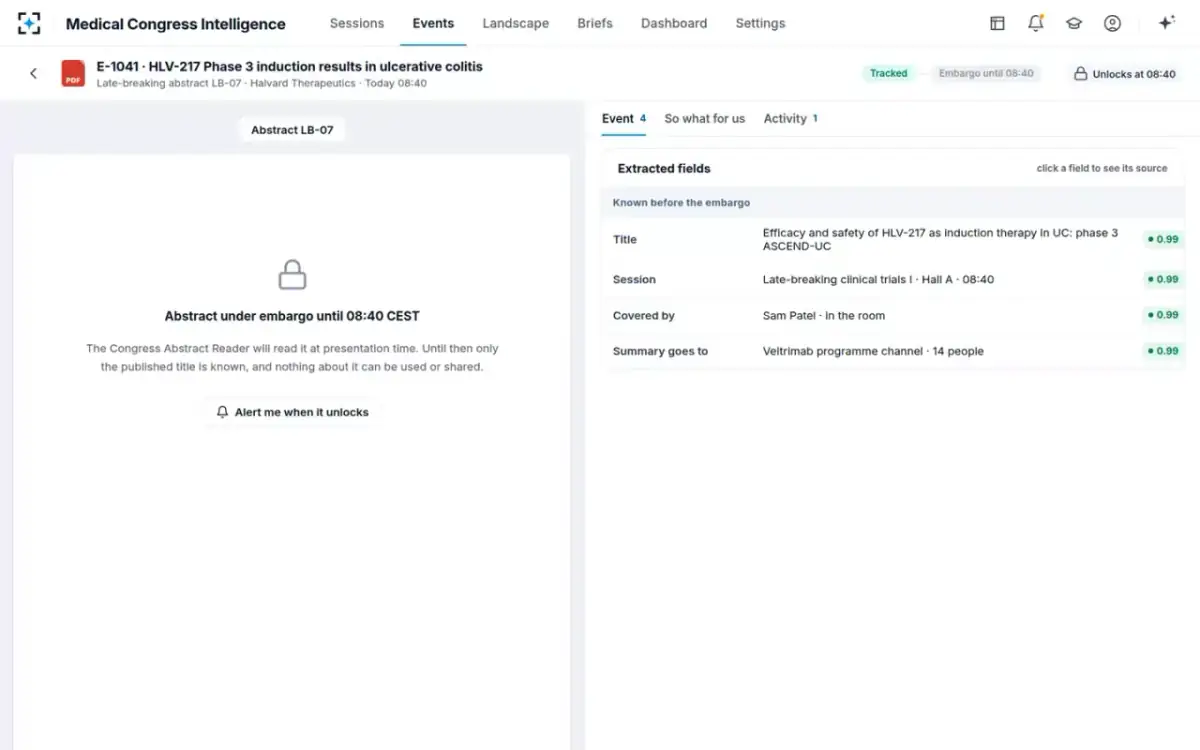
At the hour, the reading starts on its own. In the sample congress the embargo on late-breaker LB-07 lifts at 08:40, the abstract is read at 08:40, fourteen fields are extracted with a cited passage each at 08:41, the source check confirms the abstract has been public since 08:40, the comparison against the company's own trial runs at 08:42, and three cited lines reach the programme channel at 08:43. Every one of those timestamps is sample data from the solution, not a measured customer result, and 08:40 is that congress's hour and nobody else's.
At the hour: the reading starts, and each step carries its time
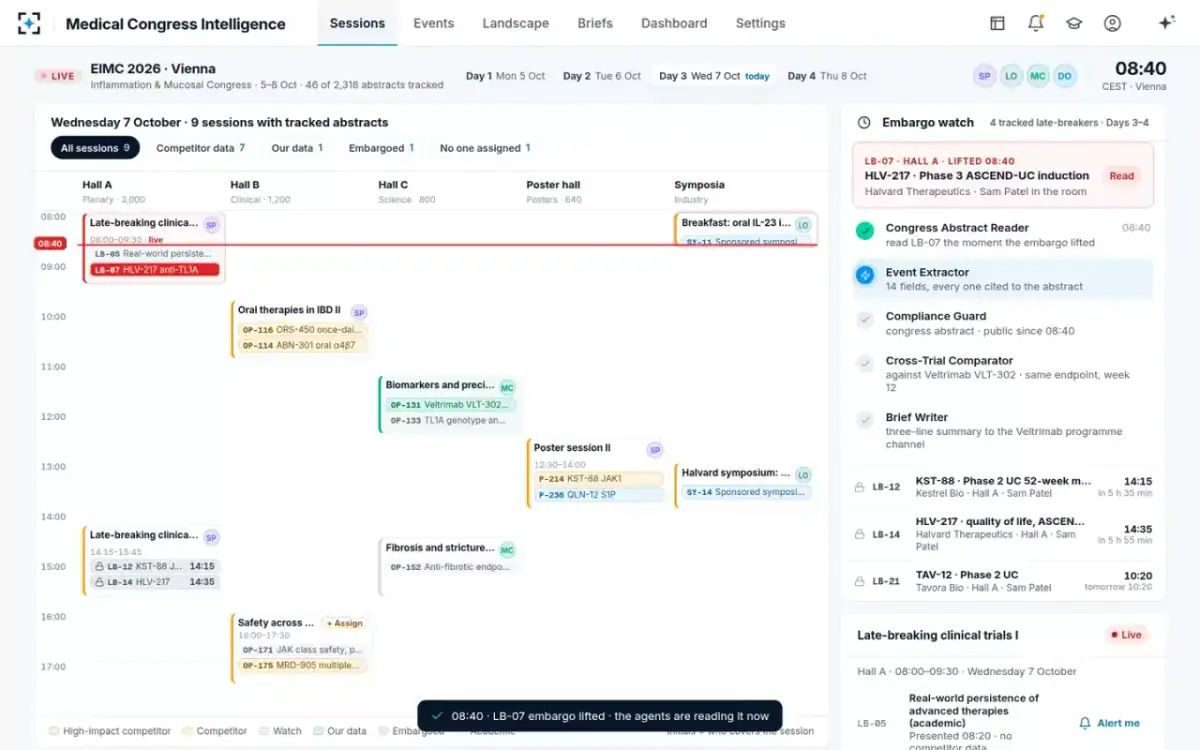
People, companies, products, trials and the congress shown here are invented characters and sample data.
Two guardrails matter more than the speed. The first is that only a facts-only summary goes out on its own, to one channel the lead approved in advance; a rating, an interpretation or a wider distribution waits for a signature. The second is that a note taken on the floor is checked before it is used at all, and held if it might not be public — a different rule from the embargo, and the one that catches the booth conversation rather than the abstract.
The rest of the meeting follows the same shape: a plan built while abstracts are still titles, an hour that fires by itself, and a person deciding what it means. Who covers a congress, seat by seat sets out the plan; what a congress number is actually worth sets out how much weight the number that arrives at the hour should carry.
Questions people ask
Are full data sets covered by a congress embargo?
Yes, and usually for longer than the abstract itself. ESMO's regulations state that data "beyond what is included in all accepted abstracts, for example full data sets, may only be made public at the start of the official programme session during which the study is presented". So an abstract can be public for weeks while the subgroup tables behind it are not, and a release quoting those tables ahead of the session breaks the rule even though the abstract did not.
Can a company issue a press release before a congress presentation?
Generally yes, in a restricted form. ESMO asks any party planning one to summarise abstract data "in a qualitative rather than quantitative way", to avoid interpretations about implications for clinical practice, to give the society advance written notice, and to say in the release that full data has been submitted for presentation. A release that goes significantly beyond those recommendations puts the abstract's placement in the programme at risk.
Can you post an abstract on social media before the session?
Not before its release hour. Until then the abstract is confidential to the author, co-authors, institution, sponsor and society, and at the AACR the society also holds the copyright, so the abstract "may not be published or reproduced elsewhere". After the hour the text is public and may be discussed; what is still not public is anything past the abstract, which at ESMO waits for the start of the session.
Does a press report of a meeting count as prior publication?
No. The ICMJE recommends that "policies designed to limit prepublication publicity should not apply to accounts in the media of presentations at scientific meetings or to the abstracts from these meetings", and its overlapping-publication guidance expressly allows a journal to consider a complete report that follows an abstract or poster displayed at a meeting. Presenters are still discouraged from giving reporters more detail than the talk contained.
Who is allowed to receive an abstract before its embargo lifts?
Reviewers and the society's own scientific committee, and journalists the society has approved. ESMO reserves the right to share embargoed material "with journalists on the authorised ESMO media list who have agreed to respect the ESMO embargo policy", and the AACR may give registered press abstracts and other materials under embargo. Receiving early access is an undertaking, not a convenience: breaking it costs the list and, at the AACR, future meetings.
Is an abstract embargo the same thing as confidentiality?
They overlap but are not the same. Confidentiality is the obligation on the people who submitted the work: ESMO requires accepted abstracts to be treated as confidential by the author, co-authors, institutes and research sponsors until public release. The embargo is the clock that ends that obligation at a named hour for a named part of the work. Once the hour passes the confidentiality ends for the abstract text and continues for everything the abstract does not contain.