Congress planning in pharma is the work of deciding, before a scientific meeting opens, what the company will do there and who owns each part of it: which sessions are covered and by whom, what the people in the room are listening for, what may be said at a stand, what comes back to headquarters and who signs it before it travels. Travel, booth build and symposium logistics are the visible half; the half that decides whether the week was worth anything is the coverage plan — a grid of sessions and hours with a named owner in every cell. Botminds' Medical Congress Intelligence is built for that half: it lays the programme out as a live grid, marks every tracked abstract and who covers it, reads each rival abstract the moment its embargo lifts and posts cited lines to the channel the lead chose, so the people in the seats spend the week interpreting rather than transcribing.
The professional standards quoted here are the society's own. The worked meeting — EIMC 2026, its sponsors, molecules and the five people named below — is fictional sample data inside the solution, and every figure drawn from it says so.
What congress planning in pharma means
A congress, in this industry's usage, is a scientific meeting run by a medical society rather than by a company: several thousand abstracts, parallel halls, poster sessions, and a handful of late-breaking slots that carry much of the news. A pharmaceutical company attends it in three different capacities at once, and the plan has to hold all three apart. It presents its own data. It runs commercial and educational activity around the meeting. And it watches what everyone else presents.
The industry's own codes treat that breadth as one scope. The trade associations' joint guidance on virtual and hybrid international congresses covers both the meeting a medical society organises and the activity companies run at it, naming exhibition stands and satellite symposia as examples. One meeting, one set of obligations, several teams — which is exactly why a plan that only names the people travelling leaves the hardest questions unassigned.
A workable plan answers four things in writing. Which sessions matter and why. Who is physically in each one. What each of those people is listening for. And what happens to what they heard between the room and the decision it is supposed to inform. The last of those is where most congress plans are thinnest, and where the week is usually lost.
The five seats that cover a meeting
Coverage is not a department; it is a small set of seats, each with a different week before the meeting and a different week after it. Five is a useful shape for a single therapy area at a single major congress: a lead who owns the plan and the signature, an analyst in the room, the programme lead the work is for, a medical affairs director covering the company's own scientific exchange, and counsel who decides what may be used.
Five seats, and what each one actually carries
Today
Owns the session tracker from the war room, rates every event and signs the debrief. The pressure is arrival time: the number has to reach the programme channel before the rival’s investor call, not the next morning.
With agents
Opens each rival readout already read, cited and compared; rates the impact, approves the interpretation and chooses who is told.
Still theirs: The rating, the interpretation, the distribution list and the signature.
Today
Covers the late-breaker hall and the posters, then writes them up after the sessions end. Most of the hours go on transcription rather than interpretation.
With agents
Listens in the room while the abstract is read at its release hour; adds notes from the floor, each checked before it is used.
Still theirs: What the slides said that the abstract did not, and the questions asked from the floor.
Today
Presenting her own study, and hearing about a rival readout the next morning from a written summary.
With agents
Reads three cited lines in the programme channel minutes after the lift, between her own sessions.
Still theirs: What the result means for the programme, and whether anything changes.
Today
Covers the sponsored symposia and asks, reasonably, which session she should be in.
With agents
Sees her sessions on the grid with her initials, the questions to answer and a reminder before each one.
Still theirs: Scientific exchange, and the insights that come out of it.
Today
Reviews what came off the floor after the fact, when something already looks wrong.
With agents
Sees anything that may not be public before it is used anywhere, and decides what the public part of it is.
Still theirs: The decision to release or hold, and nothing automated around it.
Two of those seats are often missing from a congress plan written as a travel plan. Counsel is the first: without a named person who can rule on a floor note within the day, the note either goes unused or goes out, and neither is a decision. The programme lead is the second: coverage with no named internal reader produces a document nobody acts on, which is the most expensive way to spend a congress week.
What does a competitive intelligence analyst do at a congress?
The analyst's job at a congress is to turn what happens in assigned rooms into something a decision can rest on, within the day: cover the sessions on the grid, capture what was presented against what the abstract already said, set a rival result next to the company's own on the same endpoint, and get it to the named internal reader with its source attached. Everything else — the typing, the chasing, the formatting — is overhead that has grown to fill the week.
The distinction that matters here is between a note and an insight, and the Medical Affairs Professional Society draws it sharply. "An insight is more than just raw data or simple observations," the society's insights page says. "Instead, an insight provides an understanding that informs strategy and suggests concrete actions." The longer definition in its External Scientific Engagement standards is the test an analyst can apply in the room: an insight is information collected via exchange or analysis "which, after analysis and validation, can inform strategy confirming new or preexisting views that drive planning, actions, and decisions".
Apply that test to a congress week and an uncomfortable share of the output fails it. A transcript of a session is raw observation. A number lifted from a slide with no population beside it is raw observation. What passes is the line that says what changed and for whom — and producing that line takes the part of the analyst's attention that transcription has been eating.
The coverage grid: a session, an hour, an owner
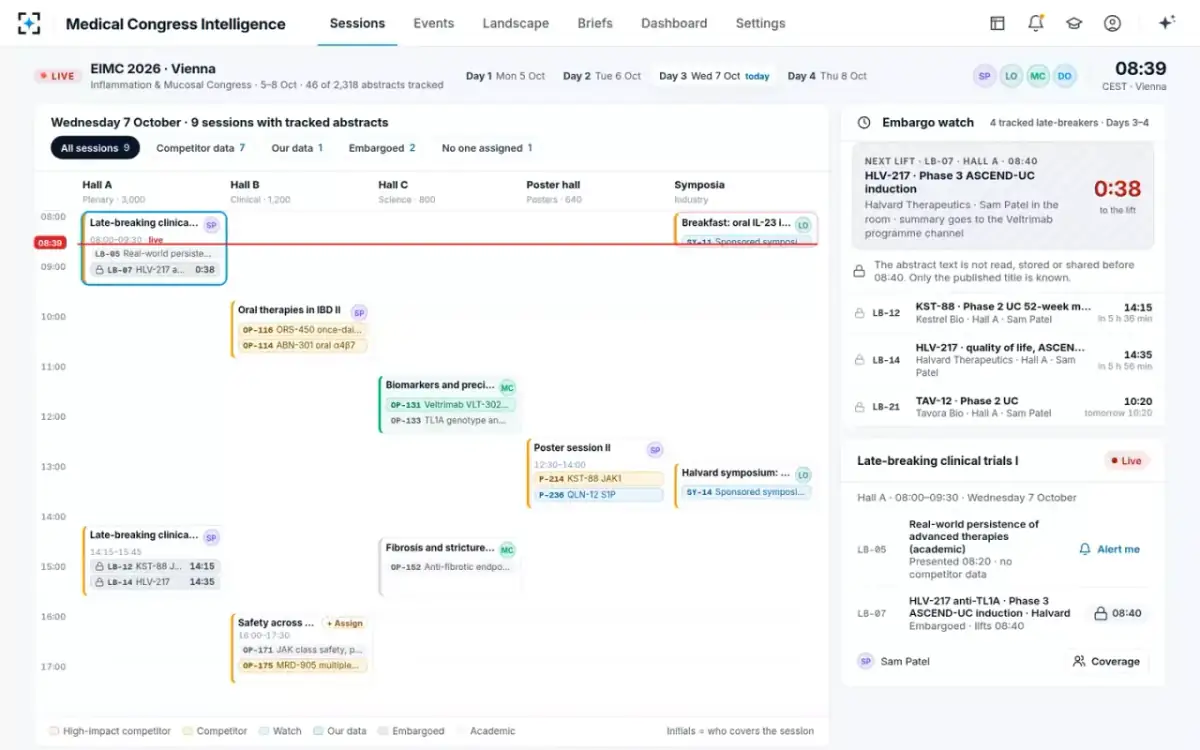
The plan's physical form is a grid: the meeting's days down one axis, its rooms across the other, every session the company cares about marked, and an owner's initials in each marked cell. At the sample congress the grid for one day — Wednesday 7 October — holds nine sessions with tracked abstracts across three halls, the poster hall and the industry symposia, out of 46 abstracts tracked for the whole meeting from a programme of 2,318. Those two numbers are the plan: selection first, coverage second.
The coverage grid, column by column — and what an empty column costs
| Column | What it holds | Who fills it | What goes wrong when it is empty |
|---|---|---|---|
| Session and room | Day, hour, hall, and the abstract numbers inside it. | Taken from the published programme as soon as titles are released. | Two people cover the same hall and nobody is in the third. |
| Why it is tracked | The competitor, mechanism or question that put this session on the list. | The lead, from the watch list the therapy area agreed. | The grid grows until it is the programme again, and selection stops meaning anything. |
| Owner | One person’s initials. Not a team name. | The lead, before the meeting opens. | The cell is covered by whoever is free, or by nobody, and only the debrief finds out. |
| What we are listening for | The two or three things that would change a decision if they were said. | The programme lead, in her own words. | The analyst writes down everything, which is the same as writing down nothing. |
| Release hour | When the abstract text behind the session becomes public. | Read from the society’s publication schedule, not the programme. | The desk either waits past the hour or works from something it should not have. |
| Where it goes | The named channel or list that receives the result. | The lead, as a standing rule agreed before the meeting. | The result sits in a notebook until the evening write-up. |
| Signed by | The person who approves anything beyond a facts-only summary. | Set once, by the lead and counsel together. | Either nothing moves, or something moves that nobody approved. |
What belongs in the second column is not a matter of taste. The same professional standards describe a mechanism for it: "Key insight topics (KITs) and key insight questions (KIQs) may be set at a global or regional level to capture strategically important topics; where these are set, it is important that Field Medical have a strong, up-to-date awareness of these priorities and report any relevant insights in a timely manner." A congress grid built from the year's standing questions selects itself; one built from whoever shouted loudest in the planning meeting does not.
The cell to watch on any grid is the one that is still blank a week out. At the sample congress it is a 16:00 safety session in the second hall, still showing an invitation to assign it. A blank cell is a decision nobody made — and a safety session is a poor place to leave one, because safety detail is exactly what an abstract carries least of.
The grid as the day actually runs, with the release hours counting down
What field medical brings back, and what it may not
Medical affairs attends a congress to have scientific conversations, not to collect competitive intelligence, and the plan has to respect the difference while still capturing what the conversations produce. The professional standards put the obligation plainly: "Field Medical teams gather insights from external stakeholders and share these insights with internal decision-makers." They also set a timing expectation: insights from those interactions "should be entered into the customer relationship management (CRM) system, or other related company insight reporting processes, in a timely manner to ensure that they can be consolidated, analyzed, and actioned as appropriate".
"Timely" at a congress means the same day, because the volume arrives in four days and the memory of which session produced which remark does not survive the flight home. That is a plan requirement, not a software one: whoever covers a session owes a written note before the next one starts.
The limit on what may be said runs the other way. The European industry association's code of practice, for example, lets promotional material at an international meeting refer to a product or use not registered in the host country only on conditions — among them a statement naming the countries where the product is registered and making clear that it, or the indication, is not registered locally. A congress plan that sends people to a stand without that sentence settled has left a compliance question to be answered by whoever is standing there at the time.
Where compliance counsel sits in the week
Counsel's seat exists because two congress questions cannot wait for a post-meeting review. The first is what may be shown and said at the company's own stand and symposia, which the codes answer in advance and which belongs in the plan rather than in the moment. The second is what may be done with something a person heard on the floor, which can only be answered case by case and often within the hour.
For companies operating across several codes at once, the trade associations' joint guidance supplies a tie-break rather than a new rule: where the applicable laws, regulations and codes conflict, the more restrictive provision applies, and the global industry code is treated as the minimum standard. A plan that names the applicable codes, in order, saves an argument in a corridor.
The floor-note question is the one that benefits most from being designed rather than improvised. In the sample congress an analyst's note from a competitor's stand quotes a staff member describing an unblinded interim safety look that has not been published anywhere. The note is held — not used in any summary or alert — and routed to counsel, who can release the part that was genuinely public, such as the study-design handout on the table. Whether information like that is usable at all is a securities question as much as a congress one, and what counts as inside information at a medical congress works through it.
How much of the week is actually spent in the room?
Less than the plan assumes, and the professional standards give a working number for the field medical seat: "For those that are full-time Field Medical professionals, the general assumption is that 70%–90% of their time is focused on preparing for and interacting with the external scientific/clinical community, and 10%–30% is internal (e.g., meetings, training, administrative work); this will vary between companies, and between teams within a single company."
The assumption a congress plan should be tested against
A full-time field medical week, at the lower bound of external time
- Preparing for and interacting with the external scientific and clinical community · 70%
- Internal — meetings, training, administrative work · 30%
At the upper bound
- Preparing for and interacting with the external scientific and clinical community · 90%
- Internal — meetings, training, administrative work · 10%
That split is written for the working year, and it is worth holding against a congress week precisely because congress week inverts it. The meeting compresses an unusual share of the year's external contact into four days and then adds a documentation load on top: notes to write, numbers to check against the abstract book, a daily summary to assemble after the sessions close. The internal share swells at exactly the moment the external share is most valuable, and the people in the seats notice.
So the honest planning question is not how many people to send. It is how many hours of the week each of them will spend producing documents rather than producing judgement — and whether anything in the plan reduces that number.
What the plan looks like when the abstracts read themselves
The shape of the plan does not change; the ownership of the mechanical steps does. The grid, the owners, the listening list and the signature all stay with people. Reading an abstract at its release hour, pulling its fields with a citation each, setting it beside the company's own trial on the same endpoint and drafting the day's summary do not need a person, and they are the steps that eat the week.
One tracked session, from the watch list to a signed debrief
A person decides
The lead sets the watch list and the gridTherapy areas, competitors and mechanisms to watch, the sessions that matter, and one owner per cell.
Agent
Tracked abstracts proposedThe published programme and the released titles become a candidate list for the lead to approve.
Never: reads or uses an abstract before its embargo lifts
Agent
Read at its release hourThe abstract is read and its fields extracted, each carrying the passage it came from and a confidence.
Never: publishes a field below its confidence bar without a person
Agent
Set beside our own trialSame endpoint, same timepoint, with the populations shown next to the numbers.
Never: drops the label that says these are separate trials, not a head-to-head
Agent
Cited lines go to one channelThe channel the lead approved in advance. Facts only, every line opening on its source.
A person decides
The analyst adds the roomWhat the slides said that the abstract did not: subgroups and the questions from the floor, as a note against the session.
Agent
Floor notes checked firstAnything that may not be public is held and routed to counsel.
Never: releases a held note itself
A person decides
The lead rates it and signsShe sets the impact, edits the interpretation and chooses who is told. Nothing beyond the facts-only summary travels without that signature.
In the sample congress the chain runs in minutes: a late-breaker's embargo lifts at 08:40, the abstract is read at that hour, fourteen cited fields exist a minute later, the comparison runs at 08:42 and three cited lines reach the programme channel at 08:43 — hours before the sponsor's own investor call. Those timings are sample data from the solution, and that hour is that congress's; the general rule is whatever the society's schedule says. The design target behind the whole arrangement is 19 analyst hours a week handed back to interpretation. It is a target, not a measured customer result.
What the programme lead actually receives, and when
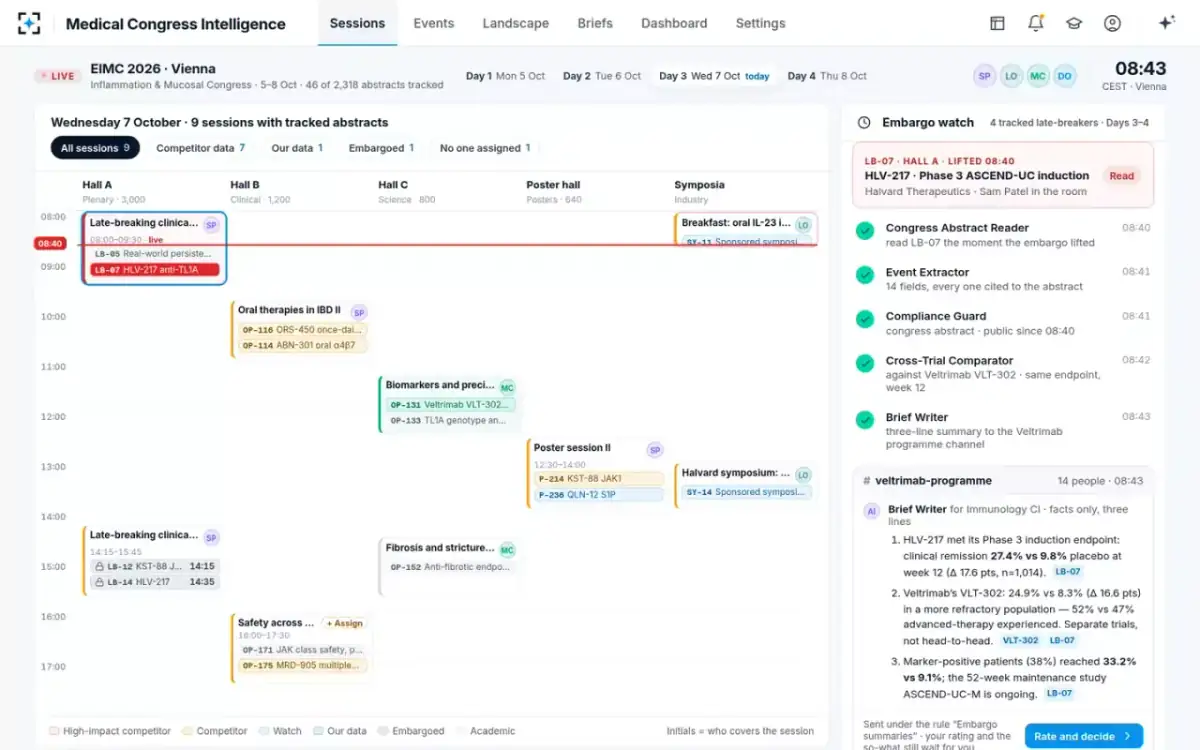
The evening piece keeps the same division. The day's debrief is drafted at 18:00 from the sessions covered, the notes matched to them and the events published that day, with held notes left out; the lead can run it earlier. It goes out when she signs it, not on a timer.
The day's debrief, drafted from the grid and waiting for a signature
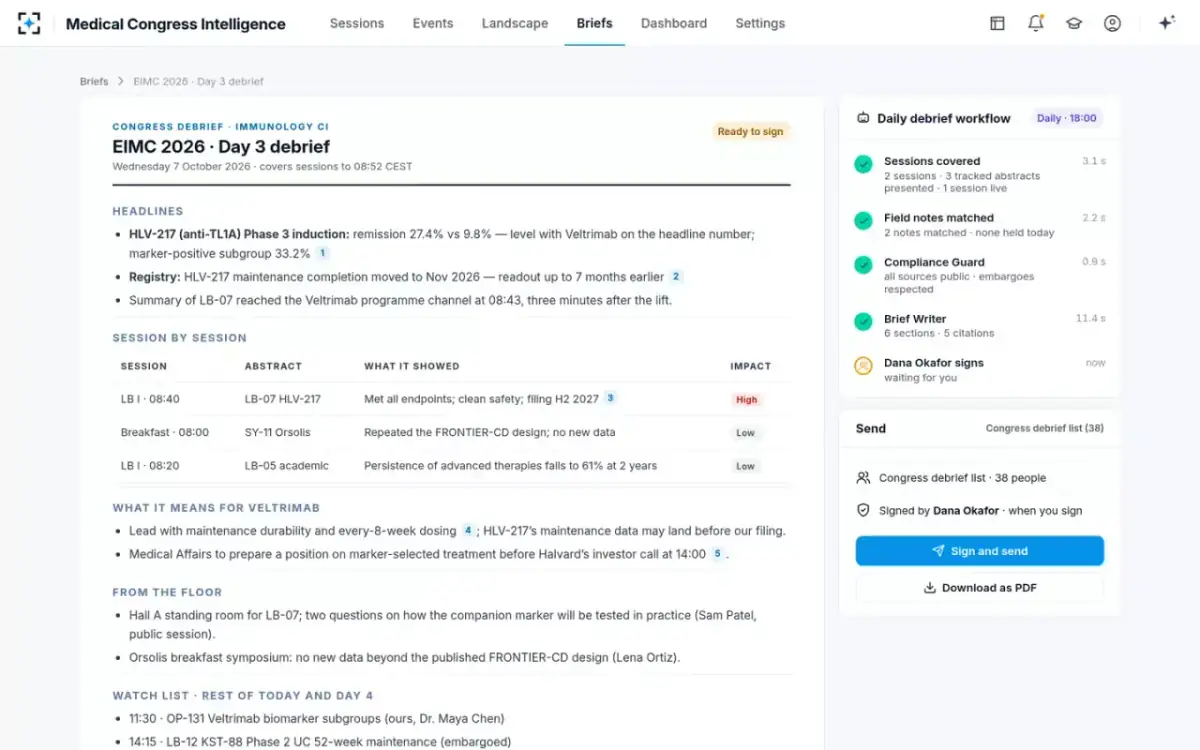
People, companies, products, trials and the congress shown on this page are invented characters and sample data.
Nine questions to settle before the coverage plan is published
- What are we actually trying to learn this year?
Standing insight topics and questions, set above the meeting, are what make selection defensible. The lead and the programme lead answer this one together.
- Which sessions does that put on the grid, and which does it leave off?
At the sample congress, 46 tracked abstracts out of 2,318. If the list keeps growing, the first question was not answered.
- Who owns each cell, by name?
Initials, not a function. The lead assigns them before the meeting opens, and the unassigned cell is visible to everyone until it is filled.
- What is each owner listening for?
Two or three things that would change a decision. Written by the internal reader who will act on them.
- When does each abstract’s text become public?
From the society’s publication schedule, abstract type by abstract type. The programme does not answer this.
- What may be said at our own stand and symposia?
Settled in advance against the applicable codes, including the registration statement the European industry code asks for where a product or use is not registered locally.
- Which codes apply, and in what order?
Where they conflict, the industry associations’ joint guidance applies the more restrictive provision, with the global industry code as the minimum standard.
- Who decides on a note that may not be public, and how fast?
A named counsel with a same-day expectation. Anything less and the note is either lost or used without a decision.
- Who signs what leaves the meeting, and what goes without a signature?
One standing rule for facts-only summaries to one channel; a signature for everything else, including the daily debrief.
Building next year's plan from this year's grid
A congress plan is worth keeping because it is also a measurement. At the end of the week the grid shows which cells were covered, which produced something that moved a decision, which produced a note nobody read, and which were never assigned at all. That is a better basis for next year's headcount than any argument about how important the meeting is.
The standards ask for the loop to be closed explicitly: "Feedback loops should be built into processes to ensure that Field Medical colleagues can see the impact that submitted insights have; this can include direct feedback to the submitter or case studies." The congress version is a short note against each covered session saying what happened to what came out of it. It takes an hour and it is the only thing that makes the next plan smaller rather than larger.
Two further pages carry parts of this plan in detail. What goes public when at a medical congress sets out the release hours the grid is built on, and what happens in the hour a late-breaker lifts follows the single cell that most often decides whether the week paid for itself. To see the grid, the summaries and the debrief working together, start from Medical Congress Intelligence.
Questions people ask
What is a congress in pharma?
A congress is a scientific meeting run by a medical society — a professional body such as a specialty association — rather than by a company, usually with several thousand abstracts across parallel halls and poster sessions. Companies take part in several capacities at once: presenting their own studies, running exhibition stands and satellite symposia, and watching what competitors present. The industry associations' own guidance treats all of those as activities at one congress, governed together.
How many people does a company send to a congress?
There is no standard number, and headcount is the wrong starting point. The useful figure is how many grid cells a therapy area intends to cover and how many hours each covered cell actually costs, including the write-up. The sample plan on this page covers nine tracked sessions on its busiest day with five named seats, only two of which are in rooms full-time.
What does a medical science liaison do at a congress?
Field medical roles attend for scientific exchange with the external clinical community, and they bring the insights from those conversations back to internal decision-makers. The professional standards expect those insights to be entered into the company's reporting system "in a timely manner" so they can be consolidated and acted on — which at a four-day meeting means the same day, not the week after.
How do you decide which sessions to cover at a congress?
From standing questions rather than from the programme. Where a company sets key insight topics and key insight questions at a global or regional level, those decide what is tracked, and the grid follows. At the sample congress that selection reduced a programme of 2,318 abstracts to 46 tracked ones — about two in every hundred.
Who signs off what goes out from a congress?
In a plan that works, one named person, decided before the meeting opens, with one narrow exception agreed in advance. In the sample setup a facts-only summary goes to a single pre-approved channel under a standing rule, while impact ratings, interpretation, alerts to any other list and the daily debrief all wait for the lead's signature. Held notes wait for counsel instead.
When should the coverage plan be finished?
Before the abstract titles are released, because the titles are what fill the grid, not what build it. Selection comes from the year's standing questions; the published titles then attach real sessions, halls and hours to cells that already have owners. A plan assembled after the programme is public tends to become the programme again.