Meeting abstracts are not peer reviewed in the sense the phrase carries on a journal article. A congress scientific committee reads submissions against published criteria and decides which to accept and in what format — typically a fast decision on a fixed document, without the revision cycle and author response of journal review. That is editorial triage, and it is a real filter, but it is a different thing from the review a manuscript goes through. The practical consequence is measurable: across 425 reports covering 307,028 abstracts, a Cochrane review found "an overall full publication proportion of 37.3%", and when abstracts do become papers the numbers frequently move. Botminds' Medical Congress Intelligence is built so that a congress number never travels without the thing that makes it readable — the passage it came from, the confidence attached to it and what kind of document it is — because the caveat is what makes the number usable, not what weakens it.
The research below is peer-reviewed work from the journals named with each figure. The screens come from the solution's fictional sample congress, and the people, companies, products and trials in them are invented.
Four published findings a congress number has to live with
37.3%
of abstracts are ever published in full, across 425 reports and 307,028 abstracts
19%
of published plastic surgery articles differed from their abstract in the results
95.6%
of matched prosthodontic research articles showed some change from their abstract
55%
of trials changed a prespecified primary outcome at some point in the trial
Abstract selection is not peer review
What a congress committee does is select, under time pressure, from a very large pile. It reads the submission against criteria the society publishes, it decides accept or reject, and where it accepts it also decides the format — a main-session talk, a short oral slot, a poster. At ESMO a late-breaking submission goes through two passes of that process and ends in one of three outcomes: an oral presentation for "original data of superior quality", a mini-oral for data "of good quality", or rejection, in which case the work "will not be accepted for presentation and will not be published". That is a genuine filter with stated standards. It is also a single decision on a fixed document, which is where it parts company with journal review.
What it cannot be is a check on the work, because the document does not contain enough to check. Scherer and Saldanha, writing for systematic reviewers who have to decide what to do with conference abstracts, put the limitation plainly: "abstracts may not contain adequate information for systematic reviewers to appraise the design, methods, risk of bias, outcomes, and results of studies reported in the abstracts". A reviewer cannot assess a risk of bias that the document never describes, and nor can a committee.
So the honest description of what an "LBA" or an accepted abstract tells you is this: a group of specialists thought the question and the design were worth the field's attention, and thought the result was important enough for a particular kind of slot. How a scientific committee decides on a late-breaker sets out that process in detail. None of it is a judgement that the numbers are right.
How many congress abstracts are ever published in full?
A little over a third, and that figure is unusually well established. The Cochrane methodology review by Scherer and colleagues pooled the literature on the question and reported that "combining data from 425 reports (307,028 abstracts) resulted in an overall full publication proportion of 37.3% (95% confidence interval (CI), 35.3% to 39.3%) with varying lengths of follow-up".
the overall full publication proportion was only 37% (95% confidence interval [CI], 35 to 39%) for abstracts of all types of studies and only 60% (95% CI, 52 to 67%) for abstracts of randomized controlled trials (RCTs)
Scherer and Saldanha, 'How should systematic reviewers handle conference abstracts? A view from the trenches', Systematic Reviews, 2019
The split in that sentence matters more than the headline. Randomised controlled trial abstracts reach full publication about 60% of the time; abstracts of all study types, about 37%. A competitive intelligence desk mostly watches trial readouts, so the higher figure is the relevant one — and it still means two in five never appear as a paper. The format of the presentation also predicts the outcome: the Cochrane review found that "studies with abstracts presented orally are more likely to be published than those presented as posters".
Nothing about that is a scandal. Trials are presented for many reasons, manuscripts are slow, and plenty of good work never gets written up. It is simply the base rate a reader needs before treating a congress figure as a durable fact. Many congress numbers are the only public version of themselves that will ever exist.
How much do the numbers move between abstract and paper?
Enough to change a conclusion, in a meaningful minority of cases. Two specialty series measure it from different angles and land in the same place.
Dagi and colleagues reviewed 486 abstracts from oral presentations at a plastic surgery conference over eleven years; "sixty-three percent (N = 305) of scientific abstracts advanced to publication in a peer-reviewed, PubMed indexed journal". Among those published articles, "nineteen percent (N = 59) of published articles contained a discrepancy in the results when compared with the initial conference abstract". Prasad and colleagues, looking at prosthodontic research abstracts from a dental research meeting matched to their later articles, counted any change rather than only results changes and found that "a total of 109 (95.6%) articles showed changes from their abstracts".
The two numbers are not in conflict; they answer different questions. Almost every paper differs from its abstract somewhere, which is unremarkable — a manuscript is longer, later and better described. In the plastic surgery series, about one in five differed in the results themselves — by the authors' definition, a change in the direction of an outcome or a quantitative change of more than 10% — which is not unremarkable at all if the result is the thing you put in a competitive summary.
Six studies, six different questions — and what each one does and does not license
| The study | What it measured | What it found | What you may say on the strength of it |
|---|---|---|---|
| Scherer and colleagues, Cochrane Database of Systematic Reviews, 2018 | How often abstracts reach full publication, pooled across the literature. | 37.3% overall, from 425 reports and 307,028 abstracts; orally presented abstracts are more likely to be published than posters. | That most congress abstracts never become papers. Not that a specific abstract will not. |
| Scherer and Saldanha, Systematic Reviews, 2019 | What systematic reviewers can actually appraise from an abstract. | 37% overall and 60% for randomised trials reach full publication; abstracts often lack enough detail to appraise design, bias, outcomes and results. | That an abstract is thin evidence by construction. Not that its headline number is wrong. |
| Dagi and colleagues, PRS Global Open, 2021 | Discrepancies in the results between conference abstracts and the published articles. | 63% of 486 abstracts were published; 19% of those articles differed from the abstract in the results. | That roughly one in five published results moved. Not that the direction of effect usually changes. |
| Prasad and colleagues, International Journal of Dentistry, 2012 | Any change between abstract and full-text publication, by category. | 109 (95.6%) of the matched articles showed some change; major discrepancies spanned purpose, methods, sample size, analysis, results and conclusion. | That change is the norm rather than the exception. Not that most changes are material. |
| Holst and colleagues, PLOS Medicine, 2023 | Changes to prespecified primary outcomes over the course of a trial. | 55% of 292 trials had primary outcome changes at some point; 23% had major changes. | That the endpoint itself is not fixed. Not that the change was improper in any given trial. |
| Singstock and colleagues, The Oncologist, 2026 | Spin in the reporting of primary endpoints in randomised myeloma trials. | Spin in about a third of published studies, and nearly two-thirds of trials with non-significant primary endpoints. | That the framing around a number needs reading as carefully as the number. Not that the number is false. |
What counts as a major discrepancy
The dental series is useful because it defined the categories explicitly rather than counting "differences" in the abstract. "Major discrepancies consisted of changes in study purpose, materials and methods, sample size, statistical analysis, study outcome, result, and conclusion." Each of those is a change a reader of the abstract could not have anticipated, and each falls in a different place.
Where the changes fell, category by category
Two of those bars should make a competitive analyst uncomfortable. A change in the statistical analysis can turn a significant result into a non-significant one without a single patient changing. A change in the conclusion is the authors themselves revising what they thought the study showed. If a congress number has already been written into a strategy document, both are changes that arrive after the document stopped being read.
Why the numbers move: enrolment, analysis, and the endpoint itself
The most mechanical reason is that the denominator changes. In the plastic surgery series, "of the published studies, 34% (N = 103) had a change in sample size" between the abstract and the article — and the direction mattered a great deal. The authors report that "the odds of a discrepancy were 25-fold greater in studies with a decrease in sample size of more than 10% when compared with studies with no change in sample size (OR 24.92, 95% CI 8.66–71.68, P < 0.001)", with an increase of more than 10% also associated with an elevated risk (OR 8.36, 95% CI 3.69–18.97).
That gives a reader something to do rather than something to worry about. The patient number in a congress abstract is the single most checkable field, and a later paper that reports a materially different one is a signal to re-read the result rather than to carry it forward.
The deeper reason is that the endpoint itself is not as fixed as a reader assumes. Holst and colleagues followed prespecified primary outcomes across trials at German university medical centres and found that "overall, 55% of trials (161 of 292; 95% CI [49%, 61%]) had primary outcome changes at any timepoint over the course of a trial, with 23% of trials (67 of 292; 95% CI [18%, 28%]) having major changes". They define the major category tightly: "major changes were defined as adding or dropping primary outcomes, changing them to secondary outcomes, or turning secondary outcomes into primary outcomes". A congress abstract reports the endpoint as it stood on the day the data closed, which is not necessarily the endpoint the trial registered or the one the paper will lead with.
Spin: the error that is not a wrong number
There is one more failure mode, and it is the hardest to catch by checking arithmetic: the number is correct and the sentence around it is not. Singstock and colleagues examined how primary endpoints are reported in randomised myeloma trials and concluded that "in this cross-sectional analysis of RCTs in myeloma, spin was present in approximately one-third of published studies and in nearly two-thirds of trials with nonsignificant primary endpoints".
Read that second clause again, because it is the operational one. When a trial misses its primary endpoint, the reporting is much more likely to lead with something else — a secondary endpoint, a subgroup, a trend. A congress abstract has 2,000-odd characters in which to do that, and a conclusion line that reads as confident as any other. An analyst summarising a competitor's abstract has to separate what was prespecified and met from what is being offered instead, and say which is which.
The practical test is short. Was the primary endpoint met, on the population it was prespecified in? If the answer is not an unqualified yes, the summary says so in its first line, whatever the conclusion of the abstract says.
Does a meeting presentation block journal publication?
No, and this is worth knowing because it is the reason so many congress numbers exist in abstract form at all. The International Committee of Medical Journal Editors states that its overlapping-publication recommendation "does not prevent a journal from considering a complete report that follows publication of a preliminary report, such as a letter to the editor, a preprint or an abstract or poster displayed at a scientific meeting".
So the abstract is not the paper's competitor; it is its forerunner, published months or years earlier, written against an earlier data cut, and selected by a committee rather than reviewed by peers. All of which means the right mental model for a congress number is not "unverified" but "provisional, and dated". The release hour an abstract is published under is itself part of that date.
Four caveats every congress number should carry
The purpose of a caveat is not to hedge. It is to tell the next reader what they may do with the number without going back to the source. Four pieces of information do almost all that work, and all four fit on one line of a summary.
What has to travel with a congress figure
- What kind of document it came from, and when.
An abstract selected by a congress committee, with the date of the data cut if the abstract gives one. "Provisional and dated" is the status; a reader who knows that can weigh it correctly without being told to be careful.
- The population the number was measured in.
Enrolment, the line of therapy, the proportion previously treated. One in three published studies in the plastic surgery series changed its sample size between abstract and article, so the denominator is the first thing to re-check later.
- Whether this was the prespecified primary endpoint, and whether it was met.
Spin was present in nearly two-thirds of myeloma trials with non-significant primary endpoints. If the headline is a secondary endpoint or a subgroup, the summary has to say so before it says the number.
- The passage the figure was taken from.
Not a reference at the end, but the sentence itself, reachable in one click. A caveat that lives in a separate document is a caveat that stops travelling after the first forward.
How a congress desk keeps the caveat attached to the number
The reason caveats fall off is mechanical, not cultural. A number is read in a hall, typed into a note, pasted into a summary, lifted into a slide and quoted in a meeting, and at each step the thing it came from is one more document away. By the fourth step the figure is a bare percentage with a drug name attached.
The design decision in Medical Congress Intelligence is to make the citation a property of the field rather than a footnote on the document. Every extracted field carries the passage it was taken from and a confidence; a field below the confidence bar is not published without a person looking at it; and each line in a summary opens on the passage it came from rather than on a reference list.
The field, its confidence, and the sentence it came from
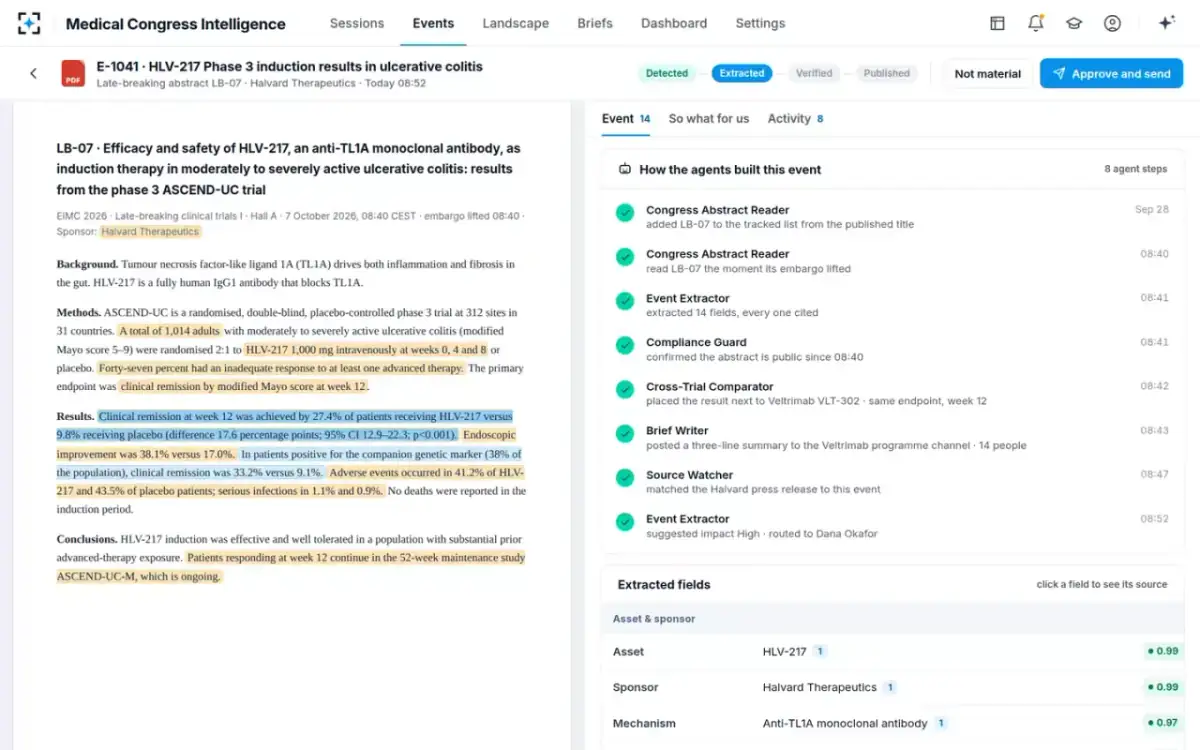
What the solution deliberately does not do is claim to verify a congress figure against a paper that does not exist yet. There is no automated check that a 27% response rate will survive to publication, because no such check is possible at the hour the abstract appears. What it does is keep the figure, its source and its status together, so that when the paper does appear the comparison is a two-minute job rather than an archaeology project.
One asset, every public mention, each with its stage
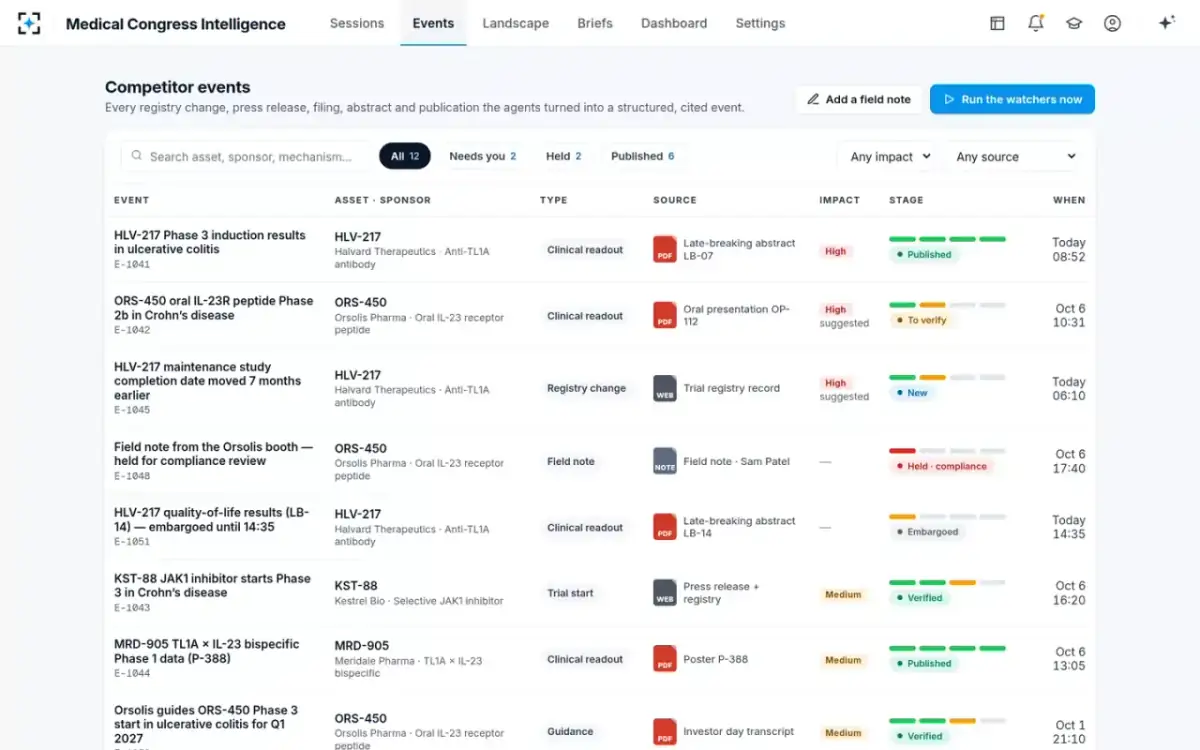
People, companies, products, trials and the congress shown on this page are invented characters and sample data.
The discipline the solution cannot supply is the reader's. A number that has been labelled correctly can still be quoted carelessly in a meeting three weeks later. What a desk can do is make the correct label the path of least resistance, and make the original passage one click away for anyone who wants to argue with it. What must match before two trials can sit in one table is the next discipline along, and the one where congress numbers do the most damage.
Questions people ask
Do conference abstracts count as publications?
For a bibliography, often yes: accepted abstracts are commonly published in a supplement to a society journal — ESMO publishes its Immuno-Oncology Congress abstract book as a supplement to its official journal — and can be cited. For evidence, they are a weaker category than a paper, because the document does not carry enough to appraise design, risk of bias or analysis, and because only about 37% of abstracts ever reach full publication at all.
Can you cite a conference abstract?
Yes, provided the citation says what it is. Cite the abstract with its number, the congress and the year, so a reader can see that the figure is a congress reading rather than a published result. Systematic reviewers who use abstracts are explicitly warned that abstracts "may not contain adequate information" to appraise the study, which is the same caution a commercial reader needs.
What percentage of conference abstracts are published in full?
37.3% across all study types, from a Cochrane review pooling 425 reports and 307,028 abstracts. For abstracts of randomised controlled trials specifically the figure is about 60%. Abstracts presented orally are more likely to reach publication than those presented as posters.
Is a congress abstract enough to change a decision?
It is often enough to change what you do next — brief a programme team, re-run a scenario, move a meeting — and rarely enough on its own to change a committed plan. The distinction is between acting on information and treating it as settled. A figure that comes with its population, its endpoint status and its source passage supports the first use safely; nothing supports the second until the full data set is public.
Does presenting at a meeting stop a journal publishing the paper?
No. The ICMJE's recommendation on overlapping publication expressly does not prevent a journal from considering a complete report that follows a preliminary report such as "an abstract or poster displayed at a scientific meeting". Authors are still asked not to give reporters more detail than the presentation contained.
Are poster abstracts reviewed differently from oral ones?
They are selected into different formats by the same committee, and the format carries information. At ESMO the top outcome for a late-breaking submission is an oral slot for original data "of superior quality", with a short oral slot for data "of good quality". The Cochrane review found that abstracts presented orally are more likely to be published in full than those presented as posters — so the format a committee chose is itself a weak predictor of whether the result will ever be written up.