A congress strategy in pharma is usually written as a list of meetings and a budget. That is a travel plan. The strategy question underneath it is harder and more useful: when your largest competitor reads out at the biggest meeting of the year, what will your organisation be able to show afterwards — who covered which session, where each number came from, who decided it mattered, who was told, and when. Congress coverage climbs four levels against that question, and what separates them is not the tooling but the artefacts each one can produce on demand. Botminds' Medical Congress Intelligence is built to the shape of the fourth, and this page is as much about getting to the third without it as about where a tool belongs.
The levels below are ours, assembled from what a congress desk is actually asked to produce by compliance reviewers, programme leads and finance. Figures from the working product come from a fictional sample congress and are marked as demonstration data. The ninety-day plan is a planning horizon for a reader with a meeting ahead, not a delivery commitment by anybody.
What the climb is measured in
4
levels, each defined by what the desk can produce rather than what it owns
8
artefacts a governed desk owes, and can show without preparing them first
9.5h
to brief a programme team by hand, in the sample baseline
demo
1.1h
median from a source being published to the alert, in the sample
demo
What should a pharma congress strategy cover?
Six decisions, and they are all decisions about constraint rather than ambition. Which competitors, mechanisms and therapy areas are watched, which is the decision that makes every other one tractable — a watch list of everything is a watch list of nothing. Which sessions are covered in person and by whom, since the scarce resource at a congress is seats, not software. Which sources count as evidence, and which are switched off. How fast a finding has to reach the people who can act on it, stated as a time rather than as "quickly". Who decides what a finding means and who is told. And who reviews anything that might not be usable.
The professional body's framework for insight generation makes the first of those concrete in a way that transfers directly to a congress. Teams should translate strategic priorities into themes and then into specific questions: "first, teams define broader themes known as Key Insights Topics. Next, they draft specific Key Insight Questions to guide field interactions and meetings", so that the desk is "focus[ed] on answering critical business questions rather than collecting random feedback". A congress strategy that cannot name the five questions it is trying to answer at the meeting will come home with a report nobody reads.
The sixth decision is the one most often skipped and the one a compliance reviewer asks about first. The pharmaceutical trade associations' joint guidance on international congresses expects companies to document clearly why they support an event — a requirement about sponsorship rather than intelligence, but the habit it describes is the same one: write down why you are there and what you expect to get.
Level 1: the debrief that arrives the next morning
A level-1 desk covers congresses reactively. Somebody senior decides a week beforehand which sessions matter, two or three people go, and they write up what they saw when they get back. The debrief is a document in an inbox. The numbers in it are correct as often as the person typing them was careful, and nobody can check without finding the abstract themselves.
It is not a failure state; it is where many desks start, and a good analyst at level 1 produces better judgement than a badly run level 3. Its two real weaknesses are both about proof. If a programme lead asks in March where a figure from October came from, the answer is a search of someone's notes. And the desk has no way to show what it did not cover, which means the gaps are invisible to everybody including itself.
Level 2: the programme read in advance
At level 2 the congress programme is read before the meeting rather than during it. A tracked list of abstracts exists, with names against sessions, and somebody has worked out where two tracked sessions collide. The write-up has a shape: a template, a distribution list, a consistent set of fields. Coverage becomes a measurable quantity for the first time, because there is now a denominator.
This is the level where many well-run desks sit, and it is reachable with a spreadsheet and a disciplined fortnight. It is also where the ceiling becomes obvious. The abstracts go public in a four-day burst; the team is in sessions; and the write-up still happens in the evening, which puts the programme team a day behind the sponsor's own communications. Who sits where, and how a team of five covers nine parallel sessions, is a planning problem in its own right — who covers a meeting, seat by seat works it through.
Level 3: continuous, cited, and inside the hour
A level-3 desk is not a congress desk that works harder four times a year. It watches continuously and the congress is a spike in the load rather than a separate activity. Registries, company releases, filings and journals are read on a schedule; the congress programme and abstracts join them as another source with a clock attached. Every fact carries the passage it came from, so a reader can check any number in a click rather than a day.
Continuity is what makes registry work pay, and the regulations are what make registry work possible. Under the US rules, results information for an applicable trial is generally due within a year of its primary completion date, and the record verification date "must be updated any time the responsible party reviews the complete set of submitted clinical trial information for accuracy and not less than every 12 months, even if no other updated information is submitted at that time". Those deadlines mean a rival's registry entry is a dated, legally maintained object. A desk reading it hourly sees a completion date move the week the entry changes; a desk reading it quarterly learns about the same change at the congress, from the stage.
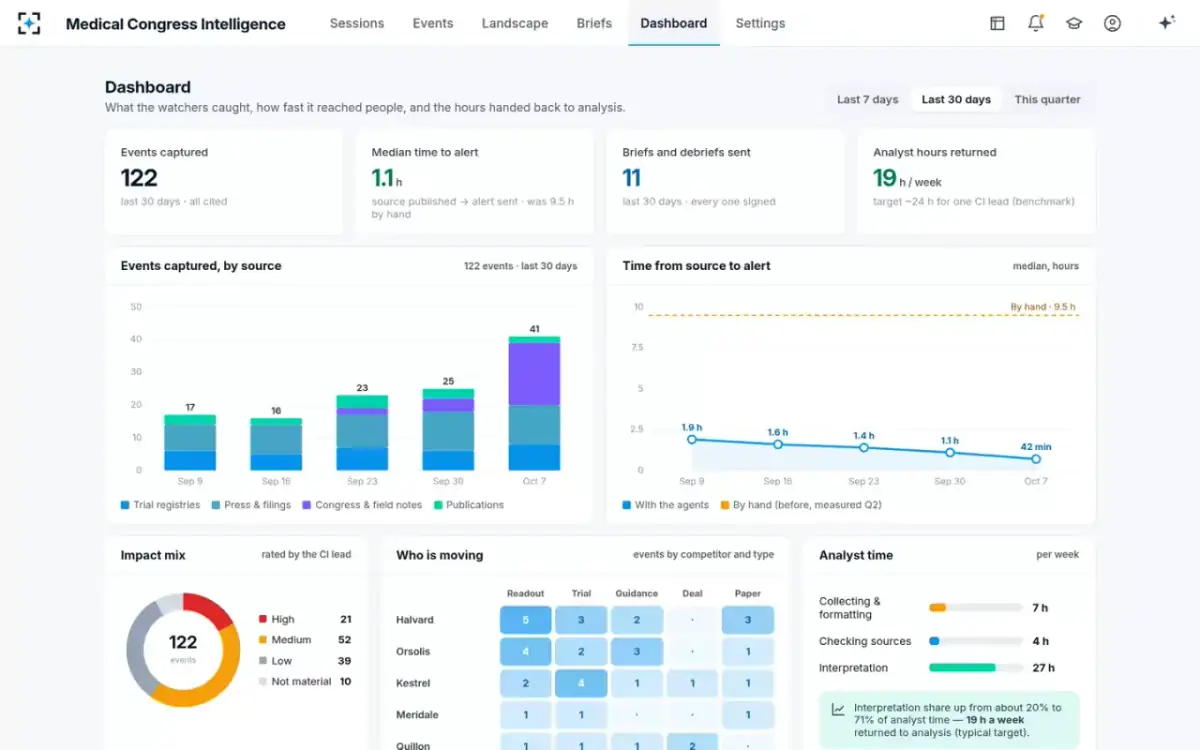
The timeliness target at this level should be stated as a number. In the sample configuration the measures reported are the median time from a source being published to the alert against the by-hand baseline, events captured by source, the impact mix and analyst time — and the sample watch covers the congress programme and abstracts, eight public trial registries, 84 company sites and 3 wires hourly, securities filings, and 38 journals weekly alongside a licensed pipeline database. Those counts describe one configuration on fictional data; the point is not the numbers but that a level-3 desk can state them at all.
Level 4: governed, measured and signed
Level 4 adds the three things a reviewer asks for and a level-3 desk usually cannot produce: a named decision on every item that went out, a compliance route for anything that might not be usable, and a measurement of the desk's own performance that would get worse if the desk got worse.
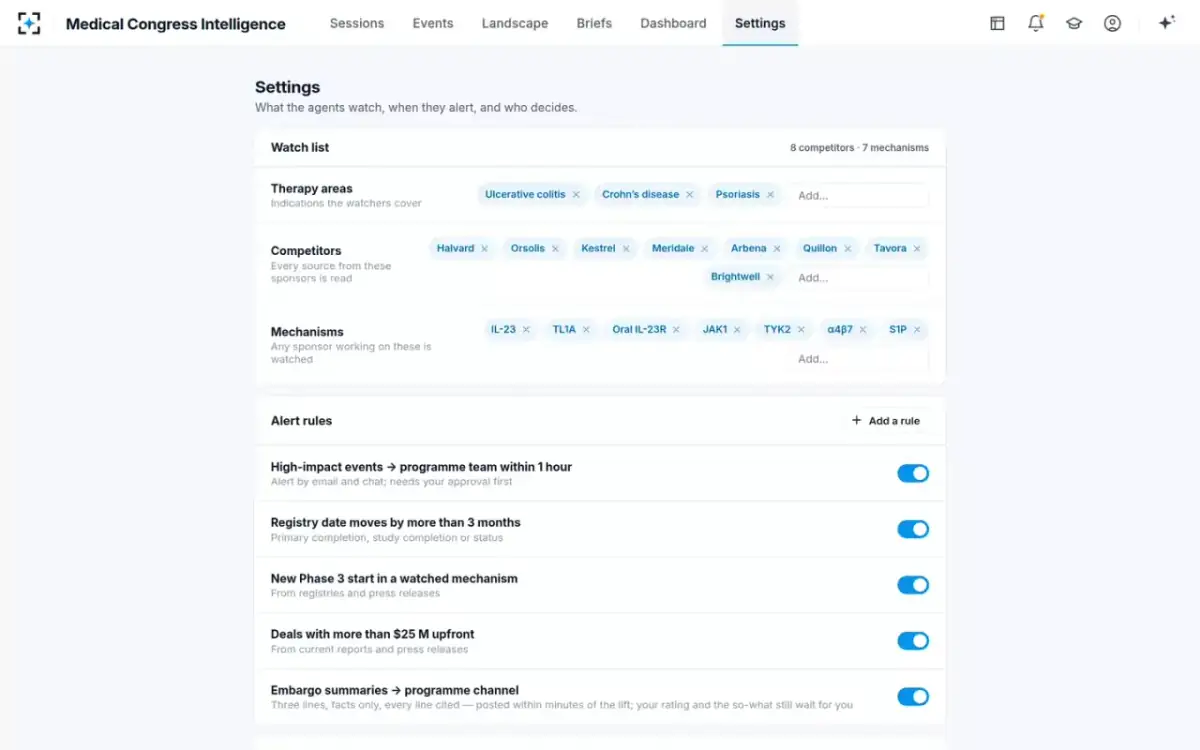
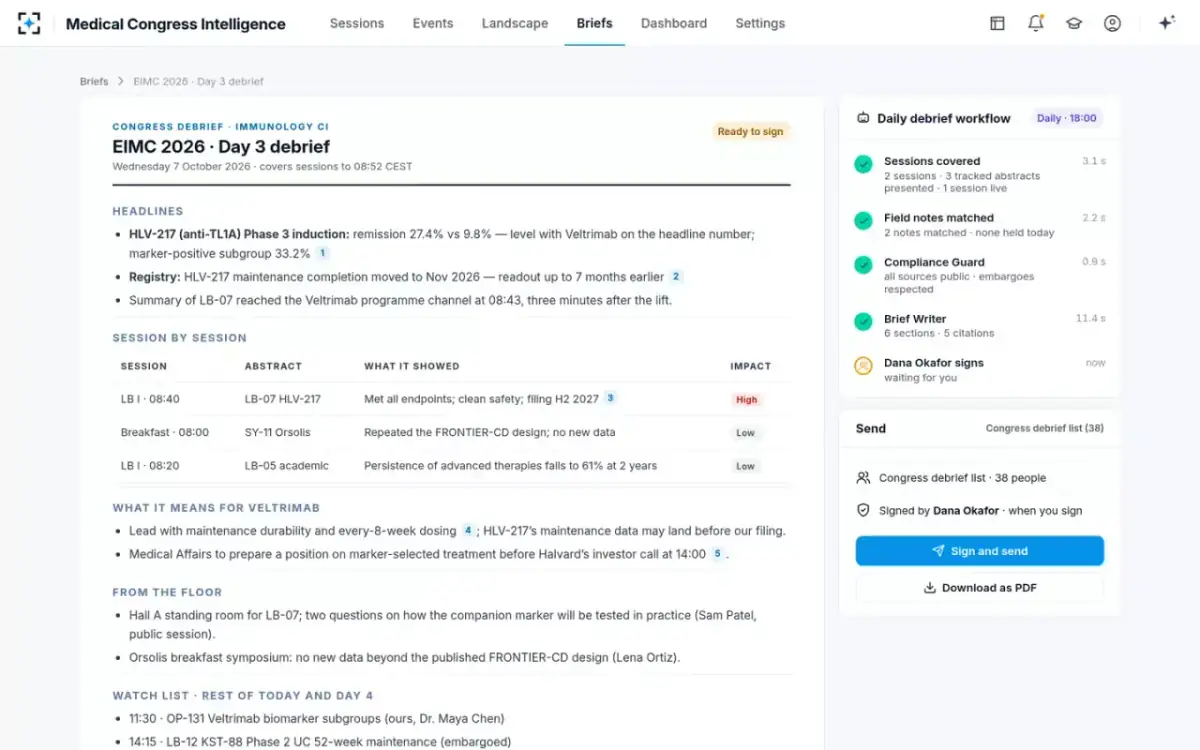
Concretely, that means exactly one output can leave without a signature and everybody can name it. It means a field note that may be non-public is held at capture and routed to one named person who alone can release its public part. It means the impact rating, the interpretation, the distribution lists and the daily debrief all carry a signature. And it means every step — added, read, held, rated, signed, sent — is kept with the item, so a question asked in March about a decision taken in October has an answer that does not depend on anybody's memory.
Two external frameworks describe the same expectation without naming congresses. The NIST AI Risk Management Framework asks for written policies that separate the roles and responsibilities of people and AI systems, including who oversees the system, and for roles, responsibilities and lines of communication that "are documented and are clear to individuals and teams". The EMA's reflection paper, writing about medicines development rather than intelligence, places the same burden on the organisation rather than the supplier.
Clinical trial sponsors, marketing authorisation applicants, marketing authorisation holders (MAHs) and manufacturers planning to deploy AI/ML technology are expected to consider and systematically manage relevant risks from early development to decommissioning.
European Medicines Agency, Reflection paper on the use of artificial intelligence in the medicinal product lifecycle, 9 September 2024
Neither document governs a competitive intelligence desk. Both tell you what the people reviewing your desk will have been reading.
How do you assess congress coverage maturity?
Not by asking the team how they work, which produces an aspirational answer, but by asking for six things and timing how long each takes to arrive. If an artefact needs assembling, the desk does not have it.
Four levels against six capabilities, and the proof each cell owes
| Capability | Level 1 · reactive | Level 2 · scheduled | Level 3 · continuous | Level 4 · governed |
|---|---|---|---|---|
| Watch list | In somebody's head. | A written list, reviewed before each meeting. | A living list driving automated collection. | Versioned, with who changed it and when. |
| Sources | Whatever was to hand. | A named set, read manually. | Read on a schedule, every version kept. | Each classified public or licensed; some deliberately switched off. |
| Timeliness | Next morning, or later. | Same evening. | A stated target in hours, measured. | Measured as a median against a baseline, reported. |
| Citation | The analyst remembers. | Sources listed at the end. | Every field opens on its passage. | Citation rate measured, not assumed. |
| Compliance hold | Ad hoc, by instinct. | A rule people are told about. | A check that runs before anything is drafted. | Held at capture, routed to one named person, timed. |
| Signature | Whoever hits send. | A reviewer, usually. | A named approver for alerts. | One enumerated exception; everything else signed, with the trail kept. |
Score each row honestly and the result is almost never a single level. A common pattern in a well-resourced team is level 3 on sources and timeliness and level 1 on compliance hold and signature, often because the collection side attracts investment and the governance side attracts nobody until something goes wrong. That mismatch is the finding, and it is cheaper to fix than the collection gap.
The eight artefacts each level owes
Ask for these eight. The honest test is not whether the desk can produce them but whether it can produce them this afternoon, without anybody writing anything new.
Eight artefacts a congress desk should be able to show without preparing them
- The watch list, with a date and an owner.
Competitors, mechanisms, therapy areas and assets. If two people produce different lists, there is no watch list.
- The coverage grid for the last meeting.
Every tracked session by day and hall, with the initials of whoever covered it — including the blanks.
- The source inventory, classified.
Every source, marked public or licensed, with the ones deliberately switched off and the reason.
- The timeliness baseline.
Median hours from a source becoming public to the programme team being told, measured over at least thirty events.
- One brief, traced end to end.
Pick a brief at random and follow every number to the passage it came from. This is the test that separates levels 2 and 3.
- The held-note log.
What was held, when, by whom, how long until a decision, and what was released. An empty log over a four-day meeting is a finding.
- The signature list.
Everything that can leave the desk without a person, written down. It should be short enough to read aloud.
- The distribution lists, with head-counts and owners.
Who gets what, who maintains each list, and the date of its last review. Stale lists are how a confidential alert reaches someone who left the programme.
Where the governance of a level-4 desk lives: the settings in Medical Congress Intelligence
What you bring to a pilot on a past congress
A pilot on a live meeting proves nothing, because nobody knows the right answers yet. A pilot on a congress that already happened proves everything, because you can mark the output. Run it on a meeting from last year in your own therapy area, and bring six things.
The watch list you would have used. The published programme and abstract book for that meeting. Your own approved top-line summaries for the assets you will compare against, so that like is set beside like and your data is labelled as yours. The distribution lists as they stood. The alert rules you would have set — which events deserve an alert within the hour, which registry moves matter, what size of deal is worth a note. And the names: who would have approved an alert, who would have signed the debrief, who reviews a held note.
Then mark it. Did it catch the events you know mattered? Did it miss any? How long would each have taken to reach the programme team? Can you follow every number to a passage? Did anything get held that should not have been, or go out that should have been held? Those five questions produce a decision; a demonstration on a vendor's own data produces an impression. The field-by-field version of the accuracy question is set out in how to measure whether an AI summarised an abstract, and the limits a tool should be held to are in six agents, six hard limits.
The same late-breaker, at a level-2 desk and a level-4 desk
Level 2 · scheduled: The analyst is in the hall, listening and writing.
Level 4 · governed: The abstract is read at the lift; the analyst listens.
Level 2 · scheduled: Still in the session.
Level 4 · governed: Three factual lines, each carrying its source, reach the programme channel under a pre-approved rule.
Level 2 · scheduled: Session over; notes in a notebook.
Level 4 · governed: The lead has rated the impact, edited the interpretation, chosen two distribution lists and left two off, and signed.
Level 2 · scheduled: The programme lead hears the result from the call.
Level 4 · governed: The programme lead has had the cited numbers, and the lead's signed position, for more than five hours.
Level 2 · scheduled: Hours of write-up after a long day in the halls.
Level 4 · governed: The debrief is drafted from sessions covered and matched notes; the lead reads, edits and signs it.
Level 2 · scheduled: Written into the notebook; caught later, or not.
Level 4 · governed: Held at capture and routed to compliance counsel; the public part of the visit stays usable.
Level 2 · scheduled: A search through notes and an abstract book.
Level 4 · governed: Open the item: the passage, the time, and the name against each decision.
Ninety days to the next meeting: the plan, week by week
Ninety days is roughly the horizon between deciding to change something and the next congress of any size. The sequence below is a planning shape for a reader with a meeting ahead; it is not a delivery schedule and nobody should read a vendor timetable into it. The ordering is the part that matters: every later step depends on the watch list, and the governance decisions have to be made by people who are hard to get hold of, so they go early rather than late.
A ninety-day planning horizon to the next congress
- Watch list and the five questionsdays 1–14
- Sources classified; baseline measureddays 15–28
- Governance: approver, signatory, held-note reviewerdays 29–42
- Pilot on a past congress; mark the outputdays 43–63
- Alert rules and distribution lists agreeddays 64–77
- Coverage grid, dry run, debrief rehearsaldays 78–90
Two notes on the sequence. The governance block sits third and not last because the approver, the signatory and the held-note reviewer are usually busy people whose diaries are the real constraint, and because a pilot you cannot show to a compliance reviewer is a pilot you will run twice. And the final block is a rehearsal rather than a launch: run one past session through the whole chain, from tracked abstract to signed debrief, with the actual people who will do it on the day.
How do you know the level actually changed?
By measuring the same things before and after on the same event mix, and by refusing to count the measures that always improve. Volume measures — events captured, briefs sent, notes filed — rise the moment anybody installs anything, and prove nothing about whether a decision got better.
Four measures survive that test. Median time from a source becoming public to the programme team being told, measured on comparable events. Coverage of tracked abstracts, and separately of the ones rated high-impact, because the second is the one that falls when the team is overloaded. Citation rate — the share of statements that open on the passage they came from. And the time a held note waits for its decision, which is the measure that tells you whether the compliance route is real or ornamental. The arithmetic behind the first of those, and what an analyst hour is worth, is set out in nine hours down to one.
The fifth measure is the hardest and the one worth building a habit around: go back to the programme team a month later and ask which briefs changed something. The professional body's guidance makes the same point about insights generally — teams "must also follow up with internal decision-makers to confirm if insights led to successful strategy shifts" — and a congress desk that can name three decisions it changed has a stronger case than one with a dashboard full of counts.
The artefact a governed desk ends each day with: the debrief in Medical Congress Intelligence
What a level-4 desk reports upward, and why none of it is a volume count
One last caution about the climb. Levels are cumulative, and skipping is expensive: a desk that buys continuous collection before it has agreed a watch list will capture an enormous amount of material nobody asked for, and a desk that automates distribution before it has named an approver has built a faster way to send the wrong thing to the wrong list. The order in the ninety-day plan above is the cheap order, and most of its first six weeks costs nothing but argument.
Questions people ask
What is a congress strategy in pharma?
The set of decisions that determine what your organisation learns from a medical meeting and what it can prove afterwards: which competitors and mechanisms are watched, which sessions are covered and by whom, which sources count as evidence, how fast a finding must reach the people who can act, who decides what it means and who is told, and who reviews anything that might not be usable. The meeting list and the budget follow from those; they are not the strategy.
What are the levels of competitive intelligence maturity?
In this model, four. Reactive: a debrief written up after the meeting. Scheduled: the programme read in advance, a tracked list, a template and a distribution list. Continuous: sources read on a schedule all year, every fact carrying its passage, and a stated timeliness target that is measured. Governed: everything in level 3, plus a named signature on each decision, a compliance route for anything that may not be usable, and measures of the desk's own performance.
What do you need before you automate congress coverage?
A watch list two people would write the same way; a timeliness baseline measured over at least thirty past events; sources classified as public, licensed or switched off; and three names — who approves an alert, who signs the debrief, who reviews a held note. Without the baseline there is nothing to show an improvement against, and without the names automation produces faster output with nobody accountable for it.
What should you pilot a congress intelligence tool on?
A congress that already happened, in your own therapy area, with your own watch list and your own approved top-line summaries. You already know which events mattered, so the output can be marked rather than admired. Score it on five questions: what it caught, what it missed, how long each would have taken to reach the programme team, whether every number traces to a passage, and whether the right things were held.
What governance does an agentic congress desk need?
Three structures and one list. A named approver for alerts, a named signatory for the debrief, and a named reviewer for held notes — all set as policy rather than chosen per item. The list is everything the system may send without a person, which should be short enough to read aloud; in the sample configuration it is a single facts-only summary of an abstract whose embargo has lifted, to one pre-approved channel, under a rule the lead can switch off.
How long does it take to go live before a congress?
That depends on what the desk already has, and anyone quoting a fixed number of weeks without seeing your watch list, your sources and your approvals is guessing. The process is the answer: the solution is built and deployed from your own requirements and documents — the watch list, the congress programme, your approved top-line summaries and the distribution lists — and goes live once every quality check has passed. The sensible first step is a run on a past congress, where the answers are already known.