Insider trading on clinical trial results is prosecuted, and the published US enforcement record is specific about where that information leaks: from the principal investigators and paid consultants who see a trial's numbers before the market does, in the days or months before the public announcement — in one case, an announcement at a conference. Sitting in Hall A and hearing a result after its embargo has lifted is a different act, because by then the sponsor has published the data to everyone in the room and everyone watching the stream. The hard cases are the ones in between — a sentence at a booth, a corridor aside, a slide that went further than the abstract — and they are hard because the person who hears them has to judge, in the moment, whether what they just heard is public. Botminds' Medical Congress Intelligence reads each tracked rival abstract the moment its embargo lifts and holds any field note it cannot show is public, unused, until the named compliance counsel decides what, if anything, may be released.
This page explains what the published actions turned on and what a congress desk can do about it. It is not legal advice, and it cannot be: whether a particular fact is material and not public is a judgement on the facts, and the person who makes it is your own counsel. What follows is the operating question a desk can answer for itself — can we show where this is public? — and what to do when the answer is no.
Three US enforcement actions on clinical trial information
$1.52M
profit the SEC alleged on 80,000 shares bought before a conference announcement
SEC v. Ou, 2024
$134,142
gains the SEC alleged a lead clinical investigator realised by selling the day after the announcement
SEC v. Catenacci, 2021
36%+
fall in one sponsor's share price after it announced an FDA hold on its trials
SEC press release 2014-100
3
of three actions involved a trial investigator the sponsor had given the information to
Is it insider trading to hear clinical trial results at a conference?
No, not by the act of hearing them, if the data is public at the moment you hear it. United States insider trading law does not turn on where you learned something. It turns on whether the information was material and not public, and on whether using or passing it on breached a duty owed to someone. A presentation whose embargo has lifted fails the second test on both counts: the sponsor has published it, and you owe nobody a duty of confidence over a number the sponsor just put on a screen in front of several hundred people.
That is why all three published actions involve the opposite situation. Each defendant was someone the sponsor had let inside: a principal investigator at a university site, a professor on a paid consulting agreement, two doctors at a urology practice that enrolled patients in a sponsor's trials. In the first, the SEC alleged that in June 2022 a principal investigator learned that the sponsor "would be publicly announcing positive clinical trial results at a conference on October 28, 2022", bought 80,000 shares, and saw the stock rise 60% following the announcement. The conference is in that sentence, but it is not what made the information inside information. What made it inside information was knowing, four months early, what the conference would say.
So the question a congress desk actually has to answer is narrower and more practical than "is this inside information". It is: can we point to where this is already public? For an abstract, the answer is a timestamp — the society published it, and what goes public when at a medical congress is written down in the society's own regulations. For a sentence somebody said, there may be no answer at all.
What is material nonpublic information in a clinical trial?
Material information is information a reasonable investor would want before deciding to buy or sell; non-public information is information that has not been broadly disseminated. In a drug programme the obvious candidates are a primary endpoint result, a safety signal, a regulatory hold, an enrolment stop and a filing date. The 2014 action is the clearest illustration of the pair, because the information at issue was bad news that the sponsor had deliberately told the investigators so that they could protect patients.
The SEC alleged that on 17 February 2012 two trial investigators "each learned from GTx that the FDA was placing a hold on the Capesaris clinical trials because of concerns about an increased risk of blood clots in participating patients", and sold their shares at an average of $5.82 before the public announcement four days later, after which the stock closed at $3.69. The duty came from paper: the clinical trial agreements "contained strict confidentiality provisions that prohibited" the doctors "from using nonpublic information about the trials for any purpose other than rendering services".
Clinical drug trial information often is critical to investors in this sector, so we will continue to vigorously investigate and prosecute those who illegally trade on this information before it's available to the market.
SEC, Division of Enforcement, press release 2014-100 (19 May 2014)
Two things follow for a competitive intelligence desk. The first is that this category of information is watched: the regulator says in terms that it prosecutes trading on trial data ahead of the market. The second is more useful. A desk covering a rival's session has no contract with that rival and no duty of confidence to breach, so its exposure is not the investigators' exposure. Its exposure is the simpler one of holding, circulating or acting on a fact that turns out not to have been public — and the way to manage that is to be able to show, for every fact in a summary, where the public version is.
Three enforcement actions, and what each one turned on
Read side by side, the three published actions have the same shape. Somebody inside the trial learned something the market did not have; the gap between learning it and the public announcement was months or days; and the trade sat in that gap. None of them is a case about a listener in a congress hall.
What the SEC said each defendant learned, from whom, and how close to the public event
| Action | Who, and what role gave them the information | What they learned | The gap, and the outcome |
|---|---|---|---|
| SEC v. Ou, Litigation Release 26198 (18 Dec 2024) | A physician and clinical professor serving as principal investigator for the sponsor's trials. | That the sponsor "would be publicly announcing positive clinical trial results at a conference on October 28, 2022". | Learned 16 June 2022; bought 80,000 shares; the stock rose 60% following the announcement. Consented to disgorgement of $1,520,455 with interest, a civil penalty of $1,520,455 and a five-year officer-and-director bar. |
| SEC v. Catenacci, Litigation Release 25291 (20 Dec 2021) | A medical school professor on a consulting agreement as lead clinical investigator for the sponsor's drug trial. | "Material nonpublic information about the positive drug trial results" for the asset in the trial. | Bought 8,743 shares shortly after; the share price rose over 300% on the announcement; sold the next day for alleged gains of $134,142. Agreed to a permanent injunction and a penalty set by the court; the US Attorney brought parallel criminal charges. |
| SEC v. Chu and SEC v. Lama, press release 2014-100 (19 May 2014) | Two doctors who were medical investigators in the trials, their practice bound by clinical trial agreements with confidentiality provisions. | That "the FDA was placing a hold on the Capesaris clinical trials because of concerns about an increased risk of blood clots in participating patients". | Learned on 17 February 2012 and sold immediately, at an average $5.82; the stock closed at $3.69 after the 21 February announcement. Settled for a combined $116,864; one defendant, who the SEC alleged had first given its investigators false information, paid a penalty of three times his trading profits. |
The pattern is worth stating plainly, because it is the opposite of the fear most congress desks carry. The risk in this field has not historically been the analyst in the audience. It has been the people the sponsor trusted with the result early — and the weeks before a planned announcement, including one timed to a conference, are exactly when that information exists and the market does not have it.
What makes information public — and does an embargo make it non-public?
There is no register of public facts, so "public" has to be shown rather than assumed. The nearest thing to a definition in US securities law is the one Regulation FD uses for the disclosure an issuer must make when it has told a few people something material: filing or furnishing a Form 8-K, or disseminating the information "through another method (or combination of methods) of disclosure that is reasonably designed to provide broad, non-exclusionary distribution of the information to the public". When the Commission adopted the rule it gave a congress-shaped example of what that can include: "announcement at a conference of which the public had notice and to which the public was granted access, either by personal attendance, or telephonic or electronic access".
That example is why the lift of an embargo is a real event and not a formality. A scientific session that the public had notice of and could register for or stream looks much like the forum the Commission described; the moment the society releases the abstract, the data in it has been distributed broadly and non-exclusively. Before that moment it has not.
An embargo itself, though, is the society's rule and not a securities-law category. ESMO's abstract regulations put the duty on the authors and the sponsor: abstracts accepted for presentation "must be considered confidential by the author, co-authors, institute(s), research sponsor(s) and ESMO until publicly released in connection with" the congress. An embargo therefore tells you two useful things and no more: that the people who hold the data have agreed to keep it confidential until a stated time, and what that time is. It does not make a fact material, and it does not make a fact that leaked anyway unpublished. What it gives a desk is a clock — and a clock is the one part of this that software can enforce without judgement. In the solution the clock is the hard limit on the reading agent: before the slot it holds only the published title, the session and who is covering it, and the six agents and their six hard limits set out how that is bounded.
Regulation FD, and why it matters to a listener
Regulation FD binds issuers, not audiences. Its operative rule is that when a company or a person acting on its behalf discloses material non-public information to the market professionals and holders the rule lists, "the issuer must make public disclosure of that same information: (a) simultaneously (for intentional disclosures), or (b) promptly (for non-intentional disclosures)". The Commission set the outer edge of "promptly" at the later of 24 hours or the start of the next day's trading on the New York Stock Exchange, after a senior official learns of the slip.
Three details matter to somebody standing on a congress floor. The rule reaches "senior officials and those persons who regularly communicate with securities market professionals or with security holders", not every employee at a stand — so a scientist at a booth may well be outside its scope, which is a fact about the issuer's obligations and not a licence for the listener. The rule does not apply to disclosures to the media. And if a company person does say something material that is not out, the company owes the market prompt public disclosure, which means a desk that writes it into a brief is circulating something the issuer itself has not yet published.
In practice Regulation FD is useful to a congress desk as a timing signal rather than a rule it must obey. If a rival makes a result public at its session and files or issues a release the same morning, the desk can point to that release as the public version of every number it is using. In the sample congress the watching agent matched the sponsor's own release at 08:47, seven minutes after the embargo lifted — a second, independent public source for the same figures.
Is competitive intelligence at a congress legal?
Yes. Reading published abstracts, trial registries, filings and journals, attending sessions you are registered for, and writing down what was said in them, is ordinary research, and most of what a pharmaceutical competitive intelligence team does is exactly that. What creates exposure is a short and specific list of acts rather than the discipline itself: trading or tipping on information that is material and not public; obtaining information through someone else's breach of a duty, including by asking for it; misrepresenting who you are to get access; and using a source in a way its terms forbid, such as logging in to a database you are not licensed for.
The published record in this field is about the first two of those. We know of no comparable body of US enforcement actions against companies for listening in a congress hall — which is not an argument that anything heard there may be used, but an indication of where the real exposure sits. It sits in what a desk does with a note it cannot source, and in whether its own staff ever ask a question whose honest answer would require the other side to break a confidence.
The sensible operating posture is therefore narrow. Collect from sources you can name. Treat a note whose public version you cannot point to as unusable until somebody qualified says otherwise. And keep the standard the same for your own data: the solution labels the team's own trial figures as theirs and compares them only against a rival result on the same endpoint, because a cross-trial comparison that quietly mixes the two is a different kind of error.
The floor: booths, corridors and the note you should not write
An exhibition stand is a publishing venue. The pharmaceutical trade associations' joint guidance on international congresses describes stands as the areas where companies display their product material to delegates in the commercial booth and their scientific material in the medical exhibition area. Everything on display there has been shown to every delegate who walks past, which is the point of putting it there. A study-design handout, a panel, a poster, a slide on a loop: all of it is material the company chose to distribute to the room.
The sentence a staff member says beside the panel is a different object. It may be an explanation of what is on the panel, in which case it adds nothing non-public. It may be a number, a date or a status that is nowhere on the panel and nowhere else — in which case the analyst has just become the only person outside the company holding it. The same guidance expects organisers to confirm each participant's status as a healthcare professional or not, listing industry representatives among those who are not, and a competitive intelligence analyst is on the floor as an industry representative, badged as one. Nobody at that stand is speaking to the public.
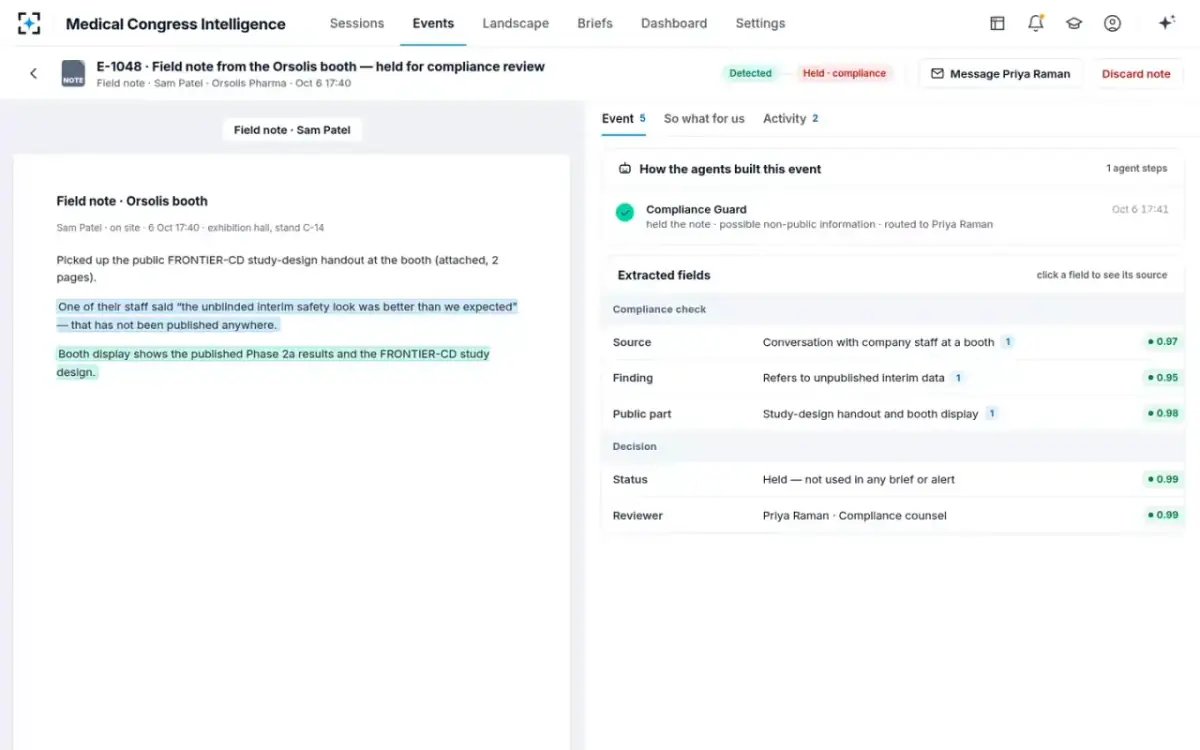
The sample congress in the solution has exactly this note, and it is worth walking through because it is the ordinary case rather than the dramatic one. The people, companies, products and the congress are fictional sample data inside the working product. On 6 October an analyst wrote up a visit to a rival's stand and quoted a staff member saying that an unblinded interim safety look had been better than expected. Nothing about that look has been published anywhere. The rest of the note — the study-design handout and what the booth display said — is unremarkable and usable.
A held note in Medical Congress Intelligence: the sentence that held it, kept apart from the public part
What should happen to a note that may be non-public?
It should stop moving, and it should stop moving before anybody downstream reads it. A note that reaches a programme channel and is then withdrawn has already been circulated; the hold is only worth having if it happens at the point of capture. Four questions decide it, and all four can be answered by the analyst who wrote the note, in under a minute, on the floor.
Four questions that decide whether a field note may be used
- Can you name where the public version is?
A released abstract, a poster on display, a registry entry, a filing, a press release — something a colleague could open. If the honest answer is "the person told me", the note goes to counsel.
- Does the sentence add a number, a date or a status that is not on the display?
Explaining a panel adds nothing non-public. Supplying an enrolment figure, an interim read, a filing month or a stop that is nowhere on the stand does.
- Would the note survive without the person who said it?
If removing the attribution removes the fact, the fact is the person's to disclose, not yours to pass on.
- Would publication of this move the sponsor's price?
Not a legal test and not yours to settle, but a good trigger: a yes or a maybe is the clearest reason to send the note to counsel rather than to a channel.
The route a held note takes in Medical Congress Intelligence, and what each step may never do
Agent
Field note capturedThe analyst adds the note from the floor; it is matched to the session and the abstracts it relates to before anyone else sees it.
Never: sends a note onward before the check below has run.
Agent
Compliance GuardChecks every source and field note: public or licensed, embargo respected, nothing that may be non-public.
Never: releases a held note itself, and never decides that a held sentence is safe.
Agent
Hold and routeThe note is marked held — not used in any brief or alert — and routed to the named compliance counsel, with the sentence that held it flagged.
Never: quietly drops the public part of the same note.
A person decides
Compliance counsel decidesReviews the held sentence and decides: keep it held, or release the public part of the note with the sentence removed.
Never: delegates the decision to the desk or to the agents.
A person decides
CI lead signs what goes outOnly a facts-only summary of a lifted abstract goes out on its own. Ratings, the so-what and any alert to another list wait for the lead's signature.
Never: signs a brief that carries a held sentence.
Designing the hold so nothing leaks by accident
Most leaks of this kind are not decisions; they are omissions. Somebody writes up the day at nine in the evening, four hours after the conversation, and the sentence has lost its context by then. Somebody forwards a draft to a wider list. Somebody pastes a quote into a slide because it was the most interesting thing they heard. A hold that depends on remembering will fail on the third evening of a four-day meeting, which is why the useful properties of a hold are all about defaults.
A hold that survives the third evening of a congress, and one that does not
A hold somebody has to remember: After the note is written up, when a reviewer reads the draft — by which time the note may have been forwarded.
A hold that is the default: At capture, before the note is matched into anything a colleague can read.
A hold somebody has to remember: The whole note is quarantined, so the analyst loses the handout and the display content too, and learns to file less.
A hold that is the default: The held sentence is separated from the public part, so the usable half of the visit stays usable.
A hold somebody has to remember: Whoever is awake and senior enough, usually over a message.
A hold that is the default: One named person, set as a policy rather than chosen per note.
A hold somebody has to remember: A decision in somebody's inbox.
A hold that is the default: Who held it, when, which sentence, who released what, and when — kept with the note.
A hold somebody has to remember: Someone screenshots a rival's post and it enters the evidence by the side door.
A hold that is the default: Switched off as a source, so it never becomes an event in the first place.
One property of that list deserves its own sentence, because it is the one that decides whether analysts cooperate with the hold at all. If holding a note means losing the whole visit, people stop writing notes. Keeping the held sentence apart from the public part is what makes the control survivable — the analyst still gets credit for the handout, the desk still gets the study design, and the one sentence that cannot be shown to be public sits with counsel where it belongs.
What the lead signs, and who is told: the point where a judgement is recorded
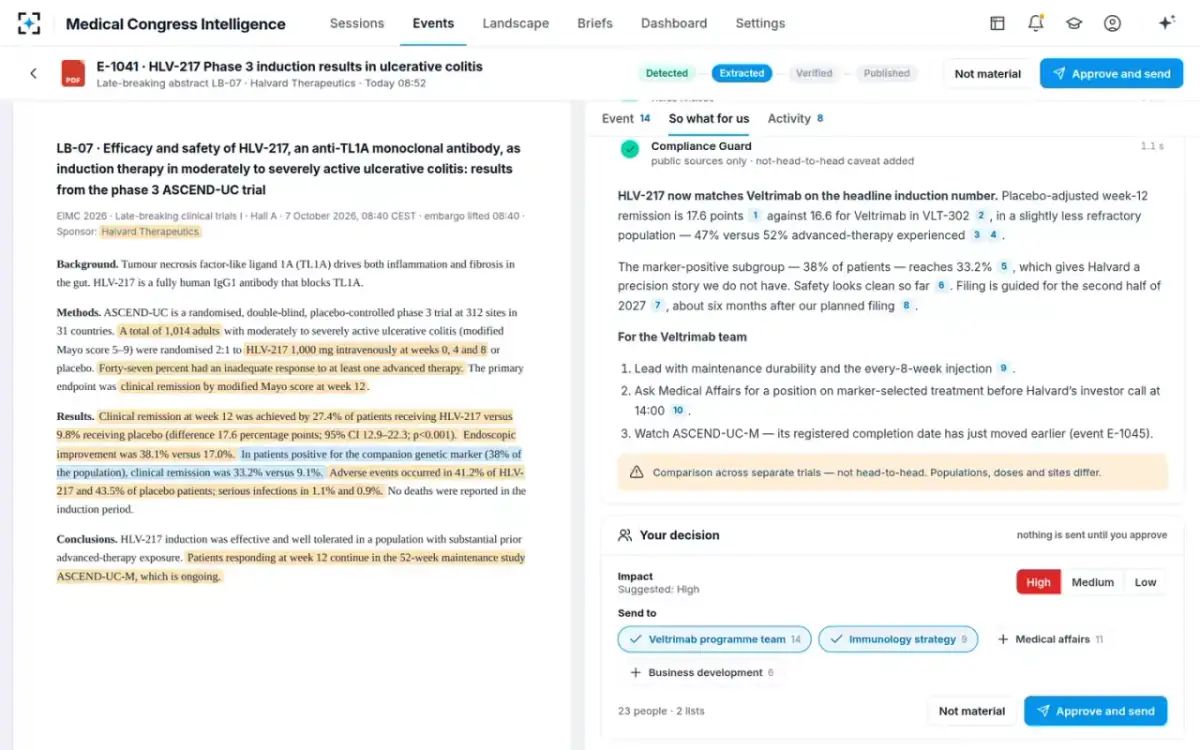
The honest limit on all of this is worth saying twice. A hold is an operating control: it stops a sentence travelling while somebody qualified looks at it. It is not a determination that a fact is immaterial, and it is not compliance with a securities law. The question of whether a given piece of information is material and not public is answered by counsel, on the facts, and no amount of routing changes that. What a desk can promise itself is narrower and still valuable: that nothing it circulates is a fact it cannot source, and that every decision to use or hold a note has a name and a time against it. Where that sits in a wider plan is set out in the four levels of congress coverage.
Questions people ask
Have doctors been charged for trading on clinical trial results?
Yes. The SEC has brought and settled several actions against clinical trial investigators, including a principal investigator who bought 80,000 shares after learning a sponsor would announce positive results at a conference, a lead investigator on a consulting agreement who sold a day after the announcement for alleged gains of $134,142, and two doctors whose practice enrolled trial patients, who sold before an FDA hold was announced and settled for a combined $116,864. In each one, the information came to the defendant through a role the sponsor had given them.
Does an embargo make information non-public?
An embargo is the society's rule, imposed on the authors and the sponsor, not a category in securities law. ESMO's regulations require an accepted abstract to be treated as confidential by its authors, their institutions and the research sponsor until it is publicly released in connection with the congress. What that gives a reader is a precise time at which the society distributes the data broadly — before it, the abstract has not been published; after it, it has.
Can a company use what its staff heard at a competitor's booth?
It depends on whether the fact can be shown to be public. Material a company puts on display at its stand has been distributed to every delegate, and a note describing it is ordinary research. A sentence that supplies a number, a date or a status which appears nowhere on the stand or in any published source is a different matter, and the safe course is to stop it moving and put it in front of counsel before anybody builds on it.
Does Regulation FD apply to the person who hears it?
A US rule that stops selective disclosure by issuers. When a company or someone acting for it discloses material non-public information to the market professionals and security holders the rule covers, the company must make public disclosure of the same information simultaneously if the disclosure was intentional, or promptly if it was not — with "promptly" bounded at the later of 24 hours or the opening of the next day's trading on the New York Stock Exchange. It binds the company, not the person who heard the information.
Who decides whether a field note can be used?
A named person, set in advance rather than chosen in the moment. In the sample configuration every field note is checked automatically at capture, anything that may be non-public is held and routed to one compliance counsel, and only she can release the public part of a held note. The competitive intelligence lead signs what then goes out and to which lists, and both decisions are kept with the note and its sources.
Is it a problem to compare a rival's result with our own trial?
Not for this reason — both numbers are published by then, so nothing non-public is involved. The problem with a cross-trial comparison is a scientific one: different populations, doses, sites and timepoints mean the two arms were never randomised against each other. The discipline is to compare the same endpoint at the same timepoint and to label the comparison as across separate trials and not head-to-head, every time it appears.