For a medical affairs team, LLM summarization accuracy has to be measured field by field. Ask a current model to summarise a trial abstract or a journal article and you will get something fluent in a few seconds. The question that matters to anyone who has to sign the summary is narrower: which parts of it are right. The published evaluations answer that, and their answer is not a single number. One peer-reviewed assessment of large language models extracting data from randomised trials found a group size read correctly 94% of the time and a standard deviation 24% of the time — in the same study, by the same model. Botminds' Medical Congress Intelligence works inside that reality rather than around it: every extracted field carries the passage it came from, and any field below a set confidence goes to a person before it is used.
This page gives the published numbers, explains why they differ so widely by field, and sets out the test a buyer or a team can run on their own abstracts to produce numbers of their own. It deliberately quotes no accuracy figure for the product. The sample congress inside it is fictional and carries no measured extraction accuracy, and inventing one would be exactly the error this page is about.
One model, one published evaluation, four kinds of number
94%
treatment-group size, in trials with binary outcomes
95% CI 85–100, 41 trials
57%
event counts, weighted across nine outcomes
95% CI 48–69
30%
the mean of a continuous outcome, across twelve outcomes
24%
the standard deviation, across twelve outcomes
95% CI 17–31
The short answer, and the shape of it
A model can summarise an abstract, and on the easy fields it is very good. It is reliable at the things that are stated once, plainly, in a fixed place: how many patients were in each arm, what the drug was, what phase the study was, when it ran. It degrades sharply as soon as a number has to be found among several candidates, read off a composite, or inferred from something adjacent. And it never signals the difference, because a wrong standard deviation arrives in the same even tone as a correct sample size.
So the only claim worth making about a summary is a per-field one, and the only way to make it honestly is to measure. "Our extraction is 95% accurate" is not a statement about anything until you know which fields, which corpus, and what counted as correct. The rest of this page is about turning that into something a sceptical programme team will accept.
What the published evaluations actually measured
Three studies are worth knowing, and they disagree far less than their headline percentages suggest, because they measured different things.
Yisha and colleagues, writing in BMC Medical Research Methodology in January 2026, took 105 randomised trials from two systematic reviews and asked ChatGPT-4 and Claude 3 Opus to extract the quantities a meta-analyst needs. Their measure, the proportion of correctly extracted items judged against the human-extracted values, ranged from 94% for the treatment-arm group size in trials with binary outcomes down to 24% for a standard deviation. Their own conclusion is the one to keep: "at present, AI tools cannot replace human reviewers but may serve as complementary aids to improve efficiency when used under supervision."
Yun, Pogrebitskiy, Marshall and Wallace, in the Proceedings of Machine Learning Research in 2024, built an evaluation set of 120 trials and 699 numerical records and measured exact match over all of them. "GPT-4 has the highest overall exact match accuracy of 0.655, followed by GPT-3.5 with 0.298" — a useful reminder that the model matters as much as the method, and that a result from one generation of models does not transfer to the next without re-measuring.
Schmidt and colleagues, in a feasibility study posted as an arXiv preprint in 2024 and revised in 2025 — not peer reviewed, and treated here as the weakest of the three — extracted study characteristics rather than outcome numbers and found "an accuracy of around 80%, with some variability between domains (82% for human clinical, 80% for animal, and 72% for studies of human social sciences)". Their most useful observation is about which items failed: "causal inference methods and study design were the data extraction items with the most errors."
Put together, the three say the same thing in different registers. Descriptive fields: good. Single stated numbers: good. Anything requiring a choice between candidates or an inference: not good enough to go out unchecked.
Which numbers does AI get wrong in a trial report?
The gradient below is from a single study and a single model, which is what makes it readable: every bar was produced by the same system reading the same kind of document, so the differences are differences between the fields and not between the setups.
Accuracy falls as a field stops being stated and starts being chosen
The first and fourth bars are the finding. Group size is the simplest quantity in a trial report, and the model reads it almost perfectly in a paper reporting responders out of a denominator — and then gets it wrong two times in five in a paper reporting a change in a score, plausibly because there the number of patients analysed is buried in a table footnote or differs between the randomised and the analysed populations. The field did not get harder. The document did.
Why continuous outcomes are the hard case
A binary outcome has a natural shape: so many of so many. A continuous outcome has a mean, a measure of spread which may be a standard deviation or a standard error or an interquartile range, a baseline, a change from baseline, and often a least-squares mean from a model rather than the raw average. A reader who wants "the standard deviation" has to decide which of several plausible numbers on the page is the one being asked for, and whether it needs converting first. That is inference, not extraction.
LLMs—including ones trained on biomedical texts—perform poorly when the outcome measures are complex and tallying the results requires inference.
Yun, Pogrebitskiy, Marshall and Wallace, Proceedings of Machine Learning Research, 2024
The same authors observe that "unsurprisingly, massive LLMs with large input context windows such as GPT-4 outperform smaller, open-source models at extracting binary (dichotomous) outcomes. For extracting continuous outcomes, LLMs perform comparatively poorly," and conclude that modern models "offer a promising path toward fully automatic meta-analysis, but further improvements are needed before this will be reliable." A congress desk is in a better position than a meta-analyst, because a late-breaking abstract usually reports a response rate and a difference against placebo rather than a change in a continuous score — but the moment a rival reports a mean change in a disease activity index, the desk is in the hard case and should know it.
How do you test an AI summary of a clinical result?
Against answers you already have. The mistake teams make is testing against their impression of the output: somebody reads twenty summaries, finds them plausible, and declares the thing works. Plausibility is exactly what a model is good at. The test has to compare each extracted field with a value a person established independently, before seeing what the machine said.
Three measurements come out of a properly run test, and they are different questions that are easy to merge into one. Field accuracy: is the value right. Citation accuracy: does the passage the summary points at actually contain that value. And faithfulness of the interpretation: does the sentence built on those fields say what the trial said. A system can score well on the first and badly on the second, which is the dangerous combination — right numbers, pointers that lead somewhere else, and no way for a reader to tell.
One summary line, and the three different ways it can be wrong
What the reader sees: A remission rate, a difference against placebo, a sample size, a date.
What has to be checked, separately: Does it match the value a person extracted from the source without seeing the summary? This is field accuracy, and it must be scored per field type, not pooled.
What the reader sees: A link or a highlight that opens the source where the number came from.
What has to be checked, separately: Does that passage actually contain that number? A correct number attached to the wrong sentence passes a numbers-only check and fails a reader who follows it.
What the reader sees: "Met its primary endpoint", "numerically favoured", "comparable to".
What has to be checked, separately: Does the characterisation match what the trial reported, including whether the result was significant on the prespecified primary endpoint?
What the reader sees: Nothing visible.
What has to be checked, separately: A dropped caveat, an omitted subgroup, an unreported discontinuation rate. Omission is the error a summary is structurally most likely to make and a reviewer least likely to catch.
The seeded-error run, step by step
A seeded-error run tests the reviewer as well as the model. You take abstracts whose answers you already know, deliberately alter a known number in some of them, and send the whole set through the system and the human review that follows it. The questions it answers are the two that matter in production: how often the extraction is wrong, and how often a wrong extraction survives the person who is supposed to catch it.
The seeded-error run, in eleven steps
- Choose 40 to 60 abstracts from your own therapy area.
Past congresses, a mix of oral and poster, a mix of binary and continuous primary endpoints. Your corpus, not the vendor's.
- Fix the field list before you start.
Asset, sponsor, phase, population, n per arm, primary endpoint, the primary result, the comparator result, the difference, significance, dates. Fifteen or so; write the definition of each one down.
- Have two people extract every field by hand, blind to each other.
Where they disagree, a third settles it. This set is the answer key and its quality caps everything downstream.
- Seed errors into a known subset.
Alter one value in roughly a quarter of the abstracts — a digit in a sample size, a swapped arm, a percentage moved a point. Keep a sealed list of what you changed.
- Run the whole set through the system untouched.
No prompt tuning on the test set, and no re-runs. A system that needs a second attempt has told you something.
- Score field accuracy as exact match, per field type.
Report each field separately with a confidence interval. One pooled number hides the fields that are failing.
- Score citation accuracy separately.
For every field, open the passage it points at and ask whether that passage contains that value. Score it as its own percentage.
- Count the seeded errors the review caught.
This is the measurement teams most often skip, and the one that predicts production behaviour: a 95% extraction with a review that catches a third of errors is worse than it sounds.
- Record how long a review took per abstract.
If careful review costs more than extraction saved, the honest conclusion is that the system helps with volume and not with time.
- Re-run on the same set whenever the model changes.
Accuracy measured on one model generation does not transfer to the next. Keep the set and the key; they are the asset.
- Publish the result internally, including the bad fields.
A scorecard that shows the standard deviation field at 30% is what lets a programme team trust the fields that are at 95%.
The NIST AI Risk Management Framework describes this as the ordinary expectation rather than an unusual rigour: its measure function uses quantitative, qualitative or mixed methods to analyse, benchmark and monitor AI risk, and the framework observes that independent review can make testing more effective and offset the biases of the people who built the system. Independent here means the reviewer did not build the prompts.
Citation accuracy is a separate measurement
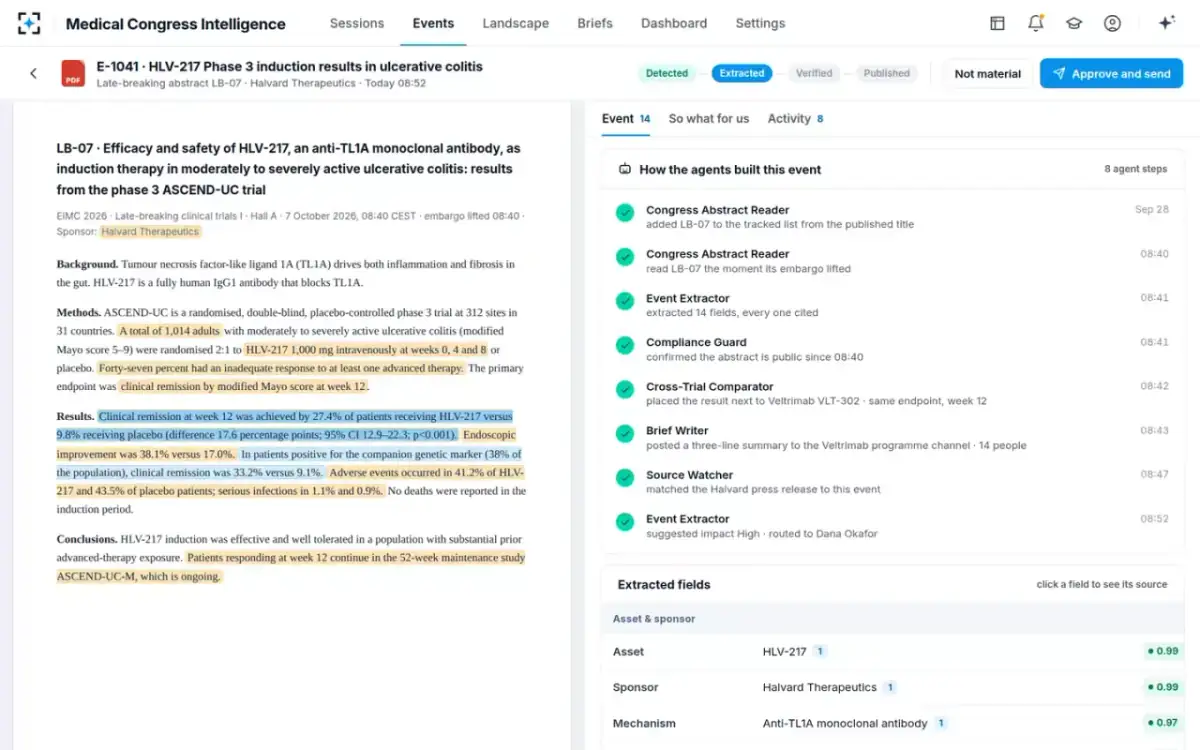
Every field in Medical Congress Intelligence cites the passage it was read from, and in the sample congress fourteen fields pulled from one late-breaking abstract each open the source highlighted at the sentence they came from. That design decision only pays if the pointers are measured, because an unchecked citation is worse than no citation: it transfers the reader's scepticism to the machine and then does not deserve it.
Measuring it is tedious and fast. For each extracted field, open the passage, read it, and mark whether the value is in it. Score the percentage. Then score a second quantity that matters more to a reader: of the fields where the value was wrong, how many had a pointer that would have shown the reader it was wrong. That second number is the real argument for citation — not that it proves the summary, but that it makes an error findable in seconds rather than in a re-read of the abstract.
Medical Congress Intelligence: each field with its confidence and the sentence it was read from
Measuring spin in an AI summary
A summary can carry every number correctly and still mislead, because the source did. A cross-sectional analysis of randomised myeloma trials published in The Oncologist in June 2026 defined spin as "reporting practices that distort or overemphasize trial findings in a manner inconsistent with the prespecified primary endpoint" and looked for it across 71 included trials. "The most common manifestation was optimistic language used to characterize unfavorable results, identified in 20 trials (28.2%)."
For an automated desk that has two consequences. The first is that a model trained to be faithful to its source will faithfully reproduce the source's framing, so a summary that says a trial "showed encouraging activity" may be an accurate summary of a trial that missed its primary endpoint. The second is that the defence is structural rather than linguistic: always extract the prespecified primary endpoint, the result on it, and whether that result was significant, as their own fields — so that a reader sees the endpoint beside the adjective. What a congress number is actually worth goes further into how abstract figures change by the time they reach a journal.
Does a confidence score mean anything?
It means something narrow and useful, and it is not accuracy. In Medical Congress Intelligence a field below 0.85 confidence is not published; it goes to a person. That is a routing rule — a line below which the system declines to act alone — and it says nothing about how often fields above the line are correct. The two quantities answer different questions: confidence asks how sure the extraction was, accuracy asks how often it was right, and a system can be confidently wrong on exactly the fields where a document is ambiguous.
What the threshold is worth is the traffic it generates. Measure two things about it: what share of fields fall below the line, which tells you how much human work the setting creates, and what the accuracy is above and below it, which tells you whether the line is in the right place. A threshold that routes two fields in a hundred and lets through most of the errors is set too low; one that routes a third of everything has turned an automated desk into a manual one. Neither number can be read off the setting itself. The six agents and their six hard limits set out the other controls the threshold sits inside.
What accuracy should you demand before a summary goes out alone?
Set a target per field and tie each one to a consequence rather than to a round number. A scorecard like the one below is what turns "is it accurate enough" into a decision a programme team can take, and it is also the document that lets you say no to a field: some fields should simply never go out without a person, however well they score.
A per-field scorecard: what to demand, how to measure it, and what happens when it misses
| Field | The target to argue about | How it is measured | What happens when it misses |
|---|---|---|---|
| Asset, sponsor, phase, population | Very high — these are stated once and plainly. | Exact match against the blind key, over the whole set. | Investigate the pipeline, not the model: a miss here usually means the wrong document was read. |
| Patients per arm | High for trials with a binary endpoint; expect materially lower for continuous ones. | Exact match, reported separately for the two document types. | Route the field to a person for continuous-endpoint abstracts specifically, rather than for everything. |
| Primary endpoint result and comparator | High, and never sent without a citation a reader can open. | Exact match plus citation accuracy, scored as two numbers. | Hold the summary. This is the field the whole brief rests on. |
| Difference against comparator, and significance | High, and checked against the stated endpoint rather than recomputed. | Exact match against the key; flag any value the system derived rather than read. | Never publish a derived difference the source did not state without a person confirming it. |
| Means, standard deviations, any continuous statistic | Do not set a target: route these to a person by default. | Measure anyway, so you know the cost of the rule. | Nothing — the rule already sent it to a person. |
| Dates: completion, filing, read-out | High, but verify against the registry rather than the abstract. | Exact match against the registry entry on the day of the check. | Treat a disagreement as a finding in itself: a moved date is often the most valuable event of the day. |
| The interpretation sentence | Not an accuracy question. | Reviewed by the competitive intelligence lead against the prespecified endpoint before it is sent. | Signature withheld. |
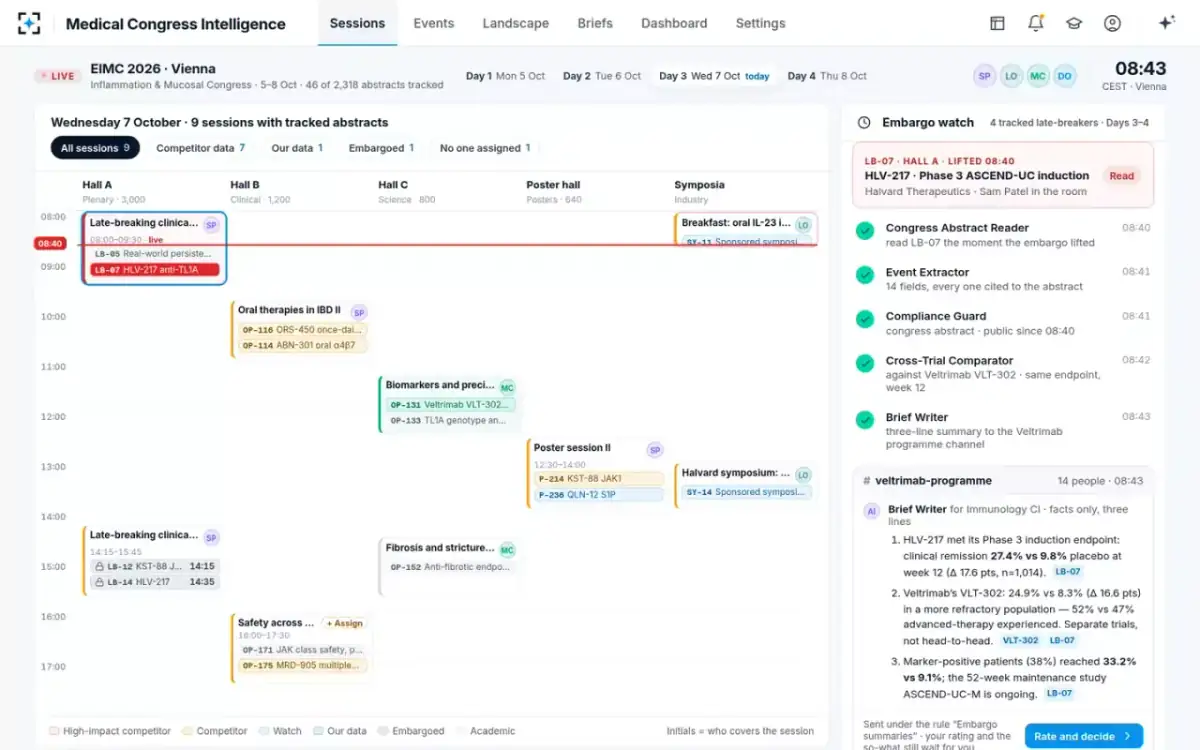
A facts-only summary in Medical Congress Intelligence, every line carrying its source
One closing argument for doing any of this. A programme team's trust in an automated desk is not won by a high number; it is won the first time somebody follows a citation, finds the sentence, and sees that it says what the summary said. Measurement is how you find out whether that will happen before you promise it.
Questions people ask
Can AI summarise a scientific abstract accurately?
Accurately enough on descriptive and simply stated fields, and not accurately enough on anything that requires choosing between candidate numbers. In one peer-reviewed assessment a model read a treatment-arm group size correctly 94% of the time in trials with binary outcomes and a standard deviation correctly 24% of the time, in trials with continuous outcomes in the same study. A single accuracy figure for "the summary" averages those two together and tells you about neither.
How accurate is AI at extracting trial results?
It depends on the field, the document and the model generation. Across 120 trials and 699 numerical records, one 2024 evaluation measured GPT-4's overall exact-match accuracy at 0.655 and GPT-3.5's at 0.298 on the same task — a gap large enough that any number you are quoted should come with the model and the date attached, and should be re-measured when the model changes.
How does a seeded error test of AI extraction work?
A test in which you deliberately alter known values in some of the documents before running them through the system, keeping a sealed list of what you changed. It measures two things at once: how often the extraction is wrong, and how often a wrong value survives the human review that is supposed to catch it. The second is the number that predicts what will happen in production, and it is the one most often left unmeasured.
Does a person have to check every AI extracted number?
Not every one, if you have measured which fields need it. The workable arrangement is to route by field type and by document type — continuous outcome statistics and derived differences always to a person, plainly stated descriptive fields not — and to review a sample of the rest on a schedule. What makes that defensible is the measurement behind the routing rule, not the rule itself.
Does a confidence score mean anything?
It is a routing signal, not an accuracy. A threshold of 0.85 says the system will not publish a field it is less sure than that about; it does not say that fields above the line are right 85% of the time. Ask instead what share of fields fall below the line, and what the measured accuracy is on either side of it — those two numbers tell you whether the threshold is in a useful place.
How do you measure whether a citation is right?
Open the passage the field points at and check that the value is in it, then score the percentage across all fields. Score a second number as well: of the extractions that were wrong, how many had a pointer that would have shown a reader the error. That is the real return on citation — not that it proves a summary, but that it makes a mistake findable in seconds instead of in a re-read.