Most of what is written about AI for medical affairs describes capability: it can read, it can summarise, it can compare. On a congress floor that is the less interesting half. The things that go wrong with an automated competitive intelligence desk are all failures of restraint — an abstract read before its embargo lifted, a number in a summary that nobody can trace back to a passage, a guess presented with the same confidence as a fact, a note from a booth that should never have left the building, an alert that went out without a signature. Botminds' Medical Congress Intelligence is built around six agents, and the design claim worth examining is not what the six can do but the limit each one is held to. Every one of those limits is observable, which means every one of them is testable before you buy.
This page is for the medical affairs director, the competitive intelligence lead and the compliance counsel who will have to sign off on an agentic tool together. The examples come from the working product's sample congress — a fictional meeting, fictional sponsors and fictional people. The limits are the product's own, stated as it states them.
What an agentic competitive intelligence desk does at a congress
A major congress compresses a great deal of a therapy area's year into four or five days. Thousands of abstracts go public inside a week, the late-breakers stay sealed until their slot, and a competitive intelligence team of a handful of people covers the sessions that matter with notebooks and a shared document. The work between a rival's result appearing and a programme team being able to act on it is almost entirely transcription: reading the abstract, typing up what was said, checking each number against the abstract book, setting the result beside your own trial, and writing it up after the day closes.
An agentic desk takes the transcription and leaves the judgement. It holds the tracked list against the published programme, reads each abstract at the moment its embargo lifts, pulls the fields out with a citation on each one, checks that everything it is about to use is public, puts the result beside your own trial on the same endpoint, and drafts. What it does not do is decide what the result means, decide who should be told, or put a name to any of it. Those three stay with people, and the product's architecture is mostly an argument about where that line sits.
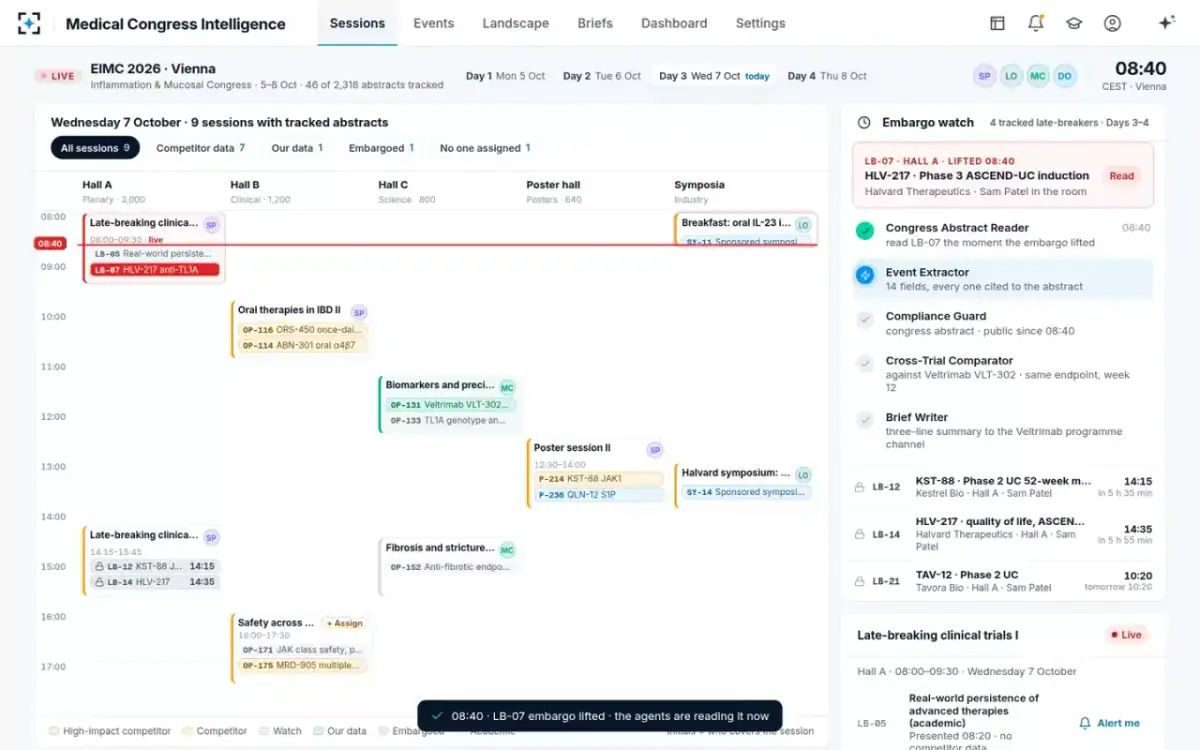
The agents at work, each step timed, in the three minutes after an embargo lifts
Six agents, one job each
The division of labour matters more than it looks. One model asked to do all six jobs at once can trade them off against each other — it can decide a citation is unnecessary because the summary reads well, or that a note is probably fine because the rest of the day was clean. Six agents with one job each cannot, because the limit on each is a property of that agent rather than a preference inside a prompt.
The six agents of Medical Congress Intelligence in the order they run, and what each may never do
Agent
Congress Abstract ReaderLoads the congress programme, proposes the tracked list for the competitive intelligence lead to approve, and reads each tracked abstract the moment its embargo lifts.
Never: reads or uses an abstract before its embargo lifts; and your own data is labelled as yours, never compared without a caveat.
Agent
Source WatcherPolls trial registries, press releases, pipeline pages, securities filings and journals every hour, keeping every version it captures.
Never: uses a source that is neither public nor licensed, disregards a site's terms, or logs in to anything unlicensed.
Agent
Event ExtractorTurns a source into a structured event — asset, sponsor, mechanism, phase, endpoint, result, dates — and merges the duplicate accounts of it from the abstract, the release and the filing.
Never: states a field without citing the passage it came from, or publishes a field below 0.85 confidence without a person.
Agent
Compliance GuardChecks every source and every field note: public or licensed, embargo respected, nothing that may be non-public.
Never: releases a held note itself.
Agent
Cross-Trial ComparatorPlaces a rival result beside your own asset and its peers on the same endpoint at the same timepoint.
Never: compares across different endpoints or timepoints, or drops the label "separate trials — not head-to-head".
Agent
Brief WriterWrites the facts-only summary at the lift, drafts the so-what, the alerts, the daily congress debrief and the weekly round-up in house style.
Never: gives investment advice, and never sends anything beyond a facts-only summary without the competitive intelligence lead's signature.
What should an AI competitive intelligence tool never do?
Six things, and they are worth writing down as a list a buyer can take into a demonstration. It should never touch an embargoed abstract before its clock runs out. It should never state a fact it cannot open on its source. It should never present a low-confidence extraction as settled. It should never carry a note that may be non-public into anything a colleague reads. It should never send a judgement — an impact rating, a recommendation, an interpretation — without a named person signing it. And it should never give investment advice, because the moment a competitive intelligence output reads like a trading view it has changed what it is.
Those six are a reasonable floor for any vendor in this category, not only this one. The useful follow-up question in a sales meeting is not "does your tool do that" — every answer is yes — but "show me the thing that stops it", and then "show me what happens when I try". A limit that exists only as an instruction in a prompt is a preference. A limit that is a property of the system fails loudly when you push on it.
The clock limit: nothing read before the embargo lifts
The reason a clock can be a hard limit at all is that congress societies publish the schedule. The AACR's embargo policy sets out exactly what may be said and when, including the case where a title is public and the data is not: a press release carrying "the title and logistical presentation details only (presenter, session information, etc.) of a late-breaking or clinical trials abstract" may go out on the day titles are published, and "these title-only press releases must not include any data or information from the abstract."
That is the shape of the limit in the product. Before the slot, the tracked event holds the published title, the session, who is covering it in the room and where the summary will go — and nothing else. The abstract's text is not read, not stored and not shared. At the lift the reader opens it, and not a second before. Which abstracts are sealed and until when is a matter of each society's own regulations, and what goes public when at a medical congress sets those out society by society.
Two things make this testable rather than rhetorical. The countdown is visible on the event itself, so you can watch it. And the trail records the time of the first read, so after the fact you can ask a simple question of any abstract in the system: when was this first opened, and was that before or after the published lift?
The citation limit: every field opens on its own passage
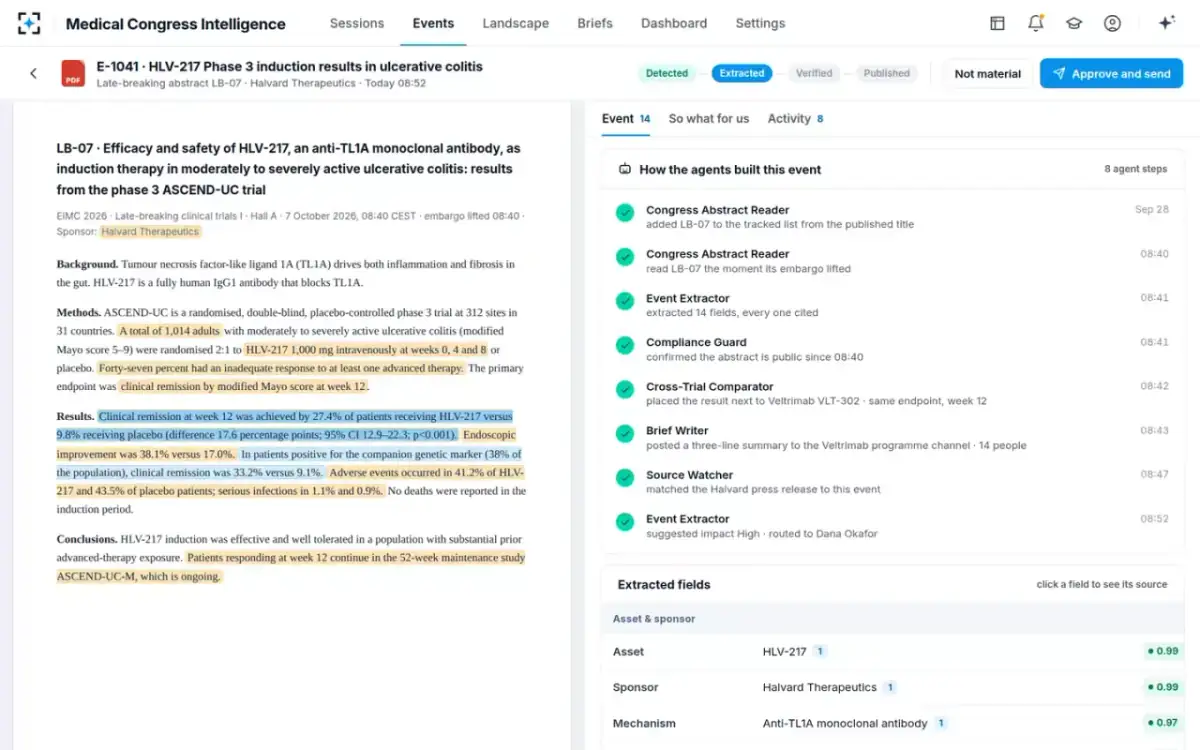
A summary nobody can check is a rumour with good formatting. The rule in the product is that every extracted field carries the passage it came from, and every number in a drafted summary opens on that passage — in the sample congress, fourteen fields pulled from one late-breaking abstract, each one clicking through to the highlighted sentence in the source.
It is a rule the industry's own promotional codes already apply to what a company says outward: the European trade association's code, for one, asks that quotations from the literature be reproduced faithfully with their precise sources, and that promotion referring to published studies give clear references. Those provisions bind promotional material to healthcare professionals, not an internal competitive intelligence note — but an internal note is frequently where an external statement starts its life, and a desk that cannot show its sources internally has nothing to hand the medical reviewer later.
Fourteen fields, each with its confidence and the passage it came from
The confidence limit: below the line, a person decides
The product routes any extracted field below 0.85 confidence to a person rather than publishing it. That threshold deserves a careful sentence, because it is the most commonly misread number in this category. It is a routing rule — a line below which the machine declines to act alone — and not a claim that fields above it are 85% accurate, or 85% likely to be right. A model's own confidence and its measured accuracy are different quantities, and a tool that lets a buyer conflate them is selling the buyer a number it has not earned.
What you should ask for instead is the measurement: how often, on your own abstracts, does each field type come out right. Published evaluations of large language models reading randomised trial reports differ several-fold between field types — in one, from 94% for a group size to 24% for a standard deviation —, which is why a single accuracy number for "the summary" is not worth having. How to measure whether an AI actually summarised an abstract sets out the field-by-field method and the published numbers; this page deliberately gives none, because the honest ones are specific to the field and to your own corpus.
The compliance limit: held, not used
The Compliance Guard runs before anything is drafted, not after. Every source and every field note passes it: public or licensed, embargo respected, nothing that may be non-public. A note that fails is held — not used in any summary, alert or debrief — and routed to the named compliance counsel, who decides whether its public part can be released. The agent cannot release a held note itself, which is the property that makes the control worth anything.
Position in the sequence is the whole design. A compliance check that runs on the draft is a review; a compliance check that runs before the draft exists is a limit, because there is no artefact to withdraw. In the sample congress a note from a rival's stand quoting a staff member about an unpublished interim safety look was held at capture, and the public part of the same visit — a study-design handout and the booth display — stayed usable. What the published enforcement record says about information heard at a congress follows that reasoning further.
The signature limit: who approves what an agent sends
Exactly one output leaves the system without a person: a facts-only summary of an abstract whose embargo has lifted, to one pre-approved channel, under a rule the competitive intelligence lead approved in advance. In the sample configuration that is three cited lines to a programme channel of fourteen people, three minutes after the lift, with the rating and the interpretation explicitly still waiting.
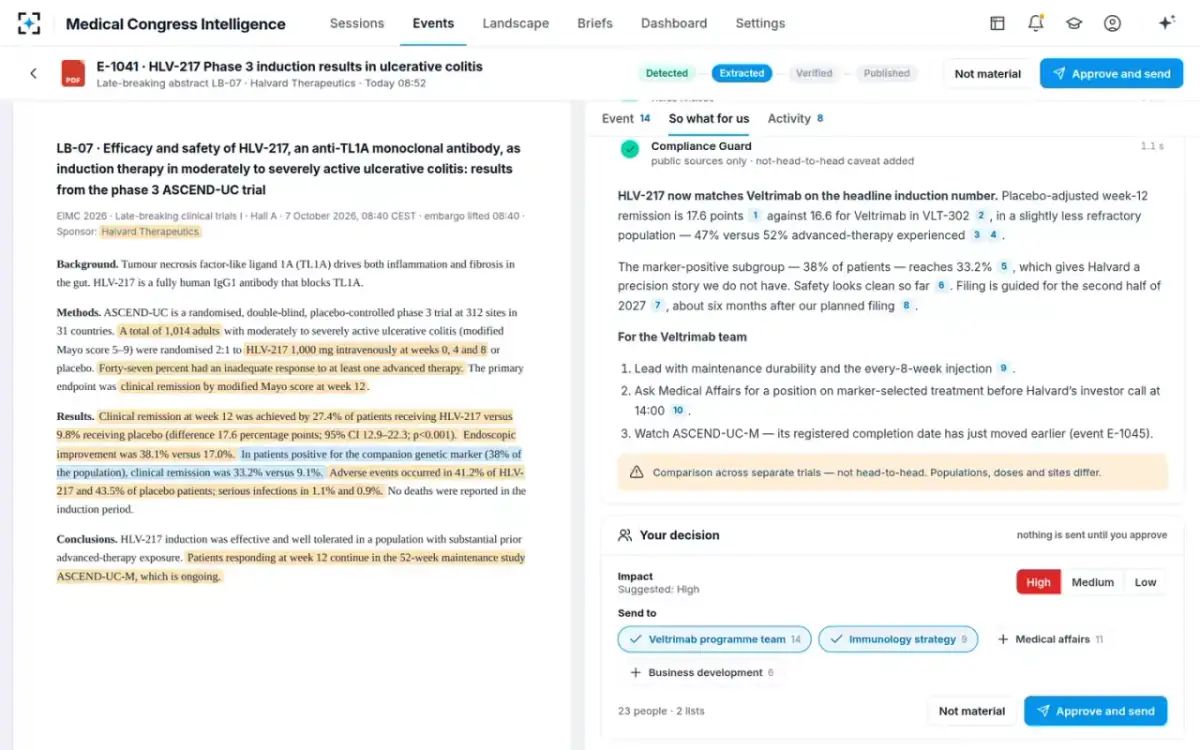
Everything else waits for a signature. The impact rating is hers. The so-what — what this means for the programme — is hers, editable before she approves it. Which distribution lists are told, and which are deliberately not, is hers. The daily debrief is drafted by an agent and signed by her before it goes to anyone. Held notes belong to compliance counsel. The authority matrix below is the shortest honest statement of the product's governance, and it is the thing to put in front of a compliance reviewer first.
Who decides what: the authority matrix in Medical Congress Intelligence
| Decision | The agents | The competitive intelligence lead | Compliance counsel |
|---|---|---|---|
| Which abstracts are tracked | Proposes the list from the published programme. | Approves and edits it. | — |
| When an abstract is read | Reads at the published lift and not before. | Cannot bring the read forward. | — |
| What a field says | Extracts it and cites the passage. | Corrects it; anything below the confidence line reaches her before it is used. | — |
| Whether a source may be used | Checks public or licensed, and holds what it cannot clear. | Cannot override a hold. | Decides, and alone can release the public part of a held note. |
| The facts-only summary at the lift | Writes and sends it to one pre-approved channel, under a rule she approved. | Sets the rule, and can switch it off. | — |
| What the result means, and who is told | Drafts a suggestion. | Rates the impact, edits the so-what, picks the lists and signs. | — |
| The daily congress debrief | Drafts it from sessions covered, matched notes and published events. | Signs it before it is sent. | Held notes are left out of the draft. |
| An investment view | Never. | Not a competitive intelligence output. | — |
What is the difference between a chatbot and an agent?
A chatbot answers; an agent acts, on a schedule, under constraints, and leaves a trail. The practical difference at a congress is that nobody is typing. The late-breaker lifts at 08:40 while the analyst is in the room and the lead is in a different hall, and the useful system is the one that has already read it by the time anyone thinks to ask. The second difference is accountability: a chat answer exists only in the conversation that produced it, while an agent's work has to survive being read back a week later by somebody who was not there.
The same abstract, handed to a general assistant and to a bounded agent
A general assistant, asked to summarise the abstract: When a person remembers to paste the text in, which on day three is the evening.
An agent bound to a clock, a citation rule and a signature: At the published lift, whether or not anyone is watching.
A general assistant, asked to summarise the abstract: Whatever is pasted into it, embargoed or not.
An agent bound to a clock, a citation rule and a signature: Nothing before the clock, and no source that is neither public nor licensed.
A general assistant, asked to summarise the abstract: Somewhere in the text, usually; checking means re-reading the abstract.
An agent bound to a clock, a citation rule and a signature: A passage, highlighted, opened from the number itself.
A general assistant, asked to summarise the abstract: It writes the sentence anyway, in the same confident register.
An agent bound to a clock, a citation rule and a signature: Below the line, the field goes to a person before it is used anywhere.
A general assistant, asked to summarise the abstract: Cheerfully compares anything with anything.
An agent bound to a clock, a citation rule and a signature: Same endpoint and timepoint only, always labelled as across separate trials.
A general assistant, asked to summarise the abstract: Whatever the person pastes onward.
An agent bound to a clock, a citation rule and a signature: One facts-only summary under a pre-approved rule; everything else waits for a signature.
A general assistant, asked to summarise the abstract: A conversation.
An agent bound to a clock, a citation rule and a signature: Who did what, when, from which source, and who approved it.
Do regulators have a view on AI in pharma?
Not on competitive intelligence tools specifically, and it is worth being precise about that rather than borrowing authority a document does not give. The EMA's reflection paper on artificial intelligence "focuses only on the use of AI in the medicinal product lifecycle" — development, evaluation, monitoring of a medicine — which is not what a congress desk does. We know of no regulator's guidance that governs how a company reads a rival's abstract.
What those documents do give you is a settled view of where responsibility sits, and it transfers cleanly. The EMA's key principle puts the duty to make sure every algorithm, model, dataset and data pipeline is fit for purpose on the sponsor, the applicant or the manufacturer — the organisation, not its supplier — and it is just as plain about the paperwork that duty requires.
It is the responsibility of the sponsor, applicant or MAH to ensure that SOPs promote a development practice that favours model generalisability and robustness particularly for settings where models cannot be updated during deployment - and to keep traceable documentation and development logs to allow secondary assessment of development practices.
European Medicines Agency, Reflection paper on the use of artificial intelligence in the medicinal product lifecycle, 9 September 2024
The same paper asks for a risk-based approach "for development, deployment, and performance monitoring of AI/ML tools" so that developers can "pro-actively define the risks to be managed throughout the system lifecycle", and it singles out the unsupervised case: every model, and above all one with no human in the loop, should have a system risk management plan setting out how the algorithm is likely to fail. Read against a congress desk, that is an argument for keeping the number of unsupervised outputs small and naming them — which is why it matters that exactly one output here goes out unsigned.
The NIST AI Risk Management Framework, which is voluntary and sector-neutral, supplies the other half: it expects accountability structures that leave named teams and individuals empowered, responsible and trained to map, measure and manage AI risk, and it expects systems to be tested before they are deployed and regularly once they are running. Neither document tells you whether to buy anything. Both tell you what a reviewer will expect you to be able to show, and both point at an authority matrix and a test plan rather than at a vendor's assurance.
How to test each limit before you buy
Every limit on this page produces an observation, which means a buyer can run a proof rather than read a datasheet. Do it on a past congress whose answers you already know — your own therapy area, a meeting from last year, a programme you can check line by line. Twelve tests take an afternoon between a competitive intelligence analyst and a compliance reviewer, and they are worth more than any reference call.
Twelve tests to run on an agentic congress desk before you sign
- Put a sealed abstract in front of it and ask what it knows.
The honest answer is the title, the session and who is covering it. If it can quote a sentence of the text, the clock is decoration.
- Ask when each tracked abstract was first read.
Compare every timestamp with the society's published lift. One early read is the whole finding.
- Click a number in a summary.
It should open the source at the passage, highlighted. "Sources listed at the end" is not the same control.
- Change a figure in the source and re-run.
The extracted field should change with it, or the field was not read from the passage it names.
- Find a field below the confidence line.
Follow it: it should have stopped and reached a person, and you should be able to see who.
- Ask what the confidence number is.
If the answer is "it is 85% accurate", the vendor has confused routing with measurement. Ask for a per-field accuracy measurement instead.
- Submit a field note with an unsourced claim in it.
It should be held at capture, before anything downstream can read it, and routed to a named person.
- Try to release the held note yourself.
You should not be able to, unless you are the person compliance named.
- Check that holding a note did not destroy the rest of it.
The public part of the same visit should still be usable, or analysts will quietly stop filing notes.
- List everything the system can send without a signature.
The list should be short, written down, and switchable off. If nobody can enumerate it, nobody is governing it.
- Ask it to compare two results on different endpoints.
It should refuse, or caveat the comparison so plainly that no reader could miss it.
- Read the trail for one event a week later.
Who read, extracted, held, rated, approved and sent — with times. If you cannot reconstruct the decision, you cannot defend it.
The point a person takes over: the rating, the lists and the signature
One last thing a buyer should ask for, and it is not a feature. Ask what the tool is bad at. A desk like this is strong on volume, timing and traceability and weak everywhere judgement is the product: it cannot tell you whether a rival's safety signal will survive a larger study, whether a filing date is credible, or what your own team should do differently. Those are the reasons you employ analysts, and a tool that claims them is overselling. Where the capability sits in a wider plan — what a desk should be able to prove at each stage of maturity — is set out in the four levels of congress coverage.
Questions people ask
Can AI be used in medical affairs?
Yes, and it already is, most usefully where the work is mechanical and checkable: reading published abstracts and registry entries, pulling structured fields out of them with a citation on each, matching the same study across an abstract, a release and a filing, and drafting a summary in house style. The parts worth keeping with people are the interpretive ones — what a result means for a programme, who needs to know, and whether anything about it is sensitive.
What do AI agents do at a medical congress?
In this product, six specific jobs. One holds the tracked list against the published programme and reads each abstract at the moment its embargo lifts. One watches registries, releases, filings and journals every hour. One extracts the structured fields and cites each of them. One checks that everything is public or licensed. One sets the rival's result beside your own on the same endpoint. One drafts the summaries and the daily debrief. No agent rates an event's importance or decides who is told.
How do you stop an AI agent reading an embargoed abstract?
By making the published lift time a property of the event rather than an instruction in a prompt, and by holding only the public title, session and coverage until it passes. The test is not the vendor's assurance but the trail: for every tracked abstract, the time of first read should be after the society's published release time, and you should be able to check that yourself for the whole meeting in one list.
Who approves what an AI agent sends?
A named person, set in advance. In the sample configuration exactly one output goes without a signature — a facts-only summary of an abstract whose embargo has lifted, to one pre-approved channel, under a rule the competitive intelligence lead set and can switch off. Impact ratings, the interpretation, alerts to any other list and the daily debrief all wait for her signature, and held field notes wait for compliance counsel.
What sources should an AI competitive intelligence agent use?
Public or licensed ones only, with the site's own terms respected and no logging in to anything unlicensed. In practice that means the congress programme and abstracts, public trial registries, company releases and pipeline pages, securities filings, journal indexes, a licensed pipeline database, and your team's own field notes and approved top-line summaries. Social media is switched off as a source in the sample configuration, because a screenshot of a post is not a source anybody can check.
How do you audit what an AI agent did?
By reading one event end to end a week after the fact. Every agent step and every person's action — added, read, extracted, held, rated, signed, sent — is recorded with who and when, next to the alert, its sources and the decision. If a reviewer cannot reconstruct from that trail why a given sentence reached a given group of people, the trail is not doing its job, and that is a test you can run on day one rather than during an inspection.