The recommended Term SOFR day count convention is Actual/360: the annual rate is divided by 360 and charged on every actual day of the interest period. Three more conventions travel with it — the rate is the one published two US Government Securities Business Days before the period starts and held for the whole period, any interest rate floor is tested daily rather than at period end, and rates are rounded to five decimal places and dollars to two. Every one of them is a recommendation a credit agreement is free to vary, which is why Loan Interest & Fee Calculation reads the index, the fixing date, the floor and the basis out of the document before it rebuilds a single accrual period.
That is also the practical lesson of this page: the Term SOFR errors that survive review are date errors, not rate errors. The index is published and public, the margin is in the grid, and what differs deal by deal is which day's fixing applies, which calendar decides that day, when the floor bites and how the days are counted. Borrowers and loans used as examples below are fictional sample data; the conventions and the regulation are real.
The three numbers a Term SOFR bill turns on
2days
US Government Securities Business Days of lookback in the recommended convention
0.11448%
tenor spread adjustment the LIBOR Act added to one-month CME Term SOFR
5dp
decimal places the rate is rounded to — dollars to two, and nothing rounded internally
What is the Term SOFR day count convention?
It is Actual/360 by recommendation and by overwhelming market practice. The Alternative Reference Rates Committee put it plainly when it published its conventions for syndicated and bilateral business loans: “The recommendation is Actual/360 days for Term SOFR and SOFR Averages, which is the standard convention in US money markets; however, it is possible to use other day-count fractions (e.g., Actual/365 days.)” (ARRC, Forward Looking Term SOFR and SOFR Averages (Applied in Advance) Conventions, July 2021).
The closing clause of that sentence is the one a servicer has to take seriously. The convention is a default the market inherited from LIBOR, not a rule, and an agreement can depart from it — most often by putting the revolving loans and the fees on Actual/360 while the amortizing term loan stays on a thirty-day-month basis. One facility, two bases, both correct. What each day-count basis does to the same balance works that arithmetic out in full.
So “is this loan Actual/360?” is not a question about SOFR. It is a question about the computation-of-interest clause, and it has to be answered per facility rather than per borrower.
The four terms that decide a Term SOFR bill, and where each is written
Index and tenor
What the agreement setsTerm SOFR, one-month tenor
Where it is writtenThe definition of the benchmark in the pricing section, plus the fallback clause that replaced LIBOR
Fixing date
What the agreement setsTwo US Government Securities Business Days before the first day of the period
Where it is writtenThe definition of the fixing or determination date, and the business-day calendar it names
Floor
What the agreement sets0.50%, applied to the index before the margin, tested every day
Where it is writtenThe floor proviso inside the benchmark definition
Day count
What the agreement setsActual/360 on the revolving loans and the fees
Where it is writtenThe computation-of-interest clause, which may set a different basis for the term loan
Actual/360, and the two places a deal departs from it
The first departure is sterling and other non-dollar tranches. The ARRC's own syndicated-loan conventions acknowledge that sterling loans conventionally count a 365-day year (ARRC, SOFR “In Arrears” Conventions), so a multi-currency facility can run two bases off one benchmark definition. The second is the term loan sitting alongside the revolver in the same agreement, written on twelve thirty-day months so its amortization schedule comes out even.
Both departures are invisible in the rate and loud in the bill. On a 92-day quarter, Actual/360 counts 92 and a thirty-day-month basis counts 90 — a 2.2% difference in the interest for that quarter at the same rate on the same balance. A core system boarded with one basis for the whole obligor, rather than one basis per facility, produces exactly that error on every statement and nowhere else.
What is the SOFR lookback, and why two business days?
The lookback is the gap between the day the index is read and the day the interest period begins. For forward-looking Term SOFR the recommendation is two business days, and the rate is then held constant for the whole period:
"For both SOFR Averages and Term SOFR, the recommended convention is to use the rate published two US Government Securities Business Days prior to the first day of the interest period and held for the entirety of the interest period, similar to the LIBOR convention today."
ARRC, Forward Looking Term SOFR and SOFR Averages (Applied in Advance) Conventions, July 2021
Two days exists for an operational reason, not a financial one. Borrowers, agents and participants all need the rate in hand before money moves, and a period that begins on Monday needs its rate on the preceding Thursday so that notices, fundings and participant allocations can be prepared. The phrase “similar to the LIBOR convention today” is the giveaway: the convention was chosen so that documents and systems built for LIBOR would keep working.
It is also easy to get wrong. A lookback is a rule about business days on a particular calendar, and a system that stores “T−2 calendar days”, or “T−2” on the wrong calendar, will produce the right rate most of the time and the wrong rate around every holiday.
The calendar that decides the date: US Government Securities Business Days
The lookback is counted on a calendar that is not the bank's own. The ARRC recommends that credit agreements count it in US Government Securities Business Days: every weekday except a day on which the Securities Industry and Financial Markets Association recommends that its members' fixed income departments close for the whole day for trading in US government securities (ARRC Term SOFR conventions; how that calendar differs from a banking-day calendar is worked through day by day in a sibling guide).
That calendar is close to a federal banking holiday calendar but not identical to it, and it includes recommended early closes and occasional full closes that a payments calendar does not carry. A servicer therefore needs the calendar the agreement names stored as data, not as an assumption — and a bill computed in a week containing a bond-market holiday is the first place to look when a quarter's interest is off by a day.
One interest period, with the fixing date the agreement defines and the one the bill used
- Fixing28 Aug
- Interest period · rate held · floor tested every day1 – 30 Sep
- Pay1 Oct
- Fixing1 Sep
- Same period · same balance · a rate 0.02077 points lower1 – 30 Sep
- Pay1 Oct
Underbilling deserves a word of its own. A difference that favours the borrower never generates a complaint, so a servicer that only investigates what borrowers query will find overbills and never find this. Checking every bill in the run, in both directions, is the only way an underbill surfaces at all.
The floor is tested daily, not at the end of the period
An interest rate floor sets a minimum for the index — commonly 0.50% or 0.75% — before the margin is added. The ARRC is explicit that the test is a daily one, and gives the reason: “If there are interest rate floors in a credit agreement, it is recommended that the floor be calculated daily and not at the end of an interest period because loans accrue interest daily and loan funds strike a daily net asset value based on this daily accrued interest” (ARRC, SOFR “In Arrears” Conventions for Syndicated Business Loans, July 2020).
On a forward-looking Term SOFR loan the index is fixed for the period, so the daily test and the period test give the same answer and the distinction looks academic. It stops being academic on a daily simple SOFR or compounded-in-arrears tranche, where the index moves every day: averaging first and then applying the floor lets days below the floor be subsidised by days above it, which is not what the clause says. A servicer running both kinds of tranche needs the floor applied the same way the agreement says in each.
Three fixings, one floor, and the all-in rate each produced
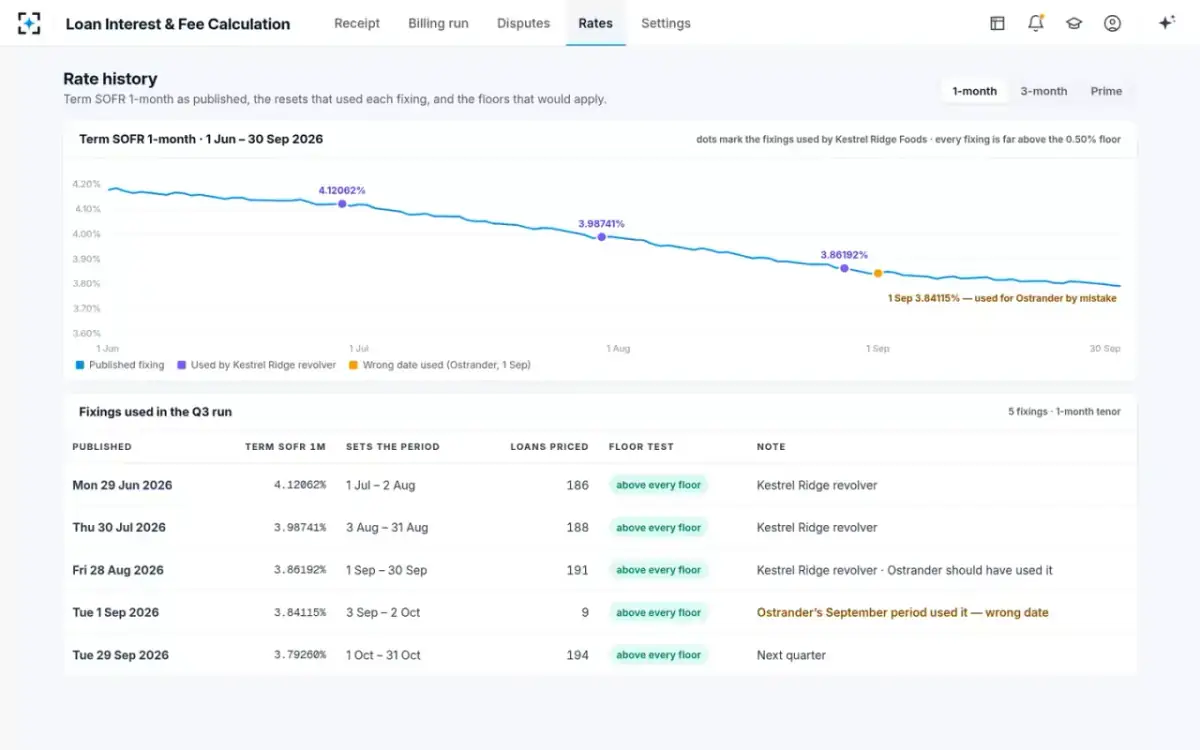
| Fixing date | Term SOFR, 1-month | Floor test at 0.50% | Margin | All-in rate for the period |
|---|---|---|---|---|
| 29 June | 4.12062% | Index above the floor; floor not reached | 2.35% | 6.47062% |
| 30 July | 3.98741% | Index above the floor; floor not reached | 2.35% | 6.33741% |
| 28 August | 3.86192% | Index above the floor; floor not reached | 2.35% | 6.21192% |
Recording the floor as not reached matters more than it sounds. “The floor did not apply” is a finding, and a bill that silently omits a term is indistinguishable from a bill that never tested it. The same holds for a quarter with no Event of Default and no fee waiver: a check that leaves no trace is a check nobody can audit.
Where the margin comes from: the pricing grid and its effective date
The margin is the half of the rate the index does not set, and on a performance-priced facility it moves. A pricing grid ties the Applicable Margin to a leverage or coverage ratio certified each quarter, with the new level taking effect from a date the agreement defines — typically a set number of business days after the compliance certificate is delivered, not from the quarter the ratio describes.
Two errors live in that gap. The first is applying the new margin from the start of the quarter the certificate reports on, which backdates a step-down the agreement did not grant. The second is the default level: most grids say that if the certificate is late, the highest margin applies until it arrives — a term that silently reprices the loan and that a system driven by the last-certified ratio will never apply at all.
In the sample agreement the margin is a flat 2.35% and the grid does not move, which is why the receipt can show one margin for the whole quarter. On a graded facility the margin belongs on the receipt per accrual period, with the certificate date beside it, exactly as the index fixing does.
What the LIBOR Act set, and what it did not
For contracts that had no workable fallback when LIBOR ended, Regulation ZZ supplies one by operation of law. For a business loan it is the matching tenor of CME Term SOFR plus a fixed adjustment: “In place of one-, three-, six-, or 12-month tenors of LIBOR, the benchmark replacement shall be the corresponding one-, three-, six-, or 12-month CME Term SOFR plus the applicable tenor spread adjustment” (12 CFR 253.4(b)(1)(ii)). The adjustments are fixed figures, not a formula: 0.00644% for overnight LIBOR, 0.11448% for one-month, 0.26161% for three-month, 0.42826% for six-month and 0.71513% for twelve-month.
What the regulation did not do is reach every loan. It applies to contracts without adequate fallback provisions; a loan already amended to a negotiated SOFR rate, or one whose fallback language the parties exercised, runs on the terms the parties wrote. A servicer therefore has three populations in one book — amended deals, statutory-replacement deals, and deals originated on Term SOFR from the start — and the spread adjustment belongs on the bill for exactly one of them. Carrying 0.11448% on all three, or on none, is a set-up error of precisely the kind that survives review because the number is small.
Four date errors that produce a wrong bill, and how each shows up
Each of these produces a bill that looks ordinary. None of them is detectable from the rate alone, because in every case the rate used is a real published fixing — just the wrong one, or applied over the wrong days.
The four, and the signature each leaves on a receipt
- The fixing date is the period’s own first day
No lookback at all. The bill is wrong by the index’s own move over two days — a few hundredths of a point, which is $412.66 on one period in the sample book. It shows up as a rate that matches a published fixing on the wrong date.
- The lookback is counted in calendar days, or on the wrong calendar
Right most of the year, wrong in any week containing a bond-market holiday. It shows up as periods that reconcile all year except two or three.
- The period’s end date is both counted and recounted
The last day of one period and the first day of the next are both charged, so a year has 365 days of interest plus one per period. It shows up as a consistent small overbill that scales with the number of periods, not the balance.
- The payment-date convention is applied to the accrual, not just to the payment
Modified Following moves the day money is due; it does not move the day interest stops accruing unless the agreement says so. It shows up at every quarter end that falls on a weekend.
Every fixing the run used, and the one applied on the wrong date
Rounding: five decimal places on the rate, two on the dollars
The ARRC's syndicated-loan conventions give three rounding instructions for SOFR loans: round the rate, never truncate it, to five decimal places; round dollar amounts to two; and do not round anywhere in between (ARRC, SOFR “In Arrears” Conventions, under “Rounding”). The third is the one systems break.
Rounding internally means rounding a daily accrual before multiplying it by the days. On a $15,000,000 balance a daily figure rounded to the cent is wrong by up to half a cent, and ninety-two of those are up to forty-six cents on one period before any other error. That is under a dollar-a-bill tolerance on its own and over it in combination, which makes it the most annoying kind of difference: too small to explain, too large to ignore.
Where the agreement is silent on rounding — and many are — the choice belongs to the servicer's own written rule, applied the same way to every loan. The sample book rounds per accrual period, to the cent, half up, and records that it did.
Twelve pricing and fee terms, read from the agreement and set against the set-up
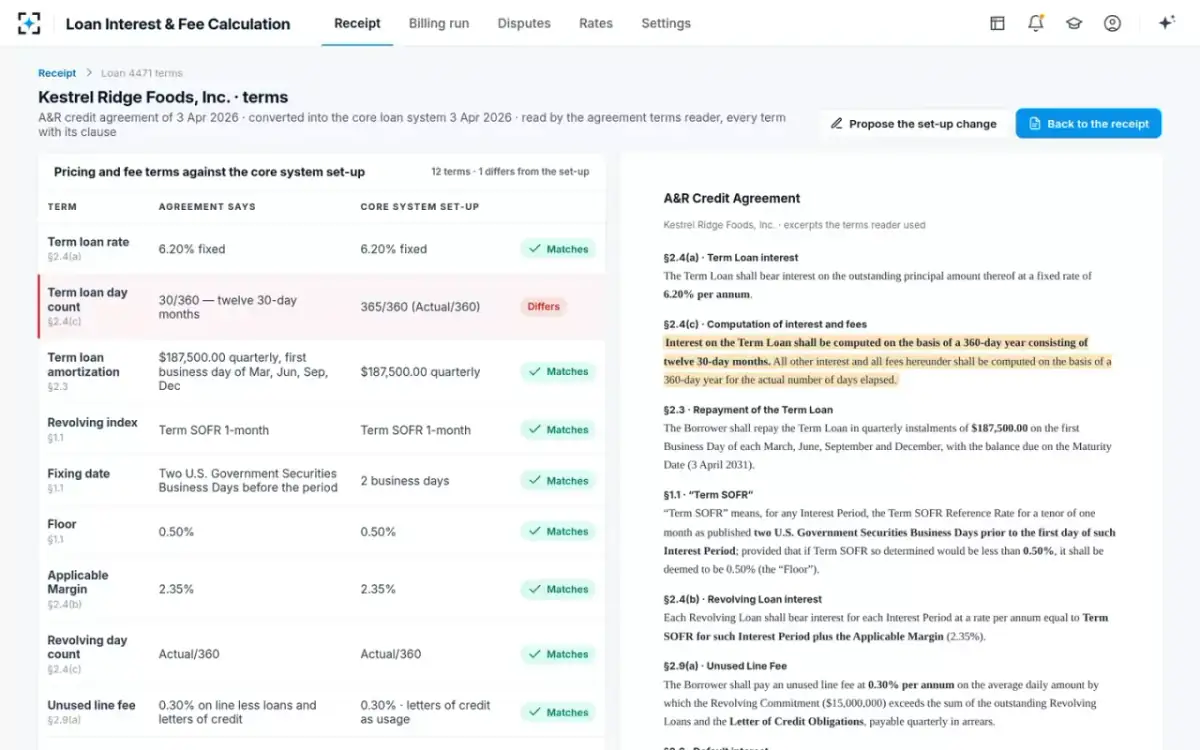
That last point is the difference between a convention and a term. Actual/360, a two-day lookback and a daily floor test are what the market recommends; what a particular bill owes is what a particular agreement says. The conventions tell you where to look. They do not tell you what you will find — and on the day a default rate starts, or on the base an unused line fee is charged on, the gap between the two is wider still. To see the four terms read out of an agreement and a bill rebuilt on them, start from Loan Interest & Fee Calculation.
Questions people ask
Is Term SOFR Actual/360 or 30/360?
Actual/360 by convention, and almost always in practice for revolving loans and fees. The ARRC recommends Actual/360 for Term SOFR and SOFR Averages while noting that other day-count fractions are possible, and sterling tranches conventionally use Actual/365. An amortizing term loan in the same agreement may still be written on twelve thirty-day months, so the answer has to come from the computation clause for that facility.
What happens if Term SOFR is not published on the fixing date?
The agreement decides, and well-drafted ones say so: common answers are the last day on which the rate was published, the next available publication, or a temporary switch to a base-rate loan. What a servicer must not do is interpolate or estimate a rate. In the sample book a missing fixing stops the calculation and the bill is held rather than computed on a guess.
What is the tenor spread adjustment for one-month LIBOR?
0.11448%, set in Regulation ZZ at 12 CFR 253.4(c). The companion figures are 0.00644% for overnight, 0.26161% for three-month, 0.42826% for six-month and 0.71513% for twelve-month LIBOR. They apply where the Board-selected benchmark replacement governs the contract — not to a loan the parties amended onto a negotiated SOFR rate of their own.
How should SOFR interest be rounded?
The recommended convention is to round, not truncate, the rate to five decimal places and dollar amounts to two, and to carry the calculation unrounded in between. Where the agreement sets its own rule, that rule governs; where it is silent, the servicer's written rounding policy should be applied consistently and recorded with the calculation, because per-period and per-bill rounding produce different totals.
Who publishes Term SOFR, and is it a Federal Reserve rate?
Not quite. Overnight SOFR is published by the Federal Reserve Bank of New York. Forward-looking term rates are a separate product published by a private administrator — CME Group's Term SOFR is the rate Regulation ZZ names as the replacement for one-, three-, six- and twelve-month LIBOR. Calling the term rate a Federal Reserve rate is a common shorthand and it is wrong in a way that matters when an agreement defines the source.
What is the difference between Term SOFR in advance and daily simple SOFR in arrears?
When the rate is known. Term SOFR is set before the period begins and held, so the borrower knows the cost in advance and the floor test is settled at the start. Daily simple SOFR accrues on each day's published overnight rate, so the period's rate is only final at the end, the floor must be applied day by day, and the agreement needs a lookback or observation shift so the final days can be invoiced. Both can sit in one agreement, on different tranches.