The administrative agent of a syndicated loan is the lender the others appoint to run the credit after it closes: it takes the borrower's interest and fee payments, splits them among the lenders and pays each one its share, keeps the register of who holds what, records assignments as shares change hands, and handles notices, draws and repayments. The hard part is never the arithmetic of a single number. It is that the shares move. A lender can buy 2.5% more of a facility on the fifteenth of a thirty-day interest period, and the agent still owes the seller for the days it held and the buyer for the days it held. Botminds' Loan Interest & Fee Calculation rebuilds a distribution the way a claim has to be answered — one day band at a time, from the effective date the agent itself recorded.
Everything worked through below is a fictional sample file inside the solution, with invented banks, borrowers and figures. The conventions come from the Alternative Reference Rates Committee, the OCC and the FFIEC Call Report instructions, linked where they appear.
One participant's claim on one September interest period
14days
held at a 20% share, 1 to 14 September
16days
held at 22.5%, from the assignment’s recorded effective date
$1,030.15
the shortfall the participant bank asked for
$549.41
the shortfall the rebuild found, and the agent paid
What does the administrative agent do on a syndicated loan?
Five jobs, in the order they bite. It receives what the borrower pays and sends each lender its share on the payment date. It keeps the register of commitments and holdings, and books each assignment with an effective date. It gives notice of rate settings, draws, repayments and defaults. It collects and splits the fees — commitment or unused-line fees, letter of credit fees, the agency fee that belongs to it alone. And it answers the questions, which in practice means explaining a distribution to a lender whose own calculation disagrees.
What it does not do is decide anything on the syndicate's behalf beyond the ministerial. Credit agreements usually make that explicit, and it matters here: when a lender disputes its distribution, the agent cannot settle the argument by negotiation. It either rebuilds the period and shows the arithmetic, or it pays whichever number is pressed hardest.
How is interest split between lenders in a syndicate?
Daily, on each lender's share of principal that day. Not by taking the period's total interest and applying the closing percentages, which is the mistake behind many disputed distributions. The ARRC states it in one paragraph, describing existing practice and then recommending the same thing for SOFR loans.
Currently, daily accrued interest is calculated on each lender’s share of principal that day. If a lender sells out of the loan completely, they are owed interest based on the time they held part of the loan, but do not earn further interest thereafter, even though they will not be paid until the end of the interest period.
Alternative Reference Rates Committee, SOFR “In Arrears” Conventions for Syndicated Business Loans, July 2020
Two things follow. A lender that sells out on day fifteen is still owed for days one to fourteen, and will be paid on the ordinary payment date along with everyone else — the money does not travel with the share. And a lender that buys in on day fifteen earns nothing for days one to fourteen, however much of the facility it holds when the payment is made. The period's interest is a stack of daily accruals, and each day belongs to whoever held the share on that day.
The arithmetic of one lender's share, and the shortcut that produces a claim
Interest for one day
the period’s interest ÷ its days
$41,206.18 ÷ 30 = $1,373.54 a day, the balance and the rate being flat all month
Set by the credit agreement
A lender’s share of that day
daily interest × the share held on that date
20% to 14 September; 22.5% from 15 September, the recorded effective date
Set by the register of lenders
What the agent owes for the period
the sum of the days, each at its own share
(14 × $1,373.54 × 20%) + (16 × $1,373.54 × 22.5%) = $3,845.91 + $4,944.74 = $8,790.65
The administrative agent
What the claim assumed instead
the closing share × every day of the period
$41,206.18 × 22.5% = $9,271.39, which is $480.74 more than is owed
The participant bank
What happens when a lender assigns its share mid-period
The period splits into bands, and every affected lender's dollars have to be worked out band by band. On the sample file the borrower is Arbor Glen Apartments and the facility is Loan 6402, agented by Northfold Bank. On 15 September, Cobalt Prairie Bank bought an additional 2.5% of the facility from Larchfield Capital, taking its own share from 20% to 22.5%. Nobody drew, nobody repaid, the rate did not reset, and September's interest came to $41,206.18 either way. The only thing that changed was who owned what — and that is enough to make one period two.
September rebuilt as two day bands, and what the 2.5% was worth in each
| Day band | Days | Cobalt Prairie Bank | Its interest for the band | The 2.5% that moved |
|---|---|---|---|---|
| 1–14 September | 14 days at $1,373.54 a day | 20% — the share it held before the assignment | $3,845.91 | Still Larchfield Capital’s |
| 15–30 September | 16 days at $1,373.54 a day | 22.5% — from the recorded effective date | $4,944.74 | Cobalt Prairie Bank’s |
| The period | 30 days · $41,206.18 in all | Two shares, not one | $8,790.65 | Worth $549.42 of the period on its own |
One interest period, one effective date, two share bands
- 14 days at 20% · $3,845.9114 d
- 16 days at 22.5% · $4,944.7416 d
- 14 days on the share it sold14 d
- 16 days without it16 d
- 30 days at 22.5% — no band boundary at all30 d
Assignment or participation? The difference that decides who you pay
Agency desks say "participant" for anyone holding a slice, and the sample file does too — the claim arrives from Cobalt Prairie Bank's participations desk. The legal difference decides whether the agent owes the claimant anything at all. In an assignment, the buyer becomes a lender of record: the agent books it on the register, and from the effective date it pays the buyer directly. In a participation, the selling lender stays the lender of record and keeps its full share on the agent's books; it receives the whole distribution and pays its participant itself, under a contract the agent is not party to and has often never seen.
So the first question on any distribution claim is which of the two happened. If it was a participation, the claimant's quarrel is with the lender that granted it, not with the agent — and the OCC's examination procedures reflect that split, telling examiners to "review participation agreements for participations sold to verify the bank's compliance with contractual terms (e.g., borrower and collateral monitoring, fee collection, payment collection, and remittance requirements)." The granting bank's remittance obligation is its own.
The same procedures put the confirmation rule the same way: "Loans serviced by other institutions, either whole loans or participations, should be confirmed only with the servicing institution. Loans serviced for other institutions, either whole loans or participations, should be confirmed with the other institution and the borrower." On the sample file the transfer was an assignment and assumption, booked by the agent with an effective date, which is why Cobalt Prairie's claim is the agent's to answer.
The recorded effective date, and why it is the only date that counts
An assignment has at least four dates attached to it, and three of them are traps. There is the date the parties signed the assignment and assumption. There is the date the trade was agreed, which may be weeks earlier. There is the date the money settled between buyer and seller. And there is the effective date the agent recorded on the register when it countersigned. Only the last one tells the agent how to pay, because it is the only one the agent itself controls and the only one every lender can see.
That is why this claim is answerable at all. The sample agreement's §9.4 provides that an assignment takes effect on the date the agent records, and the register shows 15 September. If the buyer and the seller meant the economics to run from an earlier date, that is a compensation payment between the two of them, settled between the two of them, and it never touches the agent's distribution.
A worked claim: $1,030.15 asked, $549.41 owed
Cobalt Prairie Bank's September distribution advice showed $8,241.24. Its own calculation said $9,271.39, and on 30 September it wrote to the agency desk asking for the difference of $1,030.15. Both figures were wrong, in opposite directions, and for the same reason: each applied one share to all thirty days.
Three calculations of one lender's September interest, and what each one assumed
What was assumed: 20% for all 30 days. The 15 September assignment had been recorded on the register but had not reached the distribution run.
What it produced: $41,206.18 × 20% = $8,241.24 — $549.41 short.
What was assumed: 22.5% for all 30 days, the share it held when the payment was made on 1 October.
What it produced: $41,206.18 × 22.5% = $9,271.39 — $480.74 more than is owed.
What was assumed: 20% for 14 days and 22.5% for 16, from the effective date on the register.
What it produced: $3,845.91 + $4,944.74 = $8,790.65 — the figure the agent then paid on.
What was assumed: The shortfall asked for, against the shortfall the days support.
What it produced: $1,030.15 asked; $549.41 owed; $480.74 declined, with the bands shown.
A participant's share, recalculated by day from the recorded effective date
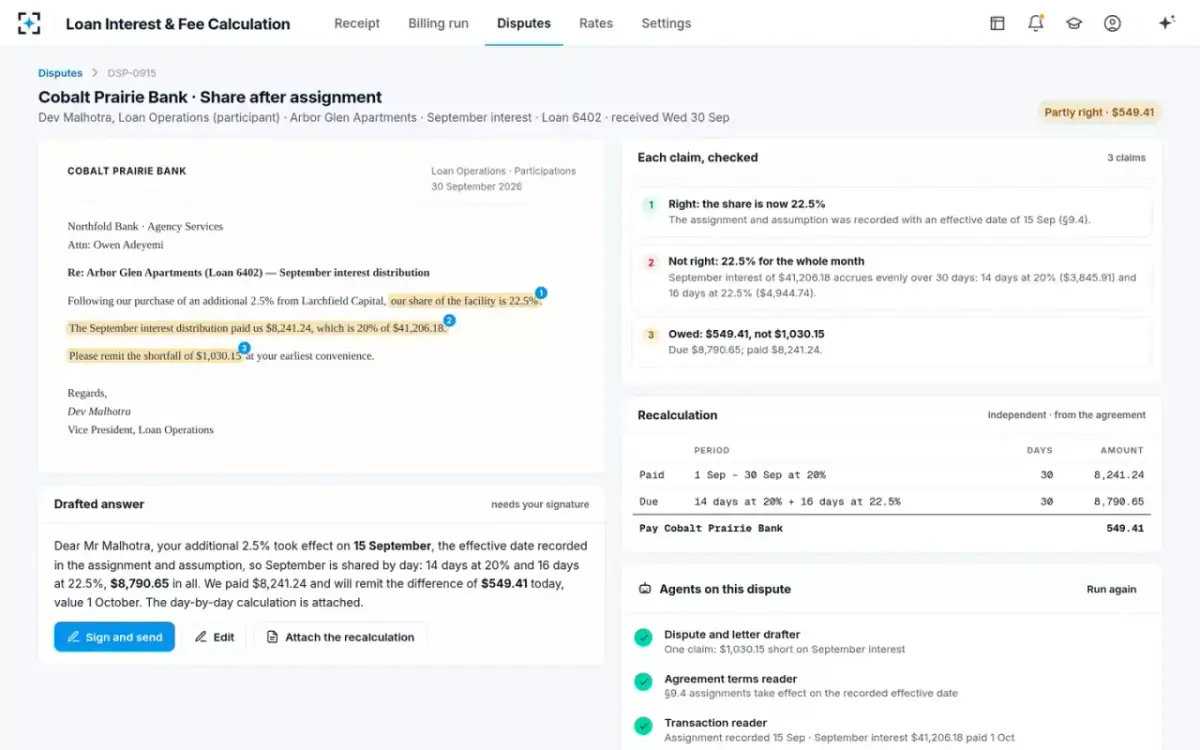
Notice how the answer is shaped. It does not say the claim is wrong; it says which of the three assertions in the letter is right. The share is 22.5%. The assignment was recorded. What does not follow is that 22.5% applies to the fortnight before the effective date. A claimant told "your calculation is incorrect" writes again; a claimant shown which sentence of its own letter survives and which does not usually does not.
The other useful property is that the answer is checkable without trust. Cobalt Prairie can verify the period total, the day count and its own share in each band from its own files, and the single fact it cannot reconstruct — the recorded effective date — is the one the register settles and the agreement's §9.4 points to.
Where rounding goes, and why per-period rounding is not per-lender rounding
This claim contains its own illustration, worth one cent. Round each band to the cent and add — $3,845.91 plus $4,944.74 — and the lender is due $8,790.65, so the shortfall against the $8,241.24 paid is $549.41. Carry the full precision to the end instead, and the 2.5% that moved for sixteen days is worth $549.42. One cent, on one claim, decided entirely by where the rounding happens.
A cent does not matter. A rule that nobody wrote down does, because the same choice made differently on two distributions makes the second one unanswerable: a claimant who rebuilds a period and lands a few cents away cannot tell whether it has found an error or a convention. There are only three defensible homes for a residue — keep it with the agent's own share, allocate it to the largest holding, or carry it into the next period — and the choice matters far less than fixing it in advance. In this solution rounding is a written setting, applied per accrual period to the cent, half up, where the agreement is silent, and every change to it is saved as a new version. That setting is what produces $549.41 rather than $549.42.
Where September's $41,206.18 went
By lender, once the assignment was picked up
- Every other lender · $32,415.53 · 78.67%
- Cobalt Prairie Bank · $8,790.65 · 21.33%
By day band
- 1–14 September · $19,229.55 · 46.67%
- 15–30 September · $21,976.63 · 53.33%
Letters of credit, fees and the shares that do not follow the loan
Not everything in a syndicate splits on the same percentages, and the exceptions are where second claims come from. The agency fee is the agent's alone. An upfront or arrangement fee is usually paid on the original allocation and does not move with later assignments. The unused-line fee follows the commitment rather than the drawn balance, so a lender whose commitment changed mid-period has a different split for the fee than for the interest — the mechanics of that fee are worked through in how an unused line fee is actually calculated.
Letters of credit are their own category, and the regulatory reporting makes the distinction plain. The FFIEC Call Report instructions tell a bank that for "syndicated standby letters of credit where each bank has a direct obligation to the beneficiary, each bank must report only its share in the syndication" — the obligation is several, and so is the fee that pays for it. Where the issuing bank instead carries the whole obligation and conveys participations in it, the whole amount stays on the issuer's books and its participants are paid by the issuer.
Payment dates carry an exception of their own. The ARRC's recommendation for loans is the "Modified Following Business Day Convention," meaning that payments that should be paid on a day that falls on a non-Business Day will be adjusted to the next succeeding business day, unless that business day falls in the next succeeding calendar month, in which case the interest payment date will be the preceding business day. A quarter ending on a Saturday can therefore be paid on the preceding Friday rather than the following Monday, and a distribution rebuilt against the wrong payment date is out by two or three days of accrual on every lender at once.
Prepayments bring the last of them. The ARRC's syndicated-loan conventions note that agreements may compensate lenders for funding losses, such as those caused by a prepayment in the middle of an interest period. Any such compensation is owed to the lenders holding the share on the prepayment date — the same day-band logic again, applied to a payment that is not interest at all.
What the agent should be able to show a participant on request
A claim is answered by evidence the claimant can check, and there are six pieces of it. The recorded effective date, with the assignment it came from. The balance on each day of the period, with any draws and repayments that moved it. The rate, with the fixing date and the published figure behind it — which reset applies is set out in the fixing date, the floor and the margin. The day count and the convention the agreement specifies. Each lender's share in each band. And the arithmetic written out, so the claimant can repeat it.
Two controls sit behind that list. The first is that a distribution is rebuilt from the agreement and the register rather than from the previous distribution, so a share that was wrong last quarter does not propagate into this one. The second is that a payment correcting a claim is signed by a person rather than released by whoever answered the letter. The OCC's internal control booklet puts the general version of that rule plainly: an appropriate level of management should "approve and authorize all transactions over a specified limit, and authorization should require dual signatures." In the sample solution the servicing officer signs up to $2,500 and the loan operations supervisor co-signs above it.
The claims queue: who asked, what was claimed, what is owed
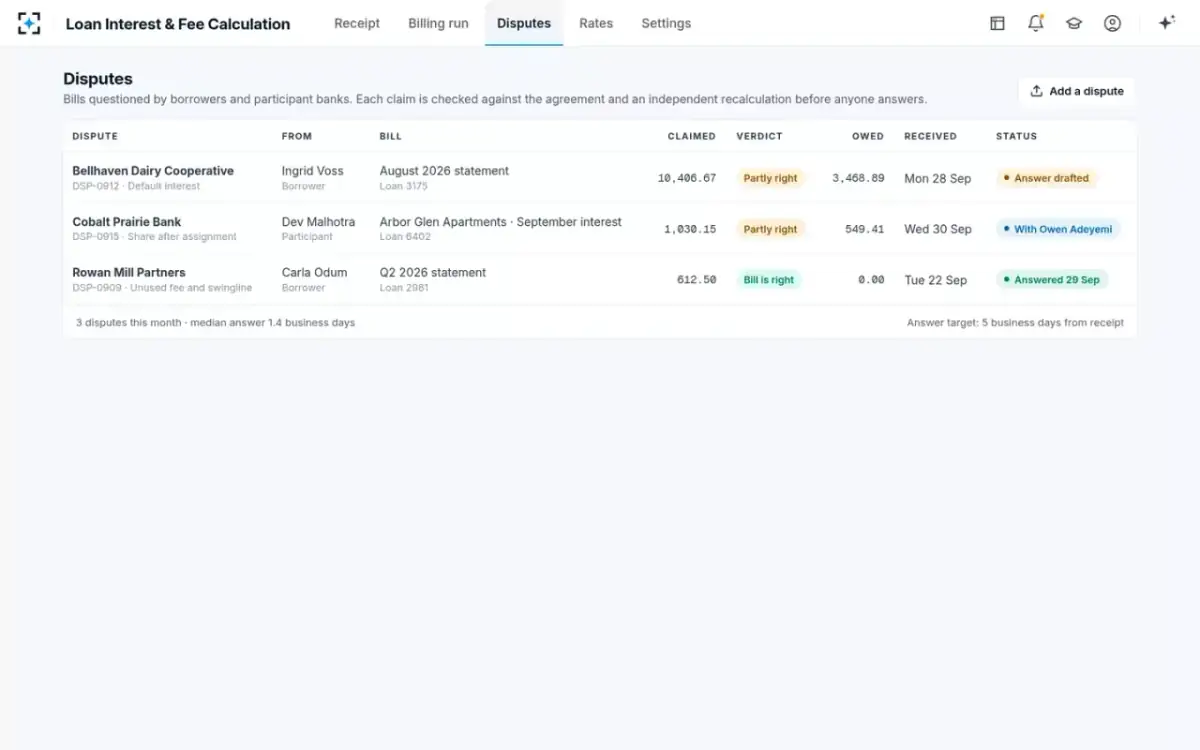
A desk that can produce those six pieces within a day stops having distribution arguments, because the argument was never really about the money. It was about whose arithmetic the other side could see. A wrong distribution that nobody checks is also an operational loss of exactly the kind set out in what one wrong loan bill costs a bank.
Questions people ask
When does a lender stop earning interest on a loan it has sold?
On the effective date of the assignment, as recorded by the administrative agent. It is owed interest for the days it held the share and nothing afterwards, and it is paid on the ordinary payment date at the end of the interest period rather than at settlement. Any economics the buyer and seller meant to run from an earlier date is a matter between the two of them.
What is the difference between a syndicated loan and a participation?
In a syndicated loan each lender has its own commitment to the borrower and is a lender of record, and an assignment moves that status to the buyer once the agent books it. In a participation the grantor remains the only lender of record and sells an economic interest in its own share; the agent pays the grantor the whole amount and the grantor pays its participant. The borrower is usually unaware of a participation and always aware of a lender.
How are rounding differences allocated between lenders?
However the agreement says, and when it is silent, however the agent has written down. The practical choices are to keep the residue with the agent's own share, give it to the largest holding, or carry it into the next period. What matters is fixing the rule in advance: a residue allocated case by case makes two identical periods pay differently, and makes any claim impossible to settle by rebuilding.
How does an agent bank answer a participant's claim?
By rebuilding the interest period day by day from the credit agreement, the balance history, the published rate fixing and the register of holdings, then setting the rebuilt figure against both the amount paid and the amount claimed. The answer should take the claimant's letter assertion by assertion and show the day bands, not just the total, so each one can be checked against the claimant's own records.
What records should an agent bank keep of distributions?
For each period: the balance on every day, the rate and the fixing date it came from, the day count applied, the register of holdings with every assignment's effective date, each lender's dollars by band, the rounding rule used, and who approved any correction. Kept that way, a closed period can be re-explained years later without re-running anything.
Does the administrative agent earn interest on its own share?
Yes. The agent is a lender like the others and is paid on its own holding on the same daily basis. Its agency fee is separate, belongs to it alone, and is not divided among the syndicate — which is one reason a lender's share of the interest and its share of the fees are rarely the same percentage.