A default interest calculation applies a higher rate — the stated rate plus a margin, or a flat rate named in the note — to the outstanding balance for the days an Event of Default is continuing. The arithmetic is the ordinary accrual arithmetic with one input changed. What makes the charge contentious is that the input nobody computes is the day count: the day the default rate starts is fixed by the agreement's notice and grace provisions, and the day it stops is fixed by whether the default is still continuing, and neither of those lives in the core loan system. Loan Interest & Fee Calculation reads both out of the agreement, rebuilds the charge day by day, and drafts an answer that addresses each claim in a dispute separately.
The worked example below is a fictional cooperative in the solution's sample data. The statute and the supervisory guidance quoted are real and linked where they appear.
One disputed default interest charge, rebuilt
21days
charged on the August statement, running from the day an email was sent
14days
the agreement actually allowed, running from the day after notice was given as it requires
$3,468.89
credited back — seven days at $495.56 a day, with the rest of the charge upheld
How is default interest calculated?
In four steps, of which only the second is arithmetic. Establish the days the default rate applies to; take the balance outstanding on each of those days; apply the default rate over the agreement's day count; and round as the agreement says. On the sample loan that produced $495.56 a day, so every argument about the charge is really an argument about how many of those days there were.
The rate itself comes from the note in one of three shapes, and each needs something different proved before it can be billed. A margin over the stated rate needs the stated rate for every day in the period, including any index resets inside it. A flat rate needs only the clause. A rate expressed as the maximum permitted by law needs an analysis of the governing law, which is why it is the formulation servicers like least.
Six tests before a default rate may be billed at all
- The clause exists and applies to this obligation
A default rate in the note does not automatically reach fees, letter of credit exposure or a swap under the same agreement. Read what the clause says the rate applies to.
- A trigger occurred that the agreement calls an Event of Default
A covenant miss, a payment miss, a cross-default or a representation failure — identified by clause, not by a status in the system.
- Notice was given in the form the agreement requires, if it requires one
Many agreements make the default rate conditional on notice and specify the method. A notice given another way may not start the clock.
- Any grace or cure period has expired
A payment default with a ten-day grace does not accrue the default rate during those ten days unless the clause says it accrues retroactively.
- The Event of Default was continuing on each day charged
Continuing is a daily test. A default cured on the 12th does not support a charge on the 13th.
- A stop date was recorded
A cure, a waiver or an amendment ends the period. A charge with no stop date keeps running until a person notices, which is the most expensive shape this error takes.
When does default interest start? Notice, cure and the day after
It starts on the day the agreement says, and the three common formulations give three different dates for the same breach. Some agreements provide that the default rate applies automatically from the date of the Event of Default. Some provide that it applies from the date the lender gives notice, or from the day after. Some provide that it applies at the lender's election, from a date the lender specifies in its notice.
On the sample agreement it was the second shape, and the gap was seven days. The borrower missed its fixed charge coverage covenant, a servicing officer emailed on 11 August, and the system began charging the default rate from that date. The agreement's notice clause required courier or registered mail; the notice that satisfied it landed later, and the rate properly started the day after — 18 August, not 11 August.
The August period, as billed and as the agreement reads
- Default rate charged from the day the email was sent11 – 31 Aug · 21 days
- Email sent · not valid notice11 – 17 Aug
- Default rate runs from the day after notice18 – 31 Aug · 14 days
Notice what the bank did not get wrong. The covenant really was missed; the Event of Default really was continuing; the rate really was the one in the note. A dispute answered as a yes-or-no question would have ended either in a full refund the bank did not owe or a flat refusal the bank could not defend. The right answer was seven days.
What counts as notice — and why an email often does not
Commercial credit agreements almost always contain a notices clause, and it is one of the few places where form genuinely controls substance. A typical clause names the permitted methods — personal delivery, a named courier, registered or certified mail, sometimes electronic mail to a specified address — names the addressees, and says when a notice is deemed given: on delivery, on the second business day after dispatch, on receipt of confirmation.
An email that does not meet those requirements may still be perfectly effective as a conversation and have no effect at all on the default rate. The practical consequence for loan operations is that the date a notice was sent is rarely the date that matters. What matters is the date the notice was given in the form the clause prescribes, and that date has to be captured from the correspondence rather than inferred from a system timestamp.
The same clause usually governs the other direction too. A borrower's cure notice, a waiver request or a dispute letter may have to be delivered the same way to count, which is a point worth making gently when answering a borrower who is arguing about the bank's notice.
A continuing Event of Default is not the same as a missed payment
Most core loan systems carry a delinquency flag driven by payment history. It is a useful operational signal and a poor proxy for the legal state of the loan, in both directions. A borrower can be perfectly current on payments and in continuing default on a financial covenant — the sample cooperative's fixed charge coverage was 1.08x against a 1.20x minimum — and a borrower can be days late on a payment and inside a grace period, with no Event of Default at all.
“Continuing” is also a daily state rather than an event. A covenant default continues until it is cured, waived or amended away; a payment default ends when the payment and any accrued charges are made. A servicer that treats the default rate as switched on by a flag and switched off by a person's memory will charge days on both sides of the true period. Examination procedures reflect the same concern, telling examiners to review accrued interest accounts by “Evaluating and testing procedures for accounting for accrued interest and for handling adjustments”, “Scanning for any unusual entries” and following up on unusual items by “tracing them to initial and supporting records” (OCC, Comptroller's Handbook, Commercial Loans).
Is default interest an unenforceable penalty?
It depends on the state whose law governs the agreement, and the law is genuinely divided. The question courts ask is whether the increase is a reasonable estimate of the lender's additional costs and risk when a loan goes bad — administration, monitoring, capital, the higher chance of loss — or whether it is a sum fixed to punish the borrower into performing. A modest increase over the contract rate on the outstanding balance is the easiest to justify on that test; a large charge applied to the whole principal at once is the hardest.
Two things follow for a servicer, and neither depends on how the enforceability question is answered. First, the analysis is state-specific and fact-specific, so an internal rule of the form “default interest is always enforceable” is not a rule, it is an assumption. Second, the parts of the charge a court is least likely to disturb are the parts that are plainly calculated: the correct rate, on the correct balance, for the days the default was actually continuing. Every day charged outside that period weakens the rest of the claim — which is the practical reason to get the start and stop dates right, quite apart from the money.
For a national bank, the federal definition of interest expressly reaches a payment compensating a creditor for “any default or breach by a borrower of a condition upon which credit was extended” (12 CFR 7.4001(a)). That settles which body of rate law the charge belongs to. It does not settle enforceability, which is a contract question under state law.
Default interest in bankruptcy: what section 506(b) allows
When a borrower files, the question changes shape. An oversecured creditor — one whose collateral is worth more than its claim — may add post-petition interest and reasonable charges provided for in the agreement:
"To the extent that an allowed secured claim is secured by property the value of which … is greater than the amount of such claim, there shall be allowed to the holder of such claim, interest on such claim, and any reasonable fees, costs, or charges provided for under the agreement or State statute under which such claim arose."
11 U.S.C. § 506(b)
Three words in that sentence do the work. Oversecured is a valuation question, decided on the collateral, and an undersecured creditor gets no post-petition interest under this provision at all. Reasonable is a judicial test applied to the fees, costs and charges. And provided for under the agreement means the claim can only include what the documents actually say — a default rate asserted in a proof of claim but absent from the note is not a charge the section preserves.
The operational consequence is that a proof of claim is a calculation, not an assertion. It needs the rate, the clause, the start date, the stop date and the balance for each stretch, all of which a servicer either has built or has to build under time pressure while a case is running.
Default interest and the late charge: when both are charged on one bill
A late charge compensates for the administrative cost of a payment that arrives late, is usually a percentage of the overdue instalment, and is charged once. Default interest compensates for the continuing risk of a loan in default, is a rate, and accrues daily. Many agreements allow both, and many allow both only in defined circumstances — commonly a late charge on an overdue instalment and the default rate only after acceleration, or after notice.
Three ways a default rate is written, and what each one needs proved
| How the note writes it | What has to be established to bill it | Where it goes wrong |
|---|---|---|
| The stated rate plus a margin — “the Applicable Rate plus 2.00%” | The stated rate for every day of the period, including any index reset inside it, plus the margin and its clause | The underlying rate is frozen at the reset in force when the default began, so later resets are missed |
| A flat rate named in the note — “18% per annum” | The clause and the days; no rate history is needed | The flat rate is applied to obligations the clause does not reach, such as fees or letter of credit exposure |
| The maximum rate permitted by law | An analysis of the governing law for the day in question, and the lender’s position under it | Nobody re-does the analysis, so a rate set at origination keeps running years later |
Where both charges appear on one statement, they should be separately computed, separately labelled and separately defensible, because a borrower may have a good argument about one and none about the other. Combining them into a single “charges” line is how a dispute about forty dollars becomes a dispute about the whole bill.
Three ways the start date is wrong, with the arithmetic for each
All three produce a charge at the right rate on the right balance. Only the days are wrong, and at $495.56 a day on the sample loan the days are the whole of the money.
The same charge, decided three ways
The delinquency flag, not the notice clause
The rate ran from the day an email was sent rather than the day after notice was given as the agreement requires. Seven days too many.
$3,468.89 over
The grace period ignored
A payment default charged from the due date, where the agreement gives ten days to pay before an Event of Default exists at all.
$4,955.56 over
No stop date recorded
The default was cured, but nothing switched the rate off; it kept running for a further twelve days until the next statement was questioned.
$5,946.67 over
The third is the worst of the three in practice, because it has no natural end. A start-date error is bounded by the length of the default period; a missing stop date runs until somebody asks. It is also the one a recalculation catches most easily, because a day on which no Event of Default was continuing has nothing behind it at all.
Answering the dispute claim by claim, instead of all or nothing
A borrower's dispute letter is usually several claims wearing one envelope: the notice was not valid, the covenant was not breached, the rate is wrong, the period is wrong. Answered as one question, it gets one answer and the answer is almost always wrong in one direction or the other. Answered claim by claim, the sample dispute resolved as partly right — the notice point was good and worth $3,468.89; the covenant point was not, because coverage really was 1.08x against a 1.20x minimum.
A borrower's dispute, each claim checked against the agreement
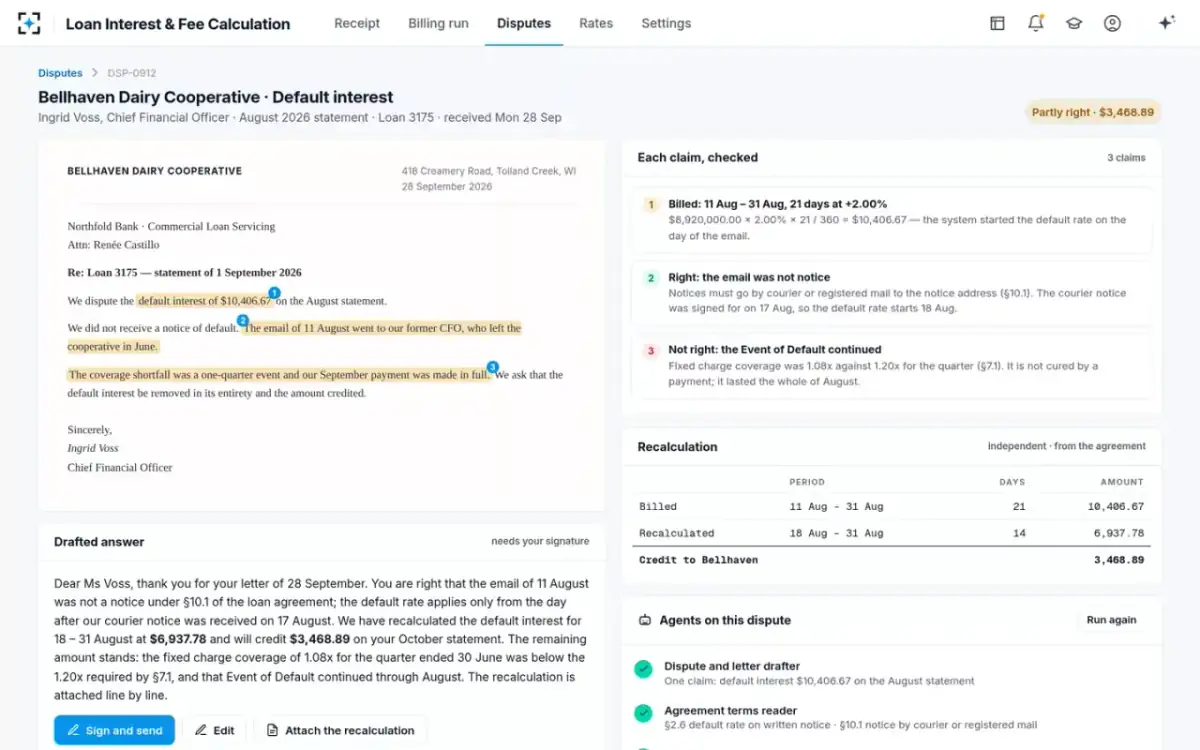
Two features of that answer are worth copying whatever system a desk runs on. It cites the clause for each verdict rather than asserting a conclusion, so the borrower can check it. And it concedes the point the bank got wrong first, which is both the honest order and the one that ends the correspondence fastest.
The disputes in front of the desk, with what each one turns on
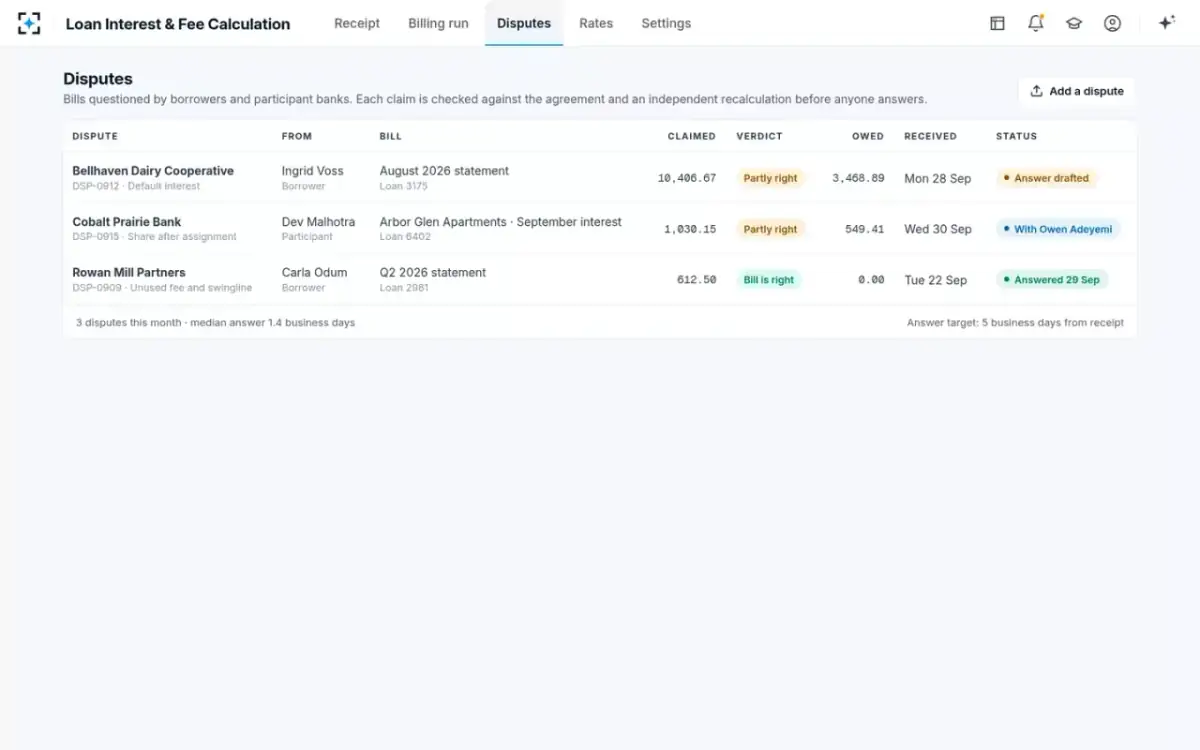
Default interest is the sharpest example of a rule that runs through every line of a commercial bill: the number follows the document, and the document is the only place the number can be checked. The same is true of which day's fixing priced the period, of what counted as usage for the fee, and of how the days themselves were counted. To see a disputed charge rebuilt day by day and answered claim by claim, start from Loan Interest & Fee Calculation.
Questions people ask
Does a lender have to give notice before charging default interest?
Only if the agreement says so — but a great many do, and when they do the form of the notice is part of the requirement. Where the clause makes the default rate conditional on notice, a notice given by a method the clause does not permit may not start the rate at all. On the sample loan that was worth seven days, $3,468.89 on one month's statement.
How long does default interest run after a breach is cured?
It should stop. The usual formulation is that the rate applies while an Event of Default is continuing, and a default that has been cured, waived or amended away is no longer continuing. The stop date needs to be recorded when the cure happens, because nothing in a core loan system will notice a covenant default being cured, and a rate left running has no natural end.
What rate is default interest usually set at?
Most commonly the contract rate plus a margin — two percentage points is a very common figure on commercial facilities — or a flat rate named in the note. Some notes instead set it at the maximum rate permitted by applicable law. Each formulation needs something different proved before it can be billed, and the third is the one most likely to be left unexamined for years.
What is the difference between default interest and a late charge?
A late charge is a one-off amount, usually a percentage of the overdue instalment, compensating for the administrative cost of chasing it. Default interest is a rate that accrues every day the default continues, compensating for the continuing risk. Many agreements allow both and some restrict when each applies, so they should be computed and shown separately on a statement rather than merged into one line.
Can a borrower get default interest refunded?
Yes, where the charge was not supported by the agreement — most often because the days were wrong. A partial credit is a far more common outcome than a full one: in the sample dispute the borrower recovered the seven days before notice and not the fourteen after, because the underlying covenant breach was real and continuing throughout.
Does accepting a late payment stop a lender charging the default rate?
It can, depending on the agreement and the governing law, which is why lenders who accept performance during a default normally send a reservation-of-rights letter at the same time. From a servicing perspective the safer habit is to decide explicitly: either the default is being treated as continuing, with the rate running and recorded, or it is not. The expensive position is an undecided one, where a rate keeps accruing that nobody has consciously chosen to charge.