Ask for operational risk examples in banks and you usually get the dramatic ones: a rogue trader, a wire sent to the wrong beneficiary, a system outage on payroll day. The expensive ones in a lending business are duller than that. A pricing term is set wrong when a loan is boarded or converted, nobody notices, and the loan is billed on that term every quarter until a borrower's controller works it out. Each bill is wrong by a few thousand dollars at most. The loss is in everything that happens afterwards. Botminds' Loan Interest & Fee Calculation exists to move that discovery forward, by rebuilding every bill from its own credit agreement before the run goes out.
This page costs one such failure end to end, using a fictional sample bank inside the solution. The supervisory language is the OCC's and the Federal Reserve Bank of New York's, linked where it appears; the dollars are demo figures on invented borrowers, not a customer's measured result.
One quarterly billing run, checked before it was sent
412bills
recalculated from their agreements between 09:09 and 09:12, before a 16:00 send
7held
bills that differed from the recalculation by more than the $1.00 tolerance
$10,354.30
overbilled across six of them, against $412.66 underbilled on the seventh
405agreed
bills that matched and went out on time
What is operational risk in banking, in one lending example?
Operational risk is the risk of loss from a bank's own processes, people and systems rather than from a borrower failing to pay. Credit risk is about the borrower; operational risk is about you. The OCC's lending booklet is unusually concrete about where it lives in a loan book, and the list is not where most risk committees look.
Operational risk is often present in the loan disbursement, payment systems, and credit administration processes. In general, the level of operational risk is correlated to the adequacy of systems, the quality of operating procedures, the adequacy of internal controls, the capability and integrity of employees, and the adequacy of control systems such as audit and credit risk review.
Office of the Comptroller of the Currency, Comptroller’s Handbook, Lending and Loan Portfolio Risk Management, version 1.0
Credit administration is where billing sits, and it is the least watched of the three. A bank with a careful underwriting process and a well-run collections desk can still bill the wrong interest for years, because nothing in the ordinary reporting cycle compares a bill with the agreement behind it. The loan performs, the borrower pays, the yield looks reasonable, and the only control that would have caught it is one few banks run on every bill: an independent recalculation.
What are examples of operational risk in banks' loan operations?
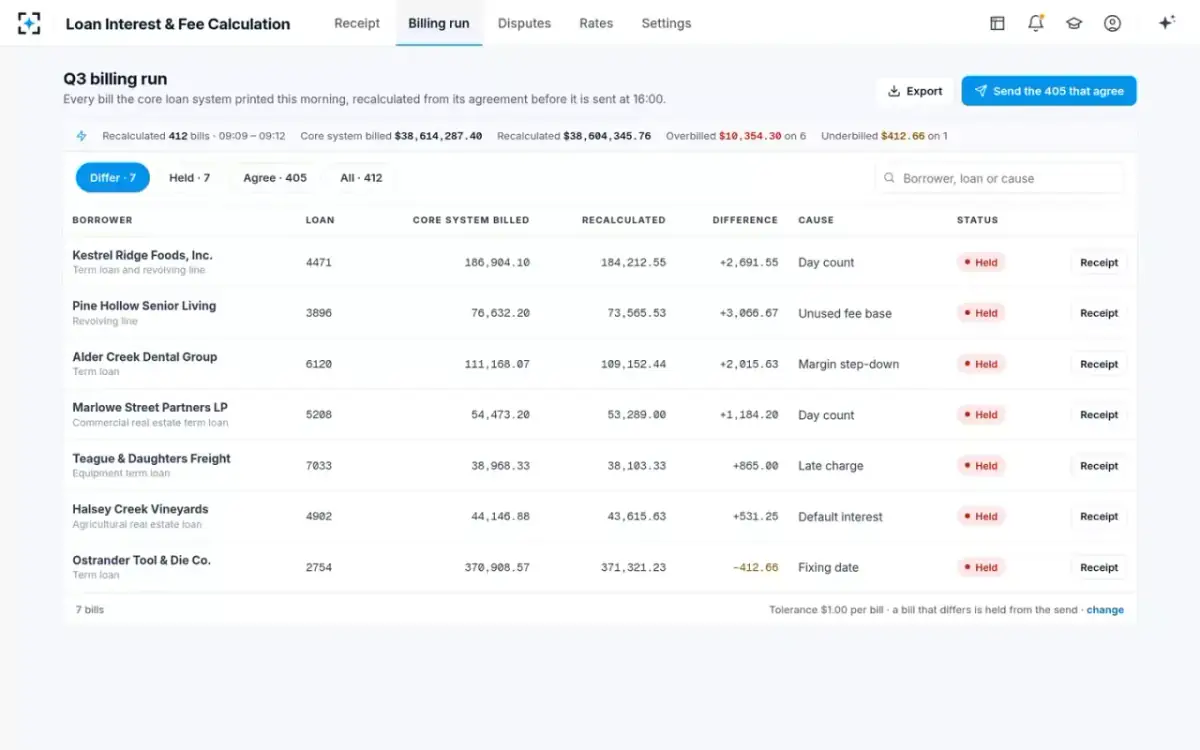
The useful list is not a taxonomy; it is the set of causes that actually appear on a run. On the sample quarter, seven bills of 412 differed from the recalculation, and the six causes between them are the whole field in miniature.
Seven held bills, and what caused each difference
Read the causes rather than the amounts and a pattern appears. A day count set to the wrong basis. A fee charged on the wrong base. A margin step-down the agreement granted and the system never applied. A late charge assessed where the agreement did not allow one. Default interest run from the wrong date. A rate fixing taken from the wrong day. Not one of them is a mistake of arithmetic; every one is a term that was read once, entered once, and never compared with the paper again.
The seventh is worth as much attention as the six. Ostrander Tool & Die was billed $412.66 too little, because its September period used the 1 September fixing instead of the 28 August one. A control that only hunts for overcharges is a customer-protection control; a control that finds both is also a revenue control, and it is far easier to fund.
Why a billing error is a process loss, not a credit loss
The distinction is not academic — it decides who owns the problem, how it is funded and whether anyone measures it. A credit loss is an outcome of a decision the bank made knowingly, within an appetite, priced into the spread. A billing error was never priced, never approved and never within anyone's appetite. The OCC's internal control booklet draws the line in a single sentence, and it is the sentence to put in front of a committee that thinks this is a back-office tidiness matter.
A significant deficiency in a control system, the booklet says, is "a deficiency in risk management. For example, the failure to process transactions in an accurate, thorough, and timely manner (a failure of internal control) exposes the bank to potential losses (transaction risk)." Three words there do the work: accurate, thorough and timely. A bill that is wrong fails the first. A bill that is wrong on every loan in a batch fails the second. A bill that stays wrong for four quarters fails the third.
There is a second reason the distinction matters. Credit losses are recognised when they happen. A billing error accrues silently and is recognised all at once, when the restitution is worked out — which means the quarter in which it is found looks worse than the quarters in which it was earned, and the people who find it get the blame for the number.
Counting the cost: the four buckets a wrong bill fills
Ask what one mis-set term costs and the honest answer has four parts in three different units. Adding them into a single figure flatters the exercise; keeping them apart is what lets a committee argue about the right one.
The four costs of one mis-set day count, in the units each is actually measured in
| The bucket | On this loan | Why it is rarely the biggest part |
|---|---|---|
| The overbilled dollars | $2,691.55 this quarter, $4,069.62 since the loan was converted | The only part anyone counts, and usually the smallest. It is also the part that must be given back whether or not anything else is done. |
| The hours to rebuild and answer | About eight hours by hand for one disputed bill (estimated), against about a quarter of an hour | Paid every time the same loan is questioned again, and again on every other loan the borrower asks about. |
| The restitution across the batch | A second loan, $1,184.20 more, plus the 38 notes that had to be read to be sure there was no third | Scales with the size of the conversion batch, not with the size of the error, and arrives as a single cheque. |
| The finding, and what follows it | A control weakness in credit administration, with remediation and testing attached | Costs management attention for several quarters and sets the bar for the next examination, long after the dollars are repaid. |
The fourth bucket is the one that changes behaviour. A bank that quietly refunds $4,069.62 has lost $4,069.62. A bank whose examiner reads the same facts as a control weakness in credit administration has acquired a programme of work, and the difference between the two outcomes is almost entirely whether the bank found it first.
The hours: rebuilding one disputed bill by hand
Price the second bucket properly, because it is the one that recurs. Rebuilding a single disputed commercial bill means finding the credit agreement and every amendment, reading the pricing terms out of them, looking up the rate fixing for each reset, reconstructing the balance through every draw, repayment and amortization, and only then rebuilding each accrual period in a spreadsheet. In the solution's own estimate that is about eight hours for one bill, and better than half of it is spent before any arithmetic starts.
Where eight hours on one disputed bill go
Rebuilt by hand, about 8 hours (estimated)
- Rebuilding every accrual period · 2.5 h · 31.25%
- Finding the agreement and its terms · 1.5 h · 18.75%
- Rebuilding draws and repayments · 1.5 h · 18.75%
- Looking up the fixings · 1 h · 12.5%
- Finding the term that caused it · 1 h · 12.5%
- Writing the answer · 0.5 h · 6.25%
Two things in that split explain why disputes take days rather than hours of calendar time. The first is that the biggest slice, rebuilding the accrual periods, cannot begin until the three slices before it are finished, so a missing amendment stops the whole exercise. The second is that the slice which actually answers the borrower's question — finding the term that caused the difference — is only an eighth of the work and comes last, when the analyst is furthest from the start.
The cohort: why one mis-set term is never one loan
Here is the part that turns a billing error into an operational loss worth a committee's time. Loans are not boarded one at a time; they arrive in batches, from a conversion, a portfolio purchase or a rate transition, and a batch is handled by the same people with the same mapping on the same day. If the mapping was wrong for one loan, the only interesting question is how many others it was wrong for.
The same error, priced at one loan, at two, and at the batch that had to be read
One loan, one quarter
Amount$2,691.55
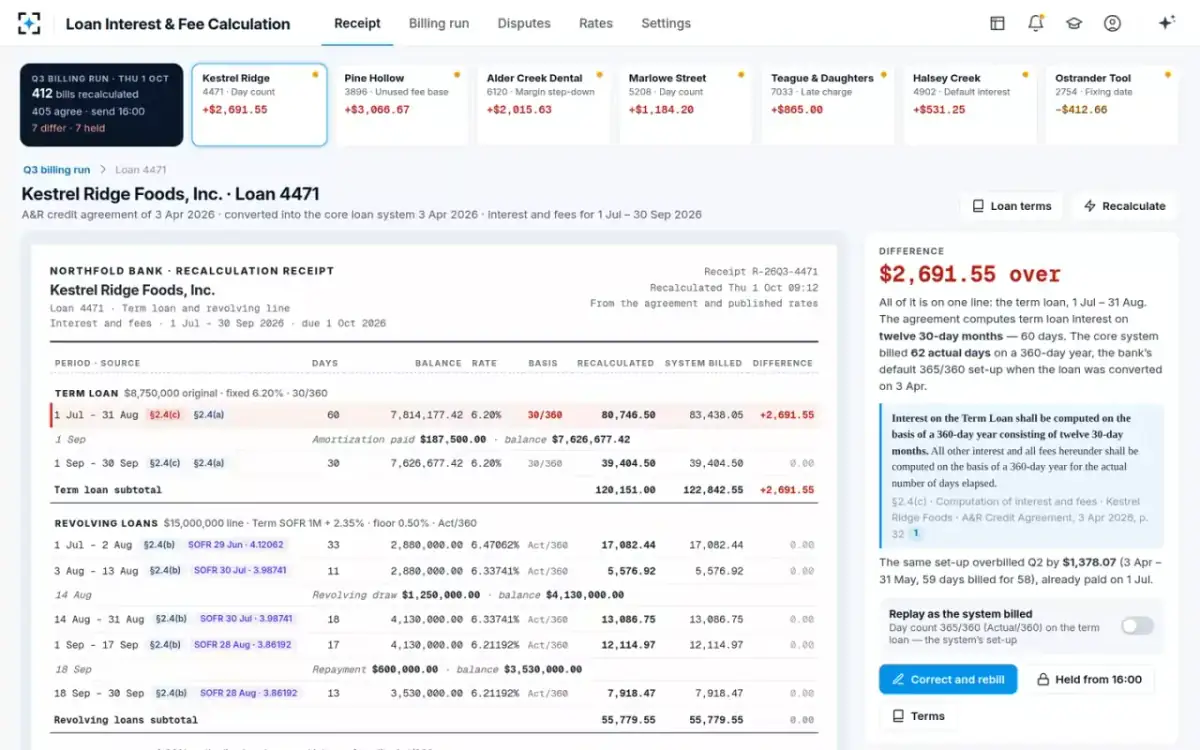
What it took to establishThe third-quarter difference on Loan 4471, all of it on the term loan line for 1 July to 31 August: 62 days billed where the note gives 60.
One loan, since conversion
Amount$4,069.62
What it took to establishThe same term also overbilled the second quarter by $1,378.07, which the borrower paid on 1 July.
The loans that shared the fault
Amount$5,253.82
What it took to establishLoan 5208 was converted the same day with the same wrong basis: $1,184.20 more this quarter.
The batch that had to be read
Amount38 loans
What it took to establishEvery note converted on 3 April was read again. Thirty-six agreed with their set-up; two did not.
The arithmetic of the batch is what nobody budgets for. Finding the second loan was cheap once the first was understood. Proving there was no third meant reading all thirty-eight notes converted on 3 April and comparing each one with its set-up, and that work had to be done whatever the answer turned out to be. Thirty-six agreed. A bank that cannot do that reading quickly has only two options, and both are bad: refund the batch without knowing, or tell the examiner it did not look.
Rate transitions are the same shape at a larger scale, and the ARRC said so while the LIBOR transition was still running: these "potential operational challenges may be greatest for products such as business loans, where many banks will face the prospect of converting a large number of loan agreements across many borrowers over a short period of time." Many borrowers, a short period, one mapping. That is a batch by another name, and the loan terms that get mis-set in a conversion follows what it does to a loan book.
The run, with the seven that differ held and each one's cause named
Spreadsheets as a control, and what examiners say about them
Most desks that check a disputed bill check it in a spreadsheet, and few treat that spreadsheet as a control that has to be tested. The OCC's internal control booklet treats it as exactly that, in one line most readers skim past: "Procedures should also exist to test the accuracy of spreadsheets and reports created by individual users."
The problem is not that spreadsheets are inaccurate. It is that a spreadsheet built to settle one argument becomes the template for the next twenty, including the parts that were wrong for the first loan and the parts that were merely specific to it. A day-count convention hard-coded for a term loan quietly misprices the next revolver pasted into it. Nobody tests it, because it was never meant to last, and it has no owner for the same reason.
The booklet also gives the structural rule that a billing check has to respect: "Segregation of duties to reduce a person's opportunity to commit and conceal fraud or errors. For example, assets should not be in the custody of the person who authorizes or records transactions." The billing version is narrower and just as binding: the recalculation must not start from the system's own billed interest. A check that takes the answer as an input will agree with it every time.
The finding: how a process failure is written up
An internal auditor who finds this writes it up in a shape that is worth knowing in advance, because the shape tells you what to build. The condition is that interest on commercial loans is billed from static data that is not compared with the governing agreement after boarding. The cause is that no control exists to make the comparison. The effect is the overbilled dollars, the restitution and the dispute hours. The criterion is the bank's own policy and the supervisory expectation that transactions are processed accurately, thoroughly and in a timely manner.
What gets argued is never the condition; it is the extent. An auditor must ask how many loans are affected, and if the bank cannot say, the finding is written for the whole portfolio rather than the two loans it knows about. That is the real reason to be able to read a batch of agreements quickly: not to answer the borrower, but to bound the finding. The same logic applies to a default rate charged from the wrong date, which is worked through in when the default interest clock starts.
What a bank can measure before anyone asks
Most of the measurement an examiner expects is already available, and some of it is already required. The OCC's commercial loans procedures tell examiners to "obtain or prepare a schedule showing the monthly interest income amounts and the commercial loan balance at each month end since the last examination," then to calculate yields and "investigate significant fluctuations and/or trends." A bank can run that on itself, and a mis-set day count on a batch shows up in it as a yield that is persistently a shade too high on one vintage.
Six questions an auditor should be able to answer about interest accuracy today
- What share of last quarter’s bills was checked against its agreement before it was sent?
For most banks the honest answer is the disputed ones, after the fact. That is a complaints process, not a control.
- How long does it take to rebuild one disputed bill, and who can do it?
If the answer is a day and two named people, the control does not scale to a batch and will not survive their leave.
- When a cause is named, how is it proved?
The only proof is reproducing the original bill with the old set-up. Anything else is a hypothesis in a letter.
- For any loan, how quickly can you list every other loan boarded or converted with it?
This is the question that bounds a finding. Not being able to answer it widens the finding to the portfolio.
- What is the tolerance, who set it, and what happens above it?
A threshold that nobody owns is a threshold that moves when a run is late. It should be a written setting with a version history.
- Which pricing terms in the core system have never been compared with the agreement since boarding?
On many books this is most of them, and saying so plainly is a better position than being shown it.
One bill as a receipt: every accrual period with its clause, its fixing and its difference
What a measurement programme buys is not the dollars; it is the sequence. A bank that finds its own error reports a number, makes restitution and closes a self-identified issue. A bank whose borrower finds it reports a number, makes restitution, explains why the control did not exist, and then builds it anyway. The work is identical. Only the order is different, and the order is what the finding is about. The classic wrong term in a commercial book is the day count, worked through in what the 365/360 method costs a borrower.
Questions people ask
What is the difference between operational risk and credit risk?
Credit risk is the risk that a borrower does not pay. Operational risk is the risk of loss from the bank's own processes, people and systems — including billing the wrong amount, applying a term the agreement does not contain, or failing to apply one it does. A performing loan billed on a mis-set term carries no credit risk at all and a real operational loss.
How much does a loan billing error cost a bank?
Far more than the overbilled amount, and in units that do not add up neatly. On the sample loan the dollars were $4,069.62 across two quarters, the rebuild was roughly eight hours of analyst time per disputed bill, a second loan in the same conversion batch added $1,184.20, and thirty-eight notes had to be read to establish there was no third. The dollars are usually the smallest of the four.
What happens when a bank discovers it overcharged interest?
It corrects the current bill, works out the restitution for every period already billed on the wrong term, and decides how far the same fault reaches across loans boarded or converted alongside it. The set-up itself then has to be changed in the core system under a documented approval, and in a well-run process the agents that found it propose the change while a supervisor approves it and loan operations applies it.
Is a spreadsheet an operational risk?
An untested one is. The OCC expects procedures to exist to test the accuracy of spreadsheets and reports created by individual users, and a dispute workbook built for one loan and reused for twenty is exactly the case the expectation is aimed at. The risk is not the arithmetic; it is the assumptions that were right for the first loan and silently wrong for the rest.
How do examiners treat a process failure like this?
As a deficiency in risk management rather than a clerical matter: the failure to process transactions accurately, thoroughly and in a timely manner is treated as exposing the bank to loss. What usually decides the severity is not the size of the error but whether the bank found it, whether it can say how many loans are affected, and how quickly it can prove the cause.
How far back does a bank have to go when it finds a billing error?
As far as the error does. There is no single period that applies to every commercial loan, so the practical rule is the one an auditor will apply: back to the date the term was first set wrong, usually boarding or conversion, for every loan the fault reached. That is why establishing the batch matters as much as establishing the amount.