The 365/360 interest method, also written Actual/360, divides the annual rate by 360 to get a daily rate and then charges that daily rate on every actual day the balance is outstanding. Over a normal 365-day year the borrower therefore pays 365 days at a 360-day daily rate: about 1.39% more interest than the stated rate, or roughly five extra days a year. Courts generally enforce it where the note states it, it is the standard convention for commercial revolving credit, and it is written into the note on purpose. The failure that costs a bank money is a different one — a system billing a basis the note never stated — and that is what Loan Interest & Fee Calculation catches, by rebuilding each bill from the agreement before it is sent.
The loans and people used as worked examples below are fictional sample data from the solution's own demonstration book. The rules, conventions and decisions are real and linked where they appear.
What a 360-day year does to a 365-day year of interest
1.0139
the ratio of a 365-day year to a 360-day year: the factor by which 365/360 raises a year of interest
5days
extra days of interest billed over a normal year — 366 days’ worth in a leap year
62 v 60
days counted for 1 July – 31 August: actual days against twelve 30-day months
What is the 365/360 interest method?
Three decisions sit behind every interest figure on a commercial loan bill: the length of the year the rate is spread over, the number of days the period is treated as having, and the balance each of those days is applied to. A day-count basis is the first two of them written as a pair. In 365/360, the denominator is 360 and the numerator is the actual calendar count — so a lender takes one three-hundred-and-sixtieth of the annual rate for each day the money is out.
That is why the convention is more commonly written Actual/360 in a credit agreement and in the market's own conventions. 365/360 is the borrower's name for it, because 365 is what a normal year costs. The two names describe the same arithmetic, and a note that uses one of them should not be read as using a different method from one that uses the other. What a note must not be read as, however, is 30/360 — which also uses a 360-day denominator but counts every month as 30 days, so a 31-day month is billed as 30. The difference between Actual/360 and 30/360 is not the year length. It is the day count.
Older texts call the same arithmetic “ordinary interest”, the banker's term for a 360-day year, against “exact interest” for a 365-day one. It survives in modern money-market practice: the Alternative Reference Rates Committee recommends Actual/360 for SOFR loans because it is the standard US money-market convention, while noting that sterling loans normally count a 365-day year (ARRC, SOFR “In Arrears” Conventions for Syndicated Business Loans, July 2020; how the same convention applies to Term SOFR).
The arithmetic, written out on one $7,814,177.42 balance
A term loan in the sample book carries $7,814,177.42 at 6.20% through July and August with no draws or repayments, so one balance covers the whole period and only the day count moves. That makes it the cleanest possible illustration of what the basis is worth.
One two-month period, billed on two bases
The daily amount
$7,814,177.42 × 6.20% ÷ 360
$1,345.775 a day
30/360 — what the note says
$1,345.775 × 60 days (two 30-day months)
$80,746.50
Actual/360 — what the system billed
$1,345.775 × 62 days (31 + 31)
$83,438.05
The difference
two days of interest, on one period of one bill
$2,691.55
Two days. The rate was right, the balance was right, the margin was right, the period was right — and the bill was $2,691.55 too high because a 31-day month was counted as a 31-day month under a clause that said to count it as 30. The same set-up had added $1,378.07 to the quarter before, which the borrower had already paid.
Notice what the arithmetic does not depend on. It does not depend on whether 365/360 is fair, or on what the borrower expected. Once the basis is read out of the clause, the number follows. That is the useful property of day count: of everything on a commercial bill it is the most completely determined by the document, and therefore the most completely checkable.
How do you calculate 365/360 interest, step by step
To calculate 365/360 interest, divide the annual rate by 360, multiply by the outstanding principal to get a daily amount, and multiply that by the actual number of days in the period. The steps below are the whole method, including the two that hand-built spreadsheets usually skip — splitting the period at every balance change, and rounding only where the agreement says to.
The six steps of a 365/360 calculation, with one period worked through
| Step | What it does | On the sample loan |
|---|---|---|
| 1. Read the basis out of the note | The clause that says how interest is computed — the year length, and how days are counted | “a 360-day year consisting of twelve 30-day months”, or “a year of 360 days … the actual number of days” |
| 2. Count the days the basis counts | 1 July – 31 August, counted two ways | 60 days on twelve 30-day months; 62 actual days |
| 3. Take the balance for each stretch | Split wherever a draw, a repayment or an amortization moves it | $7,814,177.42 for the whole period |
| 4. Apply the rate over the year length | balance × rate ÷ 360 | $7,814,177.42 × 6.20% ÷ 360 = $1,345.775 a day |
| 5. Multiply by the days | daily amount × days counted | 60 days: $80,746.50 · 62 days: $83,438.05 |
| 6. Round as the agreement says | Per accrual period, to the cent, half up, unless the note says otherwise | The difference on one two-month period: $2,691.55 |
Step 3 is where real bills get hard. A quarter with a draw on 14 August, a scheduled amortization on 1 September and a repayment on 18 September is not one calculation but four, each with its own balance and its own day count, and the agreement decides whether the day a payment lands is counted for the old balance or the new one. Step 6 matters more than it looks: rounding each accrual period to the cent and rounding once at the end of the bill give different answers, and a note that is silent leaves the choice to the servicer's own written rule.
Step 1 is the one nobody can do from the system. The basis lives in a sentence of the note, sometimes amended by a later agreement, and if that sentence is not read the other five steps compute the wrong thing very precisely.
Why a 360-day year raises the rate by about 1.39%
Because the daily rate is one three-hundred-and-sixtieth of the annual rate, and there are 365 days to charge it on. The multiplier is 365 ÷ 360 = 1.013889, so a year of interest at a stated 6.20% comes to 6.2861% of the balance — not a quoted rate anyone sees, but the rate the borrower actually pays. On $10 million that is $8,611.11 a year. In a leap year the factor is 366 ÷ 360 = 1.016667, and the same loan pays $10,333.33 more than its stated rate.
One year of interest on $10,000,000 at 6.20%, by basis
The bars make a point worth holding on to. Over a full year only the 360-day denominator with an actual-day numerator is different; the other three bases agree. Period by period they do not. Actual/365 bills a 31-day month more than a 28-day month and 30/360 bills them the same, so a quarterly bill can differ under every basis even when the annual total would not.
This is also why “is the effective rate higher?” and “is the rate correct?” are two different questions. On a 365/360 loan the effective rate is higher by construction, disclosed in the clause, and priced into the deal. Whether the bill is correct is a question about whether the basis billed is the basis written.
30/360, Actual/360 and Actual/365: which basis applies to which facility
Most commercial credit agreements use more than one basis in the same document, and it is normal rather than sloppy. A fixed-rate term loan amortized on a schedule is usually written on 30/360, because an amortization table assumes equal months. Revolving loans, letters of credit and fees run on Actual/360, because they are priced off money-market conventions where the balance changes daily. The sample agreement does exactly this, and the unused line fee on the same facility is computed on Actual/360 while the term loan beside it is on 30/360.
The four bases, on one $7,814,177.42 balance at 6.20% for July and August
| Basis | Days it counts for 1 Jul – 31 Aug | Year length | Interest for the period | Where it is usually found |
|---|---|---|---|---|
| 30/360 | 60 (two 30-day months) | 360 | $80,746.50 | Fixed-rate term loans, mortgage amortization schedules |
| Actual/360, also written 365/360 | 62 | 360 | $83,438.05 | Revolving credit, letters of credit, fees, most floating-rate commercial loans |
| Actual/365, “exact interest” | 62 | 365 | $82,295.06 | Sterling-market loans, some consumer and agricultural notes |
| Actual/Actual | 62 | 365 or 366 | $82,295.06 | Government securities and swaps; rare on commercial loans |
Two practical consequences follow. First, “what basis does this bank use?” is the wrong question; the right one is what basis this facility's clause states, because one borrower can hold two loans on two bases from the same lender. Second, a conversion or a core system migration is the moment the pairing breaks, because the facility is re-boarded and the basis is re-keyed by hand.
Is the 365/360 interest method legal?
Generally yes, where the note states it, and the disputes that reach a court are about what the document says rather than about the arithmetic itself. For a national bank the federal definition of interest is deliberately broad: 12 CFR 7.4001(a) counts any payment that compensates a creditor for extending credit, for making a line available, or for a borrower's default (the rule is quoted in our guide to the unused line fee). The day-count basis is part of how that compensation is measured, not a separate charge, and it travels with the rate.
Two places deserve care, and both are questions for counsel rather than for the billing desk. The first is a rate ceiling: because 365/360 collects 1.39% more than the stated rate over a year, a loan already priced at a state's maximum lawful rate — a default rate set at the cap is the usual case — can collect more than the cap allows over a calendar year, and whether that is permitted depends on the state's statute. The second is a disclosure regime with its own computation rule, such as an annual percentage rate on a consumer loan. Neither is an objection to the convention on a commercial note that states it. Both are reasons to know exactly what each note says.
What the Ohio Supreme Court decided in JNT Properties v. KeyBank
The most quoted modern decision on the method is the Ohio Supreme Court's in JNT Properties, L.L.C. v. KeyBank National Ass'n, 2012-Ohio-5369, a putative class action by a commercial mortgage borrower. The borrower argued that billing on a 365/360 basis collected more than the note's stated per annum rate. The note said in terms:
The clause the Ohio Supreme Court read, and what a system has to be told to reproduce it
The note, as quoted by the court: “The annual interest rate for this Note is computed on a 365/360 basis”
What the core system must hold: Basis: Actual/360 — a 360-day denominator with an actual-day numerator
The note, as quoted by the court: “by applying the ratio of the annual interest rate over a year of 360 days”
What the core system must hold: Divisor 360, not 365, and not switched in a leap year
The note, as quoted by the court: “multiplied by the outstanding principal balance”
What the core system must hold: Balance re-struck at every draw, repayment and amortization
The note, as quoted by the court: “multiplied by the actual number of days the principal balance is outstanding”
What the core system must hold: Calendar days, including the 31st of a 31-day month
The case shows how close a clearly written clause came to losing. The trial court granted the bank summary judgment; the Eighth District Court of Appeals reversed, reading the 365/360 sentence as in conflict with the stated per annum rate; the Supreme Court reversed again and reinstated judgment for the bank. It called the clause inartfully drafted but held it unambiguous, so the method it described governed. A note with only a rate and no computation sentence would have given the court nothing to enforce.
The lesson for a servicer is not “we will win”. It is that the clause is what gets read, so the only safe position is a bill that matches it. A borrower's controller who compares the note with the statement is doing in an afternoon exactly what a court would do over a year.
The failure that is not about the method: a basis the note never stated
In the sample book the term loan's note is on 30/360 and the core system has billed Actual/360 on a 360-day year ever since the loan was converted on 3 April. Nothing about that is a dispute over whether 365/360 is fair. It is a set-up field holding a value the document does not support, running silently on every bill until someone rebuilds one.
That shape of error has three properties that make it expensive. It is small per bill, so it survives review — $2,691.55 on a $186,904.10 statement is 1.4%. It is systematic, so it repeats every quarter and compounds across a conversion batch: reading all 38 notes converted on the same day found a second loan with the same mismatch. And it is the lender's error, so the money comes back with interest on the correction rather than being argued over.
One accrual line, opened: the clause and the arithmetic side by side
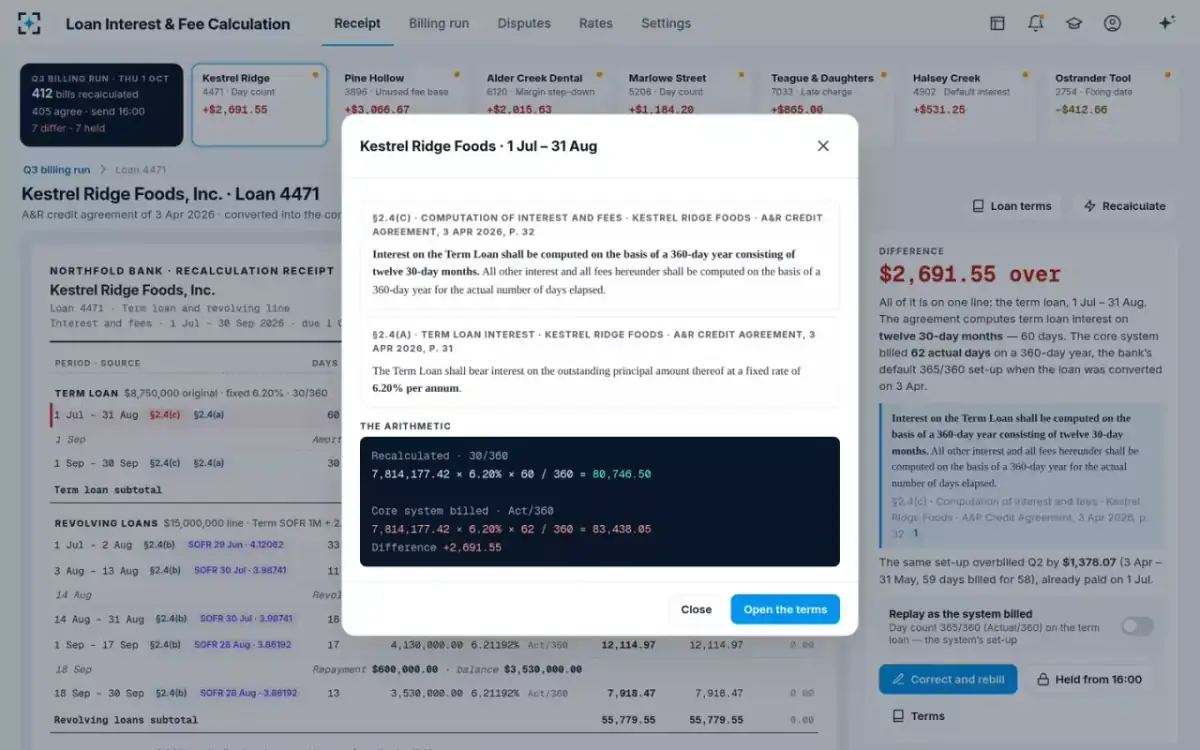
How the recalculation proves which basis was billed
Naming a cause and proving one are different things, and on a day-count difference the proof is unusually clean. Rebuild the period on the basis the note states and you get one number. Rebuild it on the basis you believe the system holds and you should get the system's number exactly — not approximately. If replaying the suspected set-up reproduces the printed bill to the cent, and nothing else on the bill moves, the cause is established rather than inferred.
That is the test the solution applies before it will name a cause at all. On the sample bill, replaying a 365/360 term-loan day count moved the line to 62 days and brought the difference to $0.00, with every other line unchanged — so the day count is the whole of it. A difference that cannot be reproduced that way stays open instead of being labelled.
The same discipline is what lets a servicer answer a borrower in one pass rather than three. The arithmetic, the clause and the replay together say what was billed, what should have been billed, and why — and the desk that has to produce that answer is usually spending half a day to two days on it in a spreadsheet.
A bill as a receipt: every period with its days, basis and rate
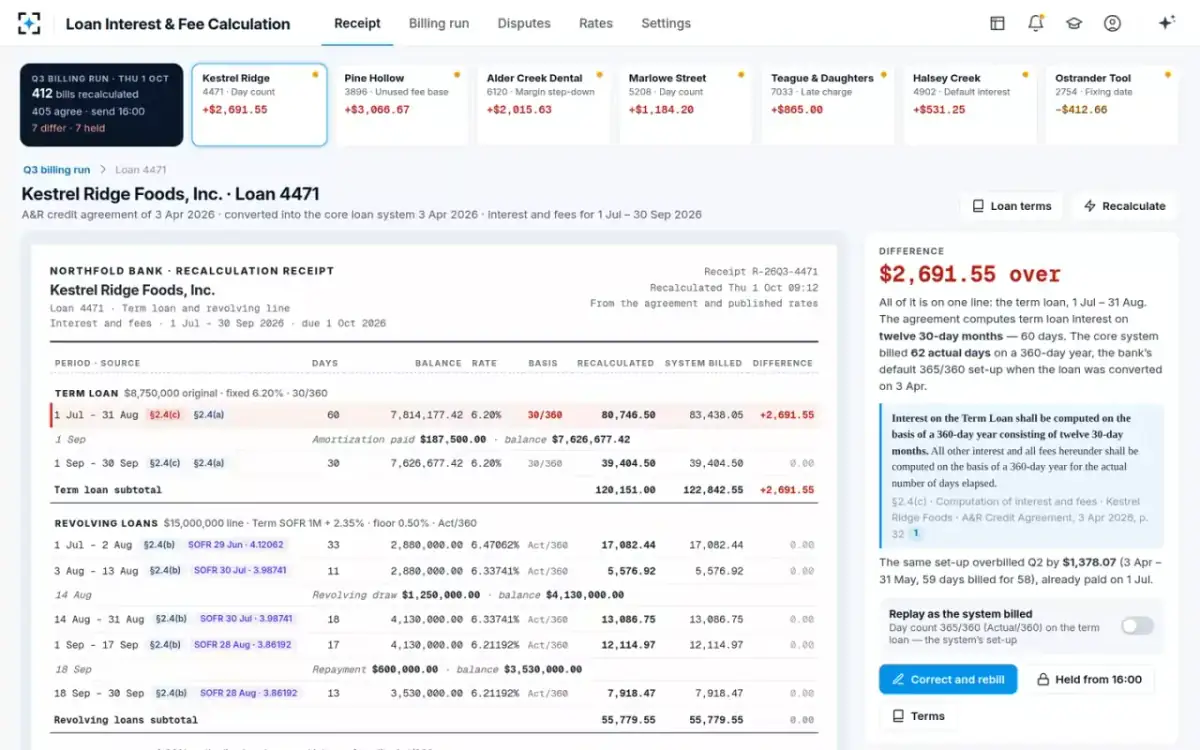
Day count is the simplest of the conventions on a commercial bill and still a classic cause of a wrong one. The harder ones sit next to it: the fixing date, the floor and the basis on a Term SOFR facility, and the day the default rate starts. To see a bill rebuilt from its own agreement before it is sent, start from Loan Interest & Fee Calculation.
Questions people ask
What is the difference between 360 and 365 interest?
The number the annual rate is divided by to get a daily rate. A 360-day year gives a larger daily rate than a 365-day year at the same stated percentage. If both then charge actual days, the 360-day version collects 365 days of a slightly bigger daily amount — 1.3889% more over a normal year. The difference only disappears if the 360-day year is paired with a 360-day count, which is what 30/360 does.
What does “365/360 basis” mean on a promissory note?
It means interest is computed by applying the annual rate over a 360-day year to the outstanding principal, for the actual number of days the principal is outstanding — the formulation the Ohio Supreme Court read in JNT Properties v. KeyBank. In an agreement drafted in market language the same method is usually called Actual/360. A note that instead says “a 360-day year consisting of twelve 30-day months” is not describing this method; it is describing 30/360.
What is the effective rate on a 365/360 loan?
The stated rate multiplied by 365 ÷ 360 in a normal year, so a 6.20% note bills at an effective 6.2861% and a 7.50% note at 7.6042%. In a leap year the multiplier is 366 ÷ 360 and 6.20% bills at 6.3033%. The effective figure is not the rate quoted in the loan documents and is not what the pricing grid moves; it is the arithmetic consequence of the basis.
How much more does 365/360 cost over a year?
About five days of interest. On $10,000,000 held for a full year at 6.20%, Actual/360 bills $628,611.11 where 30/360 or Actual/365 would bill $620,000.00 — $8,611.11 more, or $10,333.33 more in a leap year. On a revolving line the figure is smaller because the balance is smaller, but the proportion is the same.
Why do banks use a 360-day year?
It began as arithmetic convenience: a 360-day year divides evenly into twelve 30-day months and four 90-day quarters, which mattered when interest was computed by hand and in tables. It survived because money-market instruments are quoted that way, and a lender funding a loan in that market prices the loan on the same basis. The Alternative Reference Rates Committee's loan conventions still recommend Actual/360 for dollar loans and note that sterling markets use Actual/365.
Which loans use 30/360 and which use Actual/360?
As a rule of thumb, scheduled fixed-rate term debt and amortization tables use 30/360, while revolving credit, letters of credit, fees and floating-rate loans priced off a money-market index use Actual/360. But it is a rule of thumb only. The pairing is a drafting choice, both bases commonly appear in the same credit agreement for different facilities, and the only reliable answer is the clause in the note as amended.