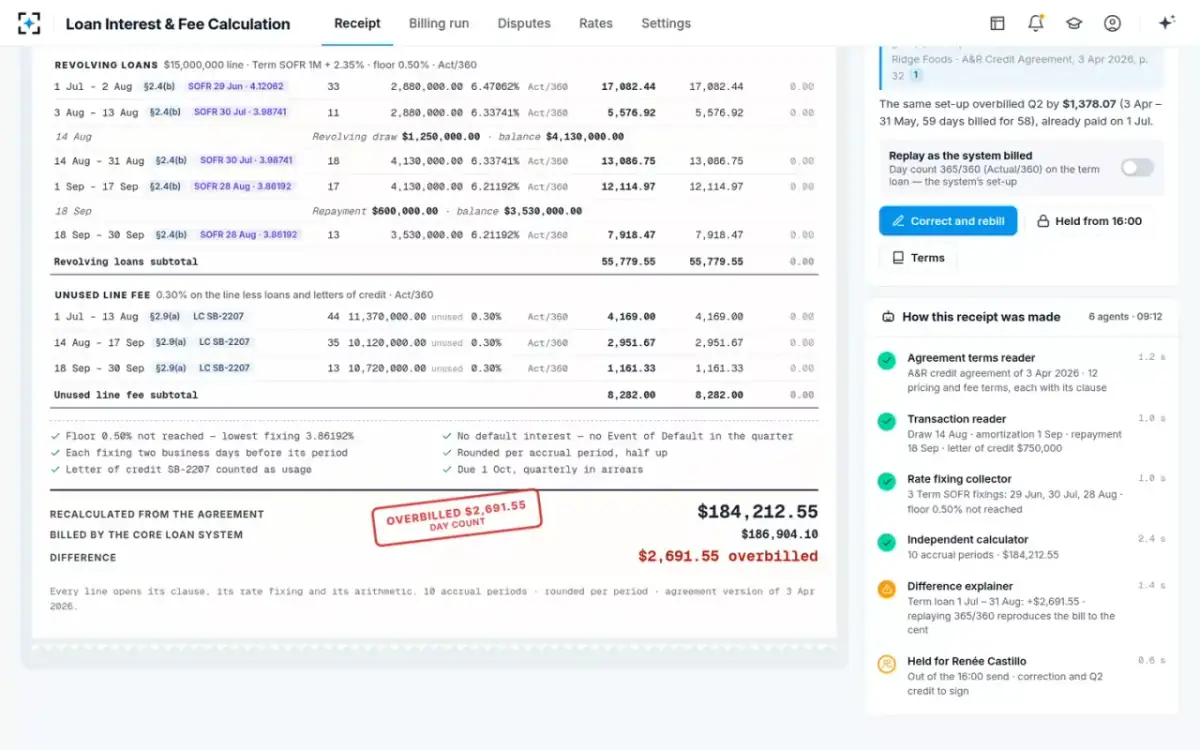
An unused line fee is a charge on the part of a revolving credit commitment the borrower has not drawn: the lender has set money aside and has to hold capital against it whether or not it is used, so it charges a small annual percentage — commonly 0.25% to 0.50% — on the average daily unused balance. The arithmetic is average daily unused × rate × actual days ÷ 360, and almost nobody disputes that formula. What they dispute is the base it runs on, because three separate decisions in the credit agreement build it. Loan Interest & Fee Calculation rebuilds the base from those clauses and from the facility's own transaction history, then sets it beside what the core system charged.
This page works one quarter through to the cent on a fictional sample facility, and then takes the base apart four ways. The regulatory material it cites is real and linked; the borrowers and loans are sample data.
One $15,000,000 commitment across a quarter: what was used, and what the fee is charged on
1 July – 13 August · 44 days
- Revolving loans drawn · 40%
- Letter of credit SB-2207 · 8.3%
- Unused — the fee base · 51.7%
14 August – 17 September · 35 days, after a draw
- Revolving loans drawn · 53.3%
- Letter of credit SB-2207 · 8.3%
- Unused — the fee base · 38.3%
18 – 30 September · 13 days, after a repayment
- Revolving loans drawn · 43.3%
- Letter of credit SB-2207 · 8.3%
- Unused — the fee base · 48.3%
What is an unused line fee?
It is the price of availability. A revolving commitment is a promise to lend on demand up to a stated amount, and that promise costs the lender something even when nothing is drawn: it has to be reported as an off-balance-sheet exposure, carried in liquidity planning, and held against in capital. The unused line fee prices that promise, usually at a quarter to a half of one percent a year on what is left unused.
Three things follow from the definition and explain most arguments about it. The fee is charged on a balance that moves every day, so it cannot be computed from a single month-end figure. It is charged on availability, so anything that eats availability without being a cash loan — a letter of credit, a swingline, a reserve — normally counts against it. And it is charged for a period, so the day a draw lands and the day a commitment is reduced both matter to the cent.
How is an unused line fee calculated, day by day
To calculate an unused line fee, work out the unused balance for each day of the period, average those daily balances, and apply the fee rate over the agreement's day count. In practice no one averages a list of 92 numbers: the period is split at every event that moves the balance, each band is weighted by its days, and the weighted total is divided by the days in the period.
Building the fee base: one day's unused balance
The commitment
$15,000,000
The revolving commitment in force on that day, after any permanent reduction
Set by the commitment schedule and every amendment
Revolving loans outstanding
$6,000,000 → $8,000,000 → $6,500,000
Re-struck on the day of each draw and each repayment
From the facility’s transaction history
Letters of credit issued
$1,250,000
Undrawn face amount of SB-2207, outstanding for the whole quarter
Counts as usage under the sample agreement
Unused balance for the day
$7,750,000 → $5,750,000 → $7,250,000
What the fee is charged on, for that day only
Averaged across the period, then priced
The same quarter, priced: average daily unused × rate × days ÷ 360
44 days at $7,750,000 unused
7,750,000 × 44
341,000,000
35 days at $5,750,000 unused
5,750,000 × 35
201,250,000
13 days at $7,250,000 unused
7,250,000 × 13
94,250,000
Weighted total, dollar-days
sum of the three bands
636,500,000
Average daily unused balance
636,500,000 ÷ 92 days
$6,918,478.26
The unused line fee for the quarter
$6,918,478.26 × 0.375% × 92 ÷ 360
$6,630.21
Two details decide whether a second person gets the same answer. The first is which day a transaction belongs to: a draw funded on 14 August raises usage from 14 August, not from 15 August, unless the agreement says otherwise, and getting that wrong on one $2,000,000 draw moves the fee by about $21. The second is whether the average is a true daily average or a shortcut — a period-end balance, or the average of the opening and closing figures. On this quarter the closing balance alone would have produced $6,947.92, which is $317.71 too much, and nothing on the statement would show why.
The commitment: what the bank is obliged to fund, and what it reports
The first input is the commitment itself, and it is not always the number on the front page of the agreement. Commitments step down on a schedule, are permanently reduced at the borrower's election, and are cut by amendment. A fee charged on the original figure after a reduction is an overcharge every day until someone notices: on this facility, a $1,500,000 permanent reduction effective 1 August that the system never picked up would have added $953.13 to one quarter's fee.
The regulatory definition of a commitment is broader than most borrowers assume, and worth knowing because it shapes how lenders think about the fee. The Call Report instructions tell banks to include, among other things, “Commitments for which the bank has charged a commitment fee or other consideration” (FFIEC 051 Call Report instructions, Schedule RC-L). Charging the fee is itself one of the markers of a reportable commitment.
Reporting is also deliberately unforgiving about escape clauses: unused portions are reported “regardless of whether they contain ‘material adverse change’ clauses or other provisions that are intended to relieve the issuer of its funding obligations under certain conditions and regardless of whether they are unconditionally cancelable at any time.” A lender cannot report a commitment as smaller because it might not have to fund it — and the same discipline is the honest way to read a fee clause.
What counts as usage — and why a letter of credit usually does
Usage is whatever the agreement says consumes availability, and on a typical revolver that is more than the cash loans. The undrawn face amount of a standby letter of credit is the clearest case: the bank is committed to pay it, the borrower cannot borrow that money, and so it reduces the unused balance the fee is charged on. Swingline loans, protective advances and agreed reserves are usually treated the same way; a term loan under the same agreement usually is not, because it does not draw on the revolving commitment at all.
The sample facility's receipt records exactly this, and records it as a finding rather than leaving it implied: letter of credit SB-2207 counted as usage for the unused line fee. Excluding it would have raised the base by $1,250,000 every day of the quarter and the fee by $1,197.92 — eighteen percent of the fee, from one classification.
Facility fee and unused fee on the same $15,000,000 commitment
A facility fee: The whole commitment, used or not — $15,000,000 every day
An unused line fee: Only the part not used — $7,750,000, $5,750,000, $7,250,000 across the three bands
A facility fee: Nothing. Drawing the line does not change the fee
An unused line fee: Reduces it. Every dollar drawn is a dollar the fee is no longer charged on
A facility fee: Predictable income that does not fall when the borrower uses the line
An unused line fee: Prices availability specifically, and falls away as the loan itself starts earning a margin
A facility fee: The commitment in force, and every permanent reduction
An unused line fee: The commitment, what counted as usage, and how the daily balances were averaged
A facility fee: Rare — one number, one rate
An unused line fee: The base: letters of credit, step-downs, the day a draw lands
Facility fee, commitment fee, unused fee: three names, two different bases
The vocabulary is genuinely inconsistent, and the names do not reliably tell you the base. “Commitment fee” is the older and broader term and is used both ways: in syndicated lending it very often means the fee on the undrawn portion, which is what this page calls an unused line fee; in other documents it means a fee on the whole commitment, which is a facility fee. “Facility fee” almost always means the whole commitment. “Unused line fee” and “unused fee” almost always mean the undrawn portion.
Because the names are unreliable, the only safe reading is the clause's own words: find the sentence that defines the amount the percentage is applied to. If that sentence says the Commitment, it is a facility fee however it is labelled. If it says the excess of the Commitment over the sum of the outstanding loans and letter of credit exposure, it is an unused fee however it is labelled. A servicer who maps a fee by its name rather than its base will board a whole portfolio wrong.
Is an unused line fee interest, or a fee?
It is both, depending on who is asking — and the two answers are not in conflict. For a national bank's own books and for the borrower's accounting, it is a fee: it is not compensation for money lent, because no money was lent. For the federal most-favored-lender rule it is interest, and deliberately so: “The term ‘interest’ as used in 12 U.S.C. 85 includes any payment compensating a creditor or prospective creditor for … making available of a line of credit” (12 CFR 7.4001(a)). The regulation goes on to separate the two worlds explicitly, providing that charges and fees that are interest within the meaning of that statute “are governed by § 7.4001 and not by this section” (12 CFR 7.4002(d)).
What this does not mean is that a commercial unused fee is capped by a usury limit. The federal definition is the gateway to a most-favored-lender analysis under state law, and whether any state ceiling reaches a fee on a commercial line is a question of that state's own statute. The practical significance for a servicer is narrower and more useful: the fee is part of the price of credit, so it should be documented, calculated and corrected with the same care as the interest line — not treated as an administrative charge that nobody rebuilds.
The day count that applies to fees, and why it differs from the term loan
Fees on a dollar revolver are conventionally computed on Actual/360, the same basis as the revolving loans they sit beside, because they are priced off the same money-market conventions. The amortizing term loan in the same agreement is often on a thirty-day-month basis instead, which is why one credit agreement can carry two day counts without being inconsistent — and why a system boarded with one basis per borrower rather than one per facility will get the fee right and the term loan wrong, or the reverse.
The size of the effect on a fee is small and persistent: on this quarter, computing the same base on Actual/365 rather than Actual/360 gives $6,539.38 instead of $6,630.21, $90.83 less. That is below most servicers' per-bill tolerance on its own, which is exactly why it survives for years. What the 360-day year is doing to the arithmetic is the same mechanism, at a larger scale, on the interest line.
Where the fee base goes wrong: four reconstructions
Each bar below is the same quarter, rebuilt with one input changed and everything else held still. That is the only honest way to size a cause: change one thing, and see what the bill does.
One quarter’s unused line fee, rebuilt four ways — the error each input makes
The fourth bar is the one worth dwelling on. It is an undercharge, so no borrower will ever report it, and it is too small to trip a per-bill tolerance. It will be found by recalculating every bill in a run, or it will not be found.
The stamped total, with the checks that did not apply written down
Reading your own bill: the five numbers to check
A borrower's controller can check an unused line fee in about twenty minutes with the agreement, the statement and the facility's own drawdown history. Five numbers decide it.
Five checks on an unused line fee, and what each one catches
| Check | Where to find it | What it catches |
|---|---|---|
| The commitment in force on each day of the period | The commitment schedule, plus every amendment and reduction notice | A fee charged on a commitment that was already reduced |
| What counted as usage | The fee clause’s definition of the amount the rate applies to | Letters of credit, swinglines or reserves counted — or not counted — against the agreement |
| The daily balances, with the date of every draw and repayment | The facility’s transaction history, not the statement | A draw dated a day late, or an average taken as a shortcut |
| The day count and the number of days | The computation-of-interest or fee clause | Actual/365 where the agreement says Actual/360, or a 90-day quarter billed as 92 |
| The rate, and the date any pricing change took effect | The pricing grid and the certificate delivery date | A grid step applied from the wrong date |
If the arithmetic disagrees with the statement, the useful next step is not an email saying the fee looks high. It is the same test a servicer applies: rebuild the quarter on the base you believe is right, then rebuild it again on the base you think the system used, and see which one reproduces the printed figure exactly. A claim that comes with the reproduction attached is answered in one pass.
A bill rebuilt as a receipt, fee lines and all
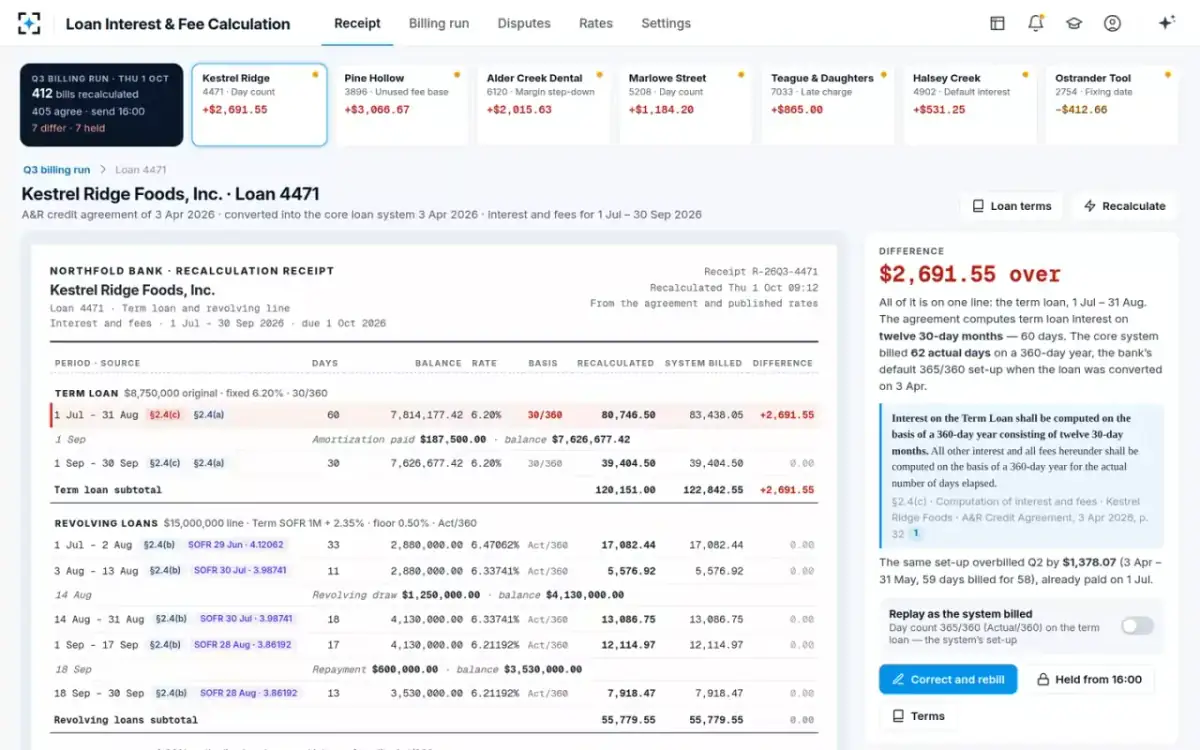
The fee is the quiet line on a commercial statement: small, regular, and built from three inputs nobody re-derives. It is also, for that reason, one of the easiest places to be wrong for years. The same is true of the day a default rate starts running, and of which day's fixing priced the period. To see a quarter's fees rebuilt from the agreement before the statement goes out, start from Loan Interest & Fee Calculation.
Questions people ask
Why is my unused fee higher than I expected?
Usually because the base is larger than you assumed, not because the rate is wrong. The three common reasons are a letter of credit or swingline you did not count as usage, a commitment that is still at its original amount in the lender's system after a reduction, and an average taken from a period-end balance rather than day by day. Rebuild the quarter from the daily balances before raising it; the arithmetic will point at one of the three.
Do letters of credit count as usage for the unused fee?
On most revolving facilities, yes: the undrawn face amount of a standby letter of credit consumes availability, so it reduces the unused balance the fee is charged on. It is a drafting choice, though, and the clause decides. On the sample facility a $1,250,000 letter of credit counted as usage, and excluding it would have raised one quarter's fee by $1,197.92.
Is a facility fee the same as a commitment fee?
Not reliably. A facility fee is charged on the entire commitment whether or not it is drawn; an unused line fee is charged only on the undrawn part. “Commitment fee” is used for both, so the label settles nothing. Read the sentence that defines the amount the percentage applies to — the Commitment, or the excess of the Commitment over usage — and classify the fee from that.
What day count is used for an unused line fee?
Actual/360 on dollar facilities, almost always, matching the revolving loans the fee sits beside. The agreement can say otherwise, and the difference is real but small: on a $6,918,478 average base at 0.375% for a 92-day quarter, Actual/365 gives $6,539.38 where Actual/360 gives $6,630.21.
How do banks report unused commitments?
In the Call Report's off-balance-sheet schedule, and gross. The instructions say to “Report in the appropriate subitem the unused portions of commitments. Unused commitments are to be reported gross, i.e., include in the appropriate subitem the unused amount of commitments acquired from and conveyed or participated to others.” Escape clauses do not reduce the reported figure, and for a syndicated facility a bank reports its own proportional share.
Does the unused fee stop when the line is fully drawn?
For any day on which it is fully drawn, yes — the base for that day is zero, so no fee accrues. But the fee is computed on an average across the whole period, so a line fully drawn for the last month of a quarter still carries a fee for the first two. This is also why a borrower who draws at the end of a quarter sees very little change in that quarter's fee and a large change in the next one.